Skip to content

Nylon (Nylon / Polyamide, abbreviated as PA) is one of the most widely used engineering plastics, known for its excellent mechanical strength, wear resistance, toughness, and machinability. In modern manufacturing, nylon is the core material for countless mechanical components, functional parts, and industrial assemblies—especially suitable for CNC milling, turning, drilling, and other machining processes.
For CNC machining shops specializing in metal and plastic parts, understanding what nylon is, how it is made, the differences among various nylon grades, and how it performs during machining directly affects part quality, performance, and material-selection guidance for customers.
What Is Nylon?
Nylon, scientifically known as polyamide, is the world’s first fully synthetic fiber—its invention marked a major milestone in polymer chemistry. Chemically, nylon refers to a class of high-molecular-weight polymers containing repeating amide bonds (–CO–NH–) in the backbone. It is among the most widely used engineering plastics globally.
Across industries such as chemical engineering, automotive, electrical systems, machinery, and industrial automation, nylon-made components are everywhere.
What Is Nylon Made Of?
Nylon is primarily produced using two chemical synthesis methods: condensation polymerization and ring-opening polymerization.
Condensation Polymerization
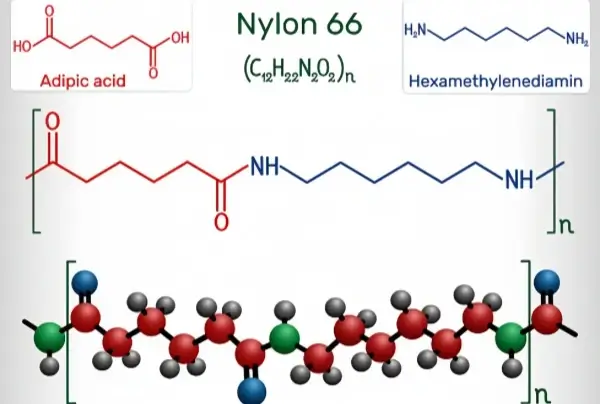
Taking nylon 66 (PA66) as an example, it is formed through a condensation reaction between hexamethylenediamine and adipic acid. During the reaction, amino and carboxyl groups combine to form amide bonds while releasing water molecules. The “66” designation refers to the number of carbon atoms in the two monomers (six each).
Ring-Opening Polymerization
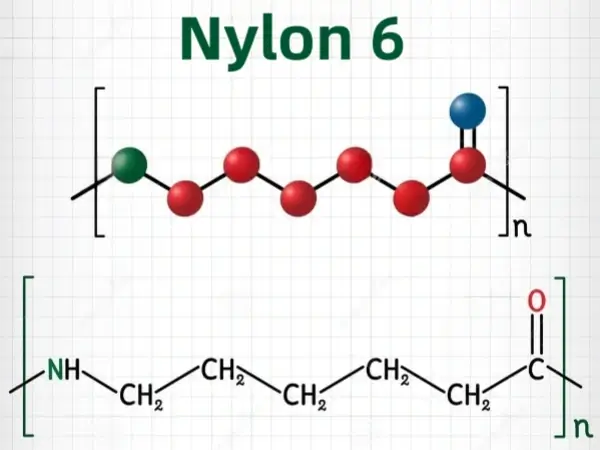
Nylon 6 (PA6), for example, is produced by ring-opening polymerization of caprolactam under heat and catalysts. The “6” represents the six carbon atoms in the caprolactam monomer.
Regardless of the synthesis route, the end product is a long-chain polymer with intermolecular hydrogen bonding, which provides nylon with its characteristic strength and toughness.
Key Properties of Nylon Plastics
- High Toughness: Nylon can absorb significant impact energy without breaking, making it an ideal material for manufacturing gears and moving parts.
- Wear Resistance: Its low friction coefficient and high hardness endow nylon with exceptional wear resistance, resulting in a longer service life than many metal materials.
- Self-Lubrication: Nylon inherently possesses a certain degree of lubricity, especially in environments with trace moisture, enabling it to operate under oil-free or low-oil lubrication conditions.
- Chemical Resistance: It exhibits good resistance to most common organic solvents, oils, and greases.
- Dimensional Changes Due to Water Absorption: This is one of nylon’s primary drawbacks. Nylon absorbs moisture from the environment, leading to volume expansion and dimensional changes, which poses a challenge for high-precision applications.
Common Types of Nylon Materials
PA6 (Nylon 6)
Well-balanced performance, excellent toughness and impact strength, good flowability—one of the most widely used nylon types.
PA66 (Nylon 66)
Higher strength, rigidity, and heat resistance than PA6; higher melt viscosity and more temperature-sensitive.
PA12 (Nylon 12)
Lower amide-bond density results in significantly lower moisture absorption than PA6/PA66. Excellent dimensional stability and low-temperature performance; more flexible.
Glass-Filled Nylon (PA + GF30%)
Adding glass fiber significantly improves strength, rigidity, and heat resistance. Common loadings: 15%, 30%, 50%.
However, glass fiber increases anisotropy and tool wear during machining.
Comparison of Common Nylon Materials
| Material | Summary | Moisture Absorption | Strength | Rigidity | Wear Resistance | Dimensional Stability | CNC Machining Difficulty | Common Applications |
|---|---|---|---|---|---|---|---|---|
| PA6 | Balanced performance, low cost | Medium | Medium | Medium | Excellent | Average | ★★☆☆☆ | Slides, gears, support parts |
| PA66 | High strength, better heat resistance | Slightly high | High | High | Excellent | Medium | ★★★☆☆ | High-load gears, structural parts |
| PA12 | Lowest moisture absorption, best accuracy | Very low | Medium | Medium | Good | Best | ★★★★★ | Precision parts, seals |
| PA + GF30 | Highest strength and rigidity | Medium | Very high | Very high | Good | Good | ★★★★☆ | Industrial structures, automotive parts |
Nylon Compared with Other Engineering Plastics
| Material | Dimensional Stability | Strength/Rigidity | Wear Resistance | Machining Difficulty | Typical Application |
|---|---|---|---|---|---|
| Nylon PA | ★★★ | ★★★★ | ★★★★ | ★★★ | Slides, gears, structures |
| POM | ★★★★★ | ★★★★ | ★★★ | ★★★★ | High-precision parts, bushings |
| ABS | ★★☆ | ★★☆ | ★★ | ★★☆ | Housings, light-load parts |
| UHMW-PE | ★★ | ★★ | ★★★★★ | ★★ | Ultra-wear components |
| Aluminum | ★★★★★ | ★★★★ | ★★ | ★★★★★ | Structural metal parts |
Is Nylon Suitable for CNC Machining?
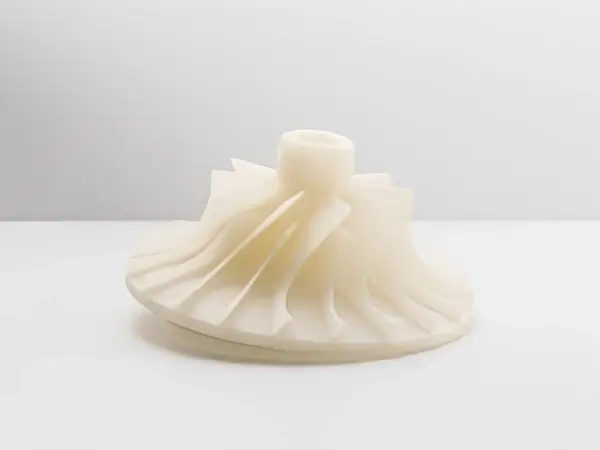
Yes—nylon is highly suitable for CNC machining. It can be quickly and accurately fabricated into prototypes, small-batch parts, and complex end-use components through:
- CNC milling
- CNC turning
- Drilling
- Tapping
- Precision cutting
However, nylon’s material characteristics—moisture absorption, thermal sensitivity, and thin-wall deformation—must be carefully managed.
Advantages of CNC Machining Nylon
- Low cutting resistance, smooth machining
- Smooth surface finish, good Ra values
- Not brittle; minimal chipping or cracking
- Ideal for structural and sliding components
- Suitable for rapid prototypes and small-batch production
Challenges in Machining Nylon and Solutions
| Issue | Cause | Professional Solutions |
|---|---|---|
| Melting / stringing | Low heat-deflection temperature | High RPM, low feed, sharp tools, forced cooling |
| Dimensional instability | High moisture absorption | Pre-drying, humidity control, sealed packaging |
| Thin-wall deformation | High toughness | Lightweight segmented cuts, optimal fixturing, optimized toolpaths |
| Size variation with temperature | High thermal expansion | Constant-temperature machining, avoid heat accumulation |
Professional CNC factories can maintain stable tolerances and reliable surface quality of nylon parts through process adjustments.
Why Nylon Is So Important in Industry
Nylon parts are widely used in:
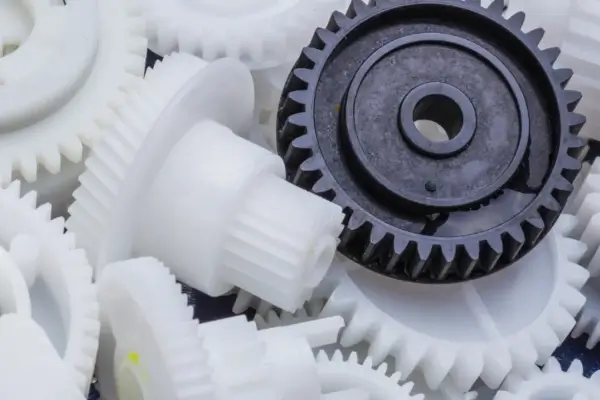
- Mechanical transmission: gears, worm wheels, sliders
- Industrial automation: guides, rails
- Automotive: bushings, connectors, clips
- Electrical systems: insulating components
- Food machinery: wear-resistant parts (food-grade nylon)
- Fixtures and tooling
These applications require lightweight, low-noise, wear-resistant, impact-resistant materials—nylon fits perfectly.
How We Ensure High Precision in Nylon Machining?
To stably produce high-precision nylon parts, a systematic solution is required:
- Equipment Capability: We adopt constant-temperature machining technology to effectively suppress thermal deformation by precisely controlling the processing environment temperature, ensuring long-term dimensional stability of parts.
- Material Preprocessing Capability: We are equipped with professional raw material pre-drying equipment to thoroughly remove moisture from the material before processing, fundamentally avoiding dimensional deviations caused by moisture absorption and expansion.
- Tool Strategy: We use specialized cemented carbide or diamond-coated tools tailored to different nylon types (unreinforced or glass fiber-reinforced) and strictly implement tool life management to ensure the cutting edges are always in optimal condition.
- Precision Machining Capability: We implement a multi-step light cutting scheme to effectively prevent material stringing or melted edges by reducing single-cutting force and heat input, ensuring surface integrity.
- Tolerance Capability: With mature processes, we can stably achieve tolerances of ±0.05mm or tighter, meeting the requirements of most precision parts.
- Inspection Process: Each finished product undergoes key dimension inspections using tools such as 2D optical measuring instruments, calipers, and micrometers to ensure compliance with drawing requirements.
- Project Experience: Our engineering team has years of experience in nylon material processing and can provide end-to-end solutions—from material selection and structural optimization to processing technology—tailored to your specific application scenarios.
Conclusion
Nylon is a high-performance engineering plastic that combines strength, wear resistance, toughness, and lightweight properties. It holds an irreplaceable position in CNC machining thanks to its balance of performance, machinability, and cost.
Although nylon has challenges such as moisture absorption and thermal sensitivity, these can be fully controlled with professional machining techniques and material expertise.
Material Selection Guide
- Balanced performance & cost → PA6
- Higher strength & heat resistance → PA66
- Precision parts & humid environments → PA12
- Metal-like rigidity & strength → Glass-filled nylon
Whether you are in the design stage, prototype development, or small-batch production, HRCCNC is ready to support your nylon CNC machining needs.
- Free material consultation
- Fast quotation—upload 2D/3D files
- DFM review to improve quality and reduce cost
Contact us today and turn your ideas into precise, high-performance parts!
Dive Deeper into Delrin
For more specialized knowledge, explore our related articles:
Delrin vs Nylon: A Detailed Comparison