Skip to content

Cutting aluminum, whether for manufacturing or at-home DIY, requires more than simple sawing. The right approach, gear, and preparation can deliver a clean, professional, and steady cut.
This guide enlists all the top methods, tools, and tips to help you achieve flawless aluminum cuts. You can handle aluminum confidently without mistakes while elevating the product quality.
Why Aluminum Cutting Requires Specific Techniques?
Cutting Issues Related to Material Properties
- Softness and Ductility: Aluminum is soft and ductile. It deforms instead of fractures, causing burrs and rough edges with improper tools.
- Low Melting Point: Aluminum melts at around 660°C. High-speed cutting can initiate frictional heat to soften aluminum, which sticks to blades.
- High Thermal Conductivity: Quick heat dissipation results in unequal expansion/contraction to hamper the dimensional accuracy.
Appropriate Tool Selection Is Obligatory
- Industry experts recommend carbide-tipped blades to resist wear and reduce sticking issues.
- Lubrication (cutting fluid or wax) is essential to prevent overheating and blade clogging.
- Specialized saws, CNC routers, and even waterjet cutting are preferred to achieve precision.
Factors to Consider for an Aluminum Cut
You must consider several factors to achieve the best possible result. Each factor directly influences tool choice, efficiency, and quality of the final product.
i. Alloy Type
Different alloys behave differently under cutting. Alloys with higher copper content (2024) are difficult to cut. Alloys with higher silicon content (4032) are more abrasive, which wears down tools faster.
ii. Thickness
Thin sheets (<3 mm) can undergo cutting with shears, lasers, or CNC routers. Thick plates (>25 mm) require industrial saws, waterjets, or milling machines. Always match blade tooth geometry to thickness.
iii. Cutting Speed
Aluminum’s low hardness with high thermal conductivity enables high-speed machining. Experts recommend 600 – 1000 m/min for CNC milling and 3000 – 6000 RPM for circular saws.
iv. Lubrication
Fluids are essential to prevent tool clogging and overheating. Tool wear increases by up to 40% when aluminum is cut dry compared to lubricated cutting.
v. Desired Finish
Smooth finish requires fine-tooth blades, proper lubrication, and controlled feed rates. Architectural Al relies on waterjet cutting to avoid heat distortion regarding clean edges.
vi. Production Volume
Manual saws, jigsaws, or routers are cost-effective for low volume (DIY or prototyping). High volume (industrial scale) calls for an auto CNC machine, laser cutting, or waterjet for consistency.
Different Approaches: How to Cut Aluminum Effectively?
Given the widespread adoption and necessity, manufacturers/DIYers deploy many distinctive methods. You can enlist the available options into three broad categories – manual, power tool, and special cuts.
Aluminum Cutting Methods: Manual Approach
Manual tools are inexpensive and widely available. They remain the default choices for DIY and small-scale industries. These approaches grant low-risk cutting compared to high-speed power tools.
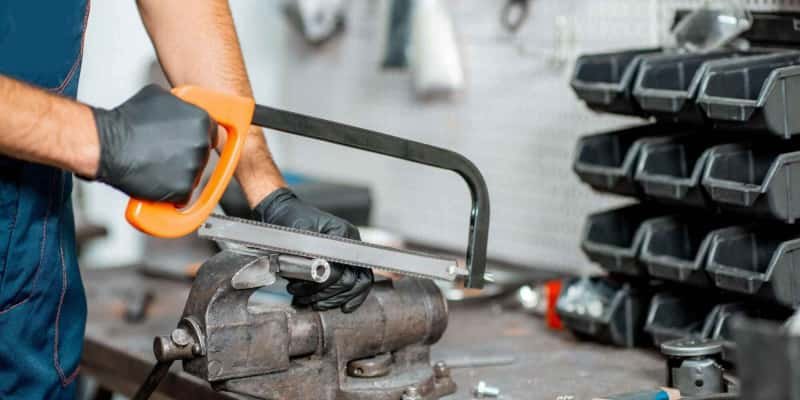
a. Hacksaw
It’s one of the most common tools for cutting aluminum rods, bars, and small sheets. You’ll need a fine-tooth blade (18–32 TPI) to avoid snagging.
Secure the aluminum firmly in a vise to prevent vibration. Apply steady strokes with moderate pressure to reduce heat buildup.
Lubricate the blade with cutting wax or light oil to reduce friction + prevent clogged teeth. A hacksaw can cut through a 25 mm rod in under 2 minutes.
b. Aviation/Tin Snips
Aviation snips (or tin snips) are scissor-like tools for cutting aluminum sheets of up to 1.5 mm thickness. There are straight-cut snips for long cuts and left- and right-cut snips for curves + circular patterns.
Choose snips with compound leverage handles. It should reduce hand fatigue while increasing the cutting force. Compound snips can reduce operator effort by up to 40% to traditional straight snips.
c. Metal Files + Abrasives
Freshly cut aluminum edges often need proper smoothing. Metal files and abrasive papers effectively remove burrs to refine the finish.
Get a bastard-cut file for rapid material removal. Switch to fine-cut files or sandpaper (120–400 grit) for polishing. Always file in one direction to avoid gouging.
Applying chalk to the file teeth prevents Al particles from clogging the file. Precise deburring reduces assembly defects by up to 25% in industrial production.
How to Do Aluminum Cuts: Power Tool Cutting
a. Circular Saw
It’s arguably the most practiced method for cutting aluminum sheets and plates. You’ll need a carbide-tipped blade with 60–80 teeth for clean cuts.
Clamp the aluminum securely to avoid vibration. Apply cutting fluid or wax to prevent blade clogging. Maintain the blade speed around 3000 – 6000 RPM.
Slower speeds risk binding, whereas excessive speed increases heat. Carbide blades last up to 5x longer than steel blades when cutting aluminum.
b. Jigsaw
It’s the best tool for curved or intricate cuts in thin aluminum sheets (<6 mm). You should get bi-metal blades with 21–24 TPI (teeth per inch).
Apply masking tape on the cut line to reduce vibration and prevent scratching. However, keep the feed rates slow to avoid blade deflection.
DIY hobbyists often use jigsaws for custom aluminum signage and decorative panels. Jigsaws can achieve cutting radii as small as 10 mm.
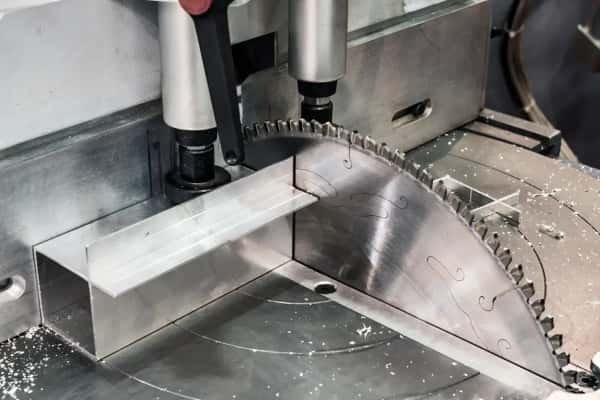
c. Miter Saw
It’s perfect for angle cuts on aluminum profiles, bars, and tubing. Get a non-ferrous metal blade with triple-chip grind teeth.
Always secure workpieces with clamps to prevent kickback. Apply lubricant sticks to reduce friction and extend blade life.
Miter saws have uses in cutting aluminum frames for modular furniture systems. It can cut extrusions up to 100 mm wide.
d. Band Saw
It’s the ideal choice for cutting thicker aluminum stock or irregular shapes. You need to get blades with 6–10 TPI for thicker sections.
Maintain steady feed pressure to avoid blade wandering. Coolant systems are necessary for industrial band saws to prevent overheating.
Band saws can cut large aluminum billets for aircraft components. Manufacturers cut blocks up to 300 mm thick with precision.
e. Angle Grinder
The particular tool enables quick cuts, trimming, and deburring aluminum. Fit with the cut-off wheels designed for non-ferrous metals.
Avoid excessive pressure to prevent wheel glazing. Always wear protective gear, as aluminum sparks are less intense but still hazardous.
Automotive repair shops have angle grinders to trim aluminum body panels. They can reach speeds of 10,000 RPM for rapid removal.
f. Rotary Tool (Dremel-type)
It suffices for small-scale precision work like engraving, trimming, or cutting thin aluminum sheets. You’ll need reinforced cut-off discs or carbide burrs.
The tool operates at speeds of 15,000 – 30,000 RPM for clean results. Always make multiple shallow passes rather than one deep cut.
Rotary tools are favored for prototyping aluminum parts in robotics and electronics. They can cut aluminum sheets up to 2 mm thick with high precision.
Making Aluminum Cuts: Professional / Specialized Ways
Mass manufacturers can barely cope with the demand for power tools. They rely on professional and specialized aluminum cutting methods.
a. Table Saw
A table saw, equipped with a carbide-tipped blade, is highly effective for cutting sheets and extrusions.
Choose blades with triple-chip grind (TCG) teeth to minimize burrs. Apply cutting wax or fluid to prevent aluminum from sticking.
b. Plasma Cutter
It implements ionized gas to melt and blow away aluminum, effective for medium-thickness sheets. High thermal conductivity can cause wider heat-affected zones.
Install high-frequency start systems and proper gas mixtures (argon-hydrogen) for cleaner cuts. Plasma cutters can cut up to 25 mm thick sheets with post-processing requirements.
c. Laser Cutting
Fiber lasers have become increasingly popular for thin to medium aluminum sheets due to precision.
Aluminum’s reflectivity requires specialized coatings on optics. Nitrogen assist gas prevents oxidation and improves edge quality.
Laser cutting can achieve tolerances as tight as ±0.1 mm, suitable for aerospace and medical devices.
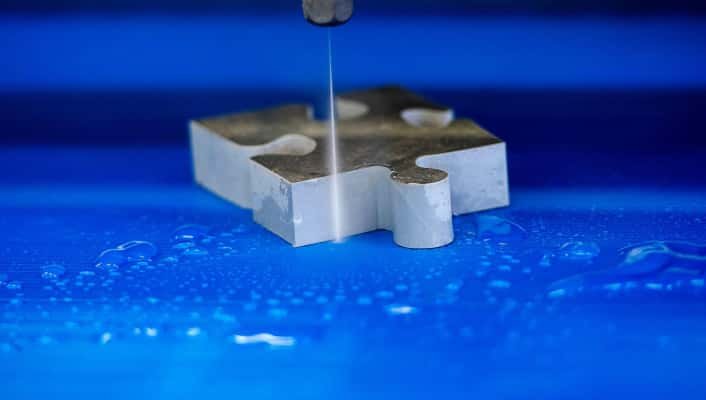
d. Water Jet Cutting
Water jets use high-pressure water mixed with abrasives to cut aluminum without heat distortion. There is no heat-affected zone (HAZ), even when cutting very thick aluminum plates (>150 mm).
Garnet abrasives are primarily suitable for aluminum due to their sharpness and durability. Water jet cutting also maintains dimensional accuracy within ±0.2 mm, even on the thicker plates.
e. CNC Router/Mill
CNC routers and mills lay the foundation of precision aluminum machining for complex geometries.
Use high-speed steel (HSS) or carbide end mills with proper lubrication. Employ climb milling to reduce burr formation.
CNC machining covers over 50% of global aluminum processing, dominating high-volume production.
Common Issues in Aluminum Cutting
01. Burr Formation
Burrs are rough edges or raised material left after cutting. Reduced surface quality can interfere with assembly. Top causes –
- Incorrect cutting parameters.
- Tool wear or poor machine setup.
- Inadequate lubrication.
Burrs can increase post-processing time by up to 30%, raising production costs significantly. Use sharp, fine-tooth blades, optimize cutting speed, and apply cutting fluids.
02. Tool Wear
Aluminum’s abrasiveness (especially silicon-rich alloys) accelerates tool wear. Worn tools produce rough cuts, increase burrs, and shorten tool lifespan.
Improper cutting speeds can reduce tool life by 50% or more. Maintain proper RPM, use carbide-tipped blades, and ensure regular tool inspection.
03. Overheating
Aluminum’s low melting point (~660°C) and high thermal conductivity make it prone to heat-related issues. Overheating causes aluminum to soften, stick to blades, and distort dimensions.
Therefore, it reduces tool lifespan regardless of quality. Apply lubrication, use mist cooling systems, and avoid excessive feed rates.
04. Safety Hazards
Cutting aluminum generates sharp edges, combustible dust, and risks of kickback. OSHA (US) and ANSI (US) mandate PPE, dust extraction, and proper machine guarding.
Fine aluminum dust is highly combustible; improper handling has caused industrial fires worldwide. Always wear PPE (gloves, goggles, masks), use dust collectors, and secure workpieces properly.
05. Surface Finish Issues
Poor finish affects aesthetics and functionality, especially in consumer products. Aerospace standards demand surface roughness below Ra 0.8 μm.
Manufacturers must adhere to precise cutting and polishing. Use fine-tooth blades, controlled feed rates, and post-cut deburring/polishing.
Conclusion
Cutting aluminum with precision feels like a gateway to creativity, efficiency, and innovation. The ability to cut aluminum cleanly and accurately ensures strength, safety, and professional-quality results. It lets you transform raw aluminum into a perfect product.
Optimal Precision for Every Aluminum Cut at HRCCNC
We’re a top-tier aluminum manufacturing company with the utmost commitment to precision cuts. HRCCNC has been serving clients for 18 years with satisfaction. Contact us to reach our experts for consultation.