Skip to content

Aluminum compounds/alloys are almost everywhere, making every property more or less important for product design. Obviously, not all properties are equal. Overlooking aluminum’s melting point is rather common during manufacturing considerations.
What’s the importance of melting point of aluminum? From DIY enthusiasts to academic students and even content creator can benefit from the underlying significance. However, this article breaks down the melting point from a manufacturing perspective.
What Does Melting Point Mean?
The melting point of a compound/substance/element indicates the temperature at which it transitions from solid to liquid. Maintaining standard atmospheric pressure is a prerequisite to measure the melting point with optimal precision.
When the element/substance/compound reaches its melting point, the supplied thermal energy from heat becomes enough to overcome the atomic bonds. It marks a threshold beyond which atoms can move freely to form a liquid.
Why Is Aluminum’s Melting Point So Important?
a. Manufacturing Efficiency
Lower Energy Consumption: Al melts at a much lower temperature than metals like iron (Fe) or copper (Cu). It enables –
- Less fuel in furnaces.
- Faster heating cycles.
- Lower operating costs.
Recycling Advantage: Re-melted aluminum uses 95% less energy than production from raw ore. It makes Al one of the most sustainable metals. Recycling 1T aluminum can save up to 14,000 kWh of energy.
b. Aluminum Behavior in Industrial Applications
The melting point also defines how aluminum behaves across different manufacturing process. For example –
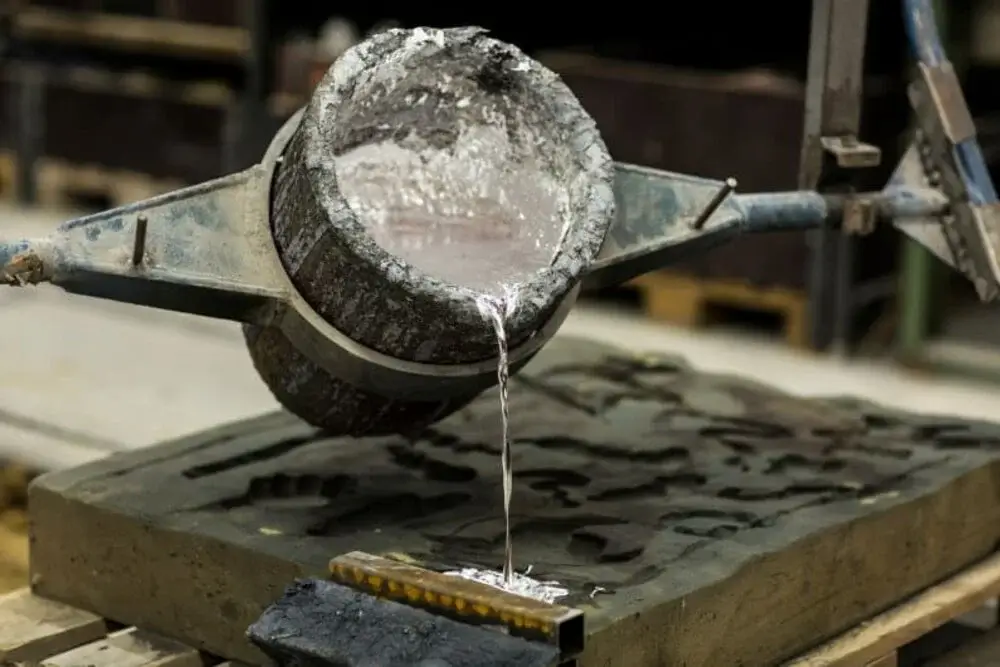
- Casting: Molten aluminum is directly poured into molds to create engine blocks, transmission housings, and aerospace parts.
- Welding: Al’s high thermal conductivity and low melting point require precise control to avoid burn-through or weak joints.
- Extrusion: Heated (not melted) aluminum is pushed through dies to form window frames, tubing, and structural components.
Consider HPDC with aluminum. A356-T6 Al alloy melts at lower temps (570°C – 615°C). it can fill molds at the required 40 – 100 m/s with precision to produce thin-walled parts like Tesla battery housings.
c. Alloy Design and Further Customization
Aluminum melting point can be tuned by alloying –
- Silicon (Si) lowers the point for superior casting fluidity.
- Magnesium (Mg) improves strength and corrosion resistance.
- Copper (Cu) enhances conductivity for lower melting points.
Also, understanding aluminum’s melting behavior can –
- Prevent casting defects related to oxide films and hydrogen porosity.
- Control microstructure through heat treatment near the melting point.
- Design advanced Al alloys for industry-specific thermal management.
Pure Aluminum’s Melting Point
The universal standard for pure aluminum (99.0% aluminum) is rather steady. Engineers, manufacturers, and researchers need to study the melting point across different scales.
| Scale | Temperature | Uses |
| Celsius (°C) | 660.3°C | Ultimate standard in metallurgy and industrial manufacturing |
| Fahrenheit (°F) | 1220.5°F | Common in the USA for HVAC, aerospace, and automotive |
| Kelvin (K) | 933.47K | Scientific standard for thermodynamic calculations in physics |
Even the slight differences in purity of aluminum affects the melting point. The melting point within pure aluminum varies as given below –
- 99.99%: 660.37°C.
- 99.50%: 657.0°C
- 99.00%: 643.0°C
Aluminum Melting Point: Aluminum Alloys
Aluminum alloys are blends of Al with other elements like Si, Mg, Cu, Zn, and others. The combination dramatically alters the melting behavior of aluminum. They initiate a broader range of melting points rather than a single temperature.
Melting Point Comparison for Common Aluminum Alloys
| Alloy Type | Alloy | Melting Temperature (°C) | Melting Temperature (°F) | Main Alloying Elements | Key Applications |
| Wrought Aluminum | 1100 | 643 – 657 | 1190 – 1215 | ~99% Al | Chemical tanks, reflectors |
| 3003 | 643 – 654 | 1190 – 1210 | Mn | Cookware, roofing, piping | |
| 5052 | 607 – 649 | 1125 – 1200 | Mg | Marine, fuel tanks | |
| 6061 | 582 – 652 | 1080 – 1205 | Mg + Si | Bicycle frames, aerospace | |
| 6063 | 615 – 655 | 1135 – 1210 | Mg + Si | Architectural extrusions | |
| 7075 | 477 – 635 | 890 – 1175 | Zn + Cu + Mg | Aircraft frames, molds | |
| 2024 | 502 – 638 | 936 – 1180 | Cu + Mg | Aerospace, military | |
| Cast Aluminum | A356 | 570 – 615 | 1060 – 1135 | Si + Mg | Automotive wheels, aerospace |
| A319 | 482 – 638 | 900 – 1180 | Si + Cu | Engine blocks, transmission cases | |
| A535 | 566 – 632 | 1050 – 1170 | Mg | Marine hardware | |
| A443 | 549 – 607 | 1020 – 1125 | Si | Heat exchangers, piping |
Factors to Affect Aluminum’s Melting Point
a. Alloying Elements
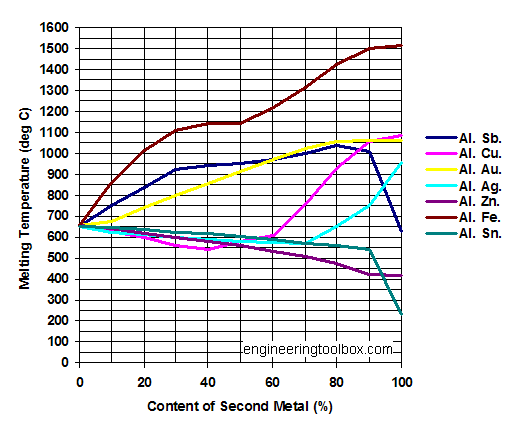
Adding other metals to Al alters the melting behavior. It also creates a melting range instead of a fixed point. For instance –
- Silicon: Si lowers the eutectic point. Al-Si alloys (A356) melt around 577°C with improved fluidity.
- Magnesium: Mg slightly reduces melting point for superior strength and corrosion resistance.
- Copper: Cu lowers the melting range significantly. Al-Cu alloys melt between 502°C – 638°C.
- Zinc: High-strength alloys (7075) melt between 477°C – 635°C. Zn also increases hot cracking risks.
b. Purity of Aluminum
Impurities like Fe or Ni form intermetallic compounds (Al₃Fe). It depresses the melting point by 2°C – 3°C. Recycled Al may contain trace contaminants, lowering the melting temperature within the range.
c. Atomic Structure/Arrangement
Fine and uniform grains support consistent melting. Coarse grains or eutectic microstructures cause semi-solid behavior. It also broadens melting intervals during reheating. Heat treatment can reorganize grain boundaries to shift melting behavior.
d. External Pressure
The melting point rises to ~666°C at 1 GPa. It seems negligible in most industrial settings. However, such slight change matters in high-pressure manufacturing.
Rapid heating causes localized overheating instead of equilibrium melting. Controlled heating enables uniform phase transition and avoids hot spots.
e. Oxide Layer (Al₂O₃)
Highly reactive Al forms a thin alumina layer (Al₂O₃). It turns the melting point to a staggering ~2000°C. The layer acts as a thermal barrier to protect against further oxidation. Controlling alumina is key to efficiency and purity in smelting.
Melting Point: Aluminum vs Other Metals
| Metal | Melting Point (°C) | Melting Point (°F) | Remarks |
| Aluminum (Al) | 660.3 | 1220.5 | Lightweight + energy-efficient (uses aerospace, automotive, packaging) |
| Copper (Cu) | 1084 | 1983 | High conductivity (uses in wiring, plumbing, electronics) |
| Iron (Fe) | 1538 | 2800 | Strong and durable (uses in construction, tools, machinery) |
| Steel | 1370 – 1510 | 2500 – 2750 | Variable by grade (uses in infrastructure, vehicles) |
| Titanium (Ti) | 1668 | 3034 | High strength-to-weight ratio (uses in aerospace, medical implants) |
| Zinc (Zn) | 419.5 | 787 | Low melting point (uses in galvanizing, die casting) |
| Lead (Pb) | 327.5 | 621.5 | Soft and dense (uses in batteries, radiation shielding) |
| Magnesium (Mg) | 650 | 1202 | Lightweight (uses in aerospace, automotive, electronics) |
| Nickel (Ni) | 1453 | 2647 | Corrosion-resistant (uses in stainless steel, batteries) |
| Silver (Ag) | 961 | 1761 | Conductive and decorative (uses in electronics, jewelry) |
| Gold (Au) | 1064 | 1947 | Non-reactive (uses in electronics, currency, jewelry) |
| Tungsten (W) | 3422 | 6192 | Highest melting point of all metals (uses in filaments, aerospace, armor) |
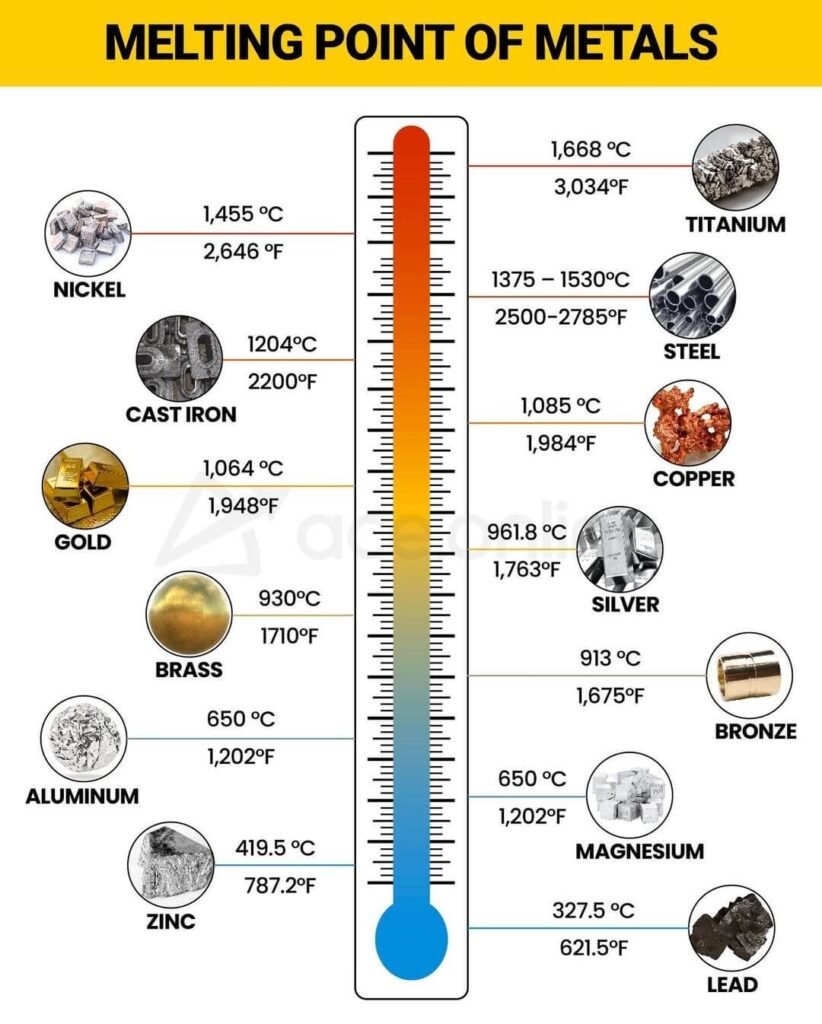
Aluminum’s advantage over other metals –
- Lower melting point means less energy requirement for casting and recycling.
- Ideal for die casting, where molten aluminum is injected into molds at high speed.
- Rapid production, prototyping, and lightweight design for sensitive components.
Problems of using high-melting metals –
- Iron, steel, titanium, and tungsten require extreme heat to increase energy costs.
- Suitable for extreme temperatures like jet engines, industrial furnaces, and armor plating.
Metals with low melting points have ups and downs –
- Lead and zinc melt easily for soldering, coatings, and low-temp casting.
- Lack of sufficient structural strength compared to aluminum and steel.
Frequently Asked Questions (FAQs)
1. Why does Al melt at a lower temperature than other metals?
2. Do aluminum alloys have the same melting point as pure aluminum?
3. How does aluminum’s melting point impact industrial applications?
– Die casting: Rapid mold filling at temperatures around 700°C – 800°C.
– Welding: Requires precise thermal control to avoid burn-through.
– Recycling: Re-melting with minimal energy and no loss in performance.
4. Why do aluminum parts sometimes require higher melting alloys?
5. What is the role of aluminum oxide during melting?
6. Why is molten aluminum preferred in casting?
7. What makes Al superior to others for thin-walled parts?
Conclusion
Pure aluminum’s melting point is a prime example of fixed value under standard pressure. However, modern manufacturing revolves around aluminum alloys. And they move within a range based on their alloying conditions. Even the slight distortion can initiate irreversible loss for the final product. Know your alloy and its exact melting point to make the most of aluminum.
Get the Best Quality Aluminum Parts from HRCCNC
No more overlooking material properties like melting point for aluminum parts. HRCCNC excels in the entire industry with leading experts, innovative solutions, and absolute precision. We’ve been here for 18 years with optimal client satisfaction. Contact us to know why you should partner with us right away.