Skip to content

In machining, Face Milling and End Milling are two basic and widely used milling techniques. Although both are used to remove material, they differ in purpose and operation. This guide will help you understand the difference, purpose, types, and applications of both.
What is Face Milling?
Face milling is one of the most important techniques in CNC machining, used when flat surfaces need to be processed with high smoothness and precision. It is the first choice in many manufacturing industries due to its ability to remove large amounts of material quickly.
Definition:
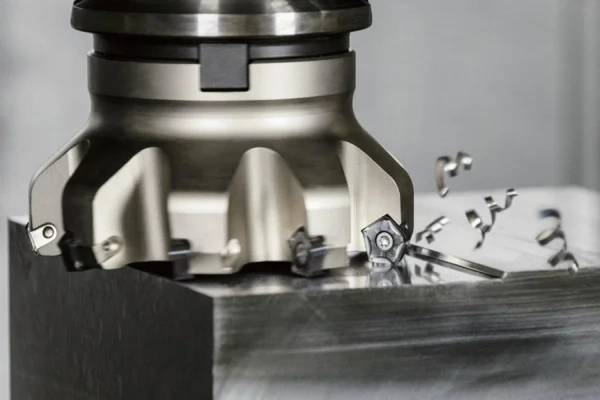
Face milling is a machining process that uses both the face and perimeter cutting edges of the tool. However, the majority of cutting forces and material removal come from the perimeter cutting edges, while the face cutting edges improve surface flatness and finish.
Tools used:
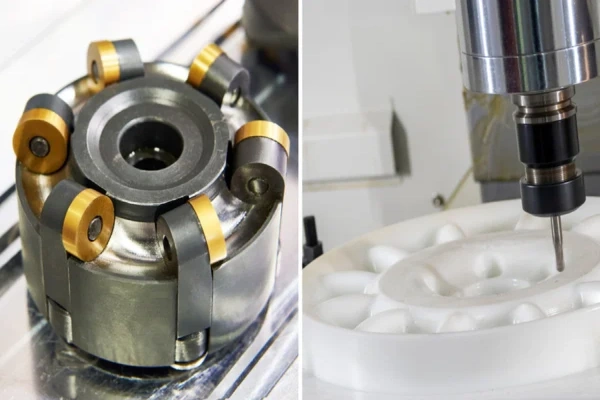
The most common tool is a large-diameter face mill cutter with many carbide inserts. The cutter is capable of removing a lot of material in one pass, increasing productivity and reducing costs.
Typical Geometry and Insert Configuration
Face mills usually have positive or neutral cutting geometry, which helps reduce vibration and cutting force. Inserts are arranged evenly around the cutter; each insert bears a part of the load, so the finished surface is smooth and uniform.
What is End Milling?
End milling is a machining method used in CNC when it is necessary to create parts with complex shapes or delicate surfaces. Unlike face milling, which focuses only on flat surfaces, end milling allows cutting in many directions and has more diverse applications.
Definition:
End milling is a machining method that can cut with the end face, side edges, or both, depending on the operation. This allows the end mill to perform many complex cutting shapes, from grooves, contours, pockets, to 3D surfaces.
Types of End Mills:
End mills come in many varieties, each serving a different purpose:
- Flat end mill: used to mill grooves and create flat surfaces.
- Ball nose end mill: suitable for machining curved surfaces, 3D models.
- Corner radius end mill: helps increase cutter life and improve cutting angle quality.
- Roughing end mill: optimizes cutting speed, specialized in removing large amounts of chips.
Capabilities:
End milling is extremely flexible. The cutter can perform grooving, drilling, milling 2D profiles, and even machining complex 3D parts. This is preferred when precision and flexibility are needed for complex parts.
Comparison: Face Milling vs End Milling
Face milling and end milling are both important techniques in CNC machining, but the way they work, the ability to remove material, and the application have many differences. Here is a detailed comparison:
Cutting Orientation & Engagement
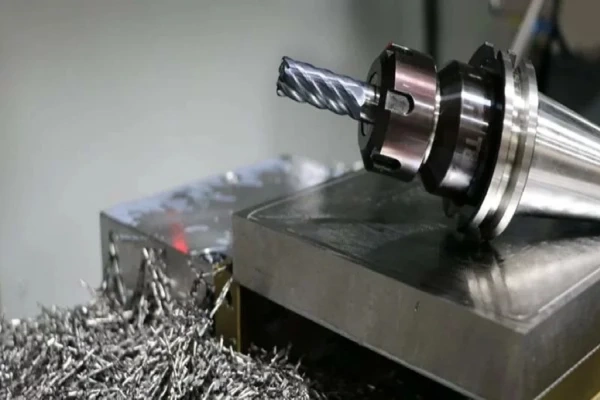
In face milling, the cutter primarily contacts the workpiece with its peripheral edges. Most of the cutting force is applied through these peripheral edges, but the axial components from the face cutting edges also contribute to material removal and help achieve a smooth, flat surface.
End milling offers greater versatility. The cutter can touch both the side edge for grooving or profiles and the tip for boring or deep cutting. End Milling can cut complex shapes and profiles in many different directions because it can make flexible contact.
Material Removal Rate (MRR) & Efficiency
Face milling typically has a higher MRR due to its larger cutter diameter and ability to cut a large area in one pass. End milling has a lower material removal rate, but is optimal for small or complex parts.
Surface Finish & Accuracy
Face milling generates flat and smooth surfaces, so it’s great for big areas that need to be flat all over.
End milling works better for small features, pockets, grooves, and complicated 3D shapes. It gives very accurate positioning, but the surface finish and precision of the finished features will depend upon the cutting parameters, running feed rate, type of end mill used, and milling process method.
Tool Wear & Cost
Face mill cutters often are more expensive, since they are larger and have more inserts, and inserts can be swapped out readily when they wear out, which saves downtime and maintenance costs. The body of the cutter usually lasts for a long time.
End mills are generally cheaper and notably more useful; however, they don’t last as long, especially on hard materials or high speeds.
Rigidity, Machine Requirements & Setup
Face milling requires a high level of machine rigidity to prevent vibration when the cutter is in contact with a large area.
End milling is often quicker to set up and can be performed on a wide range of CNC machines, even small machines. However, when machining deep pockets or complex features, machine rigidity is essential to prevent vibration and maintain dimensions.
Versatility & Application Scope
End milling is highly versatile and can be used to machine a variety of parts, such as 2D and 3D profiles, grooves, pockets, and complex parts. Face milling specializes in creating flat surfaces, less versatile but very effective when processing large areas, helping to ensure flatness and smoothness of the surface.
Depth of Cut, Width of Cut, and Pass Strategy
Face milling typically features a shallow cutting depth and a larger cutting width, enabling the machining of larger surfaces. End milling allows both the depth and width of the cuts to be easily varied. End milling typically machines parts in multiple passes to get the intended shape.
Typical Applications & Use Cases
The machining method used determines the ability to achieve high precision, save time, and improve production efficiency.
When to Use Face Milling
Face milling is ideal for creating large flat surfaces. Examples include blank preparation or surface finishing. Additionally, face milling is the best option for high surface finish and precise flatness requirements.
When to Use End Milling
End milling is the best option when the part has advanced shapes like grooves, pockets, curved, or 3D shapes. It is also the first option when machining moulds, precision machine parts, or small features that require delicate requirements.
Hybrid Strategies
Often, manufacturers utilise a combination of face milling and end milling to achieve quality results. First, the face milling is used to machine the main flat surface, then the end milling is used to machine the small details, corners, or complex geometries.
Examples in Industries
- Automotive: Face milling to mill the engine face, end milling to create grooves and holes.
- Aerospace: End milling for curved surfaces and complex profiles, face milling to finish large details.
- Mould making: Combine both, with end milling creating 3D profiles and face milling finishing the mould surface.
- Electronics: End milling is used for machining small enclosures, precise slots, and grooves in electronic housings, while face milling can be applied to flatten larger housing surfaces.
Selection Guidelines / Decision Criteria
The criteria below should assist in making a good decision for your manufacturing needs.
Define Your Primary Machining Objective
If you need a large flat surface and a good finish, face milling is the best option. If you require a complex part, a deep cavity, or a 3D surface, end milling will yield superior results.
Assess Machine Rigidity & Setup Quality
Highly rigid CNC machines are often suitable for face milling because of the high cutting force and large contact area. If the machine is small or has limited setup, end milling is better for results.
Consider Workpiece Material & Desired Surface Finish
Face milling is ideal for making flat, smooth surfaces on many materials, whether it is metal or alloys. End milling is the best option when you require complex shapes, as well as a much more intricate accuracy on conventional materials like steel, aluminum, or engineering plastics.
Evaluate Cost, Volume & Tool Budget
If you are producing large quantities and need cost efficiency, a face mill cutter with replaceable inserts will be more economical in the long run. For small volumes or diverse parts, an end mill is low-cost and easy to change.
Determine Whether a Hybrid Strategy Makes Sense
In many cases, combining both methods will yield the best results. Face milling is used to rough large surfaces, followed by end milling to finish small details, grooves, and profiles.
Check Geometric Constraints & Accessibility
If the part has tight corners, deep pockets, or complex shapes, end milling is more flexible. Face milling should only be used for flat surfaces with few corners.
Match Cutter Diameter, Pass Strategy & Tool Overhang
The cutter diameter and pass strategy determine cutting efficiency. Face milling cutters are typically large diameter, suitable for wide cuts, while end mills can flexibly adjust multiple passes to achieve the desired accuracy.
Analyze Chip Evacuation, Cooling & Machining Environment
Effective chip evacuation and cooling directly affect tool life. Face milling generally handles chips better because they are wide and shallow, while end milling requires careful coolant management and machine setup to prevent chip accumulation in deep cavities.
Challenges, Mistakes & Tips
Be aware of common challenges and mistakes, and apply proper solutions to improve tool performance and extend tool life.
Common Pitfalls in Choosing Face vs End Milling
The most common mistake is choosing the wrong method for the application. Using end milling for large areas will reduce productivity, and using face milling for deep pockets or complex parts will make it difficult to achieve accuracy. The advice is to always determine the right needs before choosing a method.
Tool Deflection, Chatter & Vibration
Long or small diameter tools often cause tool deflection, which leads to vibration and chatter. This reduces accuracy and surface quality. The solution is to choose the right tool for the tool overhang and reduce cutting speed when needed.
Choosing the Right Inserts, Number of Flutes & Tool Overhang
Choosing the right inserts for face milling and the number of flutes for end milling is important. The wrong insert will wear out quickly, and an end mill with too few flutes will reduce productivity.
A tool overhang that is too long can cause vibration. Always optimize the number of flutes, choose the right insert for the material, and keep the tool as short as possible.
Fixturing, Clamping & Workpiece Support
Insufficient clamping of the workpiece can cause vibration when cutting. In face milling, slight vibration can leave streaks on the surface. In end milling, weak clamping can cause dimensional errors. Make sure the clamping system is strong and supports the workpiece well.
Cooling, Chip Evacuation & Heat Management
Heat management and chip evacuation are vital. If chips cannot escape quickly enough, they will get stuck in the cutting groove and damage the tool. Face milling is easier to evacuate, while deep end milling requires a cooling system and compressed air support.
Regularly monitor cutting performance during machining to avoid heat buildup and damage to the tool and workpiece.
Conclusion:
Face milling and end milling both have their own advantages in CNC machining. Choosing the right technique will help improve production efficiency. To find the optimal solution and professional service, contact us at HRCCNC.