Skip to content

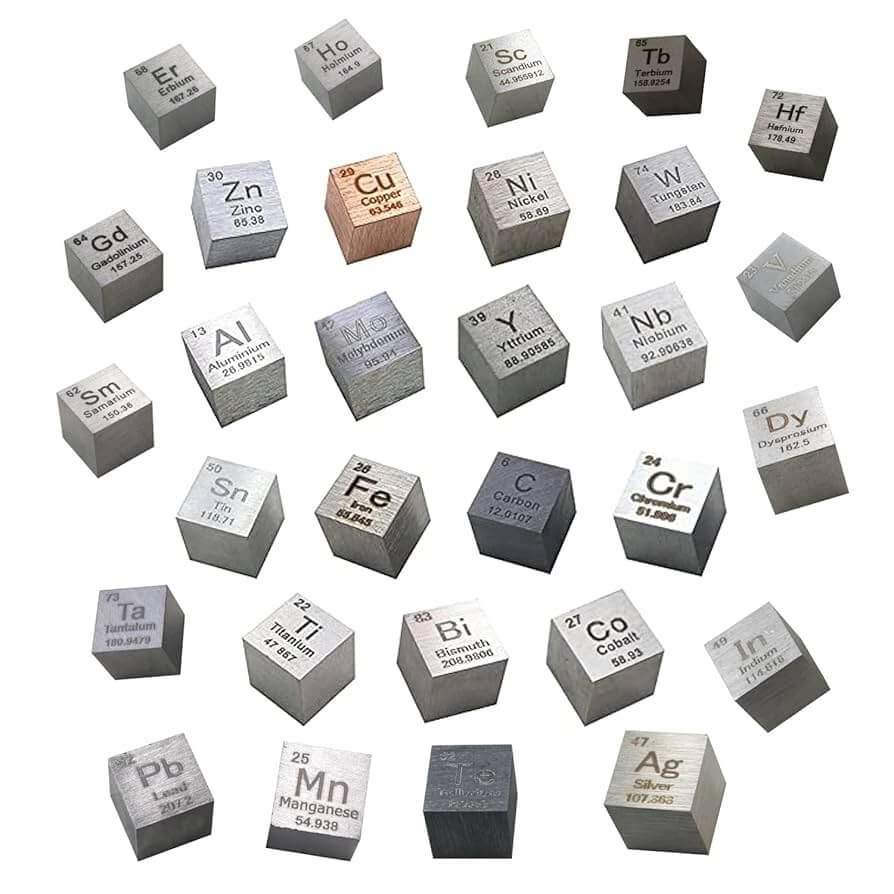
Why does aluminum (Al) feel featherlight while lead seems like a stone? The answer lies in density, a fundamental property of materials. It’s the reason why two blocks of the same size can feel significantly different in weight.
Understanding metal density plays a crucial role in engineering, manufacturing, and design. It influences performance, cost, durability, and safety across industries. And this guide covers some fundamental aspects of metal density.
What is Density?
It’s a fundamental physical property of every material. Density describes how much mass is packed into a given volume of a substance. Simply, it answers the question – how heavy is the material for its size?
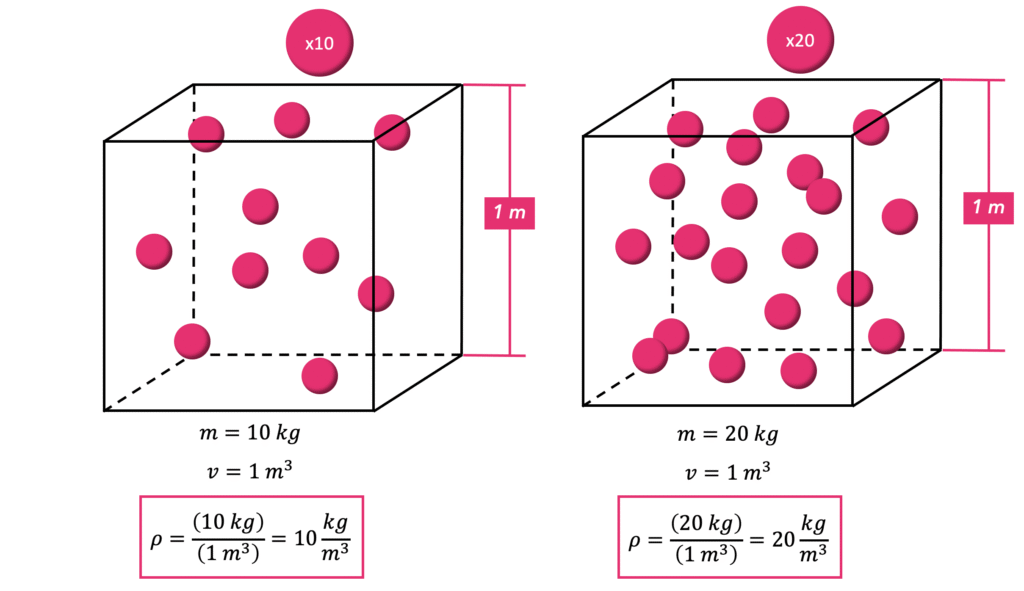
From a scientific perspective, density is the mass per unit volume of a material. It’s mostly represented by the Greek letter ρ (rho) or D. The mathematical expression for density is:
ρ or D = m / V
where ρ or D = density, m = mass of the object, and V = volume of the object.
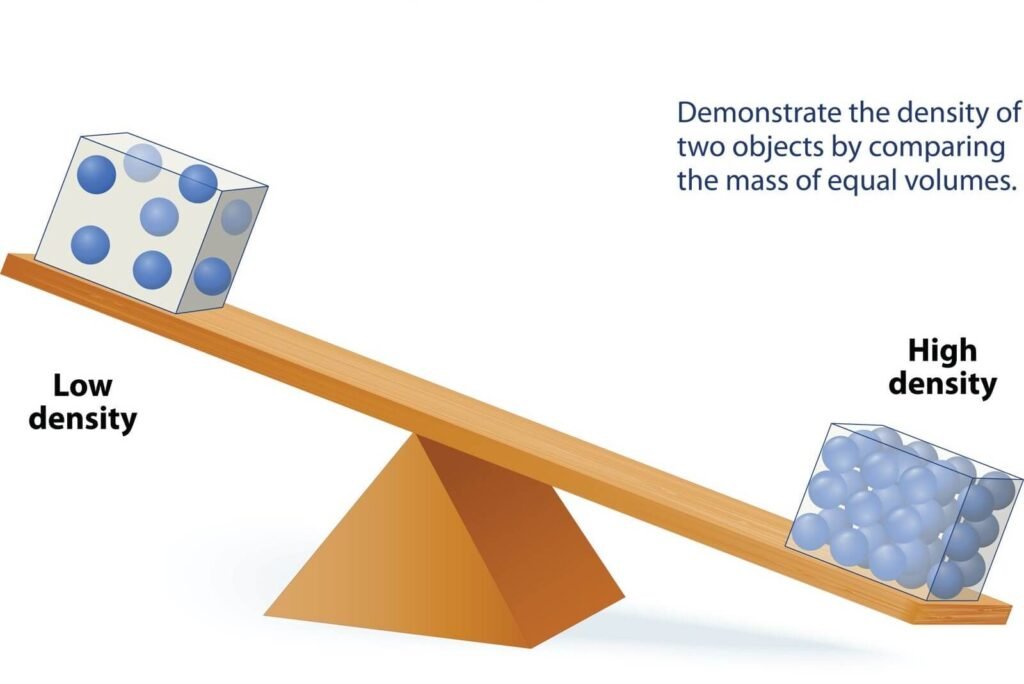
The formula is universally applicable across solids, liquids, and gases. A dense material contains more particles in a smaller (defined) space. Meanwhile, a less dense material has fewer particles spread out.
Units of Density
Density is measured using different units depending on the context. For instance –
Solids = g/cm³ ; Liquids = g/mL or kg/L ; Gases = g/L or kg/m³. Whereas kg/m³ is the SI unit.
How is Density Measured?
Likewise, density measurement depends on the material’s state and the precision required. For solids –
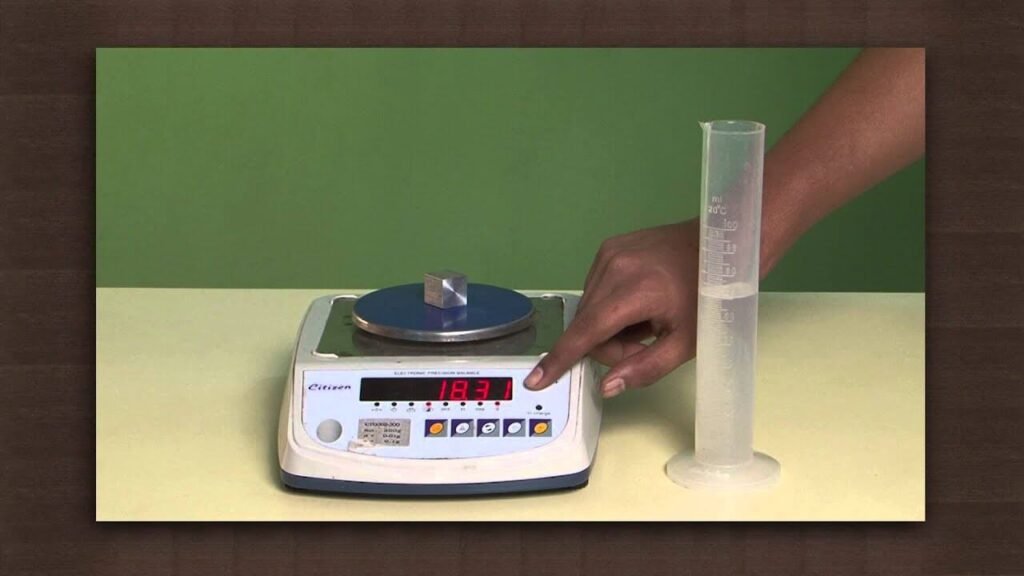
Mass is measured using a digital balance. Volume is calculated geometrically (for a cube, [V = a3]) or via water displacement for irregular shapes.
Example: A lead block weighing 113.4g and displacing 10 cm³ of water has a density of 11.34 g/cm³.
Why Is the Density of Metals So Important?
Density has been a critical design parameter. It influences almost everything, from material selection and structural integrity to cost-efficiency and sustainability.
01. Load-Bearing Capacity (Weight)
Density directly decides the weight-to-volume ratio. And the measurement remains directly attributed to strength-to-weight. It heavily impacts performance, fuel consumption, or structural stress.
02. Cost for Economic Efficiency
Density influences material volume per kilogram, affecting procurement, shipping, and manufacturing costs. High density means small volumes carry significant mass and value. Low-density metals are cheap to transport and install.
03. Thermal and Electrical Conductivity
Density correlates with atomic structure, which affects how metals conduct heat and electricity. More dense metals should contribute to superior electrical conductivity. It’s a declining opposite for most low-density materials.
04. Structural Integrity (Durability)
Density affects a metal’s resistance to deformation, fatigue, and impact, especially under dynamic loads. High density and tensile strength perfectly suit heavy-load applications. Some metals balance moderate density with exceptional fatigue resistance.
05. Thermal Mass for Heat Management
Density influences thermal inertia, which determines how quickly a material heats up or cools down. High-density metals can retain heat longer, whereas low-density metals dissipate heat quickly.
Density of Different Metals: Density Chart
You’ll need the density in different units as –
- g/cm³ is common in materials science and lab settings.
- Lb/in³ is used in US-based engineering and manufacturing.
- Kg/m³ is the SI unit for design, procurement, and logistics.
| Metal | g/cm³ | lb/in³ | kg/m³ |
| Aluminumb (Al) | 2.70 | 0.098 | 2700 |
| Magnesium (Mg) | 1.74 | 0.063 | 1738 |
| Titanium (Ti) | 4.50 | 0.163 | 4500 |
| Iron (Fe) | 7.87 | 0.284 | 7870 |
| Copper (Cu) | 8.93 | 0.323 | 8930 |
| Nickel (Ni) | 8.90 | 0.322 | 8902 |
| Zinc (Zn) | 7.10 | 0.256 | 7100 |
| Tin (Sn) | 7.31 | 0.264 | 7310 |
| Lead (Pb) | 11.34 | 0.410 | 11340 |
| Silver (Ag) | 10.49 | 0.379 | 10490 |
| Gold (Au) | 19.30 | 0.697 | 19302 |
| Platinum (Pt) | 21.45 | 0.775 | 21450 |
| Tungsten (W) | 19.25 | 0.695 | 19250 |
| Lithium (Li) | 0.534 | 0.019 | 534 |
| Molybdenum (Mo) | 10.22 | 0.369 | 10220 |
| Chromium (Cr) | 7.19 | 0.260 | 7190 |
| Cobalt (Co) | 8.83 | 0.319 | 8832 |
| Arsenic (As) | 5.78 | 0.209 | 5778 |
Density Categories for Design Optimization
| Category | Metal | Application |
| Low Density (<5 g/cm³) | Aluminum, Magnesium, Lithium | Aerospace, EVs, portable electronics |
| Medium Density (5 – 10 g/cm³) | Iron, Copper, Nickel, Zinc, Tin | Construction, wiring, consumer goods |
| High Density (>10 g/cm³) | Lead, Silver, Gold, Platinum, Tungsten | Radiation shielding, luxury goods, and defense |
Factors to Influence Density
Density is a fixed property for sure. However, several atomic, environmental, and structural factors directly influence the value. Catching up with the variables can ensure precise material behavior.
01. Atomic Mass + Packing
Density is governed by the mass of atoms at the core. The same goes for how tightly those atoms are packed within the material/metal.
- Atomic Mass: Heavier atoms contribute more mass per unit volume.
- Atomic Packing Factor (APF): Different atomic structures (FCC, BCC, HCP) pack atoms with varying efficiency.
FCC metals (copper and gold) have high APFs (around 0.74). So, they have a higher density. BCC metals (iron) have lower APFs (about 0.68). And it results in a slightly lower density.
02. Temperature
Most materials expand at increased temperatures. It also increases volume to reduce density. Metals like aluminum expand significantly with heat. That’s why it’s used in heat sinks.
Steel expands by 0.012% per °C. A 1m steel rod elongates by 1.2 mm at 100°C, slightly reducing the density.
03. Pressure
Increased pressure compresses materials, reducing volume and increasing density. It’s the primary factor to drive density in gases and soft solids.
- Gases: Air density at sea level is 1.225 kg/m³, but drops to 0.467 kg/m³ at 10,000 meters altitude.
- Solids: Under extreme pressure (in Earth’s core), iron’s density rises from 7.87 g/cm³ to 13 g/cm³.
04. Microstructure
Materials with irregular grain structures have lower effective density. For example, aluminum foam (0.5 – 1.5 g/cm³) is used in crash absorbers and architectural panels. Meanwhile, porous ceramics are used in filtration and insulation where densities can be <1 g/cm³.
05. Environmental Conditions
Humidity, altitude, and salinity can influence density in fluids and gases. Humid air is less dense than dry air because water vapor (18 g/mol) is lighter than nitrogen (28 g/mol).
Seawater density varies from 1.020 to 1.030 g/cm³ depending on salinity and temperature. The Dead Sea water marks a 1.24 g/cm³ density due to extreme salinity.
Differences in Density Within a Metal
Real-world materials exhibit internal variations due to structure, processing, and environmental exposure. Such intra-metal density differences can impact performance, durability, and suitability.
01. Crystallographic Variations
Metals are crystalline solids. Therefore, grain orientation and phase structure can cause localized density differences.
Some atomic regions may have lower atomic packing, leading to slightly reduced density. And metals like iron undergo phase changes with different densities.
02. Manufacturing Processes
Density can vary within a metal due to casting, forging, rolling, or additive manufacturing techniques.
- Casting Defects: Porosity, shrinkage cavities, and inclusions reduce local density.
- Forging + Rolling: These processes compress grains, increasing density and reducing voids.
- Additive Manufacturing (AM): Powder-bed fusion metals show 95% – 99% theoretical density.
03. Voids (Porosity)
Internal voids, microscopic or macroscopic, create effective density gradients within a metal.
- Foamed Metals: Aluminum foam used in crash absorbers can range from 0.5 to 1.5 g/cm³.
- Sintered Metals: Powder metallurgy products often feature 85% – 95% of original density.
04. Impurities and Alloying Elements
Even trace amounts of foreign atoms can alter local density. Adding other elements to a pure metal alters its mass and atomic structure.
For instance, the density of pure gold is 19.32 g/cm³. However, an 18-karat gold contains 75% gold with 25% alloy. It gives you a density of 15.6 – 17.5 g/cm³, depending on alloying elements
05. Control Techniques
Industries use advanced testing and control methods for a uniform density within a metal. The manufacturer can conduct –
- Ultrasonic Testing: Detects internal voids and density anomalies.
- X-ray CT Scanning: Used in aerospace and medical implants for 3D density mapping.
- Archimedes’ Principle: Common in lab settings for bulk density measurement.
- Laser Interferometry: High-precision density profiling in semiconductor-grade metals.
Conclusion
Metal density remains at the forefront of physical properties for good reasons. It takes a decisive part in shaping/building products from a specific metal. The moment you understand density, you can begin to balance performance, cost, safety, and sustainability.
Choose Your Project Metal at HRC
Choosing the right material is critical for CNC machining success. At HRCCNC, our well experts, with over 18 years in the industry, make it simple. Contact us now for valuable insights on metal selection.