Skip to content

Steel, as a metal, lies at the center of modern civilization. You’ll find it everywhere — holding firm, bearing loads, and resisting wear. But what makes steel reliable is its mechanical strength.
Confusion between tensile strength and yield strength is tossed around interchangeably. The two represent very distinctive properties, requiring you to have a clear understanding of steel.
What Is the Tensile Strength of Steel?
It’s one of the most critical mechanical properties of steel. Tensile strength refers to the maximum amount of tensile (pulling or stretching) stress a material (steel) can endure before failure.
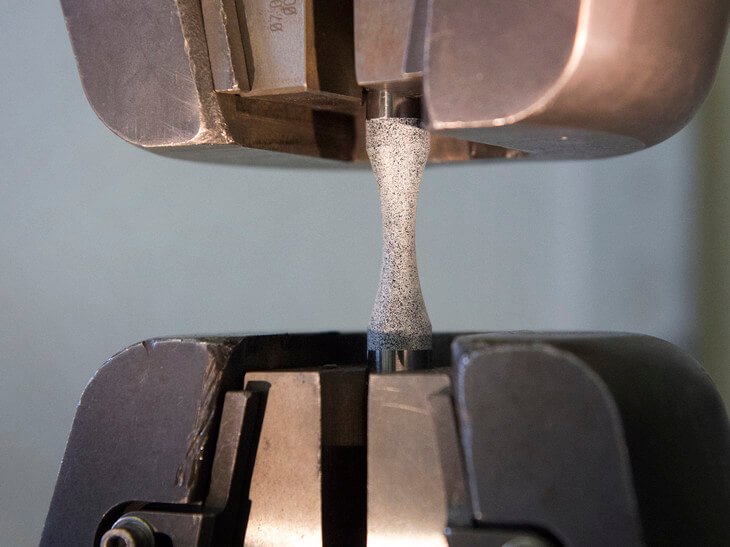
It’s measured during a tensile test, where a steel sample is pulled until it fractures. The result is expressed in MPa or psi. The value reflects steel’s resistance to elongation and rupture.
There are two key terms often associated with tensile strength –
- Ultimate Tensile Strength (UTS): The peak stress the steel can handle before breaking.
- Tensile Yield Strength: The stress at which steel begins to deform permanently under tension.
Tensile Strength Ranges by Steel Type
- Low Carbon Steel (400 – 550 MPa): Structural beams, pipelines, general use.
- High Carbon Steel (800 – 1000 MPa): Springs, cutting tools, wear-resistant parts.
- Alloy Steel (700 – 2000 MPa): Aerospace, automotive, pressure vessels.
- Stainless Steel (500 – 2000 MPa): Food-grade equipment, architecture, marine.
- Tool Steel like D2 / M2 (600 – 1500 MPa): Dies, drills, industrial cutting tools.
- Maraging Steel (Up to 3000 MPa): Aerospace, high-performance components.
- High-Speed Steel (600 – 1400 MPa): Machining tools, industrial blades.
Why Tensile Strength Matters?
- Safety: Components won’t snap under tension (bridge cables, bolts).
- Design Optimization: Engineers can choose the right steel grade for load-bearing vs flexible parts.
- Material Selection: Balance between strength and other properties related to cost.
What Is the Yield Strength of Steel?
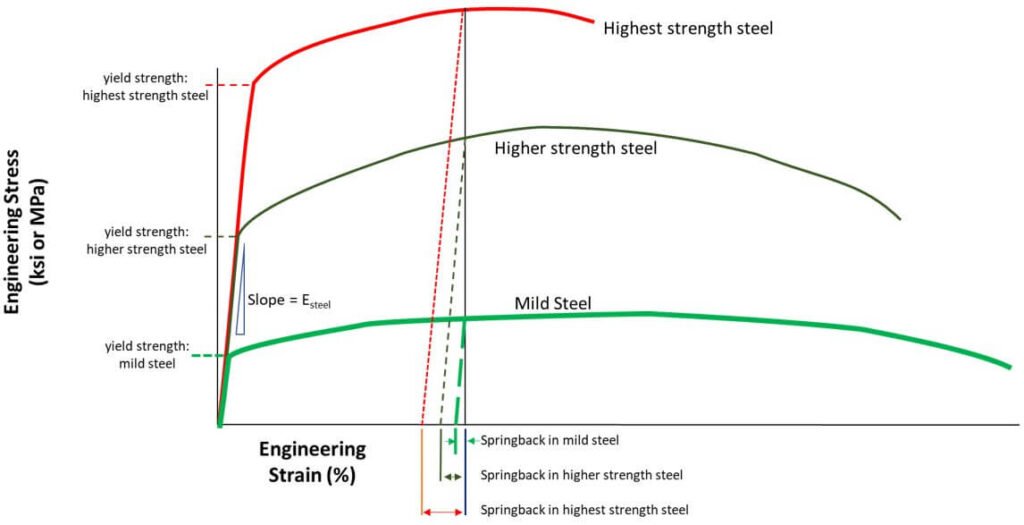
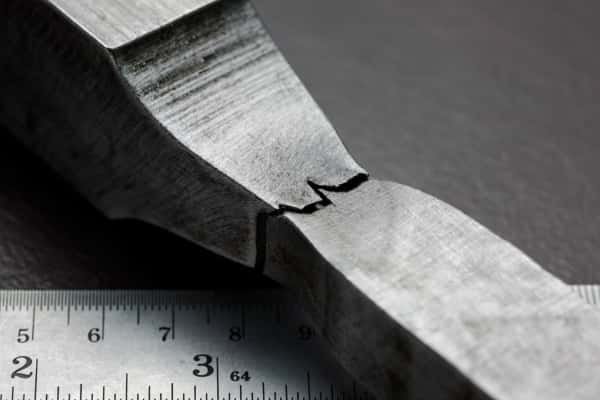
It marks the boundary between reversible and permanent deformation. Yield strength is the amount of stress (force per unit area) at which steel begins to deform plastically.
Steel behaves elastically (steel will return to its original shape upon the load’s removal) before the point. Once the yield strength is exceeded, the deformation becomes permanent.
Typical Yield Strength Values by Steel Grade
- Mild Steel like A36 / S235 (250 MPa): Structural beams, general construction.
- Medium Carbon Steel (350 – 600 MPa): Machinery parts, automotive components.
- High-Strength Low-Alloy or HSLA (350 – 700 MPa): Bridges, pressure vessels, off-road vehicles.
- Stainless Steel like 304 / 316 (215 – 290 MPa): Food-grade equipment, marine structures.
- Rebar like B500B / B500C (≥500 MPa): Reinforced concrete in seismic zones.
- Advanced High-Strength Steel (≥1000 MPa): Automotive crash zones, aerospace.
- Maraging Steel (≥1400 MPa): Rocket casings, aircraft landing gear.
Why Yield Strength Matters?
- Structural Safety: Prevention of sudden/gradual bending or buckling in beams, columns, and frames.
- Material Selection: Guides the choice of steel grade based on expected loads and environmental conditions.
- Cost Optimization: Higher yield strength allows for thinner sections, reducing material usage and weight.
- Seismic and Wind Resistance: Ensures buildings and bridges can flex without failing during earthquakes or storms.
Tensile vs Yield Strength of Steel: Key Differences
Summary of Theoretical Differences
| Aspect | Yield Strength | Tensile Strength |
| Function | Prevents permanent deformation | Prevents fracture |
| Safety Margin | Defines elastic limit (design limit for safe loading) | Defines ultimate limit (Ultimate failure threshold) |
| Design Relevance | Used in structural calculations | Used in failure analysis |
| Testing Behavior | Elastic → Plastic transition | Necking → Fracture |
| Material Selection | Prioritized in construction | Prioritized in high-stress components |
Yield Strength: The Design Threshold
Engineers use yield strength to determine safe load limits. Structures are designed to operate below the yield point to avoid permanent deformation. It’s critical for columns, beams, and load-bearing frames.
Tensile Strength: The Failure Limit
It’s used to assess ultimate capacity before rupture. The value is important for cables, bolts, and fasteners where breakage is catastrophic. It also guides material selection for high-stress applications.
Comparative Statistics Across Steel Grades
| Steel Grade/Type | Yield Strength (MPa) | Tensile Strength (MPa) | Yield-to-Tensile Ratio |
| Mild Steel (A36, S235) | 250 | 400 – 550 | 0.45 – 0.60 |
| HSLA Steel (S355, S460) | 355 – 460 | 490 – 630 | 0.70 – 0.75 |
| Stainless Steel (304, 316) | 215 – 290 | 505 – 620 | 0.40 – 0.55 |
| Rebar (B500B, B500C) | ≥500 | 550 – 600 | 0.83 – 0.90 |
| Martensitic AHSS | ≥1000 | ≥1500 | 0.65 – 0.75 |
| Maraging Steel | ≥1400 | ≥2000 – 3000 | 0.70 – 0.80 |
*Yield-to-Tensile Ratio is a key metric for steel. Higher ratios (in rebar) indicate less ductility but more predictable deformation for seismic-zone uses*
Factors to Influence Steel’s Yield and Tensile Strength
Steel’s mechanical strength, especially its yield and tensile strength, isn’t fixed. The strength is decided by a complex interaction of composition, processing, and environmental conditions.
01. Chemical Composition
The elemental makeup of steel is the foundation of its strength. More carbon increases both yield and tensile strength. Higher carbon reduces ductility and weldability.
Mild steel (0.2% carbon) has a tensile strength of 400 – 550 MPa. Meanwhile, high-carbon tool steels (>0.8%) can exceed 1000 MPa. For other alloying elements –
02. Heat Treatment
Heat treatment alters steel’s microstructure, dramatically affecting strength.
- Quenching: Rapid cooling increases hardness and tensile strength.
- Tempering: Reheating improves ductility and toughness.
- Annealing: Softens steel, reduces internal stresses, lowers yield strength.
- Normalizing: Refines grain structure, balances strength and toughness.
ASTM A514 quenched and tempered steel reaches yield strengths of 690 MPa and tensile strengths >760 MPa. Normalizing is common in structural steels like S355 (yield 355 MPa + tensile 490 MPa).
03. Grain Size and Microstructure
Smaller grains mean stronger steel, thanks to the Hall-Petch relationship.
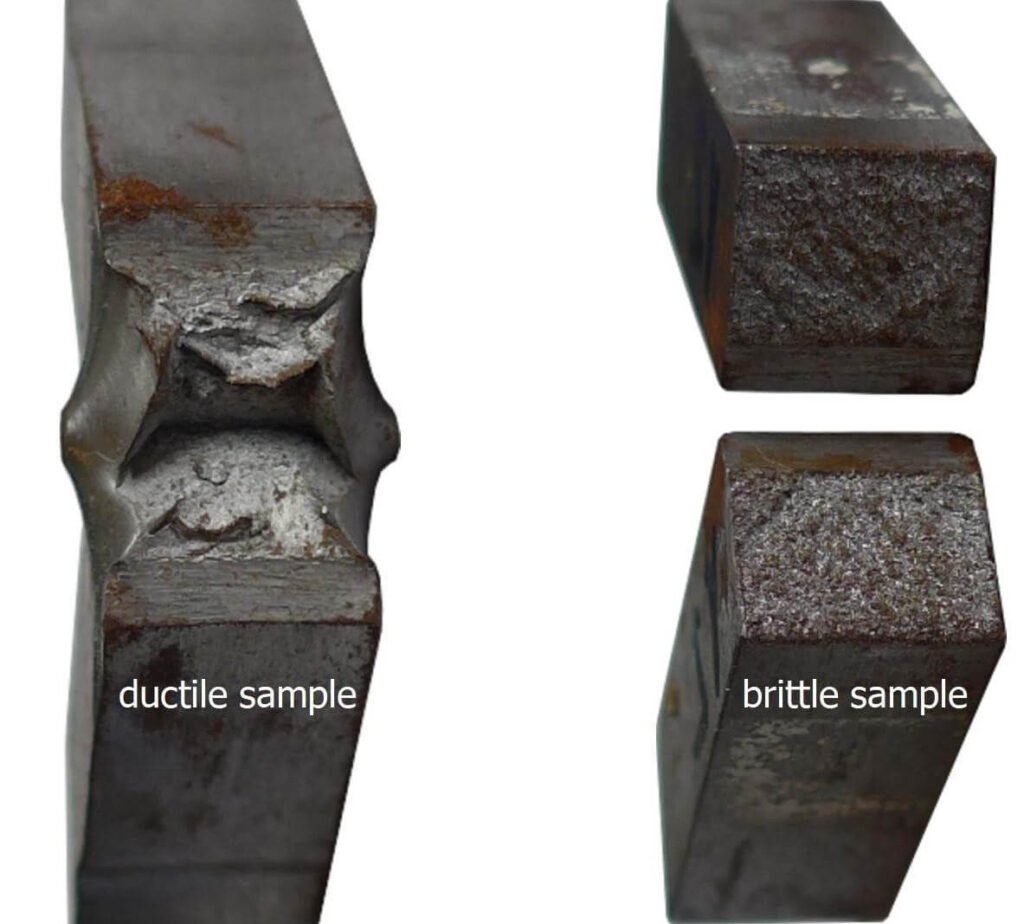
- Fine-grained steel: Higher yield and tensile strength.
- Coarse-grained steel: Lower strength but better toughness.
European S460 structural steel uses controlled rolling to achieve fine grains. It features 460 MPa for yield strength and 550 MPa for tensile strength.
04. Environmental Conditions
- Temperature: High temperatures reduce yield and tensile strength. Cryogenic conditions can cause embrittlement unless alloyed with nickel.
- Corrosion and Hydrogen Embrittlement: Corrosion pits act as stress concentrators, lowering effective strength. Hydrogen ingress (common in marine or chemical environments) can cause premature failure.
05. Manufacturing Method
- Casting vs Forging: Forged steel has finer grains and fewer defects, resulting in higher strength.
- Welding: Heat-affected zones can weaken steel if not adequately controlled.
- QA: Ultrasonic testing, tensile testing, and metallography ensure strength targets are fulfilled.
Applications of Steel Based on Tensile and Yield Strength
01. Construction and Infrastructure
Yield Strength: Structural beams, columns, and frames must resist bending and buckling under load. Rebar in reinforced concrete requires high yield strength to prevent collapse during seismic events.
Tensile Strength: Suspension cables and tension rods require high tensile strength to avoid snapping. Akashi Kaikyō Bridge (Japan) uses steel cables with tensile strengths >1700 MPa across a seismic zone.
02. Automotive and Transportation
Yield Strength: Crash zones and safety cages use high-yield steels to absorb impact. Chassis and suspension components require predictable elastic behavior under dynamic loads.
Tensile Strength: Body panels and reinforcements need high tensile strength to resist tearing. Bolts, axles, and drive shafts must withstand extreme tension without failure.
03. Aerospace/Aviation
Yield Strength: Landing gear, fuselage frames, and rocket casings require high yield strength to resist deformation during takeoff, landing, and atmospheric re-entry.
Tensile Strength: Aircraft skins, turbine blades, and missile bodies need ultra-high tensile strength to withstand aerodynamic forces and thermal stress.

04. Industrial Machinery and Tools
Yield Strength: Press frames, hydraulic cylinders, and gear housings require high yield strength to maintain shape under repetitive loads.
Tensile Strength: Cutting tools, dies, and drill bits need high tensile strength to resist fracture and wear. Tool steels (D2, M2) offer tensile strengths >1500 MPa and are used in dies and industrial blades.
05. Energy and Power Generation
Yield Strength: Wind turbine towers and nuclear containment vessels require high yield strength to resist buckling and fatigue.
Tensile Strength: Transmission lines and offshore drilling rigs need high tensile strength to endure tension and environmental stress.
06. Consumer Products and Appliances
Yield Strength: Appliance frames, furniture, and fixtures require moderate yield strength for durability without excessive rigidity.
Tensile Strength: Fasteners, springs, and blades need higher tensile strength to resist snapping and wear.
Conclusion
Steel marks a combination of resilience, safety, and innovation. And its tensile and yield strength define how the material performs when the stakes are high. Proper understanding of the two can empower builders, manufacturers, and decision-makers to choose wisely, design safely, and innovate boldly.
Get the Best-Quality Steel for Your Projects at HRCCNC
For high-end projects demanding unmatched precision in CNC machining, from HRCCNC comes the ultimate capability of steel. Leverage our 18 years of innovative leadership in steel production. Contact us for a consultation with our industry experts.
Frequently Asked Questions (FAQs)
1. How are tensile and yield strength measured in a lab?
2. What is the stress-strain curve, and how does it relate to strength?
– Elastic region: up to yield strength.
– Plastic region: permanent deformation.
– Necking and fracture: near tensile strength.
It visually distinguishes yield and tensile strength and helps engineers assess ductility and toughness.