Skip to content

Stainless steel is everywhere, from kitchen sinks to hospitals, marine, and industrial infrastructure. Don’t consider all the steels equal, as there are different grades of stainless steel available.
And 304, 18-8, and 316 are three of the most comparable stainless steel grades. They may seem interchangeable from a distance. But deep down, it’s a whole different story with in-depth distinctions.
This article breaks down the key differences among the three SS steels with advantages and applications. The details should help you choose the right steel for your project with confidence.
18/8 Stainless Steel: An Overview
The term 18/8, 18 8, or 18-8 refers to the chemical makeup. More specifically, it indicates the 18% chromium with 8% nickel. 18-8 steel is essentially a shorthand for AISI 304 stainless steel.
Standard Composition
- Chromium (Cr): 18%
- Nickel (Ni): 8%
- Carbon (C): ≤ 0.08%
- Manganese (Mn): ≤ 2.0%
- Silicon (Si): ≤ 1.0%
- Phosphorus (P), Sulfur (S): Trace
Some equivalent steel grades for 18-8 are AISI 304 (USA), SUS304 (Japan), and X5CrNi18-10 (Europe).
Exclusive Features of 18/8
- Corrosion Resistance: It performs well in mildly corrosive environments (kitchen or indoor industrial settings). However, 18-8 seems less resistant than 316 in chloride-rich or marine conditions.
- Fabrication + Weldability: 18 8 marks excellent weldability and formability for deep drawing, bending, and machining. It’s commonly used in cold-worked conditions for further strengthening.
18-8 Stainless Steel Applications
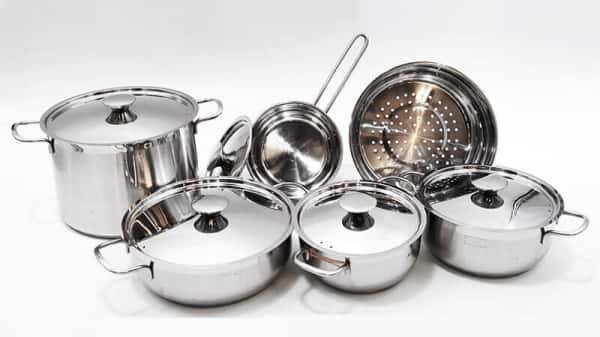
- Kitchenware and Food Processing: Cutlery, cookware, sinks, and food-grade containers.
- Medical + Laboratory Equipment: Surgical trays, sterilization containers, and lab benches.
- Industrial / Architectural Applications: Storage tanks, fasteners, and decorative panels.
- Sanitary and Plumbing Fixtures: Faucets, showerheads, and bathroom accessories.
- Chemical + Pharmaceutical Equipment: Alcohols, organic acids, and cleaning agents.
304 Stainless Steel: An Overview
It also goes by AISI 304 or UNS S30400. 304 is the most widely used stainless steel grade in the world. The steel belongs to the austenitic family, often synonymous with 18/8 stainless steel.
Standard Composition
- Chromium (Cr): 18.0% – 20.0%
- Nickel (Ni): 8.0 – 10.5%
- Carbon (C): ≤ 0.08%
- Manganese (Mn): ≤ 2.0%
- Silicon (Si): ≤ 1.0%
- Phosphorus (P), Sulfur (S): Trace
Available Variants of 304 SS
- 304L: Low carbon version for welding and less intergranular corrosion.
- 304H: High carbon version, used in high-temperature environments.
Exclusive Features of 304
- Corrosion Resistance: It performs well in mildly corrosive environments. 304 is susceptible to pitting and crevice corrosion in chloride-rich environments such as coastal areas or saltwater exposure.
- Fabrication and Weldability: Likewise, 304 comes with excellent weldability and formability for stamping, bending, and machining. It’s commonly used in cold-worked conditions for extra strength.
304 Stainless Steel Applications
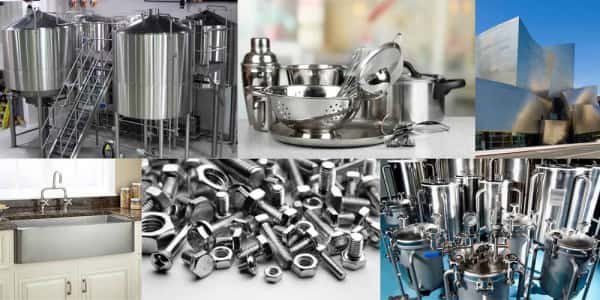
- Food and Beverage Industry: Kitchen sinks, cookware, cutlery, brewing tanks, and food-grade piping.
- Medical / Pharmaceutical: Sterilization trays, surgical instruments, and lab equipment.
- Architecture + Construction: Handrails, cladding, elevator panels, and decorative trims.
- Sanitary / Plumbing Fixtures: Faucets, showerheads, and bathroom accessories.
- Chemical and Industrial Equipment: Mild chemicals (organic acids, cleaning agents, and alcohols).
- Automotive / Transportation: Exhaust manifolds, trim, and fuel lines in Toyota and Volkswagen.
316 Stainless Steel: An Overview
It also goes by AISI 316 or UNS S31600 steel. 316 is a molybdenum-bearing austenitic stainless steel. The grade is heavily considered as marine-grade due to its superior resistance to chloride corrosion.
Standard Composition
- Chromium (Cr): 16.0% – 18.0%
- Nickel (Ni): 10.0% – 14.0%
- Molybdenum (Mo): 2.0% – 3.0%
- Manganese (Mn): ≤ 2.0%
- Silicon (Si): ≤ 1.0%
- Carbon (C): ≤ 0.08%
- Phosphorus (P), Sulfur (S): Trace
Available Variants of 316 SS
- 316L: Low-carbon version for welding and less carbide precipitation.
- 316H: High carbon version, used in high-temperature applications.
Exclusive Features of 316
- Corrosion Resistance: It performs well in marine, acidic, and chloride-heavy environments. 316 can resist pitting and crevice corrosion in submerged or coastal applications.
- Heat Resistance: 316 can effectively maintain its mechanical strength and oxidation resistance. It can withstand up to 870°C in intermittent service and 925°C in continuous service.
316 Stainless Steel Applications
- Medical / Pharmaceutical: Surgical instruments, orthopedic implants, and hospital equipment.
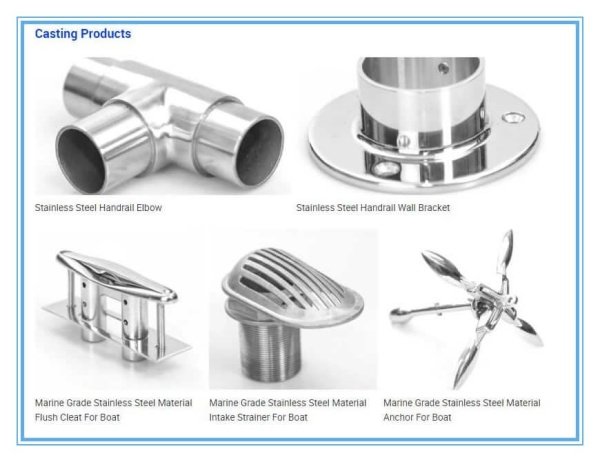
- Marine / Coastal: Boat fittings, propeller shafts, desalination plants, and offshore oil rigs.
- Chemical + Petrochemical: Chemical tanks, heat exchangers, and reactors.
- Food and Beverage Processing: Brewing tanks, dairy equipment, and kitchen appliances.
- Architecture + Construction: Handrails, cladding, and fasteners in coastal buildings.
- Aerospace and Automotive: Fuel lines, engine components, and exhaust systems under heat.
18 8 Stainless Steel vs 304 vs 316 SS Steel: Key Differences
● Alloy Composition
All three grades belong to the austenitic stainless steel family. 18/8 is a shorthand for steel containing 18% Cr and 8% Ni, the same composition as 304. 18/8 is often used interchangeably with 304.
304 stainless steel may contain slightly more nickel (up to 10.5%) and chromium (up to 20%). 316 stainless steel introduces 2% – 3% molybdenum to enhance resistance to chlorides and acids.
● Strength (Durability)
304 and 18/8 have a minimum tensile strength of around 515 MPa and a yield strength of 205 MPa. It makes them equally suitable for construction, kitchenware, and industrial fittings.
Meanwhile, 316 stainless steel matches or slightly exceeds these values, especially when cold-worked. It can maintain its strength better under stress and exposure to corrosive agents.
● Corrosion Resistance
This is where the differences among the three become the most pronounced. 18/8 and 304 are good for mildly corrosive environments (indoor industrial settings, food processing, and urban architecture).
However, they are susceptible to pitting and crevice corrosion in chloride-rich environments. 316 stainless steel, thanks to molybdenum, offers superior resistance to chlorides, acidity, and salinity.
● Temperature Resistance
304 and 18/8 can withstand temperatures up to 870°C intermittently and 925°C continuously. It makes them suitable for cookware, exhaust systems, and heat exchangers.
316 stainless steel performs similarly but resists oxidation and scaling better at elevated temperatures. It’s particularly true for acidic or chloride-laden atmospheres.
● Workability
18/8 and 304 are ideal for deep drawing, bending, and cold working. Both are equal favorites in cutlery, sinks, and architectural panels.
316, while slightly tougher due to molybdenum, offers good workability. It’s preferred in precision fabrication for medical and marine components.
● Cost Considerations
18/8 and 304 are more affordable, making them ideal for high-volume consumer goods and general-purpose industrial applications.
316 stainless steel is primarily 20% – 30% more expensive. However, in harsh environments, the long-term savings in maintenance and replacement justify the investment.
● Maintenance
304 and 18/8 require regular cleaning in humid or chloride-prone environments to prevent surface corrosion. In dry, indoor settings, they remain low-maintenance.
316 stainless steel offers low-maintenance longevity, even in aggressive cases. It resists staining, rusting, and degradation far better, making it ideal for marine, medical, and chemical sectors.
Comparison Table: 304 vs 18/8 vs 316 Stainless Steel
| Feature/Aspect | 304 Stainless Steel | 18-8 Stainless Steel | 316 Stainless Steel |
| Chromium (Cr) Content | 18% – 20% | 18% | 16% – 18% |
| Nickel (Ni) Content | 8% – 10.5% | 8% | 10% – 14% |
| Molybdenum (Mo) Content | N/A | N/A | 2% – 3% |
| Corrosion Resistance | Excellent in mild environments | Sufficient for mild environments | Superb in chloride-rich, marine, and acidic cases |
| Tensile Strength | 515 – 750 MPa | 515 MPa | 515 – 690 MPa |
| Temperature Tolerance | Up to 870°C (intermittent); 925°C (continuous) | Similar to 304 SS | Similar, with better scaling resistance |
| Workability | Excellent for welding, forming, machining | Excellent for forming and consumer-grade | Good (slightly tougher due to molybdenum) |
| Maintenance Needs | Low in dry settings, moderate in humidity | Low for indoors, stain in salty environments | Minimal, even in harsh conditions |
| Overall Cost | Affordable + widely available | Slightly cheaper or equivalent to 304 | 20% – 30% more expensive |
| Common Uses | Sinks, cookware, food processing, and architecture | Cutlery, kitchenware, consumer goods | Marine hardware, medical tools, chemical tanks |
You may wonder: What are the differences between 304 and 18/8 SS steel? Well, 18-8 describes several steels with similar Cr + Ni content. 304 is a precise and standardized alloy with tighter controls.
How to Choose from 304 vs 18-8 vs 316?
Choose 304 Stainless Steel for –
- Versatile and cost-effective material for food, arch, or industrial use.
- The intended application involves indoor or mildly corrosive environments.
- Reliable weldability and formability are required for mass production.
Choose 18/8 Stainless Steel for –
- Sourcing consumer items like cutlery, cookware, or bathroom accessories.
- A budget-friendly option with decent corrosion resistance is required.
- The audience is familiar with the 18/8 label and expects standard performance.
Choose 316 Stainless Steel for –
- The application involves marine, coastal, medical, or chemical exposure.
- Maximum corrosion resistance, especially against chlorides and acids.
- Projects and/or uses with long-term durability in harsh environments.
Conclusion
Stainless steel may look the same on the surface. Beneath the polished finish lie the performance differentiating factors that can or can’t suffice your project specs. Understanding the nuances between 304, 18/8, and 316 stainless steel can induce optimal quality for suitable products.
Have the Best-Quality Steel for Your Projects from HRCCNC
Secure top-level steel manufacturing and precision CNC machining support for your projects with HRCCNC. A leader in steel production for 18 years, we provide expert consultation to bring your designs to life.