Skip to content

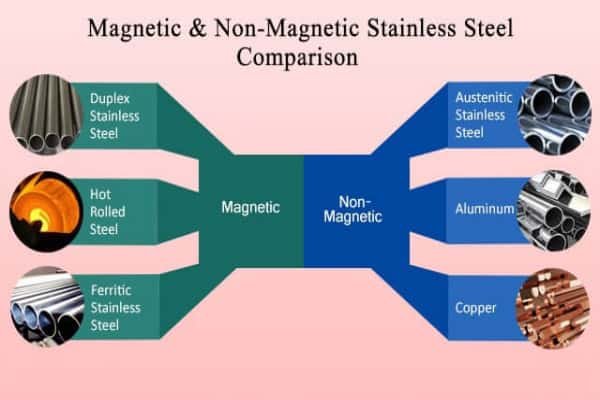
Does/should stainless steel stick to magnets? This simple question doesn’t have simple answers. Many mistakenly consider stainless (SS) steel as a single entity. That’s where all the mysteries lie.
There are different types/grades of stainless steel. And they don’t behave equally around magnets. The magnetic properties of stainless steel depend on several in-depth technical factors.
The same shiny steel surface can either repel or attract a magnet. This article discusses why some steels are magnetic while others aren’t and how magnetism varies across popular steel grades.
Stainless Steel Magnetism by Type
1. Austenitic Stainless Steel
303, 304, 316, 310, 321, and 18/8 belong to this category with a Face-Centered Cubic (FCC) structure.
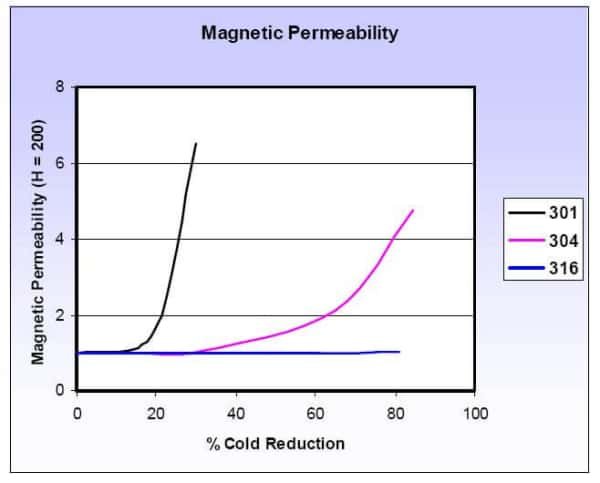
They’re usually non-magnetic in an annealed condition. However, the steels can become slightly magnetic after cold working or welding.
Magnetic Permeability: Close to 1.0 (same as vacuum), which indicates minimal magnetic response.
2. Ferritic Stainless Steel
409, 430, and 446 are the top grades from this category with a Body-Centered Cubic (BCC) structure.
Ferritic steels exhibit strong magnetism due to their ferromagnetic arrangement at the atomic level.
Magnetic Permeability: Noticeably higher than 1.0; comfortably attracted to standard magnets.
3. Martensitic Stainless Steel
410, 420, 440, and 416 mostly make up the category with a Body-Centered Tetragonal (BCT) structure.
The steels show high magnetism that can undergo further hardening through suitable heat treatment.
Magnetic Permeability: Significantly high; full retention of magnetism (permanent magnet behavior).
4. Duplex Stainless Steel
2205 and 2507 are the most popular grades with a mixed crystal structure (50% FCC + 50% BCC).
They exhibit magnetic behavior at a moderate scale due to the ferritic phase within atomic conditions.
Magnetic Permeability: Intermediate; the value can vary with steel composition and processing.
5. Precipitation-Hardening Stainless Steel
The category holds 17-4 PH and 15-5 PH, featuring a martensitic structure with hardening precipitates.
Strong magnetism prevails due to the martensitic base.
Magnetic Permeability: High; retention of magnetism after aging treatments.
Magnetism in Common Stainless Steel Grades
Austenitic stainless steels such as 303, 304, 316, and 18/8 usually show little to no magnetism in their annealed condition. Machining and cold working can introduce weak magnetism, especially in grades like 303 and 304. This change may affect CNC machining processes, including chip removal and tool performance. Grade 316 has the lowest magnetic response among these materials and stays mostly non-magnetic. However, heavily cold-worked parts such as springs can still attract magnets and interfere with magnetic sensors.
Martensitic and ferritic stainless steels behave very differently. Grades such as 410 and 416 show strong magnetic properties and respond well to magnetic fields. Manufacturers often use these grades in magnetic particle inspection to detect surface cracks and fatigue damage. Ferritic 430 stainless steel also attracts magnets easily. Recycling systems rely on this feature to separate materials quickly and reduce contamination.
Precipitation-hardening stainless steel, such as 17-4, combines high strength with clear magnetic behavior. Its martensitic structure and heat treatment create stable magnetic properties. Engineers often use 17-4 in non-destructive testing and sensor-based inspection. These applications benefit from predictable magnetism and reliable mechanical performance in demanding environments.
How Do Some Non-Magnetic Stainless Steels Become Magnetic?
Cold working is one of the most common reasons non-magnetic stainless steel becomes magnetic. Processes such as bending, rolling, drawing, or stamping deform the material at room temperature. This mechanical stress can partially change the microstructure from austenite to martensite, which introduces magnetism.
Welding can also affect magnetism in austenitic stainless steels. The localized heat alters the microstructure in the heat-affected zone (HAZ). In some cases, this leads to strain-induced martensite, especially near weld seams.
Alloy composition plays a key role as well. The balance between austenite and ferrite stabilizers determines how stable the non-magnetic structure remains. Even small changes in chemical composition within the same grade can influence whether magnetism appears under heat or stress.
How to Test Magnetism in Stainless Steel?
The simplest method is a handheld magnet test. If a magnet sticks firmly to the surface, the steel is magnetic. Consumers often use fridge magnets to test cookware, while scrap yards rely on magnets to separate ferritic and martensitic steels from austenitic ones.
For precise measurement, magnetic permeability meters such as Ferromaster measure relative permeability (μr). Industries like aerospace, nuclear, and medical manufacturing use these devices to confirm non-magnetic compliance. Standards such as ASTM A342 and EN 60404-15 provide guidance for permeability testing.
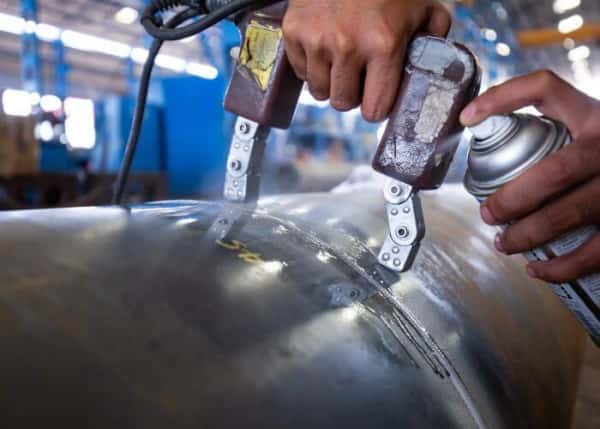
Magnetic particle inspection (MPI) works well for ferromagnetic materials. The method applies a magnetic field and iron particles to reveal surface cracks. Aerospace, defense, and oil & gas industries commonly test 410 and 17-4 PH components, pipelines, and valves using MPI.
Material composition analysis methods like XRF and OES identify alloying elements such as nickel, chromium, and molybdenum. These tests help confirm material grades when magnetic behavior causes uncertainty and support compliance with ISO and ASTM standards.
Other tools also serve specific needs. Gaussmeters and teslameters measure magnetic field strength in precision engineering and lab equipment. Eddy current testing detects changes in conductivity and permeability, which helps with quality control and high-speed sorting in recycling systems.
In daily life, simple checks still help. Strong attraction on cookware often points to ferritic 430 steel, while weak or no attraction suggests 304 or 316. Budget appliances commonly use 430 stainless steel, and medical-grade jewelry or watches usually rely on non-magnetic 316L for safety and MRI compatibility.
Does Magnetism in Stainless Steel Affect Quality or Properties?
Magnetism does not automatically mean poor quality. It signals a structural change at the atomic level, which may influence material behavior. For example, a 304 stainless steel sheet can become slightly magnetic after rolling, and corrosion resistance near bends or welds may decrease.
Magnetism itself does not cause corrosion, but the changes that create magnetism can. Cold working can reduce chromium availability at the surface after martensitic transformation. This weakens the protective oxide layer, especially in chloride-rich environments. Weld zones containing magnetic ferrite may also show localized corrosion.
Mechanical properties often change alongside magnetism. Cold-worked austenitic steels usually become harder and less ductile. These materials still perform well in springs or clips but suit forming and welding less. Martensitic grades such as 410 and 416 offer high hardness and magnetism, but they also show higher brittleness.
In sensitive applications, magnetism becomes a critical factor. Medical tools must remain non-magnetic for MRI safety. Electronic systems require low magnetic interference. Aerospace inspections depend on predictable magnetic behavior for reliable MPI results.
Common Misconceptions/Myths Resolved about Stainless Steel Magnetism
Many people believe magnetic stainless steel is not real stainless steel, but this is incorrect. Ferritic and martensitic grades such as 430, 410, and 416 are fully stainless and strongly magnetic.
Non-magnetic stainless steel does not automatically mean higher quality. Magnetism reflects crystal structure and composition, not overall performance. Grade 304 is non-magnetic when annealed, but cold working or welding can introduce slight magnetism.
A magnet alone cannot identify an exact grade. Different stainless steels may show similar magnetic behavior. Grade 316 stays mostly non-magnetic, though heavy cold work or welding can cause weak magnetism.
Some magnetism can be reduced through annealing, but full demagnetization is not always possible. All 400-series stainless steels are not the same, as ferritic and martensitic grades differ greatly in properties. Magnetism also does not indicate iron contamination, since all stainless steels are iron-based alloys.
Work-hardened 304 becoming magnetic is normal and does not mean the material is damaged.
Conclusion
Stainless steel, as a cluster of several grades and types, exhibits distinctive magnetic behavior. There are SS steels with no visible magnetism, and there are stainless steels with obvious magnetic response. Each steel serves a purpose that goes well beyond sticking to magnets.
Find Your Ultimate Steel regarding Magnetism at HRCCNC
Top-level steel CNC manufacturing covers almost all standard grades and types. No wonder we have led the industry for 18 years since the beginning. Contact us to reach top industry experts for consultation.