 Skip to content
Custom Metal Fabrication Services
HRCCNC provides online custom metal fabrication services for precision parts and assemblies used in industrial manufacturing. Upload CAD files to produce custom metal components through processes such as sheet metal fabrication, laser cutting, bending, and welding for both prototypes and production.
- Precision fabrication tolerances up to ±0.009 mm for brackets, enclosures, and structural components.
- ISO 9001:2015 certified quality system for controlled fabrication and consistent accuracy.
- Rapid prototyping and scalable production for OEM manufacturing programs.
- Metal material options include stainless steel, aluminum alloys, carbon steel, brass, and copper.
- Online metal fabrication service with RFQ support through CAD files (STEP, IGES, DXF) and 2D drawings (PDF).
Upload CAD Files to Start Your Custom Metal Fabrication Project.
What Are Fabrication Services?
Fabrication services are manufacturing processes that cut, form, and join metal and plastic materials to produce custom, high-precision functional components for industrial applications. These end-to-end fabrication services convert raw materials such as stainless steel, aluminum, carbon steel, and engineering plastics into production-ready parts used in automotive systems, aerospace equipment, electronics enclosures, and industrial machinery.
Common metal fabrication services include:
- Sheet metal fabrication for enclosures, panels, brackets, and chassis.
- Laser cutting fabrication for accurate metal profiles and detailed component shapes.
- Bending and forming fabrication to create angles, frames, and structural parts.
- Welding fabrication services to join metal components into durable assemblies.
- Die casting fabrication process to produce high-precision metal parts with strong structural integrity.
Our Core Fabrication Capabilities
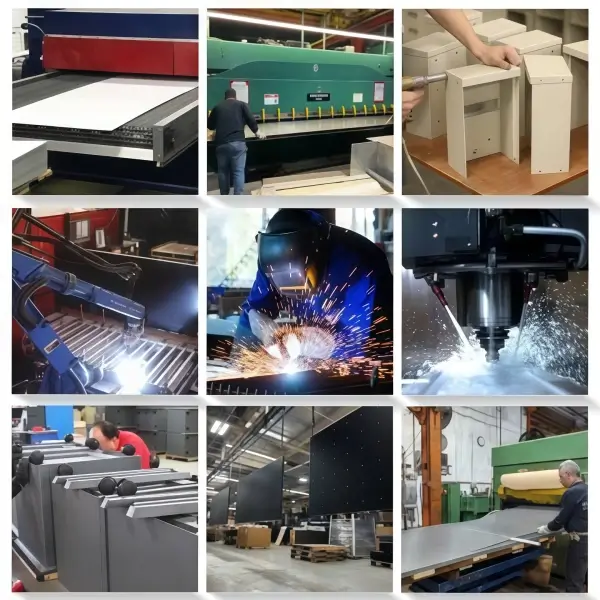
Compared with standard components, custom metal fabrication services provide greater flexibility to achieve unique geometries, tighter tolerances, and application-specific surface finishes. These end-to-end fabrication services convert raw metal materials into high-precision parts for prototypes and production. HRCCNC offers a full range of fabrication solutions to turn design concepts into production-ready components.
We provide sheet metal fabrication services that produce high-precision custom components for industrial use, including enclosures, brackets, chassis, and mounting plates. Advanced equipment performs laser cutting, CNC bending, stamping, MIG/TIG welding, and PEM hardware insertion to maintain consistent dimensional accuracy and repeatable production quality. The process supports aluminum, stainless steel, and carbon steel, with finishing options such as powder coating and painting. These services support both prototype development and large-scale production while maintaining consistent manufacturing standards.

Die Casting (Aluminum & Zinc)
Die casting is ideal for producing strong, high-precision metal parts with consistent dimensional accuracy and smooth surface finishes. The process supports aluminum die casting for lightweight components with effective heat dissipation and zinc die casting for smaller parts requiring tight tolerances and structural strength. Secondary operations such as CNC machining, drilling, tapping, and tumbling refine precision, while finishing options like anodizing, powder coating, electroplating, and polishing prepare parts for functional or aesthetic needs. Typical applications include automotive components, equipment housings, brackets, connectors, and consumer product parts.
Bending Fabrication
Metal bending fabrication forms sheet metal into precise angles and structural shapes used in brackets, enclosures, frames, and mounting plates. Advanced CNC bending machines produce consistent bends with high repeatability and clean edges across materials such as aluminum, stainless steel, carbon steel, and brass. The process supports sheet thickness from 0.5 mm to 6 mm, including multi-angle forming and tight-radius bends. Secondary operations such as welding, riveting, hardware insertion, and surface finishing prepare parts for functional assemblies and industrial equipment.

We provide sheet metal fabrication services that produce high-precision custom components for industrial use, including enclosures, brackets, chassis, and mounting plates. Advanced equipment performs laser cutting, CNC bending, stamping, MIG/TIG welding, and PEM hardware insertion to maintain consistent dimensional accuracy and repeatable production quality. The process supports aluminum, stainless steel, and carbon steel, with finishing options such as powder coating and painting. These services support both prototype development and large-scale production while maintaining consistent manufacturing standards.
Laser Cutting
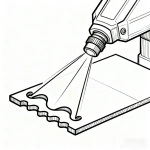
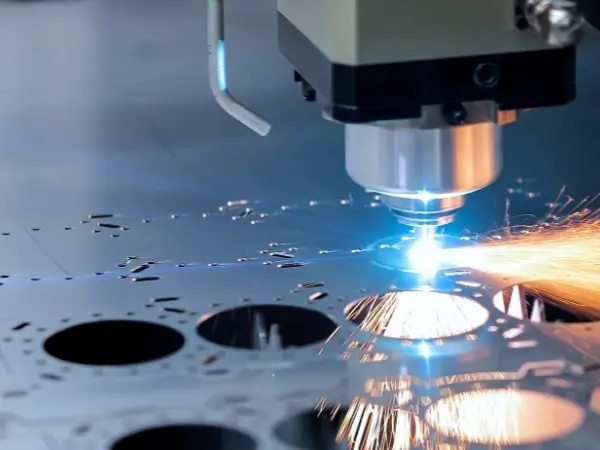
Laser cutting fabrication produces high-precision metal components with clean edges and consistent dimensional accuracy. High-power laser systems process materials such as stainless steel, aluminum, carbon steel, brass, and copper, supporting both thin sheets and heavy-gauge metals. The process creates smooth edges with minimal burrs and handles complex geometries, including ventilation holes, detailed patterns, logos, and structural cut profiles. Typical applications include metal panels, machine covers, decorative plates, signage components, industrial brackets, and precision sheet metal parts.
Welding Fabrication
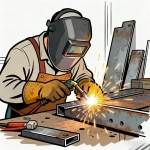
Welding fabrication joins metal components into durable assemblies and structural frameworks. Skilled welders perform MIG, TIG, and spot welding to create strong, clean joints across stainless steel, aluminum, and carbon steel. The process supports assemblies including frames, brackets, enclosures, and mechanical structures, with post-processing operations such as grinding, polishing, powder coating, and painting to improve surface quality and durability. Typical applications include chassis frames, equipment housings, structural supports, automotive parts, and industrial machinery components.
What are the Benefits of Custom Metal Fabrication?
Custom metal fabrication services reduce production cost, shorten development cycles, and improve supply chain stability while producing high-precision parts for complex industrial applications. The following advantages explain how end-to-end fabrication services support faster product development, controlled manufacturing quality, and scalable production for OEM programs.
Optimize Cost Savings
Custom metal fabrication reduces total production cost by consolidating multiple manufacturing processes into a single end-to-end workflow. Factory-direct fabrication and design for manufacturability (DFM) analysis refine part geometry, remove unnecessary machining steps, and reduce material waste. This approach lowers per-part manufacturing cost while maintaining consistent fabrication quality.
Accelerate Time-to-Market
Rapid fabrication processes shorten product development cycles by converting engineering designs into functional metal parts with fewer production steps. Integrated processes such as laser cutting, bending, welding, and finishing allow prototypes and production parts to move through the same fabrication workflow. This streamlined process reduces development delays and speeds product launch timelines.
Minimize Supply Chain Risks
End-to-end fabrication services reduce supply chain disruption by consolidating laser cutting, CNC bending, welding, assembly, and finishing within a single manufacturing partner. A centralized workflow manages material sourcing, part fabrication, hardware insertion, and surface finishing within a single production schedule. This structure reduces multi-vendor coordination, shortens lead times, and improves delivery predictability for industrial manufacturing programs.
Achieve Superior Value for Complex Parts
Custom metal fabrication produces complex components with controlled tolerances and integrated assemblies, reducing downstream manufacturing effort. Fabrication processes such as laser cutting, CNC bending, machining, and welding combine into a coordinated production sequence. This integration reduces separate part fabrication and manual assembly steps while maintaining consistent component accuracy and structural strength.
Enhance Product Performance
Precision fabrication processes improve dimensional accuracy, structural strength, and surface quality in metal components used in demanding industrial environments. Processes such as CNC bending, laser cutting, welding, and machining maintain tight tolerances and strong joint integrity across aluminum, stainless steel, and carbon steel parts. Controlled finishing operations such as grinding, polishing, and coating improve surface protection and durability.
Ensure Global Reliability
Industrial metal fabrication supports global manufacturing programs through standardized production workflows, controlled quality inspection, and international shipping. Processes such as laser cutting, CNC bending, machining, and welding maintain tight tolerances and repeatable accuracy across production batches. Dimensional inspection, material verification, and finishing checks maintain consistent part quality for OEM components used in international markets.
Industries We Serve with Custom Metal Parts
HRCCNC supports multiple industries that require custom metal parts, precision assemblies, and reliable manufacturing for complex industrial applications. From precision metal components to engineered plastic parts, our fabrication services support automotive systems, aerospace equipment, electronics devices, medical technology, and industrial machinery.
Automotive
Consumer Electronics
Aerospace
Medical Devices
Robotics & Automation
Energy
Our Metal Fabrication Process
At HRCCNC, our metal fabrication process includes quotation and engineering review, raw material preparation, fabrication and assembly operations, finishing with quality inspection, and final packaging with global delivery support. This structured workflow converts raw materials into high-precision custom components for industrial applications.
Request for Quote (RFQ)
Customers begin by submitting CAD files such as STEP, IGES, DXF, or 2D drawings in PDF format along with material requirements, quantity, and finishing specifications. Our engineering team reviews the design files to understand part geometry, tolerance requirements, and manufacturing feasibility for custom metal fabrication services.
Design Engineering / Design for Manufacturability (DFM) Review
Our engineers perform a DFM review to evaluate part geometry, tolerance requirements, and fabrication complexity. We identify opportunities to improve manufacturability, reduce unnecessary machining steps, and maintain structural integrity while preparing the design for efficient production.
Cost Estimation
Our fabrication team calculates production cost based on material type, part geometry, tolerance requirements, manufacturing processes, finishing options, and production volume. This analysis allows us to provide a transparent quotation that reflects the complete fabrication workflow.
Specification Approval and Production Scheduling
After quotation approval, we confirm the production specifications, including material grade, surface finish, tolerance range, and order quantity. The project then moves into production scheduling, where we allocate fabrication capacity and establish lead times for prototype or production orders.
Material Sourcing and Selection
We begin production by sourcing and selecting raw materials such as aluminum sheets, stainless steel plates, carbon steel, brass, or copper according to engineering specifications. Our team verifies materials to ensure they meet the required mechanical properties and fabrication standards.
Cutting and Punching
We perform cutting operations using equipment such as laser cutting machines and punching systems to shape raw metal sheets into precise profiles. This step produces accurate blank parts while maintaining consistent dimensional accuracy for downstream fabrication processes.
Bending and Forming
We use CNC bending machines to form flat metal sheets into angles, frames, and structural components according to design specifications. Controlled bending parameters such as press force, bend angle, and tooling setup allow us to maintain repeatable geometry and consistent dimensional accuracy across production batches.
Punching and Machining Features
We carry out secondary operations such as hole punching, tapping, drilling, and machining to add functional details required for assembly and installation. These operations create threaded holes, mounting points, and precision cutouts that prepare fabricated components for fastening, alignment, and integration into larger assemblies.
Welding Processes (MIG, TIG, Spot Welding)
Fabrication technicians perform MIG, TIG, or spot welding to join metal components into durable assemblies. We select the appropriate welding method based on material type, thickness, and structural requirements to produce strong, consistent weld joints.
Assembly and Fit-Up
We align and assemble fabricated parts according to engineering drawings to ensure proper fit and structural stability. Our assembly operations position brackets, frames, housings, and structural components with controlled alignment before final fastening or welding.
Grinding and Edge Finishing
We perform grinding and edge finishing operations to remove burrs, smooth weld seams, and refine sharp surface edges created during fabrication. This step improves dimensional consistency, surface quality, and handling safety while preparing parts for coating, plating, or other finishing treatments.
Welding Processes (MIG, TIG, Spot Welding)
Fabrication technicians perform MIG, TIG, or spot welding to join metal components into durable assemblies. We select the appropriate welding method based on material type, thickness, and structural requirements to produce strong, consistent weld joints.
Assembly and Fit-Up
We align and assemble fabricated parts according to engineering drawings to ensure proper fit and structural stability. Our assembly operations position brackets, frames, housings, and structural components with controlled alignment before final fastening or welding.
Grinding and Edge Finishing
We perform grinding and edge finishing operations to remove burrs, smooth weld seams, and refine sharp surface edges created during fabrication. This step improves dimensional consistency, surface quality, and handling safety while preparing parts for coating, plating, or other finishing treatments.
Surface Treatment and Coating
We apply finishing treatments such as powder coating, anodizing, electroplating, or polishing based on functional and aesthetic requirements. These surface treatments improve corrosion resistance, wear durability, and surface appearance while preparing components for long-term industrial use.
Quality Inspection and Tolerance Verification
Our quality inspectors measure fabricated components using precision inspection equipment to verify dimensional accuracy and tolerance compliance. Inspection procedures, such as caliper measurements, gauge verification, and visual checks, confirm that each part meets engineering specifications before moving to final processing.
Final Inspection
Before packaging, we conduct a final quality inspection to review dimensional accuracy, surface finish quality, and assembly integrity. Measurement tools and visual checks confirm that fabricated parts meet specified tolerances and production standards.
Protective Packaging
We pack components using protective materials such as foam inserts, anti-corrosion film, edge protection, or custom packaging trays to prevent damage during transportation. Packaging methods are selected based on part geometry, surface finish sensitivity, and shipment requirements.
Shipping and Delivery
Finished components are prepared for international shipping through coordinated logistics, secure packaging, and shipment planning. Our team manages export documentation, labeling, and order tracking to ensure smooth customs processing and reliable delivery for both prototype batches and full production orders.
Why Choose HRCCNC for Custom Metal Parts?
Choose HRCCNC for custom metal parts to manufacture precision components through end-to-end metal fabrication services with reliable quality control and engineering support. Our production system combines ISO 9001:2015-certified quality inspection, tight tolerances of ±0.009 mm, and over 18 years of fabrication expertise to produce fully custom parts tailored to your design. With factory-direct pricing, fast prototyping, stable mass production capacity, DFM engineering optimization, flexible order quantities, in-house surface finishing, and global shipping support for customers in the U.S., Europe, and other international markets, HRCCNC helps manufacturers produce complex metal components with consistent performance and dependable delivery.
Ultra-High Precision with Tight Tolerances (±0.009 mm)
18 Years of Proven CNC Expertise
Fully Custom CNC Turning Tailored to Your Needs
True One-Stop Integrated Manufacturing Services
Free DFM Feedback and Engineering Support
In-House Anodizing and Advanced Surface Finishes
Fast Quotes and Rapid Turnaround
Competitive Pricing for Complex Custom Parts
Advanced Capabilities for Intricate Metal Geometries
Reliable Global Export and Fast International Shipping
What Our Fabrication Service Clients Say About Us?
What is the Cost of Metal Fabrication?
The cost of metal fabrication ranges from $420 to $3,018 per project, depending on several manufacturing factors, including material type, part size, geometric complexity, tolerance requirements, surface finish, and production volume. Projects that require tight tolerances, complex geometries, specialized materials such as stainless steel or aluminum alloys, and additional finishing processes generally increase fabrication costs, while higher production quantities often reduce the per-part price.
At HRCCNC, we provide an accurate estimate based on your CAD files, including STEP, IGES, or DXF, along with 2D drawings (PDF), material specifications, quantities, and finishing requirements. Our engineering team reviews these details through the RFQ process to determine the appropriate fabrication methods, production steps, and lead time required for your custom metal parts.
Resource & Guides
Founded in 2008, HRC CNC is a trusted CNC machining and metal manufacturing company with 17 years of experience delivering precision-engineered custom parts to global customers. Our team of skilled engineers and technicians provides one-stop integrated services, including CNC machining, die casting, and sheet metal fabrication, supporting projects from product design to finished product delivery across North America, Europe, and Asia.
From a small CNC workshop to a global manufacturing partner, HRC has expanded through continuous capability upgrades and international quality certification, including ISO 9001:2015. Our factory is certified to ISO 9001:2015 and has been audited by SGS, ensuring strict quality control, traceability, and compliance with international manufacturing standards.
Company Introduction Video
FAQs About CNC Turning
What file formats do you accept?
We accept standard CAD file formats, including STEP, IGES, DXF, and 2D PDF drawings for custom metal fabrication quotes. Customers can submit these files with dimensions, tolerances, material requirements, and surface finishing specifications. Our engineering team reviews the design files to evaluate part geometry, determine suitable fabrication processes, and prepare an accurate quotation.
What is your minimum order quantity?
There is no strict minimum order quantity (MOQ) for our custom metal fabrication services. Customers can order single prototypes, small-batch production, or large-scale manufacturing runs, depending on project requirements. This flexible production approach allows product developers and OEM manufacturers to validate designs with prototype quantities and then scale to higher production volumes once the part design is approved.
How fast can you deliver prototypes/production?
Prototype fabrication takes 3–15 days, while mass production can take up to 30 days, depending on part complexity, material type, finishing requirements, and order quantity. Lead time also depends on fabrication processes such as cutting, bending, welding, and surface treatment. Our production team schedules fabrication efficiently to maintain a consistent turnaround for both prototype development and production orders.
Do you offer design help or DFM feedback?
Yes, we provide Design for Manufacturability (DFM) feedback because optimizing a design before fabrication helps reduce production cost, prevent manufacturing issues, and improve part reliability. Our engineering team reviews submitted CAD files to evaluate geometry, tolerance requirements, material selection, and fabrication processes. Based on this review, we recommend adjustments, such as simplifying bends, refining hole placement, and modifying tolerances, to improve manufacturability and production efficiency.
What materials do you work with?
We work with a wide range of metals and engineering plastics, including stainless steel, aluminum alloys, carbon steel, brass, copper, zinc alloys, and selected plastic materials used in industrial components. These materials support applications that require strength, corrosion resistance, dimensional stability, or thermal performance in parts such as automotive components, equipment enclosures, structural brackets, and industrial assemblies. Material selection depends on application requirements, operating environment, and the mechanical performance required of the final part.
How do you ensure quality & tight tolerances?
HRCCNC ensures quality and tight tolerances through ISO 9001:2015 quality management and controlled inspection processes, which verify that each fabricated part meets engineering specifications. Our team measures critical dimensions, tolerance ranges, and surface quality during production and final inspection to maintain tolerances up to ±0.005 mm for custom metal parts.
Ready to Start Your Custom Metal Fabrication?
Upload your CAD files to HRCCNC to receive a fast and transparent quote for custom metal fabrication based on your material selection, tolerance requirements, and production timeline. Our engineering team reviews your design, provides free DFM feedback, and manufactures high-precision metal parts for both rapid prototypes and large-scale production.
Start your online metal fabrication service quote today and move your custom metal parts into production with reliable quality and predictable lead times.