Skip to content

CNC machining of acrylic yields plastic parts with high accuracy, strength, and optical clarity. This article gives you all the information you need about the properties, methods, uses, and costs of CNC acrylic so you can choose the best one for your needs.
Material Background & Selection
To better understand why acrylic is widely used, it is important to first look at its key properties.
Properties of Acrylic (PMMA)
- Optical clarity, light transmission: Acrylic (PMMA) is well-known for its optical clarity that is nearly equivalent to glass, with a light transmission of about 92%. Because of this, acrylic is often used to make things that need to be very clear, like screens, signs, and optical equipment.
- Strength, stiffness, and impact compared to glass: Compared to glass, acrylic is much lighter and moderately hard and strong, but it is not as impact-resistant as some other engineering plastics. This material is still strong and stable enough to be used in most civil and industrial settings.
- UV resistance, weatherability: Acrylic’s UV resistance and weather resistance are also strong points, preventing the material from yellowing quickly when exposed to the sun.
- Thermal limits (softening temperature): Acrylic can only handle temperatures between 80 and 100°C, above which the material is easily softened and deformed, making it unsuitable for high-temperature applications.
- Chemical/solvent resistance: Strong organic solvents like acetone or some cleaning chemicals can damage acrylic, causing it to crack or become less clear, so attention should be paid to the usage environment.
Types & Grades of Acrylic
- Cast vs extruded acrylic: There are 2 main types of acrylic: cast acrylic and extruded acrylic. Cast acrylic is better for products that need to be clear and have a smooth surface. It also has better chemical resistance. Extruded acrylic is easy to work with, comes in a variety of sizes, and is often cheaper.
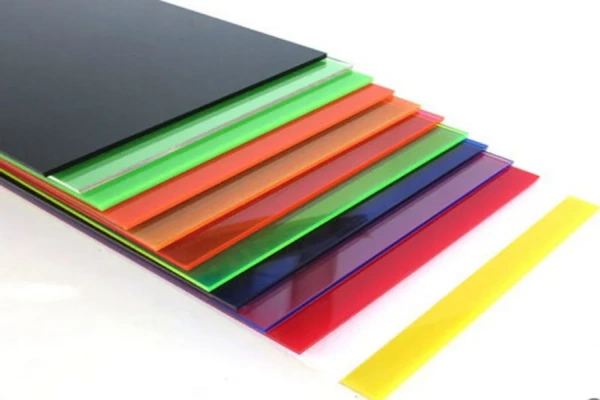
- Colored, frosted, specialty acrylics: Acrylic comes in a lot of different forms, like colored acrylic, frosted acrylic, and special types like anti-glare, UV-stabilized, or scratch-resistant coating. These differences make it possible to use them in a wider range of fields, from aesthetics to engineering.
- Tradeoffs: The choice of material requires a balance between cost and performance.
Acrylic vs. Other Transparent Plastics
Unlike other transparent plastics such as polycarbonate and PETG, acrylic has its own distinct properties.
- Susceptibility to cracking/chipping: Acrylic is brittle and prone to cracking when subjected to strong impacts, while polycarbonate stands out with many times the impact resistance. PETG is a middle ground: more flexible than acrylic, more durable, but not as transparent.
- Thermal/ impact performance: In terms of transparency, acrylic excels with light transmission that is almost as good as glass, while polycarbonate and PETG are often slightly inferior. In terms of heat resistance, polycarbonate is more stable, while acrylic is limited to 80-100°C. Acrylic surfaces are also harder and less susceptible to scratches, helping to maintain a long-lasting, shiny appearance.
- Cost and machinability differences: Acrylic is cheaper than polycarbonate but more expensive than PETG. Acrylic’s biggest strength is that it is easy to process: cut, drill, CNC, and polish almost like glass, while polycarbonate is difficult to achieve the same optical finish.
CNC Machining of Acrylic: Design Considerations & Techniques
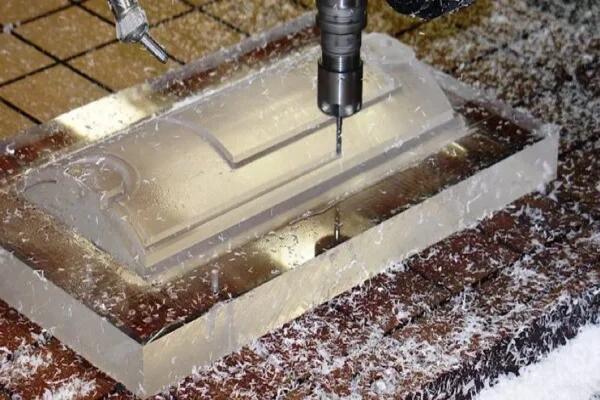
CNC machining of acrylic requires careful attention to both design and process. The following sections outline common issues, practical tips, and finishing methods to achieve the best results
Avoid Common Issues
- Melting/thermal deformation: When machining acrylic, there are some mistakes that can happen. When the cutting speed is too high, the material may melt and deform.
- Chipping, cracking, stress fractures: Because acrylic is brittle, the part can chip, crack, or develop internal stress cracks.
- Surface scratching: If you don’t protect the surface well during and after machining, it is very easy to scratch.
- Delamination, internal stresses: Sometimes, delamination or internal stress can happen, which can make the product less durable.
Acrylic CNC Machining Tips and Precautions
- Minimum wall thickness, minimum feature size: The design must follow some rules in order to get good results. To avoid cracking, you should figure out the right minimum wall thickness and part dimensions. Too thin walls can lead to deformation during machining or handling, and features that are too small may be difficult to cut accurately or may chip easily.
- Corner radii, fillets: To reduce stress concentration, internal corners should be rounded with a radius or fillet instead of being left sharp.
- Avoiding sharp interior corners: Internal corners should not be left sharp to prevent stress buildup and cracking.
- Tolerance expectations: It is usually best to have tolerances of ±0.1 mm.
Post-Machining Finishing & Treatments
- Polishing: After being produced, acrylic needs a surface treatment to restore clarity and appearance. The most common technique of polishing is mechanical polishing, to eliminate small scratches and restore smoothness to the surface.
- Vapor polishing: Used to restore optical clarity. This process melts a very thin layer of the surface and forms a near-glass surface while maintaining the depth of edges and details.
- Edge finishing and smoothing: Smooth edge finishing is common practice for enhancing appearance and contributing to safety.
- Protective masking/film preservation: You should leave the protective film on the surface until the finish is dry.
- Application of coatings: You can apply an anti-scratch or UV coating that provides a longer life for the product.
Applications & Use Cases
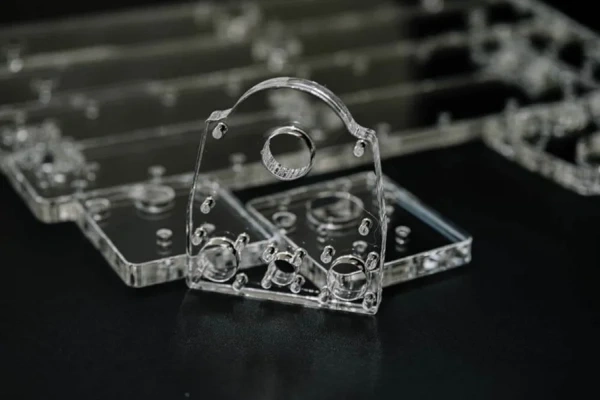
CNC machining of acrylic is currently applied in many different industries.
Engineering & Acrylic Components
Acrylic is, or has been, widely used to help produce engineering or technical components. These components require certain properties like toughness, strength, and direct precision. Acrylic is a dependable material that retains these properties for a variety of industrial objectives.
Signage, Point-Of-Sale/The Retail Environment
Acrylic is also deployed in signage applications, promotional and point-of-sale displays and decor. Its clarity and smooth surface enhance the viewing experience on products and grab consumers’ attention.
Medical and Laboratory Applications
In the medical and laboratory environment, acrylic is used to create clear, see-through devices. The safety and easy-to-clean properties of acrylic are benefits that make the application suitable.
Architectural/Acrylic Panels, Skylights, Partitions
In architecture, acrylic is used for panels, skylights, and partitions. Acrylic panels are much more durable than glass and provide the architectural aesthetic needed. Acrylic also weighs less than glass, making it easier to install and better suited for consideration in modernized building types.
Consumer Electronics
Acrylic is frequently used in consumer electronics for screens, device housings, and transparent accessories. Its clarity and smooth finish give devices a sleek and elegant look.
Prototype/Short-Run Manufacturing
CNC acrylic is ideal for prototyping and short-run manufacturing. It allows businesses to quickly manufacture an assembly or part, evaluate design, make changes based on findings, and take parts to full manufacturing. This flexibility allows for cost reduction and accelerates product development.
Advantages, Limitations & Cost Considerations
CNC machining of acrylic has clear benefits, challenges, and cost factors to consider.
Advantages of Acrylic CNC Machining
- High precision, repeatability: CNC machining of acrylic offers high precision and the ability to create many identical products, helping the details always meet the correct technical specifications according to the design.
- Low waste (subtractive but controlled): The machining process removes excess material layer by layer, creating sharp details, minimizing errors, and reducing waste.
- Fast turnaround for small to medium batches: CNC is suitable for single-piece and prototype production, as well as small- to medium-batch production, thanks to its fast speed and high stability.
- Excellent optical and aesthetic results: When machined properly, acrylic can achieve near-glass transparency and gloss, meeting both aesthetic and optical requirements.
Limitations & Challenges
- Thermal sensitivity/risk of melting: Acrylic has a relatively low tolerance to heat – it will quickly melt and/or deform if the cutting speed or cutting force is too high.
- Brittleness (cracking): The brittle nature of acrylic makes it prone to cracking or chipping if handled incorrectly. This tendency to break is particularly evident at thin parts or sharp angles.
- Cost compared to simple cutting or molding large volumes: CNC machining costs tend to be higher than laser cutting or molding for large volumes, due to longer machining times and post-processing steps.
- Tool wear, fixturing complexity: Tools or knives when cutting acrylic are prone to wear out quickly during machining, which can contribute to higher maintenance costs. Fixing part pieces before and during machining can also take experienced technicians.
Cost Drivers & Pricing Factors
- Cost of materials & wasted materials: If high-quality, clear acrylic or acrylic with special properties of UV protection and scratch resistance is used, this is also usually a more expensive material. If the designed product results in a large quantity of waste that needs to be machined away, the cost of the materials for the overall product will increase.
- Machine time (set-up, multi-axis cutting): Set-up, programming a cutting path, and multi-axis cutting operations will all directly influence the overall cost of the finished product. The more complex a product is, the more time it will take to machine the part, resulting in more costs.
- Finishing/post-processing: The cost of the overall project will also be driven by the finishing steps that occur after the machining process has taken place. Polishing, surface treatments, edge radii, or coatings will all consume extra time and labor.
- Product complexity, tolerances and number of setups: In addition to the above items, part complexity, tolerancing, and the use of multiple fixtures will all affect the cost of production. Products that have complex shapes, require tight tolerances, or use multiple fixtures, will consume more resources to machine.
CNC Acrylic Services: What Clients Should Ask / Expect
When choosing a CNC acrylic service provider, clients should look beyond price and delivery time. It’s important to ask the right questions about precision, materials, finishing, and quality to ensure the final product meets requirements.
What precision/tolerances are possible
When hiring a CNC acrylic provider, clients should have clarity on the tolerances and precision that can be achieved. With modern CNC machines, tolerances can often be as low as ±0.1 mm or tighter for smaller parts. Knowing this tolerance allows for a true evaluation of whether or not the company is suitable for the customer’s product needs.
Sample/prototyping services
Another component to consider is whether a sample or prototype can be produced before a larger production. Requesting a sample allows customers to check the quality, transparency, surface finish, and accuracy before they order more. Rapid prototyping services can also create cost savings, limit errors, and shorten time to market.
Material options offered
Not every project requires the same acrylic. It is important to ask your suppliers which material options they offer: cast acrylic, extruded acrylic, UV-resistant acrylic, scratch-resistant acrylic, or colored acrylic. Depending on the materials used, the final product can ensure technical efficiency and aesthetic efficiency.
Surface finish capabilities
Surface quality is key with acrylic products. Therefore, it is necessary to clearly discuss finishing options such as mechanical polishing, vapor polishing, smooth edge treatment, or scratch-resistant coating. These techniques directly determine the transparency, gloss, and aesthetics of the finished part.
Lead times & pricing structure
Delivery time and pricing structure are two factors that influence the customer’s decision. Some suppliers may commit to fast lead times for small orders, but will take longer for large production.
Regarding costs, it is necessary to clarify how they are calculated: by machine hours, by complexity, or by the volume of materials used. Transparency in quotations helps customers control their budget more effectively.
Quality assurance, inspection & certification
Customers need to be aware of the processing unit’s quality control process. This includes checking dimensions, tolerances, surfaces, as well as certificates related to materials or manufacturing processes.
For the medical, electronics, or architectural industries, quality certification and independent testing are important proof to ensure products meet the required standards.
Conclusion
CNC acrylic machining offers the perfect combination of precision, aesthetics, and a wide range of applications. From industrial and medical to architectural and retail, this material has always proven its outstanding value. If you are looking for high-quality CNC acrylic solutions, contact HRCCNC to turn your ideas into reality.