Skip to content

Only a few materials can outmatch the usability of steel in modern manufacturing. And the density of steel remains a key property in turning steel into a universally adopted, favored, and used material.
Steel density directly impacts shipping costs, structural integrity, and even compliance with standards. Yet, many B2B clients still fall into the trap of assuming CNC steel has a single and fixed density.
Actually, there are different grades of steel, and they possess distinctive values regarding density. Let’s break down why steel density matters, how it varies across grades, and what goes into applications.
What is the Density of Steel?
Steel’s density ranges between 7.75 – 8.05 g/cm³ (7,750 – 8,050 kg/m³). However, the most commonly implemented value (as an average) is 7.85 g/cm³ (7,850 kg/m³).
Density is defined as mass per unit volume, expressed as (ρ = m / V). It means how much steel mass is contained in a given volume (chunk) of the material (steel).
Importance of Steel Density in B2B
- Procurement: Buyers must know the density to calculate material weight per order without under- or over-purchasing.
- Costing: Density of hard metals directly impacts transportation costs; heavier steel means higher freight charges.
- Design and Compliance: Precision CNC machining relies on density values to meet ISO and ASTM for safety and reliability.
- Sustainability: Accurate density calculations optimize custom steel parts with less waste and carbon footprint.
Density Conversion: Different Types of Steel
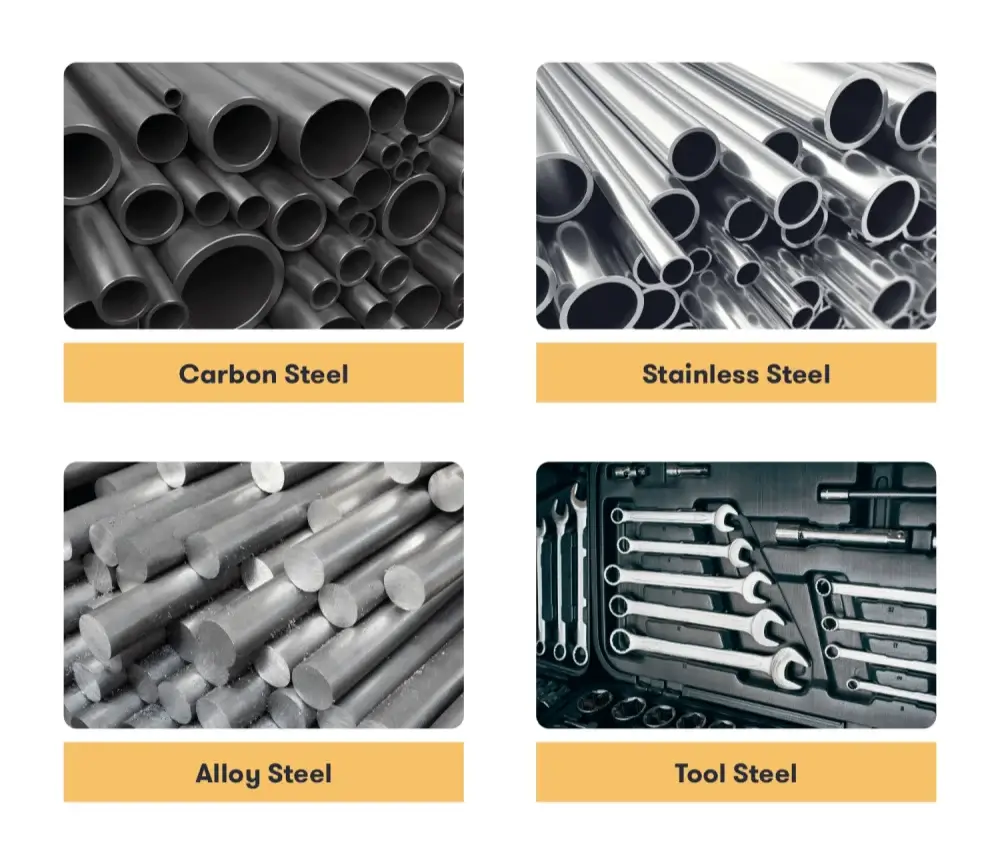
The exact density value of steel differs across grades such as carbon, alloy, stainless, and tool steels. You also need to know the density across different units (kg/m³, lb/in³, or lb/ft³) to avoid errors.
Density Conversion Table for Steel Types
*1 g/cm³ = 1,000 kg/m³ = 0.0361 lb/in³ = 62.43 lb/ft³
Key Factors Influencing Steel’s Density
As we’ve noted, steel’s density isn’t a fixed value. The changes or differences come from factors like alloy composition, manufacturing processes, impurities, and microstructural arrangements.
1. Alloy Composition
Higher carbon increases hardness with minimal effect on density. Nickel (Ni) and Chromium (Cr) can increase the value slightly. The presence of aluminum (Al) and silicon (Si) can reduce density.
2. Manufacturing Process
Cold working compacts the grain structure, marginally increasing the density. Also, forged steels with fewer voids (more common) result in a slightly higher density.
3. Impurities and Defects
Trapped gases during die casting slightly reduce steel density. Non-metallic particles (like oxides or sulfides) can alter local density.
4. Microstructure
Ferrite (body-centered cubic) steel exhibits a slightly lower density. Conversely, austenite (face-centered cubic) steel is denser.
5. Temperature and Pressure
Density decreases slightly at elevated temperatures due to thermal expansion. CNC manufacturers must account for density changes at high operating temps for pipelines.
Methods of Measuring Steel Density
Simple geometric calculation is good enough for observation or learning. Custom metal manufacturing relies on advanced laboratory techniques, each to serve different contexts. Accurate measurement of steel density is mandatory to conduct global trade with trust.
a. Direct Calculation (Mass ÷ Volume)
Weigh the steel sample using a precision balance. Measure the dimensions (length, width, height, diameter) for regular shapes. Calculate the geometric volume. Divide mass by volume to obtain density.
Example: A steel cube weighing 785 g with a volume of 100 cm³ has a density of 7.85 g/cm³. You can go for this easy method in construction and manufacturing, where steel parts are geometrically simple.
b. Archimedes’ Principle (Water Displacement)
Weigh the steel sample in air. Submerge it in water and measure the displaced volume. Divide mass by displaced volume.
Example: A steel rod displacing 50 cm³ of water and weighing 392.5 g has a density of 7.85 g/cm³. It’s good for irregular shapes like castings or scrap steel.
c. Pycnometer Method (Laboratory Precision)
A calibrated flask gets filled with liquid to measure the displaced volume with high accuracy. High-precision industries such as aerospace and defense rely on this method.
Example: Pycnometers in aerospace labs confirm the density of specialty steels for compliance with ASTM.
d. X-Ray and Ultrasonic Techniques
Advanced non-destructive testing estimates the density by analyzing atomic structure or sound wave propagation.
Example: Ultrasonic density checks in European automotive sectors ensure uniformity in alloy steels for safety-critical parts.

Metal/Material Density Comparison: Steel vs Others
| Element | Density (g/cm³) | Density (lb/ft³) | Notes/Applications |
| Steel (Carbon) | 7.85 | 490 | Construction, automotive, pipelines |
| Stainless Steel | 7.90 | 493 | Corrosion-resistant medical tools |
| Iron (Fe, base element of steel) | 7.87 | 491 | Steel’s primary component |
| Aluminum (Al) | 2.70 | 169 | Lightweight, aerospace, packaging |
| Titanium (Ti) | 4.50 | 281 | Strong but lighter than steel, aerospace |
| Copper (Cu) | 8.96 | 559 | Electrical wiring, electronics |
| Lead (Pb) | 11.34 | 708 | Batteries, radiation shielding |
| Gold (Au) | 19.32 | 1206 | Jewelry, electronics, raw investment |
| Tungsten (W) | 19.25 | 1206 | High-density, defense, and aerospace |
| Lithium (Li) | 0.53 | 33 | Lightest metal, batteries |
What are the Real-World Applications of Steel Density?
● Load-Bearing Calculations
Density determines how much weight steel beams, columns, and reinforcements can support. A 1 m³ block of carbon steel weighs 7.85 tons. Engineers use it to calculate foundation loads in skyscrapers.
● Automotive Industry
Automakers balance density with steel strength to reduce vehicle mass. It improves the fuel efficiency and meets emission standards. BMW uses aluminum (2.70 g/cm³) alongside steel to cut vehicle weight.
● Aerospace
Steel’s density makes it unsuitable for airframes compared to titanium or aluminum. However, it’s still ideal for engine components requiring durability. Steel alloys are used in landing gear assemblies.
● Marine Engineering
Steel density ensures ships remain balanced and structurally sound. Shipyards calculate steel density to optimize hull thickness. Proper thickness enables compliance with IMO safety standards.
● Renewable Energy
High-density steels (precision-CNC machined) in towers withstand severe wind loads. Offshore wind farms rely on steel to ensure structural stability against harsh marine conditions.
● Logistics and Trade
Steel density determines the shipping weight, directly influencing costs. A steel coil weighing 25 tons must be calculated precisely to avoid overloading cargo ships.

Conclusion
Steel’s density isn’t some random scientific figure, as it’s a decisive factor in metal manufacturing. And the exact value for density varies across different steel grades. Carbon steel holds the highest value, while tool steels and alloy steels feature distinctive values due to several influencing factors.
Harnessing steel density properly can help manufacturers and clients anticipate costs, ensure compliance, and optimize resources. Grasp the nuances of steel density to gain a strategic edge.
Precision Machined CNC Steel Parts for Any Projects at HRC
HRC specializes in CNC metal manufacturing by balancing material properties and project specs. We provide a wide range of custom steel parts in compliance with global standards. Our 17+ years of experience in the business guarantee satisfaction with every part. Contact us to know further details.