Skip to content

Modern manufacturing depends on CNC machining to produce high-precision components efficiently and consistently across a wide range of industries. Computer-controlled systems guide cutting tools to remove material from raw workpieces with high accuracy. Automated tool movement along multiple axes enables CNC machines to create complex parts from metals, plastics, and composite materials with repeatable results.
CNC machining follows a workflow that begins with creating a CAD design and converting it into CNC-readable code through CAM software. The machine is then set up with the required tools, materials, and coordinate settings before machining begins. Components such as spindles, chucks, ball screws, and turrets work with linear and rotational axes to control tool movement, while G-codes and M-codes direct toolpaths and machine functions.
A wide range of CNC machine types, including milling, lathes, drilling, grinding, and EDM, enables the production of parts such as engine components, housings, brackets, and structural fittings. These machines process materials such as aluminum, steel, titanium, plastics, and composites with high precision. From 2-axis and 3-axis to advanced 5-axis systems, CNC machines produce complex geometries while maintaining consistent quality in industries such as aerospace, automotive, medical devices, and consumer electronics.
What is CNC Machining?
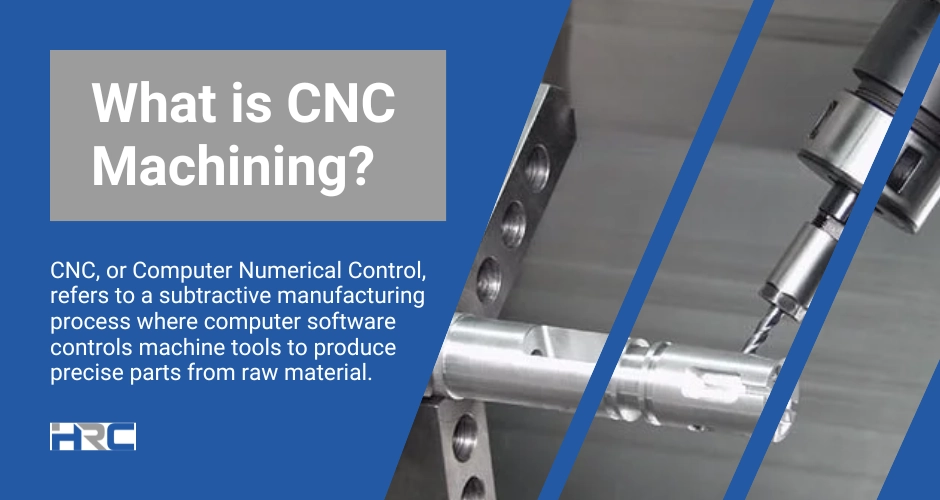
CNC, or Computer Numerical Control, refers to a subtractive manufacturing process where computer software controls machine tools to produce precise parts from raw material. In this controlled manufacturing process, a CNC machine executes a computer program that directs the spindle, cutting tools, and axis movement to cut, drill, mill, or turn a workpiece. CAD design specifications convert into numerical instructions, commonly G-code, through computer-aided design (CAD) and computer-aided manufacturing (CAM) software. These pre-programmed instructions control axis movement, tool speed, feed rate, and cutting depth with computer-controlled precision.
Manufacturers use CNC machining to produce metal and plastic components that require tight tolerances, repeatable quality, and reliable surface finish. The machining process removes material from a workpiece to shape parts with high accuracy and consistent dimensional control, producing strong, high-performance components with superior surface accuracy and impact resistance. CNC machining also supports material versatility, allowing manufacturers to process metals and engineering plastics using machines such as milling machines, lathes, routers, and grinding machines.
How Does a CNC Machine Work?
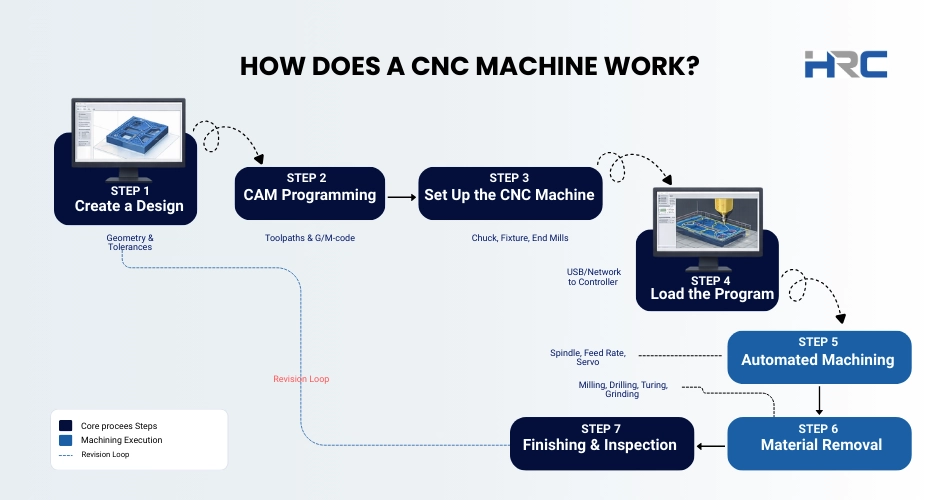
A CNC machine works through a sequence of steps that include creating a CAD design, converting the design into machine code, setting up the machine, running automated machining, and inspecting the finished component. The CNC machine controller executes programmed instructions that guide the cutting tool along the machine axis (X, Y, Z) to remove material from the workpiece and produce a precise part.
- Create a Design (CAD Model)
The CNC machining process begins with a digital part design created using CAD software. Engineers or machinists design the component by defining the geometry, dimensions, and tolerance requirements of the final part. The CAD model serves as the primary reference for the machining process, as it defines the exact shape and structure that the CNC machine must produce. This digital design file provides the foundation for generating the machining instructions used by the CNC system.
- Convert the Design to CNC Code (CAM Programming)
After the CAD model is created, the CAD design must be translated into machine-readable instructions using CAM software so the CNC machine can understand how to manufacture the part and determine the required cutting operations. The CAM system analyzes the part geometry and generates precise toolpaths that define how the cutting tool moves across the workpiece. The software then converts these toolpaths into G-code and M-code, which control spindle rotation, feed rate, axis positioning, and other machine functions during CNC machining.
- Set Up the CNC Machine
Once the CNC program is ready, the operator sets up the machine by installing the required cutting tools, tool holders, and workholding devices such as a chuck or fixture. The raw material is secured on the machine table or in the spindle. Tools are chosen based on the material and features being machined, such as carbide end mills for aluminum and steel, indexable inserts for turning, and precision drills or reamers for holes. Fixtures, soft jaws, and calibrated setups help maintain rigidity and support accurate, repeatable machining.
- Load the Program into the Machine
After the machine setup is complete, the CNC program file containing G-code and M-code instructions is loaded into the machine controller via an input device such as a USB drive, a network connection, or a machine interface. The machine control unit (MCU) reads the program and prepares the system to execute the machining operations. This step allows the controller to interpret the programmed instructions that govern spindle motion, axis positioning, and cutting-tool actions during machining.
- Automated Machining Begins
Once the program is loaded, verified, and the machine is referenced to its coordinate system, the CNC machine begins automated machining. The machine control unit reads the G-code and controls spindle speed, feed rate, and axis movements defined in the toolpaths. Servo motors move the X, Y, and Z axes with high precision while feedback systems maintain accurate tool positioning. The rotating spindle drives the cutting tool to perform milling, drilling, or turning operations, removing material in controlled passes.
- Material Removal (Subtractive Manufacturing)
During machining, the cutting tool removes material from the workpiece to form the final component geometry. This method is known as subtractive manufacturing because the CNC machine progressively removes material from a solid workpiece through operations such as milling, drilling, turning, or grinding. As the tool follows programmed toolpaths, it cuts the material in controlled passes, shaping features such as pockets, slots, contours, and holes. The controller regulates spindle speed, feed rate, and depth of cut to maintain stable cutting conditions, minimize tool wear, and achieve the required dimensional accuracy and surface finish.
- Finishing and Inspection
After machining is completed, the component undergoes finishing and inspection to verify dimensional accuracy and overall quality. The operator measures critical features using inspection tools such as calipers, micrometers, height gauges, or coordinate measuring machines to ensure the part meets specified tolerances and design requirements. Any remaining sharp edges or burrs created during machining are removed through deburring or light surface finishing. Once the part passes inspection, it is approved for the next stage of manufacturing, assembly, or final use.
What Are the Main Components of a CNC Machine?
The primary components of a CNC machine include the machine control unit (MCU), input device, drive system, machine tool system (spindle and tooling), feedback system, and the machine bed or structural frame. These components work together to execute the computer program, control tool movement across machine axes, and maintain precision during the CNC machining process.
The 15 main components of a CNC machine are:
Machine Control Unit (MCU)
The machine control unit (MCU) is the central controller that reads the CNC program and converts G-code and M-code instructions into commands for axis motion, spindle speed, and feed rate. It includes the signal processing unit (SPU), which interprets the program, and the control loop unit (CLU), which sends signals to the drive system and adjusts movement using encoder feedback to maintain precise machining.
Input Device
The input device allows the operator to load the CNC part program (G-code) into the machine control unit, enabling the machining process to begin. It transfers the program from a computer to the MCU via interfaces such as USB, Ethernet, manual data-input panels, or, historically, tape readers, enabling the controller to coordinate the spindle, drive system, and machine axes.
Driving System (Motors/Drives)
The driving system uses servo or stepper motors, amplifiers, and drive controllers to convert electrical signals from the machine control unit into precise mechanical motion. These motors rotate ball screws or lead screws to move the machine bed along the X and Y axes and position the tool along the Z axis. At the same time, encoder feedback maintains accurate speed, feed rate, and tool positioning during machining.
Machine Tool (Spindle/Tooling)
The machine tool assembly, including the spindle and cutting tools, performs the material cutting and shaping during CNC machining. The spindle rotates tools such as end mills, drills, or turning cutters stored in the tool library, while the MCU and drive system control their speed, feed, and movement to shape or cut the workpiece during machining operations precisely.
Feedback System
The feedback system continuously monitors the position and movement of machine components and provides real-time data to the machine control unit to maintain machining accuracy. Devices such as encoders and sensors measure axis position, spindle rotation, and tool movement, allowing the MCU to adjust motor commands in the drive system to maintain correct positioning and prevent errors during CNC machining.
Machine Bed/Frame
The machine bed or frame forms the structural foundation and workspace of the CNC machine, supporting components such as the spindle, axis system, and ball screws. It holds the raw material and includes holes or T-slots for fixtures that secure the workpiece, while allowing controlled movement along the X, Y, and Z axes to position the material accurately under the cutting tool.
Display Unit
The display unit provides a visual interface for the operator to monitor and control CNC machine operations via the machine controller. It displays information such as the loaded CNC program, axis positions, spindle speed, feed rate, and machine status, enabling the operator to interact with the machine control unit and verify machining operations during production.
Cooling System
The cooling system delivers coolant to the cutting zone where the tool contacts the workpiece to control temperature during CNC machining. Coolant, usually sprayed as a liquid onto the cutting area, dissipates heat, lubricates the cutting process, and flushes away chips. This prevents overheating, protects the cutting tool and spindle, and supports stable machining and longer tool life.
Headstock
The headstock is a heavy-duty component that houses the main spindle and drive mechanism, which rotate the cutting tool or workpiece during CNC machining. Located on the left side of a CNC lathe, it receives power from the drive system and transfers rotational motion to the spindle and chuck, influencing machine accuracy, swing capacity, and torque during operation.
Tailstock
The tailstock is a supporting component positioned opposite the headstock, stabilizing long or cylindrical workpieces during CNC turning operations. It is usually hydraulically operated and includes a sliding base, a quill with a live or dead center, and clamping mechanisms that align the workpiece with the spindle and chuck, reducing deflection and vibration when machining parts such as shafts or screws.
Chuck
The chuck is a workholding device mounted on the spindle that grips and secures the workpiece during CNC machining, especially in lathe operations. Common types include three-jaw chucks for general self-centering work, four-jaw chucks for irregular shapes or independent adjustment, collet chucks for high precision, and magnetic chucks for ferromagnetic materials, keeping the workpiece aligned with the spindle and cutting tool during machining.
Ball Screw
The ball screw is a mechanical linear actuator that converts the rotational motion of a servo motor into the linear movement of a CNC machine axis. It consists of a screw shaft with a helical groove, a ball nut, ball bearings, and seals, allowing the table or cutting tool to move along the X, Y, or Z axis with high positioning accuracy.
Turret
The turret is a rotating tool-holding unit used in CNC lathe machines that stores multiple cutting tools and positions the required tool for each machining operation. It acts as a tool-changing device that automatically indexes under commands from the machine control unit, allowing rapid switching between tools such as turning cutters, drills, and boring tools without manual replacement.
Encoder
The encoder is a sensing device that converts the motion of machine components, such as spindle or axis motors, into electrical signals that the control system can read. Linear, rotary, and angle encoders provide real-time position feedback to the machine control unit, allowing the system to verify axis movement and adjust the drive system to maintain accurate positioning during machining.
Pallet
The pallet is a removable workpiece holder or standardized fixture platform that supports and positions the workpiece during CNC machining. It allows quick loading and unloading of parts outside the machining area and enables rapid, precise workpiece swapping via manual methods, automated pallet changers (APC), or robotic systems, reducing downtime and increasing productivity.
What Are the Types of CNC Machines?
The major types of CNC machines include CNC milling machines, CNC lathes (turning machines), CNC routers, CNC grinding machines, and more, each designed for specific machining operations and materials. These machines use computer numerical control to guide cutting tools along programmed axes, enabling the production of precision parts across many manufacturing industries.
CNC Milling Machines
A CNC milling machine is a computer-controlled machine tool that removes material from a solid workpiece using rotating multi-point cutting tools to produce precision parts. Using CAM-generated toolpaths, the machine moves the tool along 3-, 4-, or 5-axis configurations to machine metals such as aluminum and stainless steel, and plastics like PVC and HDPE, enabling accurate and repeatable production through CNC milling.
CNC Lathes (Turning Machines)
A CNC lathe, or CNC turning machine, is a computer-controlled machine tool where the workpiece rotates while a cutting tool removes material to produce cylindrical or rotational parts. During CNC turning, the workpiece is held in a chuck and rotated about a horizontal or vertical axis while the machine executes programmed instructions to perform operations such as facing, threading, drilling, and boring, producing components like shafts, bushings, and fasteners with precise dimensional control.
CNC Routers
A CNC router is a computer-controlled cutting machine that removes material with rotating tools to create shapes, slots, and surface profiles. It interprets CAD files and programmed toolpaths to machine materials such as wood, plastics, foam, and soft metals for 2D, 2.5D, and 3D carving, with machine types ranging from desktop and benchtop models to industrial systems for consistent production quality, reduced labor time, and versatile material handling.
CNC Drilling Machines
A CNC drilling machine is a computer-controlled machine tool that uses a rotating drill bit to create cylindrical holes in a stationary workpiece with precise positioning and depth control. CAD and CAM instructions define hole location, diameter, feed rate, and drilling depth, enabling CNC drilling to produce accurate hole patterns and consistent placement in industrial components.
CNC Grinding Machines
A CNC grinding machine is a computer-controlled machining system that uses a rotating grinding wheel to remove small amounts of material, achieving high dimensional accuracy and fine surface finishes. The machine controls wheel position, feed movement, and contact with the workpiece through programmed instructions, enabling precise finishing of components such as camshafts, crankshafts, and cutting tools through CNC grinding.
CNC Plasma Cutting Machines
A CNC plasma cutting machine is a computer-controlled system that uses a high-temperature plasma arc generated by ionized gas, such as shop air, nitrogen, or oxygen, to cut electrically conductive metals like steel, aluminum, and stainless steel. The CNC controller guides the plasma torch along programmed paths to produce accurate profiles and shapes at high cutting speeds, while nesting techniques help reduce material waste during CNC plasma cutting.
CNC Laser Cutting Machines
A CNC laser cutting machine is a computer-controlled system that uses a focused laser beam to melt or vaporize material along programmed cutting paths. Mirrors or fiber optics direct the beam to a nozzle that focuses it onto the workpiece, enabling precise and high-speed cutting. Common types include CO₂ and fiber lasers, which are widely used to produce complex shapes in sheet metal and industrial parts.
CNC Electrical Discharge Machines (EDM)
CNC Electrical Discharge Machine (EDM) is a computer-controlled machining system that removes material by electrical discharges between an electrode and a conductive workpiece submerged in a dielectric fluid. CNC EDM uses spark erosion to shape hardened metals without physical cutting forces, enabling precise machining of complex geometries and fine features. Common types include Wire EDM and Sinker EDM, widely used for tooling, aerospace parts, and medical components that require tight tolerances.
CNC Press Brake Machines
A CNC press brake machine is a computer-controlled metalworking tool that bends sheet metal with high accuracy and repeatability. It includes a main frame, ram, worktable, back gauge for positioning, and a computerized controller powered by a hydraulic or electrical system. This setup enables the production of precise components, such as cabinets, panels, and structural parts, for the automotive, aerospace, and electrical industries.
CNC Wire Cut Machines
A CNC wire-cut machine is a computer-controlled EDM system that uses a thin, electrically charged wire to cut conductive materials with high precision. The CNC system guides the wire along programmed paths to create intricate, burr-free shapes, even in very hard materials. Ideal for low-tolerance components like surgical tools, implants, molds, punches, and dies, it delivers accurate, clean-edged parts for tooling, aerospace, and electronics applications, often reducing the need for secondary finishing.
CNC Swiss Machines
A CNC Swiss machine is a high-precision turning system for small, complex cylindrical parts. With a sliding headstock and multi-tool setup, it performs turning, milling, drilling, and threading in one step. It produces thin-walled, intricate components with minimal manual work, ideal for medical implants, watch parts, electronic connectors, and miniature shafts, delivering high accuracy, burr-free finishes, and efficient machining of delicate or slender metal parts.
Mill-Turn Systems
A Mill-Turn system is a hybrid CNC machine that combines milling and turning operations in a single setup, enabling the complete machining of complex parts without moving them between different machines. With multiple spindles, sub-spindles, and synchronized tools, these systems allow continuous, unattended operation, reducing cycle times, minimizing errors, and improving accuracy while producing intricate components in fewer operations for high-volume production.
CNC Woodworking Machines
A CNC woodworking machine is a computer-controlled tool that automates tasks like milling, drilling, and intricate carving for furniture, cabinetry, and artistic projects. By following programmed CAD/CAM instructions, these machines produce cabinetry, architectural details, complex 3D shapes, and personalized items with extreme precision, high repeatability, reduced waste, and increased efficiency compared with manual woodworking methods, making them ideal for high-precision, decorative, and functional wood components.
Multi-Axis CNC Machines
A multi-axis CNC machine is a computer-controlled system capable of moving a cutting tool or workpiece along three or more axes simultaneously, including linear axes (X, Y, Z) and rotational axes (A, B, C). Common configurations include 2-, 3-, 4-, and 5-axis. This enables the production of intricate parts such as turbine blades, impellers, and medical implants with fewer setups, reducing vibration and ensuring high precision across the aerospace, automotive, medical, and mold-making industries.
What Materials Can Be Used in CNC Machining?
CNC machining can process metals such as aluminum alloys, stainless steel, titanium, brass, and magnesium, as well as engineering plastics like ABS, POM, polycarbonate (PC), nylon, PEEK, and PMMA. Each material is selected based on the component’s required strength, thermal properties, and machinability. Metals support the production of durable, high-precision parts, while plastics provide lightweight, corrosion-resistant components suitable for prototyping, industrial systems, and consumer products.
Metal Materials
CNC machining commonly processes metals such as aluminum alloys, stainless steel, steel, titanium alloys, brass, and magnesium due to their strength and durability. These materials support the production of high-precision components used in industries such as aerospace, automotive, medical devices, and industrial manufacturing.
Aluminum Alloy
Aluminum alloy is a lightweight metal with approximately 1/3 the density of steel, offering excellent machinability, corrosion resistance, and thermal conductivity. It is widely used in CNC machining for aerospace components, automotive parts, and consumer electronics such as laptop frames, where reduced weight, high-performance heat dissipation, and precision machining are critical.
Stainless Steel
Known for its durability and corrosion resistance, stainless steel is widely used in CNC machining for parts that require long-term strength and reliability. Grades such as 304 and 316 are suitable for medical devices, food-processing equipment, marine components, and other applications that require structural stability, corrosion resistance, and precise machining tolerances.
Steel
Valued for its strength and durability, steel is widely used in CNC machining for parts that require structural reliability and wear resistance. Alloy grades such as 1018 and 4140 are commonly machined into industrial machinery components, tooling, gears, and automotive structural parts, providing cost-effective performance and consistent mechanical properties under load-bearing conditions.
Titanium Alloy
Titanium alloy is a high-strength, lightweight metal used in CNC machining for demanding applications that require biocompatibility, corrosion resistance, and heat tolerance. Grade 5 (Ti-6Al-4V) is the most commonly machined titanium alloy, used in medical implants, aerospace components, and high-temperature parts, where precise CNC control is essential due to the material’s hardness and heat sensitivity during cutting.
Brass
Widely valued for its excellent machinability and corrosion resistance, brass is a metal alloy well-suited for CNC machining. Common grades such as C360 are used to produce connectors, terminals, valves, fittings, and decorative hardware, offering smooth cutting, reduced tool wear, and precise dimensional accuracy in both mechanical and electrical applications.
Magnesium Alloy
Recognized for their exceptional light weight and high strength-to-weight ratio, magnesium alloys are used in CNC machining for applications where weight reduction is important. They are often applied in aerospace, automotive, and electronics components. Due to the flammability risks associated with machining, strict safety controls are required to produce lightweight, precise parts while maintaining structural performance and dimensional accuracy.
Kovar Alloy
Kovar is a nickel–cobalt–iron alloy engineered to match the thermal expansion of materials such as borosilicate glass and ceramics. CNC machining processes Kovar to produce components used in hermetic sealing applications, such as electronic packages, optical devices, and aerospace systems. Its controlled thermal expansion supports dimensional stability and seal integrity under temperature variation.
Plastics Materials
Plastics such as ABS, polycarbonate (PC), POM, nylon, PEEK, and PMMA are widely used in CNC machining for components that require lightweight, corrosion-resistant, and durable properties. They are commonly machined into prototypes, industrial parts, and consumer products, offering good machinability, dimensional stability, and surface finish.
ABS
ABS (Acrylonitrile Butadiene Styrene) is a versatile and affordable thermoplastic with strong impact resistance and excellent machinability. It is widely used in CNC machining for consumer products, electronic enclosures, and functional prototypes, and its ability to accept paint and adhesives makes it ideal for customized housings and production-ready plastic components.
Polycarbonate (PC)
Known for its transparency and high impact strength, polycarbonate (PC) is a durable thermoplastic often used in CNC machining. It offers heat resistance up to 135 °C and is commonly machined into optical parts, safety guards, and medical device housings, providing clarity, structural strength, and reliable performance in demanding environments.
POM
Valued for its rigidity and low friction, POM (Polyoxymethylene), also known as acetal, is well-suited for precision CNC machining. It is commonly used to produce gears, bearings, and mechanical parts such as zip fasteners, offering smooth motion, dimensional stability, and durability in components exposed to repeated use.
Nylon
Nylon is a flexible, wear-resistant thermoplastic with high tensile strength and durability, making it suitable for CNC machining of components that experience friction or load. It is commonly used to produce bushings, washers, gears, and automotive connectors, offering resistance to oils and fuels while maintaining dimensional stability and reliable performance in demanding industrial and automotive applications.
PEEK
Engineered for demanding environments, PEEK (Polyether Ether Ketone) is a high-performance thermoplastic with heat resistance up to 260 °C, strong chemical resistance, and biocompatibility. CNC machining of PEEK is widely used for aerospace components, medical implants such as spinal devices, and industrial parts that require precise, durable, and chemically stable performance in harsh operating conditions.
PMMA (Acrylic)
PMMA (Polymethyl Methacrylate), or Acrylic, is a transparent thermoplastic offering optical clarity up to 92% light transmission, UV resistance, and dimensional stability. It is ideal for producing light covers, display panels, signage, lenses, and protective screens, providing a glass-like appearance with improved impact resistance, lower weight, and consistent surface finish for visual and functional applications.
What Are the Different CNC Machine Axis Configurations?
CNC machines are classified into 2-axis, 3-axis, 4-axis, 5-axis, and multi-axis systems based on the number of axes they can move along. These systems use linear axes (X, Y, Z) and rotary axes (A, B, C), where each added axis increases flexibility for complex geometries, multi-face machining, and fewer setups while improving accuracy and efficiency in industries such as aerospace, automotive, and medical manufacturing.
2-Axis CNC
A 2-axis CNC machine typically operates along the X and Z axes and is most commonly associated with CNC lathes, where the workpiece rotates while the cutting tool moves linearly. This configuration supports turning operations such as facing, straight turning, and basic contouring of cylindrical parts like shafts and rods, providing high precision and repeatability for rotational components.
3-Axis CNC
A 3-axis CNC machine is a standard machining setup for producing parts with complex surfaces and precise dimensions. It moves along three linear axes, X, Y, and Z, enabling precise machining of 2D and 3D geometries, including housings, brackets, and other mechanical components commonly used in manufacturing.
4-Axis CNC
A 4-axis CNC machine adds a rotary axis (A or B) to the standard X, Y, and Z axes, allowing the workpiece or tool to rotate for machining on multiple faces or angles. This capability is well-suited for cylindrical parts, shafts, and components that require machining around the workpiece without repeated repositioning.
5-Axis CNC
A 5-axis CNC machine moves along three linear axes (X, Y, Z) and two rotational axes (A, B, or C), allowing complex parts to be machined from multiple angles in a single setup. Common configurations of 5-Axis CNC include Table-Table (Trunnion), Head-Table, and Head-Head (Swivel Head), enabling precise machining of curved surfaces and undercuts for high-precision aerospace, medical, and automotive components.
3+2 or Indexed 5-Axis
A 3+2 or Indexed 5-Axis CNC machine combines three linear axes (X, Y, Z) with two rotational axes that position the workpiece at a fixed angle before machining. The machine indexes the part between operations, allowing several sides of a component to be machined while maintaining stable cutting conditions.
Multi-axis/Mill-Turn
Multi-axis CNC machines, including mill-turn systems, combine milling and turning operations across multiple linear and rotational axes within a single setup. These systems integrate rotating spindles and live tooling to machine complex parts that require both rotational and prismatic features, such as aerospace fittings or medical implants, reducing part handling, improving accuracy, and increasing production efficiency.
Higher-Axis (6, 7+ Axis)
Higher-axis CNC machines, including 6-axis and 7+ axis systems, add extra rotational or linear axes beyond standard 5-axis configurations for highly complex machining operations. Many integrate sensor technology and Industrial Internet of Things (IIoT) systems to achieve high accuracy and minimal repositioning, enabling efficient production of intricate multi-face components.
What Programming Codes Are Used in CNC Machines?
CNC machines use G-codes (Geometric Codes) and M-codes (Machine Codes) to control machining operations. G-codes define tool movement, path, speed, and positioning, while M-codes manage machine functions such as spindle control, coolant flow, and tool changes. These codes convert CAD/CAM designs into precise instructions that guide the CNC machine, ensuring accurate, repeatable machining and consistent component production
G-Codes (Geometric Codes)
G-codes are the primary programming language used in CNC machining, consisting of alphanumeric commands that control tool movement and positioning. Commands such as G00 (rapid positioning), G01 (linear cutting), and G02/G03 (circular interpolation) define how the cutting tool moves along programmed paths. G-codes regulate toolpaths, feed rates, coordinate positioning, and cutting direction while also handling functions such as tool compensation and coordinate system selection, enabling CNC machines to produce precise components with high accuracy and repeatability.
M-Codes (Miscellaneous/Machine Codes)
M-codes are auxiliary commands that control machine operations not directly related to toolpath movement, including spindle start and stop, coolant activation, tool changes, and program control functions. Common examples include M00/M01 for program stops, M30 for program end and reset, and M98/M99 for subprogram execution. M-codes work in coordination with G-codes to ensure synchronized machine actions, and most CNC controllers typically allow one primary M-code per block depending on the control system, supporting clear command execution and stable machining performance.
What Software Is Used for CNC Machines?
CNC machines rely on software such as CAD, CAM, simulation, and machine control programs to design, plan, and execute precise machining operations efficiently. This integrated software ecosystem ensures accuracy, efficiency, and repeatability across a wide range of CNC applications, from aerospace components to custom prototypes.
Key software types used for CNC machines include:
- CAD (Computer-Aided Design):
Used to create detailed 2D or 3D part models with exact dimensions and tolerances. Popular examples like SolidWorks and AutoCAD allow engineers to visualize complex geometries, simulate assembly fits, and define features that will later guide CNC operations.
- CAM (Computer-Aided Manufacturing):
Converts CAD models into precise toolpaths and G-code/M-code instructions for CNC machines. Software such as Mastercam or Fusion 360 calculates optimal cutting strategies, tool selection, spindle speeds, and feed rates to ensure efficient, high-quality material removal.
- Simulation Software:
Verifies machining sequences and toolpaths virtually before production to prevent collisions, errors, or material waste. Examples include Vericut and NCSimul, which help predict outcomes, optimize cutting order, and improve safety in high-precision operations.
- Machine Control Software:
Interfaces directly with the CNC machine controller, managing spindle motion, axis positioning, and real-time monitoring. Systems such as Fanuc, Siemens SINUMERIK, and Haas CNC control software execute programs, track production progress, and provide feedback to operators for immediate adjustments.
What Are the Advantages of CNC Machining?
CNC machining offers high precision, accuracy, repeatability, speed, and the ability to create complex geometries, making it essential for modern manufacturing. The process also supports a wide range of materials and helps reduce waste, enabling efficient, consistent, and cost-effective production.
10 advantages of CNC machining are:
- Precision & Accuracy
By combining computer programming and automated tool control, CNC machining enables manufacturers to produce parts with exceptional precision and tight tolerances. Controlled toolpaths guide cutting tools along exact trajectories, minimizing human error. This leads to higher product quality, reduced scrap, and consistent output across large production runs, meeting strict specifications in industries like aerospace, automotive, and medical devices.
- Repeatability
CNC machining guarantees precise, repeatable parts, ensuring uniform quality across every production run. Computer-controlled automation and pre-programmed toolpaths eliminate variations caused by manual operations. The result is fewer errors, consistent part quality, and scalable production, which is vital for industries like automotive, aerospace, and electronics, where reliable performance and component interchangeability are critical.
- Speed & Efficiency
By automating precise, high-speed cutting operations, CNC machining accelerates production and reduces costs. Automated tool movement, optimized CAM-generated toolpaths, and simultaneous multi-axis control allow machines to run continuously at high feed rates and spindle speeds. The result is faster turnaround for prototypes and production parts, higher throughput, and lower labor costs, helping manufacturers meet tight deadlines and streamline workflow.
- Complex Geometries
To produce intricate and precise components that are difficult or impossible with manual machining, CNC machining uses multi-axis control, precise toolpath programming, and automated spindle movements. This enables cutting tools to reach complex shapes, curves, and undercuts with high accuracy, allowing aerospace, medical, and automotive manufacturers to reduce setups, enhance part functionality, and minimize post-processing requirements.
- Material Versatility
As a process that supports a wide range of materials, CNC machining allows manufacturers to work with metals, plastics, and composites. Programmed toolpaths, controlled spindle speeds, and automated feed rates are adjusted to suit different material properties such as hardness and machinability. This enables flexible production across industries such as aerospace, automotive, and medical while maintaining precise, high-quality parts.
- Reduced Waste
CNC machining reduces material waste by removing only the necessary amount of raw material to achieve the desired part geometry. This benefit is enabled through precise computer-controlled toolpaths, accurate spindle control, and optimized feed rates, which minimize excess cutting and scrap. The practical impact is lower material costs, more sustainable production, and improved manufacturing efficiency, especially important for expensive metals and high-volume production runs.
- Lower Labor Costs
By automating precise cutting, tool movement, and machine control, CNC machining reduces labor costs and limits the need for manual intervention during production. Program-controlled processes and multi-axis machining allow a single operator to supervise multiple machines or complex tasks. This lowers staffing requirements, improves operational efficiency, maintains consistent part quality, and supports scalable production.
- Improved Safety
To improve operator safety during machining operations, CNC machines reduce direct contact with cutting tools and moving parts. Automated toolpaths, enclosed machining areas, and computer-controlled processes limit exposure to sharp or high-speed components. These features support compliance with industrial safety standards while allowing operators to supervise production rather than perform hazardous manual tasks.
- Superior Surface Finish
CNC machining provides a superior surface finish by precisely controlling cutting speeds, feed rates, and tool engagement. This benefit is enabled through computer-programmed toolpaths, multi-axis control, and consistent spindle operation, which reduce vibrations, chatter, and surface irregularities. The practical impact is high-quality, smooth parts that require minimal post-processing, improving product aesthetics, performance, and overall manufacturing efficiency.
- Flexibility & Customization
Considered a highly adaptable manufacturing process, CNC machining offers flexibility and customization by allowing manufacturers to quickly adjust programs and tooling to produce different parts or modify designs. These capabilities rely on programmable toolpaths, multi-axis control, and automated operations that support rapid changes without extensive setup. Manufacturers can therefore produce custom components, prototypes, and small-batch runs efficiently while reducing lead times.
What Are the Disadvantages of CNC Machining?
While CNC machining offers numerous advantages, it has some limitations, such as high upfront costs, expensive repairs, the need for skilled labor, programming complexity, and time-consuming setup for certain parts. These factors may affect production efficiency and overall cost-effectiveness in some manufacturing situations.
High Upfront Costs
CNC machining requires a substantial initial investment in advanced machines, specialized tooling, licensed CAM software, and system installation before production can begin. Because these systems rely on sophisticated hardware and computer-controlled technology, the overall setup cost can be significant. Manufacturers must commit considerable capital upfront, which may limit adoption among small businesses or in low-volume production environments.
Expensive Repairs
Repairing CNC machines can be costly due to their reliance on precision mechanical assemblies, electronic control units, sensors, and specialized replacement parts. Repairs often require trained technicians and manufacturer-specific components to restore accuracy and performance. Machine downtime during these repairs can interrupt production schedules and increase operational costs, creating practical implications for manufacturers.
High Operating Costs
Modern CNC machining operations often incur high operating costs due to the continuous use of electricity, cutting tools, coolant, lubricants, and other machining consumables during production. As machines run for extended periods, these resources gradually accumulate into significant operational expenses. Manufacturers, therefore, monitor machine utilization, tool life, and maintenance schedules to keep production costs under control.
Skilled Labor Needed
A significant challenge in computer-controlled machining is the reliance on skilled operators and programmers to manage machine setup, program development, and troubleshooting tasks. These responsibilities require technical knowledge and practical experience to ensure machines operate with accuracy and efficiency. Without sufficient expertise, programming errors or inefficient machining processes may occur, leading manufacturers to invest in skilled personnel or training programs to maintain productivity and part quality.
Programming Complexity
Computer-controlled machining involves complex programming that requires precise G-code and M-code instructions together with carefully generated CAM toolpaths for each component. As part geometry and machining strategies become more advanced, programming becomes more demanding, and errors may lead to poor surface finish, dimensional inaccuracies, or tool damage. Manufacturers often rely on experienced programmers and additional planning time to develop accurate machining programs.
Time-Consuming Setup
Accurate machining depends on careful setup procedures such as positioning workpieces, measuring and offsetting cutting tools, and defining precise coordinate systems. These preparation steps help ensure machining accuracy but often require considerable time. Setup becomes more time-intensive when producing custom parts or small production batches, potentially extending preparation time before machining begins.
Complex Geometries
Producing extremely intricate geometries with CNC machining often requires specialized cutting tools, advanced multi-axis machining strategies, or multiple machining operations. While CNC technology can handle complex designs with high precision, these additional requirements increase programming complexity, machining time, and process planning effort. As a result, manufacturing highly detailed components may involve longer production cycles, greater tooling, and higher overall production costs.
Regular Maintenance
Maintaining CNC machine accuracy and reliability requires regular servicing, such as lubrication, calibration, inspection, and component replacement. Continuous machining operations cause mechanical wear on spindles, guideways, and other moving parts, which must be addressed to prevent loss of accuracy and maintain stable performance. Manufacturers must allocate time and resources for preventive maintenance to avoid unexpected failures and maintain consistent production quality.
What Are the Primary Cutting Parameters of CNC Machine Operations?
Primary cutting parameters in CNC machining include spindle speed (S), feed rate (F), depth of cut (DOC), cutting speed (V), and stepover, which control tool movement, material removal, and surface quality. Proper adjustment of these parameters improves machining precision, efficiency, and tool life, with each parameter influencing factors such as tool rotation, feed movement, material removed per pass, heat generation, and surface finish.
Below are the 5 primary cutting parameters of CNC machine operations:
Spindle Speed
Spindle speed is the rate at which the cutting tool rotates during machining, typically measured in revolutions per minute (RPM). It determines how quickly the cutting edge engages the material, affecting heat generation, tool wear, surface finish, and overall machining efficiency. Proper adjustment, together with feed rate and depth of cut, helps maintain optimal cutting conditions and extend tool life.
Feed Rate
Feed rate is the linear speed at which the cutting tool moves relative to the workpiece, usually measured in millimeters per minute (mm/min). It controls how quickly the tool engages the material, affecting surface finish, dimensional accuracy, and material removal rate. Proper coordination with spindle speed and depth of cut helps maintain machining efficiency and prevent tool damage.
Depth of Cut
Depth of cut (DOC) is the thickness of material removed in a single pass of the cutting tool. It determines the load on the tool and the amount of material removed, influencing machining efficiency, cutting forces, and surface finish. Proper adjustment of spindle speed and feed rate helps prevent excessive tool wear, chatter, or workpiece deformation.
Cutting Speed
Cutting speed is the relative speed between the cutting tool and the workpiece, usually measured in meters per minute (m/min). It affects heat generation, tool wear, surface finish, and overall machining efficiency. Proper coordination with spindle speed, feed rate, and depth of cut helps optimize performance and prevent tool overheating.
Stepover
Stepover is the lateral distance the cutting tool moves between successive passes, determining how much of the workpiece surface is covered during each toolpath. This parameter controls toolpath overlap and influences surface finish and material removal efficiency. Coordinating stepover with feed rate, cutting speed, and depth of cut helps maintain efficient machining and consistent surface quality.
What Axis and Coordinate Systems Are Used in CNC Machines?
CNC machines control tool and workpiece movement using linear axes (X, Y, Z), rotational axes (A, B, C), and coordinate systems such as the Machine Coordinate System (MCS) and Work Coordinate System (WCS). Movement is programmed through absolute positioning (G90), which references a fixed origin, or incremental positioning (G91), which measures movement relative to the current tool location.
Linear Axes
Linear axes (X, Y, and Z) control straight-line movement of the cutting tool or workpiece along three perpendicular directions, forming the primary motion system in CNC machining. They position the tool accurately during milling, drilling, or turning operations so each cut follows the programmed path. Linear axes influence material removal accuracy, dimensional precision, and surface finish. Proper calibration reduces errors, lowers scrap, and improves production efficiency.
Rotational Axes
Rotational axes (A, B, and C) allow the cutting tool or workpiece to rotate around one or more linear axes, enabling machining of angled surfaces, undercuts, and complex 3D geometries. They support multi-face machining and designs that cannot be completed with linear movement alone. By controlling tool orientation and part rotation, rotational axes improve precision, surface quality, and machining flexibility while reducing the need for multiple setups.
Machine Coordinate System (MCS)
Defined by the CNC machine itself, the Machine Coordinate System (MCS) establishes the fixed origin and reference framework that governs all axis movements and machine positioning. It ensures consistent and repeatable positioning across operations, forming the foundation for programming and toolpath execution. MCS influences machine accuracy, axis alignment, and tool–workpiece interaction, thereby supporting reliable, high-precision production while reducing setup errors.
Work Coordinate System (WCS)
Positioned relative to the workpiece, the Work Coordinate System (WCS) defines the machining origin and reference point used by the CNC program for a specific setup. It allows operators to accurately locate the workpiece on the machine table and align toolpaths with the intended part geometry. WCS supports repeatable machining across multiple setups or fixtures. This ensures consistent tool positioning, cutting precision, and accurate machining of complex or large components.
Absolute vs. Incremental: Absolute (G90)
Absolute positioning (G90) references all movements from a fixed origin, while incremental positioning (G91) measures movements relative to the current tool location. These positioning modes provide flexibility in programming complex toolpaths and adapting to different machining strategies. By controlling how tool movements are calculated, they influence machining accuracy, tool positioning, and error prevention. Proper use allows programmers to manage multi-step operations, repeated patterns, or fine adjustments more efficiently while reducing the risk of cumulative errors.
What Are the Common Uses and Applications of CNC Machining?
CNC machining is widely used across the aerospace, automotive, medical, woodworking, metalworking, tooling, electronics, consumer goods, and defense industries, enabling efficient production of precision parts and complex components. Its automation, high accuracy, and material versatility make it suitable for both prototype development and high-volume production.
Aerospace Components
CNC machining produces critical aerospace components such as turbine blades, engine housings, structural airframe parts, and landing gear components that require strict tolerances and high-performance materials like titanium and aluminum alloys. Aerospace manufacturing depends on precise machining to maintain safety, weight optimization, and structural integrity, and CNC machining ensures consistent accuracy, repeatability, and the ability to produce complex geometries required for aircraft and space systems.
Automotive Parts
Used to manufacture engine blocks, transmission components, suspension parts, and custom aftermarket products, CNC machining enables accurate shaping of complex automotive parts from strong metals and alloys. Automotive production requires consistent dimensional accuracy and large-scale repeatability. CNC machining is used since automated processes maintain uniform quality and reduce production errors. Precision control supports both high-performance components and efficient mass production.
Medical Tooling
CNC is used to create surgical instruments, implants, prosthetics, and dental devices with highly precise dimensions and smooth surface finishes required for safe medical use. These products require strict precision and biocompatible materials to ensure patient safety. CNC machining meets these requirements by delivering precise dimensions and high-quality finishes. This precision supports the production of complex and reliable medical components.
Woodworking
Furniture, cabinetry, decorative panels, and moldings are produced using CNC machining to achieve intricate designs and precise shaping. The woodworking industry requires detailed patterns and consistent shaping across multiple pieces. CNC machining meets these needs through computer-controlled cutting that improves accuracy and production speed. Its complex carving capability supports detailed and repeatable designs.
Metalworking
Industrial machinery components, structural parts, dies, and molds are produced via CNC machining to achieve precise shaping and high durability in metal. Metalworking requires accurate machining of strong materials to maintain structural integrity and performance. CNC machining supports these requirements by ensuring consistent dimensions and controlled material removal. Automated processes improve production reliability and surface quality.
Tooling
Custom jigs, fixtures, molds, dies, and cutting tools are produced using CNC machining to support accurate positioning and shaping in manufacturing operations. These tools require high-dimensional accuracy to guide and stabilize production processes. CNC machining meets this need by delivering precise measurements and repeatable results. Its ability to produce complex tooling designs improves manufacturing efficiency and setup accuracy.
Electronics
CNC machining produces connectors, housings, heat sinks, and enclosures with precise dimensions required for compact electronic devices. Electronics manufacturing requires tight tolerances and accurate small-scale components, which CNC machining supports by producing detailed parts with consistent precision. This accuracy ensures proper assembly, reliable device performance, and effective heat management.
Consumer Goods
Sports equipment, appliance components, and custom-designed products are manufactured using CNC machining to ensure consistent quality and precise detailing. The consumer goods industry requires reliable production and flexibility for varying product styles, which CNC machining supports through automated processes that maintain precise dimensions. Its precision machining capabilities support complex shapes and efficient large-scale production.
Defense
CNC machining fabricates firearm components, armor plating, precision mounts, and aerospace defense systems that must meet demanding military performance standards. Defense manufacturing requires strict tolerances and dependable operation in challenging conditions, which CNC machining supports through consistent precision and repeatable production. Its ability to machine complex geometries and high-strength materials ensures durable, mission-ready components.
What Does a CNC Machine Operator Do?
A CNC machine operator is responsible for setting up, operating, monitoring, and maintaining CNC machines to produce precision components according to specifications. Their role ensures that machining operations are executed accurately, safely, and efficiently, while maintaining consistent quality and minimizing downtime.
6 main responsibilities of a CNC machine operator are as follows:
- Setup & Operation
To prepare the machine, CNC operators install and calibrate cutting tools, secure the workpiece with fixtures or clamps, and load the correct CNC program. They set tool offsets, work coordinate systems, spindle speed, and feed rates while confirming proper machine alignment. Accurate setup ensures the programmed toolpath is followed and parts meet design specifications.
- Production & Monitoring
During machining, CNC machine operators actively monitor spindle performance, feed rates, coolant flow, and axis movements. They track tool wear, cutting conditions, and program execution through machine displays and sensors. By making real-time adjustments, they maintain dimensional accuracy, prevent damage to tools or parts, and ensure consistent production quality throughout the run.
- Quality Control
CNC operators inspect machined components using precision instruments such as calipers, micrometers, dial indicators, and coordinate measuring machines (CMM). They verify tolerances, surface finishes, and geometric accuracy against engineering drawings. Consistent inspection and documentation ensure parts meet quality standards, reduce rework, and support traceability for complex or high-precision components.
- Maintenance
CNC machine operators perform routine maintenance by cleaning chips, lubricating moving parts, inspecting tool holders, and verifying machine alignment. They replace worn cutting tools, check coolant levels, and address minor mechanical or electrical issues. Regular upkeep preserves machine accuracy, extends equipment lifespan, and prevents unplanned downtime, keeping production reliable.
- Troubleshooting
When issues such as tool wear, vibration, misalignment, or programming errors occur, CNC operators quickly diagnose and resolve them by analyzing machine alarms, inspecting tooling and setups, and adjusting parameters or offsets as needed. Prompt and accurate troubleshooting prevents part defects, reduces downtime, maintains consistent production quality, and ensures machines return to optimal performance efficiently.
- Safety & Compliance
To maintain a safe working environment, CNC operators follow workplace safety procedures, wear personal protective equipment, and check machine guards, emergency stops, and proper signage. They also ensure machines operate within regulatory and manufacturer guidelines. Observing these safety practices protects personnel, prevents accidents, and supports reliable, compliant machining operations.
What Skills and Qualifications Are Required for CNC Machine Operation?
CNC machine operators need an appropriate educational background, technical knowledge of CNC operations, hands-on experience with machines and tools, troubleshooting skills, and strong communication and organizational abilities. These skills enable accurate machine setup, G-code/M-code interpretation, tool maintenance, and problem-solving, ensuring consistent part quality and efficient production.
High School Diploma or GED
A high school diploma or GED serves as the foundational educational requirement for CNC machine operators, providing essential skills in math, reading, and basic technical understanding. It ensures operators can understand technical manuals, safety procedures, and machine instructions. This qualification supports accurate machine operation, adherence to production protocols, and workplace efficiency, forming the baseline for further technical training and hands-on CNC skills.
Vocational Training or Certifications in Manufacturing Technology
Specialized vocational training or certifications in manufacturing technology, typically requiring 1–2 years of preparation, equip CNC operators with the technical skills and hands-on experience needed for advanced machine operation. These programs provide practical training in machine setup, programming, and safety procedures, preparing operators for real-world manufacturing tasks. Completing such training ensures efficient operation, consistent production quality, and the ability to handle complex parts and advanced CNC systems.
Understanding of CNC Machine Operations
Mastering CNC machine operations helps operators understand machine setup, programming, and tooling, enabling them to control key aspects of the machining process. This skill equips CNC operators to interpret G-code, adjust machine parameters, and coordinate tool movements to produce accurate and high-quality parts. A solid understanding of CNC operations supports efficient production, reduces errors, and maximizes machine performance, enabling operators to maintain consistent output and meet engineering specifications.
Basic Math Calculations
Proficiency in arithmetic, fractions, decimals, and geometry relevant to CNC machining enables operators to perform accurate measurements and calculations, producing precise parts. Having this skill allows operators to accurately calculate dimensions, tolerances, speeds, and feed rates, ensuring that parts meet design specifications. These mathematical abilities further support precise machine operation, effective quality control, and streamlined workflow, minimizing errors and reducing rework.
Understanding of CNC Machines, Tools, and Equipment
Understanding CNC machines, tools, and equipment involves knowing the functions, capabilities, and limitations of different CNC systems, cutting tools, and fixtures. This knowledge allows operators to select the correct tooling, configure machines properly, and anticipate machining challenges, ensuring efficient operation. Mastery of this skill ensures consistent part quality, optimizes tool life, and maintains smooth workflow, while minimizing errors and machine downtime in production.
Troubleshoot Minor CNC Machining Issues
Effectively troubleshooting minor CNC machining issues requires operators to identify and resolve problems such as tool wear, misalignment, programming errors, or feed inconsistencies. This capability is essential for keeping machines running smoothly, reducing downtime, and maintaining consistent production quality. Being able to troubleshoot supports efficient workflow, prevents defective parts, and enhances overall machine reliability, enabling operators to respond quickly to issues without halting production.
Able to Stand for Long Periods
Being able to stand for long periods is a physical requirement for CNC machine operators who often work on the shop floor for extended shifts. This endurance is important for efficiently moving between stations, monitoring multiple machines, and performing precise adjustments without interruptions, supporting a consistent workflow, maintaining attention to detail, and ensuring the quality and safety of the machining process.
Operate Machinery in a Fast-Paced Manufacturing Environment
CNC machine operators must be able to perform efficiently in fast-paced manufacturing environments, managing multiple machines and meeting tight production schedules. Being able to work effectively under these conditions ensures operators can maintain steady production, make timely adjustments, and deliver high-quality parts, supporting overall operational efficiency and minimizing delays or workflow bottlenecks.
1-2 Years of Experience
Possessing one to two years of experience in CNC machining or a related manufacturing environment gives operators practical knowledge of machine setup, tool handling, and production workflows. This experience is valuable because it enables CNC machine operators to anticipate potential issues, apply proven techniques, and maintain consistent part quality, ensuring efficient production and minimizing errors in real-world manufacturing settings.
Communication Skills
Strong communication skills are critical for CNC machine operators to convey part specifications, report machine issues, and coordinate with engineers, supervisors, and team members. Effective communication ensures information is clearly understood, reduces the risk of errors, and promotes collaboration, enabling smooth workflow, consistent machine performance, high-quality output, and faster resolution of production challenges.
Organizational Skills
CNC machine operators rely on strong organizational skills to effectively coordinate multiple tasks, such as machine setup, program loading, operation monitoring, and quality inspections. Being well-organized ensures tasks are performed systematically, tools and materials are correctly arranged, and production schedules are met. This capability enhances workflow efficiency, reduces errors, and maintains consistent part quality, supporting smooth and reliable operations in a manufacturing environment.
What Are the Career Paths in CNC Machining?
CNC machining provides diverse career opportunities, spanning from entry-level operator roles to advanced technical and management positions. Each path offers opportunities to develop specialized skills, gain hands-on experience, and advance in the manufacturing industry.
Entry-Level (Operator/Trainee)
An entry-level CNC operator or trainee handles basic machine setup, material loading, and production monitoring under supervision. This role typically requires a high school diploma or GED and basic CNC training or vocational coursework. Operators often have less than 2 years of experience and earn an average annual salary of $47,022 ($22.61/hour), as per ZipRecruiter, though figures vary by region and industry. This position provides hands-on experience with machine operation, safety procedures, and quality control, forming the foundation for advancement to more technical roles.
Mid-Level (Skilled Technician)
A mid-level CNC technician handles more advanced responsibilities, including programming, troubleshooting, multi-axis operations, and precision part production. This role usually requires a vocational certificate or associate degree and 2–5 years of hands-on experience. ZipRecruiter reports that skilled CNC machine technicians earn an average annual salary of $52,175 ($25.08/hour), depending on location and industry. This position enables professionals to oversee complex CNC operations, optimize machine performance, and maintain consistent part quality, bridging entry-level and advanced roles.
Advanced Level (Technical/Management)
An advanced-level CNC professional works in technical programming, process optimization, or supervisory and management roles, overseeing production, workflow, and team operations. This role generally requires a bachelor’s degree in manufacturing, mechanical engineering, or significant CNC experience, with 5+ years of hands-on experience in complex machining environments. According to ZipRecruiter, advanced professionals earn $73,276 annually ($35.23/hour), depending on industry and location. They optimize machine programs, ensure high-precision production, coordinate operators, and implement efficiency improvements, maintaining quality and operational excellence.
What is The Difference Between NC And CNC Machines?
NC (Numerical Control) machines are mechanically or electronically controlled tools that follow pre-programmed instructions stored on punched tapes or cards, whereas CNC (Computer Numerical Control) machines use computers to execute programs, allowing more flexibility, automation, and precision in machining operations. CNC machining offers faster setup, easier program modifications, multi-axis control, and higher repeatability than traditional NC machines.
| Feature | NC Machines | CNC Machines |
| Control Method | Mechanical/electronic controls | Computer-based controls |
| Program Storage | Punched tape or cards | Digital memory (software programs) |
| Flexibility | Changes require manual reprogramming | Programs can be modified quickly in software |
| Precision & Repeatability | Moderate, prone to human error | High, consistent, minimal human error |
| Setup Time | Longer, manual adjustments required | Shorter, software-guided setup |