Skip to content

Stainless steel lays the foundation of modern civilization. It’s everywhere, from your indoor settings to classified facilities. You’re guaranteed to interact with stainless steel every now and then.
Most people don’t even realize the science and strategy behind SS steel’s universal applicability. Even why this engineering marvel is called ‘stainless’ is known by a few.
This guide digs up stainless (SS) steel from the very bottom. You’ll understand what it is, how it’s made, different types/grades, and why it’s everywhere.
What Is Stainless Steel?
It’s a corrosion-resistant iron alloy of iron (Fe) and chromium (Cr). Stainless steel also includes nickel, molybdenum, and others.
Its ability to resist rust and staining, even in harsh environments, is the defining feature. And that’s where ‘stainless’ comes in.
Standard Stainless Steel Composition
- Iron (Fe): Balanced (base metal).
- Chromium (Cr): 10.5% – 30% (corrosion resistance + hardness).
- Nickel (Ni): 8% – 10% (toughness, ductility, corrosion resistance).
- Molybdenum (Mo): 2% – 3% (resistance to pitting and crevice corrosion).
- Carbon (C): <1% (strength and hardness)
- Manganese (Mn): 1% – 2% (improved hot working properties)
Brief History
- Early Discoveries (Late 1800s): Scientists began experimenting with chromium-alloyed steels and noticed corrosion-resistant properties.
- Breakthrough (1913): British metallurgist Harry Brearley invented the first true stainless steel while making a rust-resistant alloy for gun barrels. His alloy contained 12.8% chromium and 0.24% carbon.
- Global Expansion (20th Century): Stainless steel rapidly gained traction in Europe and the US. It became an integral part of construction, processing, and medical tools by the mid-20th century.
Stainless steel now stands as a global commodity. Over 60 million metric tons of stainless steel have been manufactured in 2024 alone. And China accounted for more than 50% of the global output.
Why the Name “Stainless”?
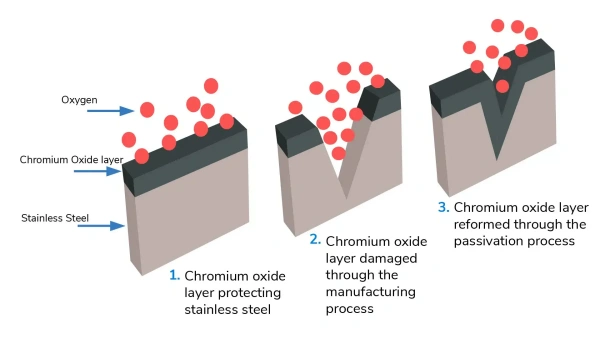
The name “stainless” comes from its ability to resist staining and rusting. The minimum 10.5% chromium reacts with oxygen to form a thin, invisible, and self-repairing layer of chromium oxide. It actively resists further corrosion while giving stainless steel its signature resilience.
European Synonyms: The French refer to SS steel as inox, short for inoxydable (= non-oxidizing). It becomes nichtrostender Stahl or non-rusting steel in German.
Key Properties of Stainless Steel
Physical Properties
- Density: Around 7.9 g/cm³. Stainless steel is heavier than aluminum but lighter than copper. It initiates a balance between strength and formability.
- Appearance: Its natural luster and retained polish or brushed finish are ideal for aesthetic applications.
- Magnetism: Austenitic stainless steels (304, 316) are generally non-magnetic. Meanwhile, ferritic and martensitic grades may exhibit magnetism.
- Recyclability: Stainless steel is 100% recyclable, with over 90% of stainless steel scrap reused globally.
Mechanical Properties
- Tensile Strength: Varies by grade. For example, Grade 304 has a tensile strength of 515 MPa. However, grade 316 reaches up to 620 MPa.
- Hardness: Martensitic grades like 410 and 420 are heat-treatable. They can achieve high hardness levels to suit knives and surgical tools.
- Ductility: Austenitic stainless steels exhibit excellent ductility. They can be drawn into wires or deep-formed into complex shapes.
- Fatigue Resistance: Stainless steel performs well under cyclic loading. That’s why it’s used in aircraft landing gear and automotive suspensions.
Thermal Properties
- Melting Point: Ranges from 1400°C to 1450°C, depending on the alloy composition.
- Thermal Conductivity: Lower than carbon steel (10 – 30 W/m·K). It’s suitable for applications requiring heat resistance.
- Expansion Coefficient: Austenitic grades expand more than ferritic ones. It’s a crucial spec in designing components exposed to temperature fluctuations.
- Heat Resistance: Grades like 310 and 446 are capable of withstanding temperatures above 1000°C.
Chemical Properties
- Corrosion Resistance: Stainless steel forms a passive oxide layer that resists rust. Grade 316, with added molybdenum, excels in marine and chemical environments.
- Oxidation Resistance: Stainless steel can prevent oxidation even at high temperatures. That’s why it’s ideal for jet engines and industrial kilns.
- Acid Resistance: Ferritic and duplex grades are extensively used in chemical plants. It’s because they can effectively resist nitric and sulfuric acids.
- Hygiene: The non-porous surface prevents potential bacterial/microbial growth. It makes stainless steel the standard in operating theater and food processing.
Different Types of Stainless Steel
Stainless steel isn’t a single material. Instead, it refers to a family of alloys categorized by individual microstructure and performance characteristics. Each type serves distinct specification requirements.
a. Austenitic Stainless Steel
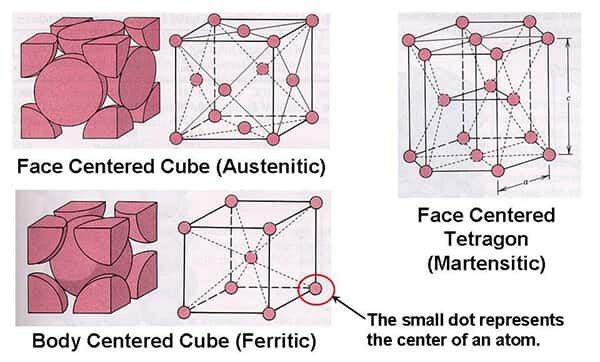
It features a face-centered cubic (FCC) crystal structure. Austenitic SS steels account for 70% of the global production. The composition includes high Cr (16% – 26%) and Ni (6% – 22%) content. Key grades include 304, 316, 321, and 310.
Notable Properties
- Excellent corrosion resistance.
- Non-magnetic (in annealed condition).
- High ductility and toughness.
- Good weldability and formability.
Real-Time Applications
- Food processing equipment.
- Architectural facades (Chrysler Building, NYC).
- Medical devices and surgical instruments.
- Marine components (Grade 316).
b. Ferritic Stainless Steel
It has a body-centered cubic (BCC) structure. Ferritic SS steels get preference in auto parts across Europe and Asia for cost-effective corrosion resistance. The composition features chromium (10.5% – 27%) with low or no nickel. Key grades include 409, 430, and 446.
Topmost Properties
- Moderate corrosion resistance.
- Magnetic in nature.
- Resistance to stress corrosion cracking.
- Lower cost due to minimal nickel.
Real-World Applications
- Automotive exhaust systems.
- Washing machine drums.
- Indoor architectural trim.
c. Martensitic Stainless Steel
It also marks a BCC structure. Martensitic SS steels are essential in precision tooling due to their hardness and edge retention. The composition includes moderate chromium (11.5% – 18%) against a higher carbon content. Key grades are 410, 420, and 440C.
Foremost Properties
- High hardness and strength.
- Magnetic in nature.
- Heat treatable.
- Lower corrosion resistance.
Real-Time Applications
- Cutlery and knives.
- Surgical tools.
- Industrial blades
- Wear-resistant parts.
d. Duplex Stainless Steel
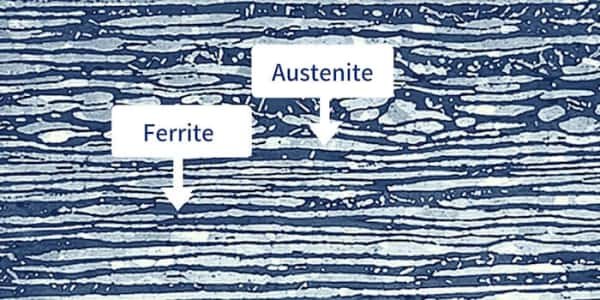
It comes with a mixed microstructure of austenite and ferrite. Duplex SS steels are in demand in Middle Eastern and Southeast Asian infrastructure for their durability. The composition holds Cr (19–28%), Ni (5% – 8%), and Mo (up to 5%). Key grades are 2205 and 2507.
Noteworthy Properties
- High strength (twice that of austenitic).
- Excellent resistance to chloride stress corrosion.
- Magnetic in nature.
Real-World Applications
- Offshore oil rigs.
- Chemical processing plants.
- Desalination equipment.
e. Precipitation-Hardening (PH) Stainless Steel
The atomic structure is martensitic or semi-austenitic. PH steels are heavily favored in the US, Europe, and Japan for their superior strength-to-weight ratio. It features Cr (15% – 17%) and Ni (4% – 7%) with copper, aluminum, or niobium. Key grades are 17-4PH and 15-5PH.
Standard Properties
- High strength and hardness.
- Good corrosion resistance.
- Fully heat treatable.
- Magnetic in nature.
Real-Time Applications
- Aerospace components.
- Nuclear reactor parts.
- High-performance valves/shafts.
Stainless Steel Grades Explained
SS steel grades are classification codes to define an alloy’s composition, properties, and applications. The grades help engineers, manufacturers, and designers select the right material for specific needs.
Why are Stainless Steel Grades Important?
Stainless steel denotes a family where you can’t find any one-size-fits-all. Different applications require distinctive stainless steel. Grades ensure consistency, safety, and performance across industries.
Stainless steel grades are standardized by several international bodies. For example,
- AISI/SAE (USA): 304, 316, 410 [most widely used globally]
- EN (Europe): 1.4301, 1.4404 [numeric codes based on composition]
- JIS (Japan): SUS304, SUS316 [common in Asian markets]
- GB (China): 06Cr19Ni10 [rapidly increasing global relevance]
Popular Stainless Steel Grades
a. Grade 304 (Austenitic)
Composition: 18% Cr + 8% Ni
Properties: Excellent corrosion resistance, formability, and weldability.
Applications: Kitchenware, architectural panels, food processing.
304 accounts for 50% of global stainless steel usage.
b. Grade 316 (Austenitic)
Composition: Similar to 304 + 2% – 3% Molybdenum.
Properties: Superior resistance to chlorides and marine environments.
Applications: Marine hardware, chemical processing, medical implants.
Sydney Opera House’s exterior cladding has 316.
c. Grade 410 (Martensitic)
Composition: 11.5% – 13.5% Cr with higher carbon.
Properties: High hardness, moderate corrosion resistance.
Applications: Cutlery, surgical tools, valves.
d. Grade 430 (Ferritic)
Composition: 17% Cr with low Ni.
Properties: Good corrosion resistance, magnetic, and lower cost.
Applications: Automotive trim, appliance panels.
430 has many uses in the European automotive industry.
e. Grade 17-4PH (Precipitation-Hardening)
Composition: 17% Cr + 4% Ni, Cu, Nb
Properties: High strength, corrosion resistance, heat treatable.
Applications: Aerospace components, nuclear reactors, high-performance shafts.
Limitations of Stainless Steel
Despite all the top-notch characterization, stainless steel has specific limitations. Keeping the drawbacks in mind is mandatory for selecting the right grade for optimizing performance and cost.
a. High Initial Cost
Stainless steel is more expensive than carbon steel or aluminum. The high cost comes from the alloying elements like chromium, nickel, and molybdenum.
Professional Solution
- Lifecycle Cost Analysis (LCA): Industries now prioritize total cost of ownership over upfront costs.
- Selective Use: Engineers use stainless steel only in critical areas (corrosion-prone zones) and combine it with cheaper materials elsewhere.
b. Weight and Density
Stainless steel is heavier than aluminum. It becomes a drawback in weight-sensitive applications like aerospace or automotive.
Professional Solution
- Grade Optimization: Implement duplex or PH grades that offer higher strength-to-weight ratios.
- Hybrid Design: Combine SS steel with lightweight composites or aluminum in structural applications.
c. Low Thermal Conductivity
Stainless steel has lower thermal conductivity (15 W/m·K) than copper or aluminum. Less efficient heat transfer may hinder smooth heat dissipation.
Professional Solution
- Deploy in Controlled Zones: SS steel is used in areas requiring heat resistance rather than heat transfer.
- Composite Heat Exchangers: Manufacturers integrate stainless steel with high-conductivity materials.
d. Susceptibility to Chloride Attack
Even high-grade stainless steel like 304 can corrode in chloride-rich environments (coastal areas and/or swimming pools).
Professional Solution
- Upgrade to Grade 316 or Duplex: Molybdenum enhances resistance to pitting and crevice corrosion.
- Protective Coatings: Epoxy or ceramic coatings are applied to surfaces in marine and chemical plants.
- Cathodic Protection: Used in offshore platforms and pipelines to prevent electrochemical corrosion.
e. Magnetism in Certain Grades
Ferritic and martensitic grades are magnetic. The well-known property may interfere with sensitive electronic or medical equipment.
Professional Solution
- Choose Austenitic Grades: Grades like 304 and 316 are non-magnetic in annealed form.
- Post-Processing Treatments: Solution annealing can reduce magnetism in borderline cases.
f. Fabrication Challenges
Stainless steel is harder to machine and weld than mild steel due to its toughness and work-hardening properties.
Professional Solution
- Specialized Tooling: Implement carbide-tipped tools and low-speed machining techniques.
- Advanced Welding: TIG welding + laser welding are preferred for precision and minimal distortion.
- Automation: CNC machining and robotic welding improve consistency to reduce labor costs.
Conclusion
Stainless steel marks a symbol of resilience, innovation, and reliability. The alloy group quietly powers modern life with strength, hygiene, and sustainability. Knowing its types, grades, properties, and limitations should give you some insight into the best possible option for your needs.
Best-Quality Steel Products to Meet Your Needs at HRC
Enjoy top-tier steel production services based on your project specs with HRC. We have been leading the steel CNC manufacturing industry for 17 years. Contact us to reach our industry experts for consultation.