Skip to content

Teflon is widely used in industry and everyday life for its nonstick, chemical-resistant, and heat-resistant properties. This guide will cover its structure, nature, and diverse applications.
Basic Definitions & Relationships
Before going into the details, it is helpful to understand some definitions.
What Is PTFE (Polytetrafluoroethylene)
PTFE is a nonstick synthetic fluoropolymer that is characterized by chemical resistance, durability, and resistance to high temperatures. It finds extensive use in cooking utensils, industry, and other high-performance technologies.
What Is Teflon (Brand Name / Trademark)
Teflon is the brand name registered by DuPont (now Chemours) as its trade name for PTFE products.
Is PTFE The Same As Teflon?
Teflon refers to commercial PTFE products, which may include additives or coatings for specific applications. The difference is that PTFE is the scientific name, while Teflon is the more widely used common commercial name.
Other Related Fluoropolymers (FEP, PFA, Etc.)
Other fluoropolymers are also available besides PTFE; these include FEP or PFA. Their properties are similar to those of PTFE. They are more flexible, easy to process, and can be used for some specialised uses in industry and electronics.
Chemical Structure & Synthesis
To understand why PTFE possesses such remarkable properties, it is necessary to examine its chemical structure and the manufacturing process that yields it.
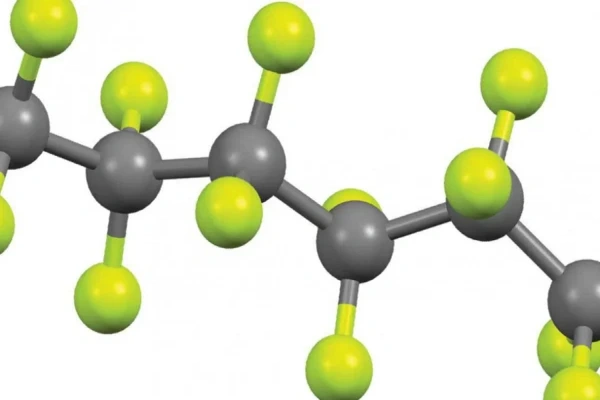
Monomer: Tetrafluoroethylene (TFE)
PTFE is a polymer formed by linking many TFE (Tetrafluoroethylene) monomers into long chains.
Polymerization Process
The synthesis of PTFE is a polymerisation reaction, i.e., the attachment of numerous TFE molecules in a sequence to create a chain. This process forms long polymer chains, which, combined with the fluorine atoms, give PTFE its chemical resistance and nonstick characteristics.
Molecular Structure, Bonding & Crystallinity
The molecular structure of PTFE consists of tightly bonded carbon atoms surrounded by fluorine atoms, creating a strong bond that provides excellent resistance to both heat and chemicals. The surface is relatively smooth due to PTFE’s semi-crystalline structure.
Physical Parameters
PTFE is solid, white, low-density, and has a very low coefficient of friction. It is also stable over a broad temperature range, from extremely cold to nearly 260°C. This makes PTFE both durable and suitable for a wide range of environmental conditions.
Key Properties Of PTFE / Teflon
Having an understanding of the basic structure, it is possible to see the key properties of PTFE. These properties make the material widely applicable in both daily life and industrial settings.
Low Coefficient Of Friction / Nonstick Behaviour
PTFE has a very low friction coefficient, a smooth surface, and is virtually non-sticky. Due to that, it can be commonly used in nonstick pans, machine parts, and applications where less friction is required.
Chemical Inertness / Corrosion Resistance
PTFE is highly reactive to acids, strong solvents and alkalis. The chemical inertness of this makes it an excellent solution in the chemical industry and in highly corrosive environments.
Thermal Resistance & Degradation Thresholds
PTFE can withstand temperatures of approximately 260°C. It starts decomposing above 350°C and generates toxic gases.
Electrical / Dielectric Properties
PTFE is an excellent insulator and can withstand various conditions. It finds many applications as an insulator in cables, electronic parts, and telecommunications devices.
Mechanical Behaviour, Wear, Creep & Limitations
PTFE is moderately strong in mechanical terms, but wears easily under heavy loads or impact. Moreover, this material will creep (slowly deform) under long-term pressure. Thus, it is commonly reinforced or mixed with other materials to eliminate this shortcoming.
PTFE / Teflon Coatings
Along with solid material form, PTFE can be used as a coating. These coatings offer various advantages based on the usage and the nature of the surface that should be coated.
What Is A PTFE / Teflon Coating
PTFE coating (Teflon coating) is a thin fluoropolymer layer (placed on metal, plastic, or glass) to give it nonstick, anti-corrosion, and friction-reduction characteristics.
Types & Variants Of Coatings
PTFE coatings are available in various forms, depending on the application, including sprays, dips, powders, and reinforced variants for enhanced mechanical properties.
Application Methods
PTFE can be applied to surfaces through spraying, dipping, or powder coating, and is typically baked afterwards to ensure durability and stability.
Performance Trade-Offs & Limitations
The PTFE coatings excel in nonstick and chemical resistance, but their mechanical strength is not as high as that of metals or ceramic coatings. Technical requirements also tend to increase the coating cost.
Comparison With Alternative Coatings
PTFE has an advantage over epoxy, ceramic, or nickel finishes because it offers a smoother surface and superior chemical resistance. Other coatings, however, may be more suitable for applications that require high hardness or scratch resistance.
Applications & Use Cases
Due to its exceptional characteristics, PTFE has been integrated into a wide variety of applications, ranging from everyday household cookware to industrial and high-tech uses.
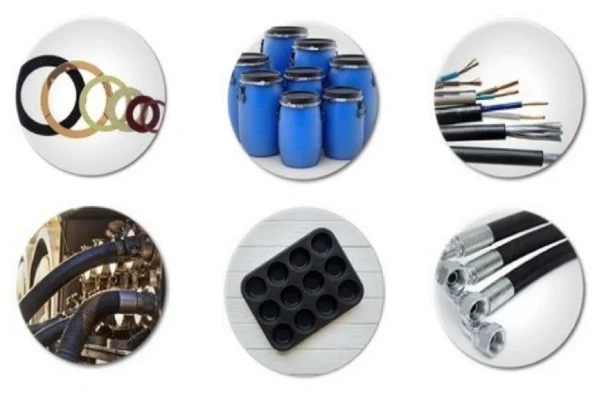
Cookware & Nonstick Surfaces
PTFE is utilised in cookingware, particularly nonstick cooking pans. This coating helps prevent food adhesion, reduces the amount of grease required, and improves surface durability in the long term. It is highly thermally stable, which makes PTFE typically safe at normal cooking temperatures (up to ~260°C).
Industrial Uses: Seals, Gaskets, Liners, Bearings
In industry, PTFE is used for seals, gaskets, liners, and bearings. PTFE’s notable advantages include its low friction coefficient and self-lubricating nature, which help machines run more smoothly and extend component durability.
Chemical & Harsh-Environment Applications
PTFE does not dissolve in most acids, alkalis, and strong solvents. Hence, it is commonly employed within chemical plants, tanks, or industrial waste treatment systems. A coating made of PTFE will help prevent corrosion, reduce the possibility of equipment malfunction, and reduce maintenance expenses.
Electrical / Electronics Applications
PTFE is an excellent material for use in cables, electronic components, and circuit boards due to its exceptional dielectric properties. It guarantees electrical insulation and high resistance to high temperature and humidity. This allows electronic devices to function reliably and securely, even in harsh environments.
Speciality & Emerging Applications
PTFE is studied in numerous high-tech areas, in addition to its usual applications. In the medical field, it is applied as a coating on surgical instruments to prevent bioadhesion.
PTFE in aerospace and nanotechnology minimises friction, enhances the efficiency of operation, and creates the possibility of new applications in the future.
Thermal Degradation, Safety & Environmental Aspects
Safety and environmental impact should also be considered when using PTFE.
Decomposition Temperatures Of PTFE
PTFE is relatively resistant to heat; at the average temperature of cooking conditions (less than 260°C), PTFE is safe. However, when heated beyond 350°C, it begins to release toxic gases and decompose.
Fume Release & Polymer Fume Fever / “Teflon Flu”
When PTFE overheats, it may produce fumes with an unpleasant odour. When inhaled in large quantities, individuals can develop a cough, low-grade fever, and flu-like fatigue (also known as “Teflon Flu”). This disorder typically resolves within a matter of days if exposure is discontinued.
Health & Environmental Concerns
PTFE does not present any hazard in everyday use. The fumes generated when overheated, however, are dangerous to both health and the environment.
Safe Handling & Usage Guidelines
To be on the safe side, PTFE-coated pots and pans must never be heated without food or water in them. In the industrial sector, ventilation systems are necessary for handling PTFE, as inhaling fumes can occur due to high temperatures.
Regulatory / Standards Context
The principal regulatory authority agencies worldwide, such as the FDA and EFSA, have recognized the safety of using PTFE in cookware.
Additionally, production standards are becoming stricter to minimise environmental impact, allowing users to rely entirely on products with PTFE coating.
Conclusion
Teflon is a nonstick material of PTFE, which is chemically and highly durable. It is applicable in numerous industries, both in cooking and aviation. For a specific CNC machining solution involving a PTFE part or coating, please get in touch with us at HRCCNC.