Skip to content
Anyone who knows about metal manufacturing is guaranteed to hear of zinc (Zn) at several points. The versatile element is almost everywhere – construction, electronics, agriculture, consumer goods, etc.
Modern industries continue to push efficiency. That’s why you must have a clear understanding of zinc. And this article digs up every essential factor relevant to the metal’s manufacturing and applications.
What is Zinc (Zn)?
The transition metal holds a bluish-white appearance in its pure form. Zinc’s symbol is Zn, which also marks an atomic number of 30. It ranks 24th among the abundant elements found in the Earth’s crust.
Zn features a standard atomic weight of 65.38. The metal remains brittle at room temperature, but it becomes malleable above 100°C. That’s why Zn is the first element in group 12 (low-melting metal group) of the periodic table.
Zinc has 25 known isotopes, of which 5 are stable. Zn-66, Zn-67, and Zn-68 are the most stable. Zn-64 covers nearly half of zinc’s total abundance. It’s also the 2nd-most-abundant mineral in the human body.
Industrial Emergence
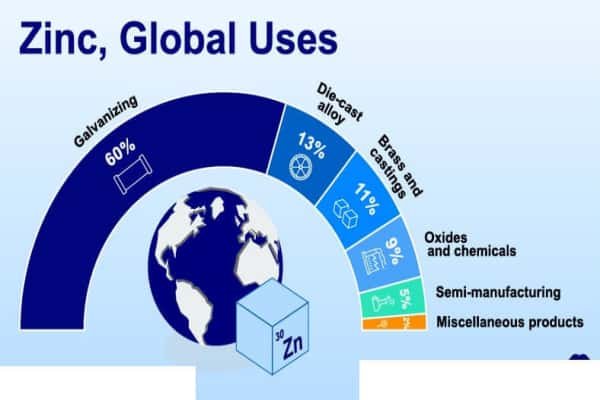
Zinc’s industrial rise accelerated during the Industrial Revolution. The process of galvanization used Zn to coat iron and steel to prevent rust. Even today, over 60% of global zinc production goes into galvanizing.
China, Australia, and Peru have been the top producers. Global production has exceeded 13M+ metric tons annually. Current demand mainly comes from infrastructure, automotive, and renewable energy.
Standard Zinc Specifications
Global benchmarks like ASTM B6 and ISO 752 have defined Zn specs. The standards clearly classified zinc into grades based on purity, chemical composition, and physical properties.
- ASTM B6 (USA): Defines grades and impurity limits for industrial use.
- ISO 752 (International): Harmonizes zinc specs for global trade.
- EN 1179 (Europe): Covers zinc for galvanizing and alloying applications.
- JIS H 2102 (Japan): Emphasizes the ingots for zinc die casting.
Chemical Composition with Grades
Zinc has been classified into five industrial grades under the ASTM B6-18 standard. Those would be –
- Special High Grade: ≥ 99.995 Zinc for electronics and pharmaceuticals.
- High Grade: ≥ 99.99 Zinc for die-casting and precision components.
- Intermediate Grade: ≥ 99.5 Zinc for general galvanizing and construction.
- Prime Western Grade: ≥ 98.5 Zinc for structural steel and roofing.
- LME (London Metal Exchange) Grade: ≥ 99.995 for industrial metal trading.
Physical and Mechanical Properties
- Density: 7.14 g/cm³
- Melting Point: 419.5°C or 787.1°F
- Boiling Point: 907°C or 1664.6°F
- Thermal Conductivity: 116 W/(m·K)
- Electrical Conductivity: 28% IACS
- Young’s Modulus: 108 GPa
- Hardness (Brinell): 38 HB
The comparatively low melting point makes Zn energy-efficient for die-casting. Meanwhile, its moderate hardness supports wear resistance in consumer goods.
Standard Zinc (Zn) Sources
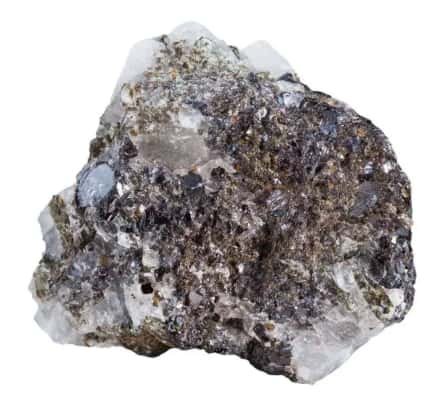
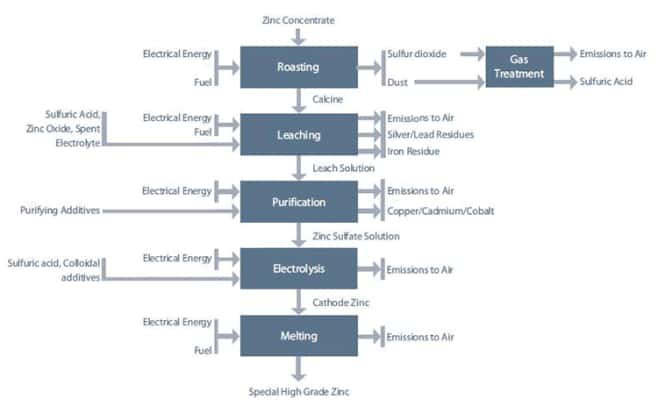
Zinc is primarily sourced from mineral ores like sphalerite. The metal gets extracted through complex processes, including roasting, leaching, and electrolysis or smelting.
Zinc Ore Sources
Moderately reactive Zn is rarely found in native metallic (pure) form. Instead, it occurs in zinc-rich minerals like –
- Sphalerite (ZnS): Main source of zinc worldwide; often found with lead, copper, and iron.
- Smithsonite (ZnCO₃): Carbonate ore, historically used before sphalerite became dominant.
- Hemimorphite (Zn₄Si₂O₇(OH)₂·H₂O): Silicate ore, less common but still mined in some regions.
- Franklinite (ZnFe₂O₄): Found in magnetite-rich deposits, especially in New Jersey, USA.
Zinc Extraction Process: Step-by-Step Breakdown
- Step #01: Mining and Crushing – Ores are mined and crushed to liberate zinc-bearing minerals.
- Step #02: Concentration via Flotation – Crushed ore is mixed with water and chemicals to separate ZnS from waste rock. Froth flotation yields a concentrate with 40% – 60% Zn.
- Step #03: Roasting – Zinc sulfide is roasted in air to form zinc oxide (ZnO) and release sulfur dioxide (SO₂). The reaction: 2ZnS + 3O₂ → 2ZnO + 2SO₂
- Step #04: Leaching – Zinc oxide is dissolved in sulfuric acid to produce zinc sulfate (ZnSO₄). Impurities like iron and lead are removed through filtration and precipitation.
- Step #04: Purification and Electrolysis – Zinc sulfate solution undergoes electrolysis, where electric current deposits pure Zn on cathodes. It yields 99.995% pure zinc.
Alternative Extraction: Imperial Smelting Process
It’s used chiefly on mixed ores containing lead and zinc. The process involves simultaneous smelting in a blast furnace, producing zinc vapor and lead bullion.
What is Zinc Used For in Manufacturing?
Global zinc reserves are estimated at 250 million metric tons. However, 30% – 40% of zinc in use comes from recycled sources.
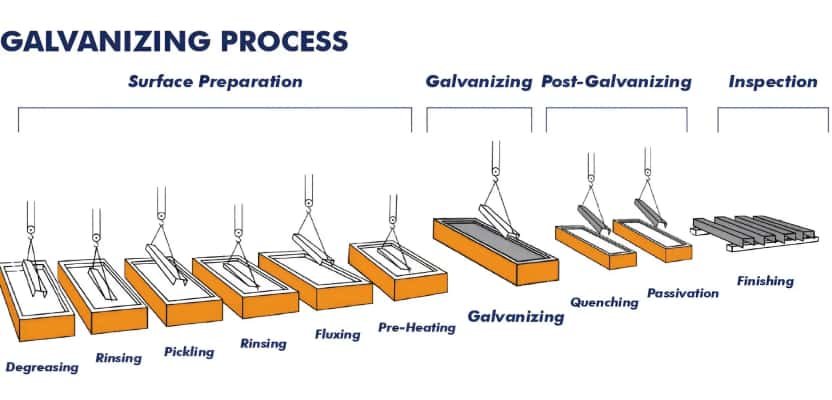
a. Galvanization
It’s the process of coating steel or iron with zinc to prevent rust. The sacrificial anode corrodes instead of the underlying metal. Galvanization is mandatory in humid, coastal, or industrial environments.
Over 60% of global consumption goes to steel galvanization. Hot-dip galvanizing is the most common method, where steel gets immersed in molten zinc (450°C).
b. Alloys and Metal Combinations
Zinc is a key alloying element, especially in brass (a combination of copper and zinc). The ratio determines the alloy’s strength, ductility, and color.
- Brass usually contains 5% – 40% zinc, depending on the intended application.
- High-zinc brass is used in plumbing, musical instruments, and decorative hardware.
- Low-zinc brass offers better corrosion resistance than that used in marine fittings.
- Zinc alloy metal like Zamak (Zn + Al + Mg + Cu) are incredibly popular in zinc die casting.
Some high-end applications require strength and formability. Manufacturers choose alpha-beta brass (30% – 35% zinc) to balance machinability and corrosion resistance.
c. Zinc (Zn) Die Casting
Zinc die casting involves injecting molten zinc into steel molds under high pressure. It’s perfect for producing complex and high-volume components with tight tolerances.
- Zinc’s low melting point (420°C – 450°C) grants fast cycle times and energy-efficient production.
- Zn die casting can achieve tolerances as tight as ±0.005 inches to ensure high dimensional accuracy.
- Zinc offers superior plating compatibility and aesthetic appeal compared to Al or Mg counterparts.
- Zamak 3 suits general-purpose casting, and Zamak 5 goes well with higher strength and hardness.
Advantages of Zinc in Manufacturing
● Corrosion Resistance
Rust prevention through galvanization is one of the most valuable traits. It forms a protective layer that corrodes in place of steel or iron. Galvanized steel can last 20 – 50 years, depending on the exposure.
● Alloy Versatility
Zinc has been a key alloying element in brass and Zamak. Brass with 30% – 35% zinc offers machinability and resistance. Zamak alloys are used in automotive parts, door handles, and consumer electronics.
● Sustainability (100% Recyclable)
Zinc retains its properties through recycling. Recycling Zn saves up to 76% of the energy compared to primary production. Implementing closed-loop recycling systems can reduce costs and environmental impact.
● Cost-Effectiveness
Zinc (Zn) is abundant, affordable, and globally traded. It’s an accessible metal for manufacturers of all scales. Even the pricing stability further supports predictable budgeting for large-scale projects.
Downsides Associated with Zinc
Zn also comes with noteworthy limitations associated with manufacturing. The limitations must be carefully considered in material selection and industrial design.
● Limited Mechanical Strength
Zinc alloys, especially in die-cast form, have lower tensile strength and impact resistance. The tensile strength ranges from 200 to 400 MPa. The brittle metal is prone to cracking under stress or impact.
● Susceptibility to Corrosion in Harsh Environments
Zinc alloys, the ones with impurities, can corrode in humid, saline, or acidic environments without proper coating. Zinc pest (intercrystalline corrosion) can occur in older or poorly alloyed zinc castings.
● Environmental and Health Concerns
Excessive Zn in wastewater or soil poses ecotoxicological risks. ZN gets toxic at high concentrations to aquatic life and plants. Industrial discharge regulations (EU and the US) limit the Zn concentrations.
● Dimensional Instability Over Time
Zinc alloys experience creep. It’s a slow deformation under constant stress at elevated temperatures. It limits usability in high-temperature or load-bearing applications (engine parts or structural fasteners).
● Shorter Lifespan in Certain Applications
Zinc components may have a shorter lifespan in demanding environments. Galvanized coatings can wear off in abrasive/acidic conditions. Zinc die-cast parts in electronics degrade faster under thermal cycling.
Sector-Specific Industry Applications
- Construction and Infrastructure: Galvanized steel across buildings, bridges, and pipelines. Zinc roofing and cladding in Europe for aesthetic appeal.
- Automotive and Transportation: Die-cast automotive components (door handles, carburetors, fuel pumps, and seatbelt anchors).
- Electronics and Consumer Goods: Smartphone housings, remote controls, and laptop hinges. Zinc oxide in semiconductors, sensors, and LED phosphors.
- Agriculture: Zinc sulfate in fertilizers, zinc-enriched rice varieties, and zinc oxide in animal feed.
- Healthcare and Pharmaceuticals: Zinc oxide in ointments, sunscreens, and antiseptic creams. Zinc gluconate/sulfate in cold remedies and supplements.
- Energy: Zinc-air and zinc-ion batteries as non-toxic alternatives to lithium-ion systems. Zinc-coated steel in solar panel frames and wind turbine structures.
Zinc Myths and Misconceptions
Misconception #01: Zinc Is a “Soft“ or “Weak“ Metal
Many believe zinc lacks mechanical strength. However, it oversimplifies Zn’s performance. Zinc alloys like Zamak 5 can reach tensile strengths of 400 MPa.
Misconception #02: Zinc Is Environmentally Harmful
Zinc is viewed as a pollutant due to its presence in industrial wastewater. However, the fact ignores its recyclability and essential biological role. Zinc is 100% recyclable without loss of properties.
Misconception #03: Zinc Is Only Used for Galvanization
Galvanization accounts for the majority of zinc use. Nonetheless, Zn applications are far broader. Zinc is used in die casting, brass production, electronics, pharmaceuticals, and energy storage.
Misconception #04: Zinc Is Outdated or Low-Tech
Some view zinc as a legacy metal, overshadowed by newer materials like aluminum or composites. Zinc is at the forefront of battery innovation in zinc-air and zinc-ion techs for grid-scale energy storage.
Conclusion
Zinc has had a definitive impact on global manufacturing for centuries. You can impart durability, efficiency, and innovation with the right approach. Galvanization, alloying, die casting, or anything else – balancing the properties to meet the demand must come first.
Get Your Zinc Parts for Standard Uses from HRC
We’re a leading manufacturer with a commitment to precision engineering from the core. HRCCNC has been in the game for 17+ years with absolute success. Contact us for consultation on your Zinc projects.