Skip to content
Delrin or Nylon? It’s a common choice in design and manufacturing. Both are robust, but using them in the right applications is key. Let’s break down their differences to help you find the answer quickly.
What Is Delrin?
Delrin is a polyoxymethylene (POM), which has superb mechanical properties and is also resistant to chemicals. It provides an effective solution for components subjected to stress and friction.
For more specialized knowledge, explore our related articles:
Delrin (POM-H) – The Ultimate Guide to Acetal Homopolymer
What Is Nylon?
Nylon, scientifically known as polyamide, is the world’s first fully synthetic fiber—its invention marked a major milestone in polymer chemistry. Chemically, nylon refers to a class of high-molecular-weight polymers containing repeating amide bonds (–CO–NH–) in the backbone. It is among the most widely used engineering plastics globally
For more specialized knowledge, explore our related articles:
What’s Nylon? Understanding PA Materials for Precision CNC Machining
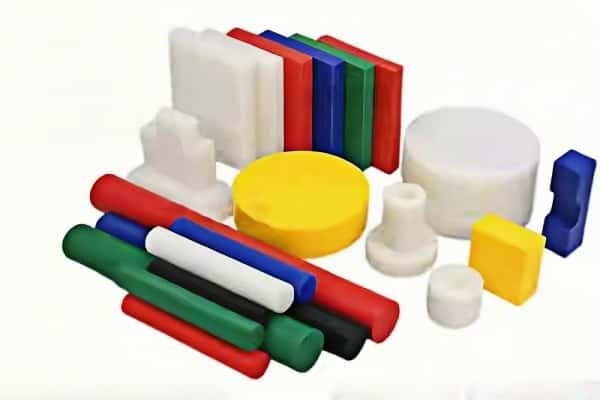
Comparison of the Chemical Compositions
- Delrin: Delrin is a homopolymer of formaldehyde, composed of polyoxymethylene (POM). It is of a high crystallinity structure, which gives it rigidity, dimensional stability, and low friction.
- Nylon: Nylon or polyamide (PA) is a condensation polymer of diamines and dicarboxylic acids. Its molecular chains are linked by amide bonds, making it more flexible and hygroscopic than Delrin.
Comparison of the Mechanical Properties
- Tensile Strength: Delrin typically has higher tensile strength (around 10,000 psi) compared to Nylon (8,000–12,000 psi, depending on the grade).
- Stiffness: Delrin is firmer due to its crystalline structure, which allows it to retain its rigidity. Nylon is flexible to some extent.
- Flexibility: Nylon better absorbs shock and vibration, while Delrin offers superior dimensional accuracy.
- Impact Resistance: Both materials have good impact strength; however, Nylon performs better in dynamic applications.
Environmental Performance
Nylon absorbs up to 3–4% more moisture from the environment, which may interfere with the material’s dimensional stability. Delrin has a low moisture absorption rate of less than 0.2%, making it suitable for use in environments with high humidity. Thus, Delrin is more suitable for precision parts exposed to moisture.
Temperature Resistance
- Nylon: Nylon can be used at continuous service temperatures of up to 120°C and intermittent exposure temperatures of up to 150°C. It, however, becomes soft under high humidity due to the absorption of water.
- Delrin: The continuous use temperature of Delrin is approximately 100°C, with a melting point of approximately 175°C. It maintains stiffness at moderate temperatures and becomes even more rigid when cooled.
- Coefficient of Thermal Expansion Comparison: When compared to Nylon, Delrin has a lower coefficient of thermal expansion, making it more accurate in dimensional control due to temperature variations.
Machinability
- Delrin: Delrin is exceptionally easy to machine, providing clean cuts and minimal burring. It provides close tolerances and is perfect for use in precision CNC machining.
- Nylon: Nylon, too, can be machined quite successfully, but is softer and, therefore, may develop fuzzing or deformation at high speed.
- Ease of Comparison: Delrin can be machined to closer tolerances, whereas Nylon requires careful monitoring of cutting speed and tool temperature to prevent warping.
Chemical Resistance
- Delrin: Hydrocarbon, solvent, and the most neutral chemical-resistant. It can, however, degrade in strong acids or bases.
- Nylon: Nylon offers fair resistance to chemicals, but is subject to attack by strong acids and oxidizing agents. It also tends to take up oils and fuels over time.
Application Selection Criteria
Utilize Delrin in high-precision, low-moisture, and dimensionally stable applications, such as gears, bushings, and structural components. Nylon is preferred for applications requiring flexibility, light weight, and impact resistance, like fasteners, cable ties, and dynamic machine components.
Conclusion
Choose Delrin: When precision, stability, and low friction are your top priorities. —especially in humid environments.
Choose Nylon: When toughness, impact resistance, and vibration absorption are more critical.
HRCCNC specializes in custom CNC machining parts using Delrin and Nylon. For related product customization needs, please feel free to contact us.