Skip to content


Nylon (Nylon / Polyamide, abbreviated as PA) is one of the most widely used engineering plastics, known for its excellent mechanical strength, wear resistance, toughness, and machinability. In modern manufacturing, nylon is the core material for countless mechanical components, functional parts, and industrial assemblies—especially suitable for CNC milling, turning, drilling, and other machining processes.
For CNC machining shops specializing in metal and plastic parts, understanding what nylon is, how it is made, the differences among various nylon grades, and how it performs during machining directly affects part quality, performance, and material-selection guidance for customers.
What Is Nylon?
Nylon, scientifically known as polyamide, is the world’s first fully synthetic fiber—its invention marked a major milestone in polymer chemistry. Chemically, nylon refers to a class of high-molecular-weight polymers containing repeating amide bonds (–CO–NH–) in the backbone. It is among the most widely used engineering plastics globally.
Across industries such as chemical engineering, automotive, electrical systems, machinery, and industrial automation, nylon-made components are everywhere.
What Is Nylon Made Of?
Nylon is primarily produced using two chemical synthesis methods: condensation polymerization and ring-opening polymerization.
Condensation Polymerization
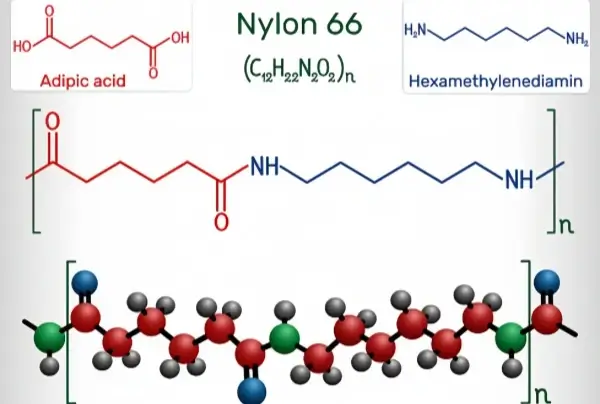
Taking nylon 66 (PA66) as an example, it is formed through a condensation reaction between hexamethylenediamine and adipic acid. During the reaction, amino and carboxyl groups combine to form amide bonds while releasing water molecules. The “66” designation refers to the number of carbon atoms in the two monomers (six each).
Ring-Opening Polymerization
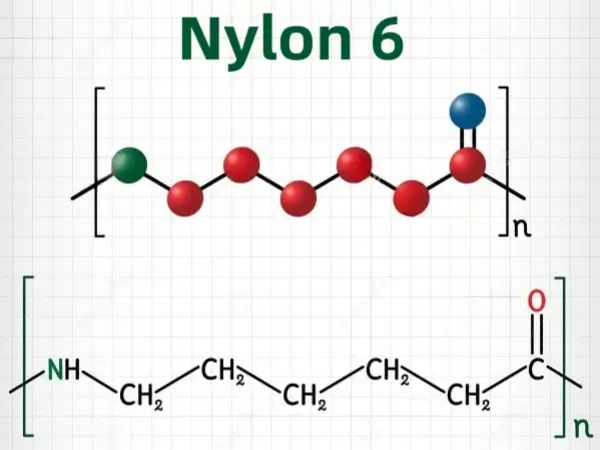
Nylon 6 (PA6), for example, is produced by ring-opening polymerization of caprolactam under heat and catalysts. The “6” represents the six carbon atoms in the caprolactam monomer.
Regardless of the synthesis route, the end product is a long-chain polymer with intermolecular hydrogen bonding, which provides nylon with its characteristic strength and toughness.
Key Properties of Nylon Plastics
- High Toughness: Nylon can absorb significant impact energy without breaking, making it an ideal material for manufacturing gears and moving parts.
- Wear Resistance: Its low friction coefficient and high hardness endow nylon with exceptional wear resistance, resulting in a longer service life than many metal materials.
- Self-Lubrication: Nylon inherently possesses a certain degree of lubricity, especially in environments with trace moisture, enabling it to operate under oil-free or low-oil lubrication conditions.
- Chemical Resistance: It exhibits good resistance to most common organic solvents, oils, and greases.
- Dimensional Changes Due to Water Absorption: This is one of nylon’s primary drawbacks. Nylon absorbs moisture from the environment, leading to volume expansion and dimensional changes, which poses a challenge for high-precision applications.
Common Types of Nylon Materials
PA6 (Nylon 6)
Well-balanced performance, excellent toughness and impact strength, good flowability—one of the most widely used nylon types.
PA66 (Nylon 66)
Higher strength, rigidity, and heat resistance than PA6; higher melt viscosity and more temperature-sensitive.
PA12 (Nylon 12)
Lower amide-bond density results in significantly lower moisture absorption than PA6/PA66. Excellent dimensional stability and low-temperature performance; more flexible.
Glass-Filled Nylon (PA + GF30%)
Adding glass fiber significantly improves strength, rigidity, and heat resistance. Common loadings: 15%, 30%, 50%.
However, glass fiber increases anisotropy and tool wear during machining.
Comparison of Common Nylon Materials
| Material | Summary | Moisture Absorption | Strength | Rigidity | Wear Resistance | Dimensional Stability | CNC Machining Difficulty | Common Applications |
|---|---|---|---|---|---|---|---|---|
| PA6 | Balanced performance, low cost | Medium | Medium | Medium | Excellent | Average | ★★☆☆☆ | Slides, gears, support parts |
| PA66 | High strength, better heat resistance | Slightly high | High | High | Excellent | Medium | ★★★☆☆ | High-load gears, structural parts |
| PA12 | Lowest moisture absorption, best accuracy | Very low | Medium | Medium | Good | Best | ★★★★★ | Precision parts, seals |
| PA + GF30 | Highest strength and rigidity | Medium | Very high | Very high | Good | Good | ★★★★☆ | Industrial structures, automotive parts |
Nylon grade chart: PA6 vs PA66 vs PA12 vs PA-GF30
Among these stock-shape examples, PA12 has the lowest measured water uptake, while PA66-GF30 has the highest tensile stiffness; choose the grade around the part’s humidity exposure and load.
| Material and example stock grade | Tensile strength (MPa) | Tensile modulus (MPa) | Water uptake, 24 h / 96 h (% by mass) | Selection implication | Source |
|---|---|---|---|---|---|
| PA6 — TECAMID 6 natural | 79; ISO 527-2 | 3,300; ISO 527-2 | 0.30 / 0.60; 23 °C, ISO 62 | General-purpose wear parts; include moisture movement in the tolerance review. | Ensinger PA6 data |
| PA66 — TECAMID 66 natural | 85; ISO 527-2 | 3,500; ISO 527-2 | 0.20 / 0.40; 23 °C, ISO 62 | Higher strength and stiffness than the listed PA6 example; still moisture-sensitive. | Ensinger PA66 data |
| PA12 — TECAMID 12 natural | 53; ISO 527-2 | 1,800; ISO 527-2 | 0.04 / 0.07; 23 °C, ISO 62 | Lower moisture uptake, with less stiffness than the listed PA6 and PA66 examples. | Ensinger PA12 data |
| PA-GF30 example: PA66-GF30 — TECAMID 66 GF30 black | 91; ISO 527-2 | 5,500; ISO 527-2 | 0.10 / 0.20; 23 °C, ISO 62 | Stiffer structural parts; account for fiber direction, tool wear and exposed fibers. | Ensinger PA66-GF30 data |
The listed data describe specific semi-finished stock grades. Ensinger reports mechanical data generated directly after machining in the standard German climate; these are not dry-as-molded injection-resin values. Water-uptake tests use specimens approximately 50 mm in diameter and 13 mm high. The 24 h and 96 h results are separate timed measurements, not a range or an equilibrium-humidity value.
PA-GF30 means a polyamide reinforced with 30% glass fiber; the base polymer must also be specified. PA6-GF30 and PA66-GF30 are not interchangeable. Confirm the actual stock supplier’s datasheet, conditioning state and material direction before releasing a drawing.
Nylon Compared with Other Engineering Plastics
| Material | Dimensional Stability | Strength/Rigidity | Wear Resistance | Machining Difficulty | Typical Application |
|---|---|---|---|---|---|
| Nylon PA | ★★★ | ★★★★ | ★★★★ | ★★★ | Slides, gears, structures |
| POM | ★★★★★ | ★★★★ | ★★★ | ★★★★ | High-precision parts, bushings |
| ABS | ★★☆ | ★★☆ | ★★ | ★★☆ | Housings, light-load parts |
| UHMW-PE | ★★ | ★★ | ★★★★★ | ★★ | Ultra-wear components |
| Aluminum | ★★★★★ | ★★★★ | ★★ | ★★★★★ | Structural metal parts |
If the main decision is wear performance versus dimensional stability in changing humidity, use our Delrin vs Nylon comparison to review the trade-offs. For an acetal homopolymer alternative, see the Delrin POM-H guide, which explains how this material differs from acetal copolymer.
Is Nylon Suitable for CNC Machining?
Yes—nylon is highly suitable for CNC machining. It can be quickly and accurately fabricated into prototypes, small-batch parts, and complex end-use components through:
- CNC milling
- CNC turning
- Drilling
- Tapping
- Precision cutting
However, nylon’s material characteristics—moisture absorption, thermal sensitivity, and thin-wall deformation—must be carefully managed.
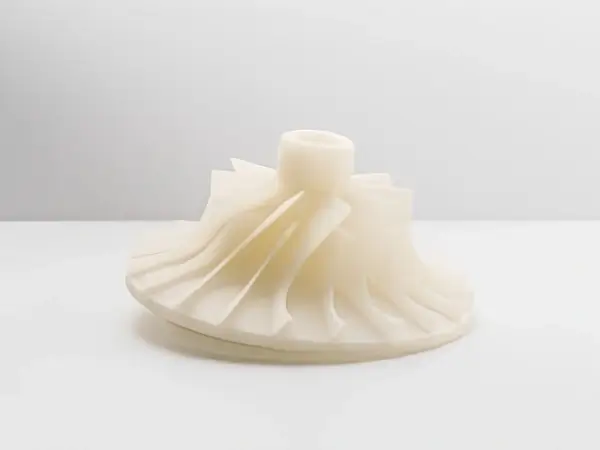
Advantages of CNC Machining Nylon
- Low cutting resistance, smooth machining
- Smooth surface finish, good Ra values
- Not brittle; minimal chipping or cracking
- Ideal for structural and sliding components
- Suitable for rapid prototypes and small-batch production
Challenges in Machining Nylon and Solutions
| Issue | Cause | Professional Solutions |
|---|---|---|
| Melting / stringing | Low heat-deflection temperature | High RPM, low feed, sharp tools, forced cooling |
| Dimensional instability | High moisture absorption | Pre-drying, humidity control, sealed packaging |
| Thin-wall deformation | High toughness | Lightweight segmented cuts, optimal fixturing, optimized toolpaths |
| Size variation with temperature | High thermal expansion | Constant-temperature machining, avoid heat accumulation |
Professional CNC factories can maintain stable tolerances and reliable surface quality of nylon parts through process adjustments.
Moisture absorption and how it moves your tolerance
Nylon absorbs water from humid air and liquid contact. As its moisture content changes, a finished part can swell and its stiffness can change. A dimension accepted immediately after dry machining may therefore move during transport, assembly or service.
Water absorption in a datasheet is a mass percentage, not a linear expansion percentage. To estimate dimensional movement, use supplier data for dimensional strain or measure a representative part between the specified initial and service conditions. Do not use a 24-hour immersion result as a prediction of equilibrium behavior in humid air.
For a part machined exactly at nominal size, just 0.10% assumed linear growth uses the entire +0.05 mm allowance on a 50 mm dimension.
| Initial dimension at nominal (mm) | Assumed positive linear strain | Calculated growth (mm) | Drawing tolerance (mm) | Upper-limit allowance left (mm) |
|---|---|---|---|---|
| 20.00 mm feature | 0.10% | +0.020 | ±0.050 | 0.030 before other errors |
| 50.00 mm feature | 0.10% | +0.050 | ±0.050 | 0.000; at the upper limit |
| 100.00 mm feature | 0.10% | +0.100 | ±0.050 | −0.050; exceeds the upper limit |
Calculation: dimensional change ΔL = initial length L × linear strain ε, with ε expressed as a decimal. In this example, 0.10% = 0.001, so 50 mm × 0.001 = 0.050 mm. Remaining upper-limit allowance = 0.050 mm − ΔL. The calculation excludes machining error, measurement uncertainty, thermal expansion and mechanical restraint.
For critical fits, define the inspection temperature, relative humidity and moisture-conditioning state on the drawing or inspection plan. Agree whether acceptance applies to dry stock, conditioned parts or the service state. Validate conditioning time for the actual wall thickness, then finish-machine and inspect under the agreed conditions. Drying controls the starting state; sealed packaging slows later moisture exchange but does not make nylon non-hygroscopic.
For glass-filled nylon, check each critical direction separately. Fiber orientation and geometric constraints can make movement uneven, so the simple free-expansion calculation above cannot establish a finished bore clearance or assembly fit on its own.
Annealing schedule for nylon parts
Annealing relieves internal stress that can be released by heavy stock removal or uneven machining. It is different from drying or moisture conditioning. When stress relief is needed, leave finishing allowance so dimensional movement can be corrected afterward.
Nylatech’s published cast-nylon example uses a slow ramp to 300 °F (about 149 °C), thickness-based holding and controlled cooling; use it only for stock confirmed compatible with that procedure.
| Process stage | Schedule for the covered cast-nylon stock | Source / application note |
|---|---|---|
| Heat-up | Take at least 4 hours to reach 300 °F (about 149 °C). | Nylatech annealing guidance; do not substitute an immediate hot-oven soak. |
| Hold | At 300 °F (about 149 °C), use 30 minutes per 0.25 inch (6.35 mm) of thickness. | Nylatech annealing guidance; holding time is separate from ramp and cooling time. |
| Cool-down | Cool to room temperature at 30 °F per hour (about 16.7 °C per hour). | Nylatech annealing guidance; the Celsius figure converts a temperature rate, not an absolute temperature. |
For this published example, a 25.4 mm section has a calculated 2-hour hold; total cycle time also includes heating and cooling.
| Section thickness | Hold temperature | Calculated hold only | Basis and scope |
|---|---|---|---|
| 12.7 mm / 0.50 inch | 300 °F / about 149 °C | 1 hour | 0.5 h × 12.7 / 6.35; covered cast-nylon stock only. |
| 25.4 mm / 1.00 inch | 300 °F / about 149 °C | 2 hours | 0.5 h × 25.4 / 6.35; covered cast-nylon stock only. |
| 50.8 mm / 2.00 inches | 300 °F / about 149 °C | 4 hours | 0.5 h × 50.8 / 6.35; covered cast-nylon stock only. |
Source: Nylatech Machining Guide, Annealing section. Temperatures and times above are a named supplier example, not a universal nylon schedule. Obtain grade-specific instructions for other PA6 stock, PA66, PA12 and glass-filled nylon, including the heating medium, support method and section-thickness definition.
A practical sequence is rough machining → supplier-approved stress relief → controlled cooling → agreed moisture conditioning → finish machining → final inspection. Check distortion and critical dimensions on a trial part before applying the cycle to a batch.
Why Nylon Is So Important in Industry
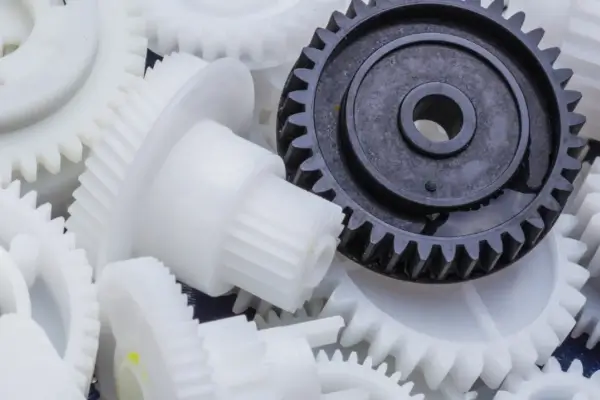
Nylon parts are widely used in:
- Mechanical transmission: gears, worm wheels, sliders
- Industrial automation: guides, rails
- Automotive: bushings, connectors, clips
- Electrical systems: insulating components
- Food machinery: wear-resistant parts (food-grade nylon)
- Fixtures and tooling
These applications require lightweight, low-noise, wear-resistant, impact-resistant materials—nylon fits perfectly.
How We Ensure High Precision in Nylon Machining?
To stably produce high-precision nylon parts, a systematic solution is required:
- Equipment Capability: We adopt constant-temperature machining technology to effectively suppress thermal deformation by precisely controlling the processing environment temperature, ensuring long-term dimensional stability of parts.
- Material Preprocessing Capability: We are equipped with professional raw material pre-drying equipment to reduce the initial moisture content before processing. Because nylon can reabsorb water during storage and service, conditioning and inspection must match the agreed environment; drying alone does not prevent dimensional deviations caused by moisture absorption and expansion.
- Tool Strategy: We use specialized cemented carbide or diamond-coated tools tailored to different nylon types (unreinforced or glass fiber-reinforced) and strictly implement tool life management to ensure the cutting edges are always in optimal condition.
- Precision Machining Capability: We implement a multi-step light cutting scheme to effectively prevent material stringing or melted edges by reducing single-cutting force and heat input, ensuring surface integrity.
- Tolerance Capability: With mature processes, we confirm achievable tolerances by reviewing the grade, geometry, moisture state and inspection conditions, meeting the requirements of most precision parts.
- Inspection Process: Each finished product undergoes key dimension inspections using tools such as 2D optical measuring instruments, calipers, and micrometers to ensure compliance with drawing requirements.
- Project Experience: Our engineering team has years of experience in nylon material processing and can provide end-to-end solutions—from material selection and structural optimization to processing technology—tailored to your specific application scenarios.
Conclusion
Nylon is a high-performance engineering plastic that combines strength, wear resistance, toughness, and lightweight properties. It holds an irreplaceable position in CNC machining thanks to its balance of performance, machinability, and cost.
Although nylon has challenges such as moisture absorption and thermal sensitivity, these can be fully controlled with professional machining techniques and material expertise.
Material Selection Guide
- Balanced performance & cost → PA6
- Higher strength & heat resistance → PA66
- Precision parts & humid environments → PA12
- Metal-like rigidity & strength → Glass-filled nylon
For custom CNC Plastic Parts, send your 2D drawing and 3D model with the required nylon grade, critical dimensions, service temperature and humidity, and the inspection or conditioning requirements. These details help establish a realistic machining and inspection plan before quotation.
Whether you are in the design stage, prototype development, or small-batch production, HRCCNC is ready to support your nylon CNC machining needs.
- Free material consultation
- Fast quotation—upload 2D/3D files
- DFM review to improve quality and reduce cost
Contact us today and turn your ideas into precise, high-performance parts!
Dive Deeper into Delrin
For more specialized knowledge, explore our related articles:
Delrin vs Nylon: A Detailed Comparison
FAQs
1. What is nylon?
Nylon, scientifically known as polyamide (PA), is a high-performance synthetic polymer widely used in industrial applications for its high strength, toughness, wear resistance, and self-lubricating properties.
2. What is nylon made of?
Nylon is made from chemical monomers such as caprolactam, hexamethylenediamine, and adipic acid through condensation or ring-opening polymerization. Its backbone contains characteristic amide bonds (–CO–NH–).
3. What is nylon plastic?
Nylon plastic refers to nylon in forms suitable for injection molding, extrusion, or CNC machining—typically granules, plates, or rods—distinct from nylon fibers.
4. What are the common applications of nylon?
Applications include gears, bearings, sliders, bushings, industrial structural parts, housings, automotive components, and electrical insulation parts.
5. How are nylon parts manufactured?
Nylon components are produced via injection molding (for mass production), CNC machining (for small batches or high precision), 3D printing (rapid prototyping), and extrusion (tubes, rods, profiles).
6. Is nylon toxic?
Pure nylon is non-toxic. Certain food-grade or medical-grade nylons (such as some PA12 grades) are safe for direct contact applications. However, fumes from high-temperature processing and glass-fiber dust should be avoided through proper ventilation.