Skip to content

Polypropylene (PP) is one of the most used thermoplastics. It’s featured in everything from packaging films and household goods to automotive parts and medical devices. Like other plastics, PP’s behavior under heat covers a large part of its usability.
More specifically, it’s about the melting point of polypropylene. The melting temperature lies at the core of PP’s durability, processing, and suitability across industries. Explore the temperature(s) at which thermoplastic polypropylene melts.
What’s the Melting Point of Polypropylene?
Polypropylene (PP) doesn’t melt at a single, steady, and sharp temperature. Instead, the plastic features a range that reflects its molecular structure.
Most commercial-grade PP melts at approximately 160°C – 170°C (320°F – 338°F). The range stands as the practical reference for designing, quality control, and processing.
It’s obligatory for plastic CNC machining and custom plastic component manufacturing. Such sectors rely on precise thermal data for dimensional accuracy.
Melting Point Table: Polypropylene (PP)
Polypropylene doesn’t refer to a single plastic material in industrial manufacturing. It’s more like a common family, consisting of different grades/types of PP.
And the melting ranges for common PP types also vary. Otherwise, precision plastic machining ops for consistency with different formulations becomes problematic.
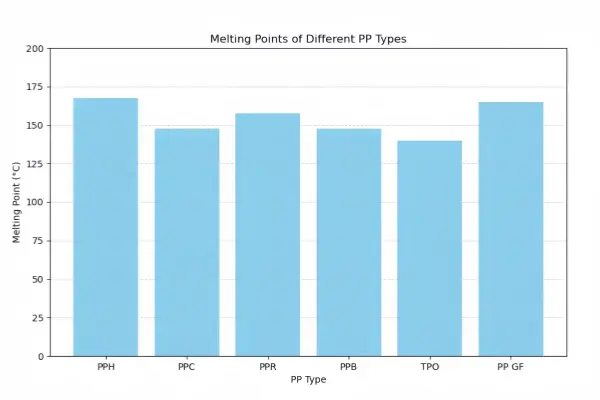
Comparison Table: Melting Point Range of Different PP Grades
| PP Type | Short Description | Melting Range (°C) | Melting Range (°F) | Exclusiveness |
| Homopolymer (Isotactic PP) | Pure PP from a single monomer + well-organized molecular structure | 162 – 170 | 324 – 338 | High crystallinity, stiffness, and chemical resistance. |
| Random Copolymer PP | PP with trace ethylene randomly incorporated into the chain | 150 – 165 | 302 – 329 | Reduced crystallinity, improved clarity, and enhanced toughness |
| Impact Copolymer (Block Copolymer PP) | PP blended with ethylene-propylene rubber domains | 155 – 165 | 311 – 329 | Higher impact strength at lower temperatures |
| Nucleated Homopolymer PP | Homopolymer PP with nucleating agents added to refine the crystal structure | 164 – 170 | 327 – 338 | Improved stiffness, dimensional stability, and cycle times |
| Filled PP (Talc, CaCO₃) | PP compounded with mineral fillers like talc or calcium carbonate | 160 – 168 | 320 – 334 | Enhanced rigidity, reduced shrinkage, and lower cost |
| Glass-Fiber Reinforced PP | PP reinforced with glass fibers | 160 – 168 | 320 – 334 | Improved dimensional stability and creep resistance |
| Syndiotactic PP (Specialty) | A specialty PP with a syndiotactic molecular arrangement | 130 – 150 | 266 – 302 | Lower crystallinity, softer, and more flexible |
| PP–PE Blends | Mixtures of polypropylene and polyethylene | 140 – 160 | 284 – 320 | Broadened melt window, improved flexibility, and balanced toughness with processability |
| Recycled PP (Post-consumer/Industrial) | PP recovered from waste streams | 150 – 168 | 302 – 334 | Properties vary depending on contamination, blending, and processing history |
The given values represent standard peak DSC (Differential Scanning Calorimetry) ranges for commercial grades. Implement them as a design and processing reference rather than a single fixed temperature.
Melting Point vs Softening Temperature of Polypropylene (PP)
The melting point remains around 160°C – 170°C (320°F – 338°F), where the PP crystals fully liquefy. The softening temperature, meanwhile, is notably lower. Melting point (Tm) refers to the temperature at which the PP atomic structure breaks down, transitioning into a fully molten state.
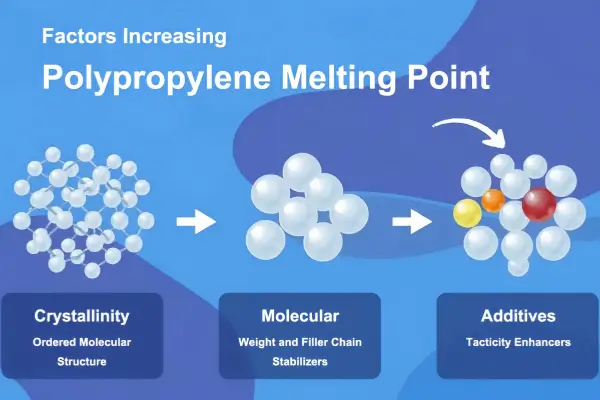
Meanwhile, softening temperature (Ts) denotes the temperature at which PP begins to lose its shape or rigidity under load, without melting. Manufacturers involved in precision machining measure Ts with Vicat Softening Temperature (VST) or Heat Deflection Temperature (HDT).
Vicat Softening Temperature is 150°C for homopolymer PP. And the glass transition temperature is 0°C – 10 °C, where amorphous regions become rubbery.
Does Polypropylene (PP) Always Melt at the Same Temperature?
Polypropylene (PP) doesn’t melt at a single fixed temperature. More importantly, the exact melting profile varies across grades and formulations.
In industrial practices, “melting point” is seen as a shorthand for a peak DSC melting temperature. But onset and endset temperatures mark a broader transition that shifts with material structure.
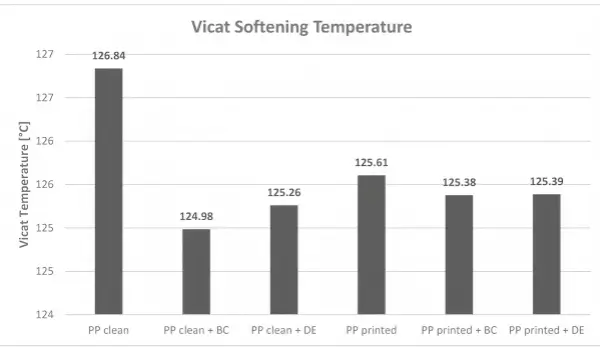
Factors Influencing PP Melting Point
1. Copolymer versus Homopolymer
Homopolymer PP (usually isotactic) melts toward the upper end (162°C – 170 °C). Random and impact copolymers with disrupted structures lower or broaden the melting range (150°C – 165°C).
This particular variability holds great significance in plastic CNC machining + custom plastic component manufacturing. It’s because different PP grades demand tailored thermal and machining strategies.
2. Additives and fillers
Nucleating agents increase crystallization. It sharpens the melting peak and slightly nudges it upward for an improved dimensional stability in precision plastic machining.
Mineral fillers (talc, CaCO₃) and glass fibers leave the melting point near the standard range. It also alters cooling rates and crystallization kinetics, affecting the apparent transition in tests and CNC plastic machining.
Stabilizers and pigments can shift crystallization behavior for custom plastic manufacturing. The induced changes in the melting point are subtle throughout the melting profile.
3. Processing History
Fast cooling reduces crystallinity in plastic manufacturing. It lowers the subsequently measured point while broadening the transition. Flow-induced crystallization during injection/extrusion creates oriented structures.
Those plastic components may melt over a different profile. Post-processing thermal exposure (annealing) can tighten the melting range. It can even raise the peak Tm slightly in CNC machining.
Expert Recommendations for Consistent Production
Don’t use “PP” generically. Match homopolymer/copolymer and nucleation to your property targets. Also, confirm the melting range and processing temperatures in the datasheet.
Always prefer DSC. Record onset, peak, and endset melting point. Also, correlate the range with crystallization temperature (Tc), MFR/MFI, and mechanical tests for reliable QC.
Adjust for thermal conductivity. Fillers and glass fibers change heat transfer and crystallization kinetics. Ask the engineers to adapt the gate design, packing, and cooling to avoid warpage.
Separate melting from service limits via Vicat/HDT. The melting range indicates full phase change. So, define the service temperatures through softening specs + loading stats.
What Happens When Polypropylene (PP) Is Heated?
Polypropylene (PP) undergoes a series of distinct transitions when heated. The plastic’s behavior under heat is shaped by its atomic structure. The simplified sequence – Solid → Softening → Molten Behavior.
PP remains rigid (solid state) from room temperatures up to 80°C – 100°C. It also retains the mechanical strength. In this range, PP can resist many chemicals to maintain the dimensional stability.
As PP approaches Vicat softening temperature (150 °C), it begins to lose rigidity. Some parts become rubbery in the softening phase (100°C – 150°C). Also, the material can deform under stress.
Atomic structure breaks down in the molten state (160°C – 170°C / 320°F – 338 °F). And PP transitions into a fully molten state. The polymer chains become mobile, allowing PP to be shaped.
Melting Point Comparison: Polypropylene vs Other Plastics
| Plastic | Melting Point (°C) | Melting Point (°F) | Notable Applications |
| Polypropylene (PP) | 160 – 170 | 320 – 338 | Packaging, automotive, textiles, medical devices |
| Low-Density Polyethylene (LDPE) | 105 – 115 | 221 – 239 | Flexible films, grocery bags, squeeze bottles |
| High-Density Polyethylene (HDPE) | 130 – 137 | 266 – 279 | Rigid containers, pipes, toys |
| Polyethylene Terephthalate (PET) | 250 – 260 | 482 – 500 | Beverage bottles, fibers, and engineering films |
| Polyvinyl Chloride (PVC) | 100 – 260 (softens, decomposes before true melt) | 212–500 | Pipes, flooring, cables |
| Polystyrene (PS) | 240 (softens near 90 – 100°C) | 464 | Packaging, disposable cutlery |
| Nylon (Polyamide 6,6) | 255 – 265 | 491 – 509 | Automotive, textiles, industrial parts |
Applications of Polypropylene (PP) Melting Point
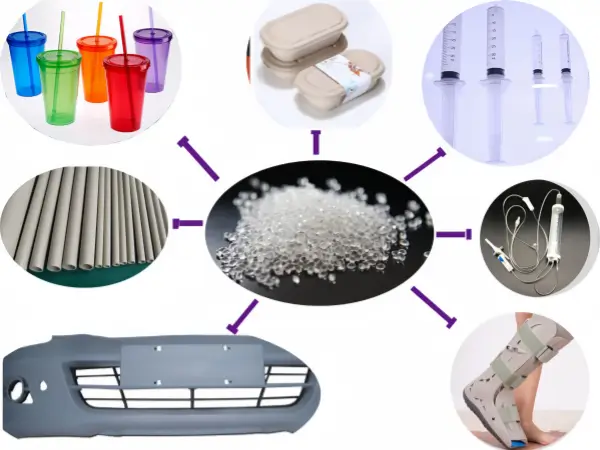
PP’s melting point lets hot-fill containers withstand liquids filled at 85°C – 100°C without collapsing. Controlled melting enables biaxial orientation. Such a mechanism produces strong yet lightweight packaging films.
Impact copolymer PP is molded at 200°C – 230°C, leveraging its melting point for complex geometries in interior + exterior parts. Cabin parts must survive 85°C – 95°C. And PP’s melting point ensures dimensional stability under these conditions.
PP’s melting point supports gamma sterilization. It has uses in medical devices like syringes, IV components, and disposable medical containers. PP fibers are produced by heating above 190 °C for stable rheology. It primarily suits hygiene products, carpets, and geotextiles.
PP’s melting point supports molding of housings and components that withstand moderate heat. Containers, furniture, and many toys benefit from PP’s balance of rigidity and melt processability.
Safety Concerns While Heating Polypropylene (PP)
Pure PP is chemically stable. It doesn’t release harmful substances when heated to typical service or processing temperatures.
PP is readily favored in food packaging and containers as it doesn’t leach toxic chemicals under normal heating conditions.
Regulatory agencies such as the FDA (US) and EFSA (EU) approve PP for food applications, reinforcing its safety when used correctly.
Risks When Overheated
At 270°C – 300°C, PP undergoes chain scission and oxidation (thermal degradation). The process creates volatile organic compounds (VOCs) and potentially irritating fumes. Overheating of PP causes yellowing or browning, along with loss of impact strength.
Like most plastics, PP is highly combustible. Excessive heating can lead to ignition if exposed to open flame or poor ventilation. PP with additives (pigments, stabilizers, fillers) releases harmful compounds. Poorly stabilized PP can emit aldehydes or hydrocarbons during degradation.
Conclusion
In summary, polypropylene’s melting point is anchored in the 160°C – 170 °C (320°F – 338°F) range. The thermal properties directly shape how the polymer is processed and applied across industries. PP’s thermal behavior, when appropriately understood, guarantees reliability, efficiency, and innovation.
Melting’s correlation to softening and degradation allows engineers, manufacturers, and designers to balance cost, performance, and safety with PP products. However, the use of polypropylene components must remain within safe limits to avoid potential overheating hazards.
Custom Manufacturing of Plastic Parts Available at HRCCNC
HRCCNC possesses in-depth expertise in balancing material properties with processing techs. We provide a broad range of plastic products in compliance with global standards. Our 18 years of experience in the machining industry ensure you receive the best CNC plastic products. Contact us to know further details.