Skip to content

Carbon fiber continues to get preference as an alternative to many regarding strength-to-weight parts. However, its staggering price almost immediately raises eyebrows among clients.
Carbon fiber guarantees performance, sustainability, and competitive advantage. The high cost sparks hesitation, forcing clients to ask – Why is carbon fiber so expensive, and is the investment worthy?
This article unpacks the pricing of carbon fiber and the factors that drive it up. Strategic B2B trade-offs with buyers get simple by knowing when CNC carbon fiber is worth the premium.
An Overview: What is Carbon Fiber?
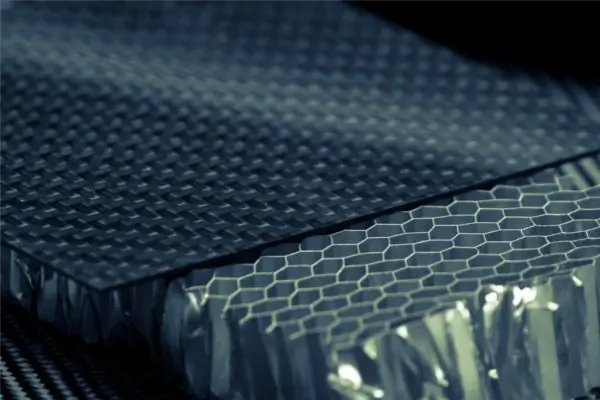
Carbon fiber is a synthetic fiber. It features thin but strong crystalline filaments of carbon atoms. Those fibers, bundled together, get woven into fabrics or combined with resins to form carbon fiber-reinforced polymers (CFRPs).
Key Carbon Fiber Properties
Tensile strength measures about 500 – 700 ksi, compared to aluminum’s 40 – 70 ksi. Its density is 1.6 g/cm³, significantly lighter than aluminum (2.7 g/cm³) and steel (7.8 g/cm³). carbon fiber is extremely rigid in terms of stiffness for structural applications.
Unlike metals, carbon fiber doesn’t rust or degrade easily. Its thermal expansion is very low (dimensional stability under temperature changes). Lightweight fiber reduces fuel consumption in planes and cars in compliance with sustainability.
As per Global Carbon Fiber Market Forecast (2026 – 2031), the growing demand is expected to reach 562.77 kilotons by 2031 with an 18.06% CAGR. And Asia-Pacific has been the fastest-growing market.
Carbon Fiber Applications
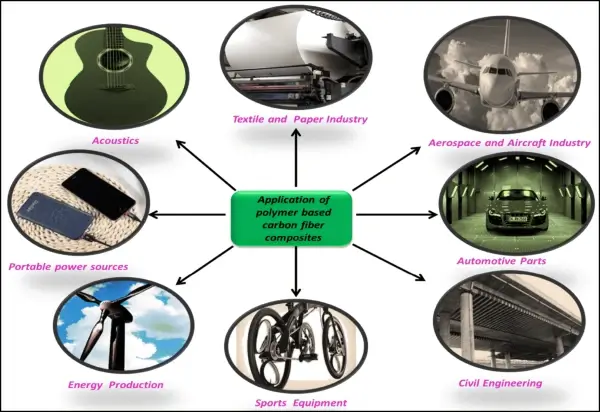
The increasing push for carbon fiber comes from high-end industries like automobile, aviation, sports, and even medical. Boeing 787 Dreamliner (aircraft) uses 50% carbon fiber composites to reduce weight and fuel consumption.
BMW i3 and Lamborghini Aventador (automotive) incorporate carbon fiber for lightweight performance. Precision-machined wind turbine blades (renewable energy) increasingly rely on carbon fiber for strength and efficiency.
High-end bicycles, tennis rackets, and golf clubs are choosing carbon fiber for better performance. Prosthetics and surgical instruments benefit from their lightweight-ness and biocompatibility.
How Much Does Carbon Fiber Cost?
Carbon fiber costs vary widely depending on grade, form, and application. As expected, B2B buyers looking for alternate CNC precision machining mostly go for lower prices through bulk contracts.
Raw Carbon Fiber (per kg)
Commercial PAN fiber costs $10 – $20/kg (automotive and sporting goods). It’s higher for standard modulus fiber ($20 – $30/kg). And high-modulus (aero-grade) fiber costs $40 – $50/kg or more. Precursor material (PAN vs pitch), production process, and demand cycles directly influence the price.
Carbon Fiber Fabric (per square meter)
You can get basic woven fabric at $20 – $40/m². Intermediate modulus fabric is available for $50 – $70/m². However, specialized aerospace fabric costs about $80 – $100/m². Fabric costs rise with tighter weaves, higher modulus, and prepreg (pre-impregnated resin) treatments.
Carbon Fiber Composite Parts
Automative parts (like hoods or panels) cost $200 – $500 per part. It gets to $500 – $1,000+ per part for aerospace-grade components, depending on complexity. You can even opt for per kg basis. Automative parts costs $200 – $500/kg for resin infusion, curing, machining, and quality assurance.
Bulk contracts and long-term supply agreements reduce costs significantly. Aerospace and automotive OEMs can negotiate at lower rates. Hobbyists, small workshops, and consumer markets pay 2–3x more.
What Cost Drivers Make Carbon Fiber Expensive?
Carbon fiber’s high cost originates from the energy-intensive processing of costly raw materials with complex equipment. Even the global supply chains are tightly controlled by a few custom part manufacturers.
PAN Production
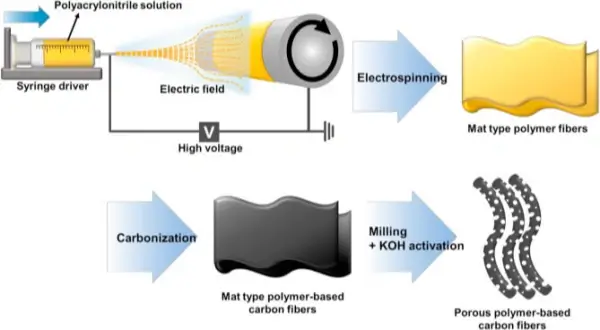
Polyacrylonitrile (PAN) is the primary precursor for carbon fiber (it accounts for 90% – 95% of the total production). That’s why the PAN contributes to carbon fiber’s high price. PAN comes from petroleum-based chemicals, which are high-priced.
It’s sensitive to global oil market fluctuations. The produced PAN must hold extreme purity for consistent fiber quality. Impurities compromise tensile strength and stiffness. PAN precursor alone can represent 50% or more of the total carbon fiber production cost (Source: Upscaling the Production of Polyethylene-Based Precursor Fibres for Carbon Fibre Manufacturing: Challenges and Solutions, 2025).
Japan’s Toray Industries is the world’s largest carbon fiber producer. The company invests heavily in PAN precursor plants to stabilize costs. Businesses in precision machining may consider alternatives like lignin-based carbon fiber.
Manufacturing Process
Carbon fiber production is energy-intensive and technologically complex. The process involves several high-temperature steps. Only a few highly advanced CNC machining operations are comparable in complexity.
PAN fibers need to be oxidized at 200–300°C for several hours (stabilization). The fibers get heated to 1,000–3,000°C in an inert atmosphere (carbonization). Fibers undergo chemical treatments to improve bonding (including surface treatments). They require specialized furnaces and continuous processing.
Growing energy prices across Europe have significantly increased the production costs. Government subsidies in China are helping local firms to scale custom CNC part production.
Low Production Volume
Manufacturers still produce carbon fiber in relatively low volumes compared to metals like steel or aluminum. And low-volume production by CNC machining brands limits economies of scale.
Limited production runs mean fixed costs (equipment, labor, certification) are distributed across fewer units. And it raises the per-unit price to a staggering amount.
Modern aerospace and advanced defense consume a large share of high-grade carbon fiber. It leaves a limited supply for the automotive and consumer industries.
However, recycling initiatives (recycled carbon fiber or RCF) are growing. It can offer 20% – 40% cost savings. Nonetheless, the quality is not yet on par with virgin fiber.
Factors Affecting Carbon Fiber Price
Though the price is considered high almost universally, the price range varies as discussed already. Several factors related to the desired properties for the intended uses alter the pricing.
a. Fiber Grade (Standard vs Aerospace)
CNC manufacturers categorize carbon fiber into standard-grade (industrial/commercial) and aerospace-grade fibers. Your choice of the grade exerts a direct impact on cost.
Standard grade fibers serve automotive, construction, and consumer goods. It should cost about $10 – $20 per kg for raw fiber.
Aerospace grade fibers require higher purity, tighter tolerances, and advanced processing. It costs $40 – $50 per kg or even more.
b. Modulus and Strength
Carbon fibers are also classified by modulus (stiffness) and tensile strength. And the specifications based on your precision machining needs directly influence the price.
Standard modulus (SM) delivers around 230 GPa stiffness in automotive and sports. Intermediate modulus (IM), with about 300 GPa stiffness, takes a higher cost due to enhanced performance.
High modulus (HM) of around 400 GPa stiffness goes in aerospace and defense (premium price). Ultra-high modulus (UHM), with 450+ GPa stiffness, is rare and more expensive ($100+ per kg).
Wind turbine blades use intermediate modulus fibers for strength and fatigue resistance. High modulus fibers in satellite structures grant dimensional stability like high-end CNC components.
c. Resin System
Modern projects barely use carbon fiber as a standalone material. It’s combined with resins to form carbon fiber-reinforced polymers (CFRPs). And the choice of resin system significantly affects pricing.
Epoxy resins are the most common with strong bonding and durability. Somewhat cost-effective but still adds $20 – $50/kg to composite price.
Thermoplastic resins are more expensive with limited recyclability and faster processing. It’s getting more attention in CNC automotive applications.
High-temperature resins (polyimides) also introduce substantial expense due to specialized curing processes in aerospace/defense.
d. Certification and Testing Requirements
Certification may not pop up in your mind when it comes to material pricing. However, it’s one of the largest hidden cost drivers, especially in the aerospace industry.
FAA, EASA, and military specifications require exhaustive testing for every batch. Certification can add 20% – 30% alone to total production costs.
Mechanical testing, fatigue analysis, and environmental exposure tests are mandatory. North America leads in certified aerospace-grade carbon fiber.
Conclusion
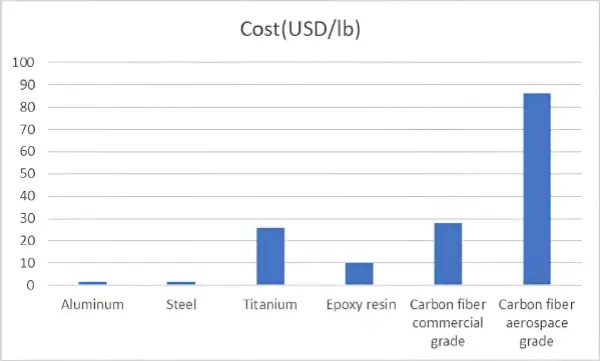
Carbon fiber’s high price revolves around the expensive + extensive processing of costly raw materials. Nonetheless, it justifies the precision, energy, and performance to outperform steel, aluminum, and even titanium. Manufacturers as well as clients must look into project specifications by deciding on PAN precursors, manufacturing complexity, production volumes, resin systems, and certification needs. Only a well-balanced approach with carbon fiber can make the high investment worth every penny.
Premium Carbon Fiber Composites for Your Needs at HRCCNC
HRCCNC specializes in some of the most advanced manufacturing materials like carbon fiber composites. We offer a perfect balance of specs, properties, and cost implications. Our 18 years of presence in the CNC machining industry are commended by innovation and satisfaction. Contact us to know further details.