Skip to content

A CNC router is a high-speed cutting machine primarily used for softer materials and sheet processing, while a CNC milling machine is a precision machining system designed for harder materials, deeper cuts, and the production of tight-tolerance parts. CNC routers cut wood, acrylic, foam, MDF, and composite panels over large work areas with rapid spindle speeds, whereas CNC milling machines cut steel, titanium, brass, molds, aerospace components, and precision industrial parts with greater cutting forces and more stable machining conditions.
The differences between CNC routers and CNC milling machines mainly involve material compatibility, machining precision, spindle speed, torque capability, work area size, production cost, and manufacturing applications. Routing systems generally prioritize faster sheet processing and lower operating costs for softer materials, whereas milling systems focus on high-precision machining, controlled feed pressure, and the production of complex parts in industrial manufacturing environments.
What are the Core Differences Between a CNC Router and a CNC Milling Machine?
A CNC router cuts softer materials at high speed across a large work area, while a CNC milling machine cuts harder materials with greater rigidity, higher cutting forces, and higher precision. These differences can be better understood by comparing their key features side by side.
| Factor | CNC Router | CNC Milling Machine |
| Definition | High-speed machine for softer materials and sheet cutting | High-rigidity machine for precise machining of harder materials |
| Machine Structure | Gantry-style open frame | Rigid closed-frame structure |
| Cutting Tool Movement and Axis | Fast multi-axis movement with lighter force | Controlled multi-axis movement with higher cutting force |
| Rigidity and Stiffness | Lower rigidity | Higher rigidity and stiffness |
| Depth of Cut and Force Handling | Shallow cutting capability | Deep cutting capability |
| Speed vs Torque Capability | High spindle speed, lower torque | Lower spindle speed, higher torque |
| Material Compatibility | Wood, plastic, foam, soft aluminum | Steel, titanium, stainless steel, hard alloys |
| Precision and Tolerance | Moderate accuracy | High precision and tight tolerance |
| Work Area and Size | Large work area for panels and sheets | Smaller work area for precise parts |
| Applications | Woodworking projects, signage, panels | Industrial parts, molds, and precise parts |
| Cost and Efficiency | Lower investment and faster sheet production | Higher investment with accurate, repeatable production |
Machine Structure
Unlike CNC milling machines that use rigid, enclosed frames, CNC routers rely on lightweight gantry structures to enable large work-area movement and faster routing operations. The open machine structure of routing machines supports woodworking projects, cabinet panel production, and signage production across large surfaces. Milling systems maintain stiffness when machining steel and titanium. This structural variation affects vibration control, machining stability, and production accuracy in aerospace manufacturing and mold production.
Cutting Tool Movement and Axis
Compared to CNC milling machines that prioritize controlled multi-axis machining, CNC routers move the cutting tool at a higher speed across larger workpieces and sheet materials. CNC routers use rapid X, Y, and Z-axis travel for routing wood, plastic sheets, decorative panels, and acrylic products. In contrast, CNC milling machines support deeper tool paths for precise machining of parts. This movement difference affects surface finish and dimensional control in tooling systems, engraving, and industrial manufacturing.
Rigidity and Stiffness
Higher rigidity allows CNC milling machines to handle greater cutting force, while CNC routers use lighter structures designed for faster movement and softer materials. Routing systems maintain efficient routing performance across wood, MDF, and composite panels using lower structural stiffness. On the other hand, milling systems reduce vibration during metal machining through reinforced construction. This rigidity difference supports the production of precise parts in industrial machining, tooling, and heavy-duty fabrication environments.
Depth of Cut and Force Handling
While CNC routers use shallow cutting passes for rapid material removal, CNC milling machines perform deeper cuts with greater torque and controlled feed pressure. CNC routers commonly process acrylic, wood, and composite panels with a lighter cutting force to maintain spindle efficiency. Meanwhile, CNC milling machines are used to mill aluminum, steel, and titanium components using a stable cutting depth. This machining capability supports decorative routing, mold production, and industrial material processing applications.
Speed vs Torque Capability
Higher spindle speeds benefit CNC routers in sheet-cutting applications, whereas CNC milling machines require greater torque for machining dense materials and complex parts. Many CNC routers operate between 12,000 RPM and 24,000 RPM, while CNC milling machines commonly operate between 2,000 RPM and 10,000 RPM, depending on material hardness and tooling requirements. As a result, CNC milling machines deliver greater cutting forces for precise metal machining. This performance difference supports furniture production, automotive fabrication, and industrial steel component manufacturing.
Material Compatibility
Soft materials are commonly suited to CNC routers, while harder materials require the rigidity and machining stability provided by CNC milling machines. CNC routers machine wood, foam, acrylic, MDF, and composite panels using high-speed spindle rotation and low cutting forces. CNC milling machines process brass, titanium, steel, and hardened alloys during industrial machining operations. This material compatibility difference affects signage production, woodworking projects, aerospace manufacturing, and automotive fabrication.
Precision and Tolerance
Greater machining precision distinguishes CNC milling machines from CNC routers in applications that require tight tolerances and repeatable accuracy. CNC routers commonly maintain tolerances between ±0.005 inch and ±0.02 inch in woodworking and sheet-cutting applications, while CNC milling machines may achieve tolerances between ±0.001 inch and ±0.005 inch for precise industrial parts. When comparing these two, milling systems provide a stable surface finish and precise measurements during industrial parts production. This tolerance difference supports aerospace machining, mold manufacturing, medical component production, and precision engineering operations.
Work Area and Size
Large-format production environments typically favor CNC routers, while compact precision machining environments rely more on CNC milling machines. Router setups support oversized table configurations for signage manufacturing, furniture production, and sheet material processing. CNC milling machines prioritize spindle stability and rigid machining zones instead of open work area capacity. This size difference affects woodworking operations, tooling systems, and industrial manufacturing involving complex metal components.
Applications
Different manufacturing objectives determine whether CNC routers or CNC milling machines provide better machining efficiency and production performance. CNC routers produce carved furniture parts, decorative wood panels, acrylic signage, and sheet-based products using rapid routing movement. Metal machining systems manufacture engine components, molds, dies, and aerospace parts requiring high precision. This application difference affects the woodworking industry, automotive production, and industrial machining environments.
Cost and Efficiency
Lower machine investment commonly makes CNC routers more suitable for high-speed sheet production, whereas a CNC milling machine requires greater investment for rigid construction and precise machining capability. CNC routers reduce operating costs in wood-plastic processing through faster routing operations and simpler machine structures. In contrast, CNC milling machines depend on stable machining systems and advanced spindle control. Manufacturers often compare CNC machining costs when selecting equipment for industrial production or prototyping workflows.
What Are the Operational Differences Between a CNC Router and a CNC Milling Machine?
A CNC router operates at high spindle speeds with lighter cutting passes for rapid sheet processing and softer materials, while a CNC milling machine uses greater torque, controlled feed pressure, and greater machining rigidity for harder materials and precise part production. These operational differences affect tooling, maintenance, safety, power consumption, upgrade flexibility, machine downtime, production scalability, and workflow efficiency across woodworking shops, signage production, prototyping environments, and industrial machining facilities.
Tooling Types
CNC routers primarily use router bits for high-speed cutting of softer materials and for decorative applications, while CNC milling machines use heavy-duty milling cutters, such as end mills, face mills, and drill bits, for precise metal machining. CNC routers support engraving bits, compression bits, and carving tools for processing wood and plastic. CNC milling machines handle accurate parts production with greater cutting stability and controlled machining performance. Tool selection directly affects surface finish, machining precision, and material compatibility.
Maintenance Requirements
CNC routers require simpler maintenance, with frequent spindle and table cleaning during high-volume woodworking operations, whereas CNC milling machines require precision calibration, coolant management, lubrication checks, and periodic alignment inspections to maintain stable metal machining performance. CNC routers commonly require daily or weekly cleaning because of dust and debris buildup. CNC milling machines depend on scheduled maintenance routines to maintain machining accuracy, reduce downtime, and support long-term production efficiency.
Safety Considerations
CNC routers generate high dust levels, airborne debris, and elevated spindle noise during wood and plastic routing operations, while CNC milling machines produce sharp metal chips and exert greater cutting forces during metal machining. CNC routers commonly require dust collection systems and hearing protection. CNC milling machines depend on protective guarding and controlled material handling. These safety differences affect operator protection procedures, workplace cleanliness, and machine setup requirements.
Power Consumption
CNC milling machines consume more power due to high-torque spindles, rigid machine construction, and the demands of cutting hard metals, whereas CNC routers typically operate with lower power requirements for high-speed machining of softer materials such as wood and plastic. CNC routers are more energy-efficient during sheet processing and large panel production. CNC milling machines require additional energy for coolant systems, spindle control, and heavy-duty metal cutting, which affects operating costs and production planning.
Upgrade and Flexibility
Greater modular flexibility makes CNC routers easier to modify compared to CNC milling machines that commonly use fixed machine structures with limited upgrade options. Routing systems support spindle upgrades, rotary attachments, vacuum tables, and tool expansion for woodworking projects and signage production. Milling systems prioritize machining stability instead of flexible machine configurations. This upgrade difference affects production scalability, workflow expansion, and manufacturing adaptability.
How CNC Router Works?
A CNC router cuts and shapes softer materials using a high-speed spindle and computer-controlled axis movement. Machining begins with a digital design created in computer-aided design (CAD) software. CAM software then converts the design into numerical G-code instructions that control spindle speed, cutting depth, tool path, and machine movement during routing operations. CNC routers process wood, acrylic, MDF, foam, and composite panels for signage production, furniture manufacturing, and decorative panel machining.
CNC Router Working Process:
- CAD Design Creation: The process begins with CAD software, where the required part, pattern, or product layout is designed digitally.
- CAM Software Conversion: CAM software converts the CAD design into G-code instructions that guide the CNC router during machining.
- G-Code Loading: The generated G-code loads into the CNC router control system to define spindle speed, cutting depth, feed rate, and tool movement.
- Axis Movement and Gantry Motion: The gantry system moves the cutting tool along the X, Y, and Z axes while the workpiece remains fixed on the machine table.
- High-Speed Material Cutting: The spindle rotates at high speed, removing material gradually through shallow cutting passes to achieve smooth, accurate routing.
- Finished Part Production: The CNC router completes cutting, engraving, carving, or panel shaping based on the programmed machining instructions.
How CNC Milling Machine Works?
A CNC milling machine removes material from a workpiece using rotating cutting tools and computer-controlled instructions to produce precise, complex metal parts. Machining begins with a digital CAD model that defines the geometry and dimensions of the required component. CAM software converts the design into numerical G-code instructions that control spindle speed, feed rate, cutting depth, machining sequence, and tool movement during production. CNC milling machines commonly process steel, titanium, aluminum, brass, and hardened alloys for aerospace manufacturing, tooling systems, mold production, and industrial machining applications.
CNC Milling Machine Working Process:
- Digital Part Design and Programming: Engineers create a CAD model of the required component, and CAM software generates machining instructions for the milling operation.
- Machine Setup and Tool Loading: Operators secure the workpiece, install cutting tools, and configure spindle speed, feed rate, coolant flow, and machining parameters.
- Multi-Axis Machining Movement: The CNC milling machine controls synchronized movement along 3, 4, or 5-axis configurations for precise tool positioning.
- Controlled Material Removal: Rotating cutting tools remove material using stable feed pressure, deeper cutting passes, and controlled machining forces to achieve dimensional accuracy.
- Automatic Tool Changes and Finishing: Many CNC milling machines automatically switch tools during machining to perform drilling, slotting, contouring, and surface finishing operations.
- Precision Part Completion: The machine completes high-precision machining for molds, aerospace components, engine parts, tooling systems, and industrial metal components.
What Are the Advantages and Disadvantages of CNC Router and CNC Milling Machine?
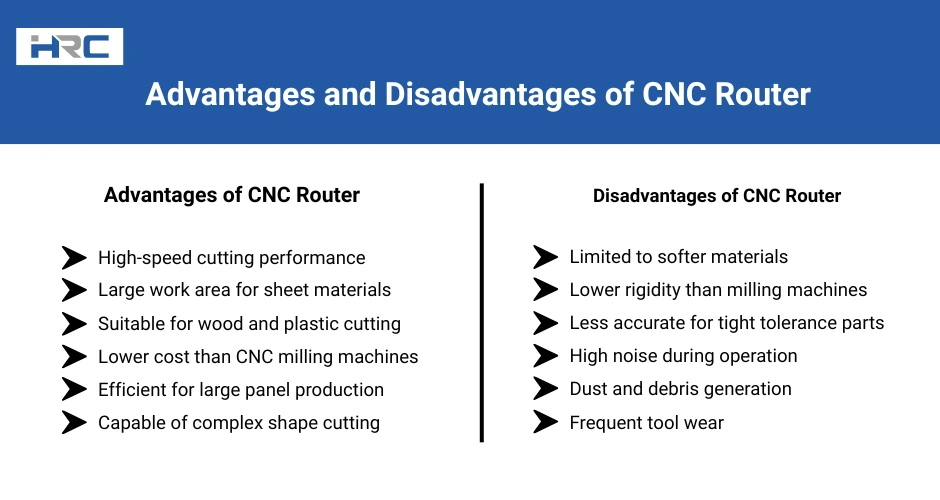
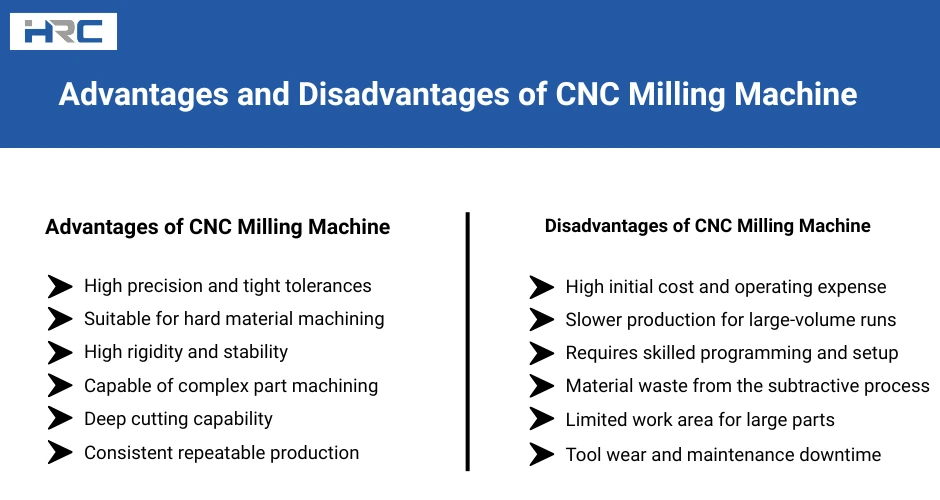
CNC routers offer advantages such as high-speed cutting, support for large work areas, lower operating costs, and efficient sheet material processing, while CNC milling machines provide high precision, deeper cutting capability, greater machining rigidity, and accurate production of complex metal parts. Because both machines are designed for different production requirements, their operational limitations also vary significantly. CNC routers face challenges in rigidity and tight-tolerance machining, whereas CNC milling machines involve higher investment, slower large-volume production, and greater maintenance requirements in industrial manufacturing environments.
Advantages of CNC Router
- High-speed cutting performance: High spindle speeds ranging from 12,000 RPM to 18,000 RPM allow CNC routers to process sheet materials rapidly, improving production efficiency in woodworking projects, cabinet manufacturing, signage production, and large-panel machining operations.
- Large work area for sheet materials: CNC routers use large table configurations to efficiently process cabinet panels, acrylic sheets, plywood, MDF boards, and oversized workpieces for furniture production, signage manufacturing, and large-panel routing operations.
- Suitable for wood and plastic cutting: CNC routers machine wood, MDF, foam, and composite materials efficiently using rapid spindle movement and lighter cutting force.
- Lower cost than CNC milling machines: Compared to CNC milling machines, CNC routers are more affordable because they use lighter machine structures, lower cutting forces, and simpler machining systems for softer materials.
- Efficient for large panel production: Through rapid gantry travel and high-speed routing movement, CNC routers support continuous sheet processing and steady output during furniture production, cabinet manufacturing, and repetitive panel-cutting operations
- Capable of complex shape cutting: Multi-axis routing enables CNC routers to produce decorative carving, engraving, curved edges, intricate patterns, and detailed shape cutting across wood, acrylic, foam, and composite materials.
Disadvantages of CNC Router
- Limited to softer materials: Lower cutting forces restrict CNC routers from efficiently machining hardened steel and dense industrial alloys.
- Lower rigidity than milling machines: CNC routers use lighter machine structures, which may increase vibration during machining and affect cutting stability, dimensional accuracy, and surface finish.
- Less accurate for tight tolerance parts: Moderate precision limits CNC routers in applications requiring extremely accurate measurements and repeatable industrial machining.
- High noise during operation: Rapid spindle rotation and continuous high-speed routing cause CNC routers to generate elevated noise levels during woodworking, acrylic cutting, and sheet-processing operations.
- Dust and debris generation: Airborne dust and routing debris commonly accumulate during CNC router operations on wood, MDF, acrylic, and composite materials, increasing cleaning requirements and affecting workplace conditions.
- Frequent tool wear: Router bits may require replacement weekly during continuous production runs and high-speed sheet processing operations.
Advantages of CNC Milling Machine
- High precision and tight tolerances: Controlled machining conditions enable CNC milling machines to produce precise parts with a stable surface finish and repeatable accuracy.
- Suitable for hard material machining: High rigidity and cutting force support machining of steel, titanium, brass, and hardened industrial alloys.
- High rigidity and stability: Reinforced machine structures reduce vibration and maintain stable cutting performance during heavy-duty machining operations.
- Capable of complex part machining: Multi-axis machining supports molds, aerospace parts, engine components, and detailed industrial part production.
- Deep cutting capability: Higher torque and controlled feed pressure enable deeper cuts across dense metal materials.
- Consistent repeatable production: Automated machining control maintains dimensional consistency across batch production and industrial manufacturing workflows.
Disadvantages of CNC Milling Machine
- High initial cost and operating expense: Rigid machine construction, advanced spindle systems, and precision components increase equipment and maintenance costs.
- Slower production for large-volume runs: Controlled machining speeds may help keep operating costs under control during large-scale sheet production.
- Requires skilled programming and setup: Complex manufacturing tasks often require experienced operators for tool setup, programming, and process calibration.
- Material waste from the subtractive process: Metal machining removes excess material during cutting, which can increase raw material waste in some production environments.
- Limited work area for large parts: Compact machining zones restrict processing capacity for oversized panels and large-format workpieces.
- Tool wear and maintenance downtime: Continuous metal machining can accelerate tool wear and necessitate scheduled maintenance to maintain machining accuracy.
Which is Better, CNC Router vs CNC Milling Machine for Your Needs?
CNC routers are better suited for high-speed processing of sheet materials and softer materials, while CNC milling machines are more suitable for precise machining of harder materials and complex industrial components. Production workflow, tolerance expectations, cutting depth requirements, and workpiece dimensions usually determine which machine best fits a specific manufacturing environment. No single machine is universally better because machining requirements, material type, and production goals vary across woodworking, prototyping, signage production, and industrial manufacturing operations.
When Should You Choose a CNC Router Over a CNC Milling Machine?
CNC routers are more suitable for woodworking projects, signage production, cabinet manufacturing, and acrylic sheet processing that require large work area coverage and rapid production speed. Their high-speed routing capability and large-format machining support efficient sheet processing, repetitive panel cutting, and cost-effective production of softer materials across manufacturing environments.
Below are the common situations where CNC routers are preferred:
- Woodworking and Furniture Production: CNC routers process plywood, MDF, hardwood, and composite boards efficiently for furniture manufacturing and decorative panel cutting.
- Signage and Acrylic Sheet Processing: Large work areas support acrylic cutting, engraving, foam shaping, and signage production, with high-speed routing.
- Large Panel and Sheet Material Cutting: CNC routers handle oversized panels and continuous sheet processing for cabinet manufacturing and repetitive production workflows.
- Soft Material Machining: Businesses working with wood, foam, plastics, and soft aluminum benefit from faster machining and lower operating costs.
- High-Speed Production Requirements
Rapid gantry movement and continuous routing help maintain steady output during high-volume panel cutting.
When Should You Choose a CNC Milling Machine Over a CNC Router?
Choose a CNC milling machine when production requires machining steel, titanium, hardened alloys, deep cuts, tight-tolerance parts, and complex metal components. Aerospace manufacturing, mold production, tooling systems, and precision engineering environments rely on stable cutting forces and controlled machining conditions to achieve accurate, repeatable results. A CNC milling machine also supports repeatable accuracy and detailed surface finish requirements for high-precision industrial parts.
Can a CNC Router and a CNC Milling Machine Work Together in One Production Workflow?
Yes, CNC routers and CNC milling machines often work together in integrated manufacturing workflows to improve production speed, machining accuracy, and material-processing efficiency. Many manufacturers use CNC routers for rapid sheet cutting, large-panel processing, and initial material shaping before transferring parts to CNC milling machines for detailed machining and precision finishing.
Within the same production setup, CNC routers commonly handle rough cutting and high-speed processing of wood, plastic, composite panels, and soft aluminum. CNC milling machines then perform tight-tolerance machining, deep cuts, detailed surface finishing, and the production of complex components for industrial parts, molds, tooling systems, and precision engineering applications.