Skip to content

What is Washer Hardware?
Definition and Basic Functions of Washers
Washer hardware refers to thin, disc-shaped mechanical components with a central mounting hole, essential auxiliary parts in industrial assembly and fastener systems. As fundamental fastening accessories, washers are widely used to assist bolts, nuts and other fasteners in completing stable connection operations. The core basic functions of washer hardware include uniform pressure distribution, surface protection, gap adjustment, friction reduction and vibration buffering. It can effectively prevent the bolt head or nut from directly squeezing the workpiece surface, avoid indentation, abrasion and structural damage, and improve the overall stability of mechanical connections. Different washer type designs correspond to different functional scenarios, covering ordinary fastening, anti-loosening, shock absorption, sealing and precision assembly fields.
Matching Principle of Washers and Bolts
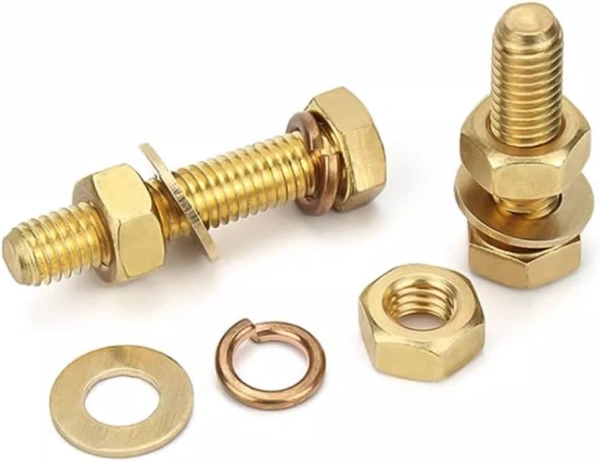
The coordination of washers and bolts is the core of standard mechanical assembly. When a bolt is tightened, axial torque will generate concentrated pressure on the contact surface of the workpiece. The washer is sandwiched between the bolt head/nut and the workpiece, which expands the stress-bearing area, disperses local pressure, and prevents bolt loosening caused by uneven stress. Standard matching rules require that the inner diameter of washers for bolts is slightly larger than the bolt outer diameter to ensure smooth installation, while the outer diameter is reasonably sized to cover the bolt pressure area. Scientific matching of washers and bolts can significantly improve the fastening strength, durability and seismic resistance of the connection structure, which is applicable to all mechanical fastening scenarios from civil hardware to industrial equipment.
Role of Small Washer in Precision Assembly
Small washer is a miniature type of washer hardware, featuring ultra-thin thickness, small outer diameter and high dimensional accuracy, which is indispensable in precision electronic equipment, instrumentation, micro machinery and miniature automated assembly lines. Unlike ordinary standard washers, small washers focus on micro-gap adjustment, precise pressure balancing and ultra-fine surface protection. In precision assembly, tiny assembly gaps and subtle vibration friction will affect the equipment operation accuracy. Small washers can fill micro gaps, reduce assembly tolerance errors, and avoid micro-abrasion of precision parts caused by frequent vibration. Meanwhile, high-precision small washers can maintain stable preload of micro bolts, ensuring the long-term stable operation of precision equipment.
Common Washer Types and Applications
Standard Washer / Type A Washer
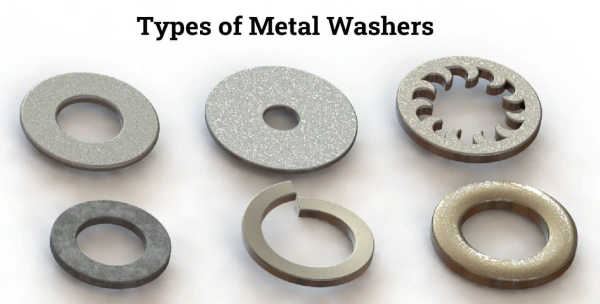
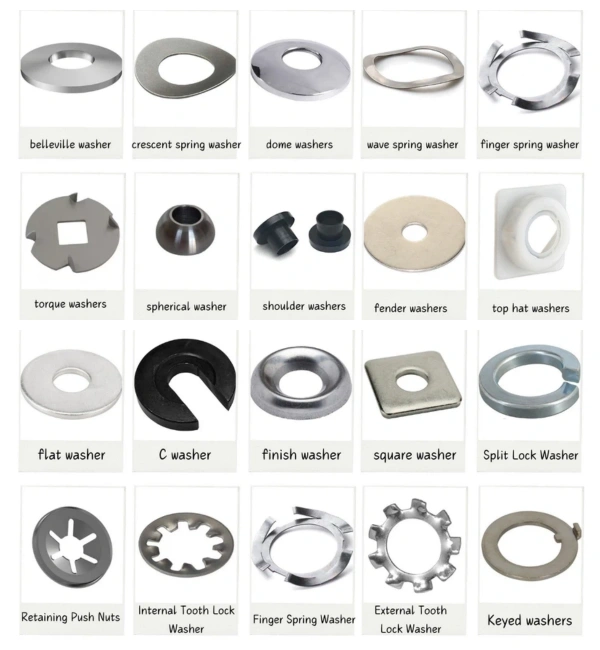
Standard washer, also defined as Type A washer in industrial standards, is the most basic and widely used flat washer. It adopts a flat disc integral structure with smooth upper and lower surfaces, no special structural protrusions or anti-loosening designs, and strictly follows ISO and DIN standard dimensions. Type A washer is made of conventional metal materials, with low cost and strong versatility, mainly used for conventional fastening, pressure dispersion and workpiece surface protection. It is the most common supporting accessory for washers for bolts in daily machinery, building hardware and general equipment assembly, suitable for static connection scenarios without severe vibration and impact load.
Difference Between Fender Washer and Standard Washer
Fender washer is a special flat washer with a large outer diameter. Compared with standard washer and Type A washer, its core feature is that the outer diameter is significantly larger while the inner diameter remains consistent with the standard size. The oversized contact area enables fender washers to disperse pressure in a larger range, which is suitable for soft materials such as wood, plastic and thin metal plates that are easy to deform. Standard washers focus on conventional universal assembly, while fender washers are targeted at thin and fragile workpieces, effectively preventing workpiece depression and penetration caused by bolt tightening.
Countersunk Washer
Countersunk washer has a conical countersunk structure on one side, which matches the chamfer of countersunk bolts. This washer can make the bolt head completely sink into the workpiece surface after installation, realizing a flat and smooth assembly surface. It is widely used in equipment shells, decorative parts and precision machinery that require flat surface, avoiding protruding bolt structures affecting assembly aesthetics and equipment operation. It is a special washer type for hidden fastening assembly.
Shoulder Washer
Shoulder washer is a composite structural washer with a raised shoulder step. The shoulder structure can realize precise positioning and insulation isolation, effectively limit the bolt insertion depth, and avoid excessive tightening pressure damaging parts. It is often used in electrical equipment, rotating machinery and precision fixture assembly, with excellent positioning stability and anti-pressure protection performance.
C Washers / C Shaped Washer
C washers, also known as C shaped washer, are open special washers with a C-shaped notch structure, different from the closed ring structure of traditional standard washers. The biggest advantage of C shaped washer is convenient installation and disassembly without completely removing bolts and nuts. It can be directly clamped into the bolt rod from the side gap, which greatly improves the maintenance efficiency of equipment. C washers are mostly used in mechanical parts that require frequent disassembly and temporary limit fastening, and are one of the practical special washer type options in industrial assembly.
Crescent Washer and Special Structures
Crescent washer is a special curved structural washer with a crescent arc profile, belonging to non-standard special washer hardware. Different from flat washers, crescent washers have elastic buffering performance, which can fine-tune the assembly pressure and absorb tiny vibration. Its asymmetric arc structure can adapt to irregular contact surfaces, solve the fastening deviation problem of inclined assembly surfaces, and is widely used in special mechanical structures, vehicle accessory assembly and non-standard equipment connection scenarios.
Analysis of Lock and Spring Washer Types
Types of Lock Washer: Open, Serrated and More
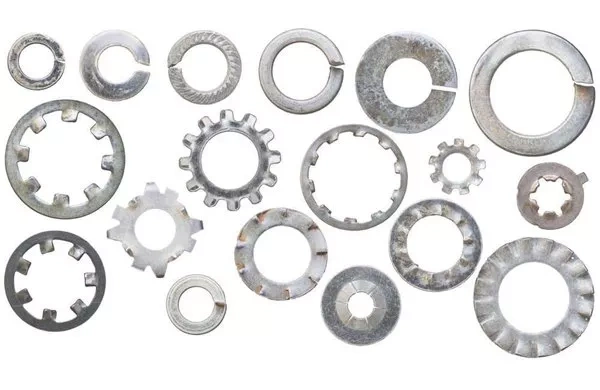
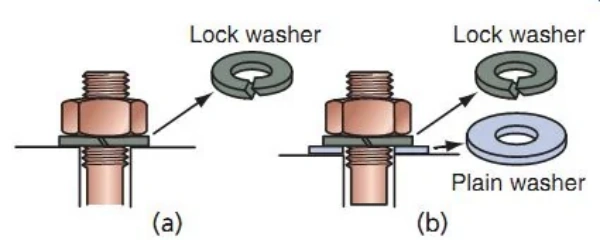
Types of lock washer cover multiple structural forms, mainly including open lock washers, serrated lock washers, tab lock washers and external tooth lock washers. The core function of all lock washers is to prevent fastener loosening caused by vibration, impact and thermal expansion and contraction. Open lock washers rely on structural tension to lock bolts; serrated lock washers increase friction through surface dense tooth patterns, firmly bite the contact surface, and provide strong anti-loosening effect. These lock washer types are essential for high-vibration working conditions such as mechanical equipment, automobile operation and engineering machinery.
Types of Spring Washers: Disc, Wave and More
Spring washers are elastic washers relying on metal elasticity to provide preload, mainly including disc spring washers, wave spring washers and conical spring washers. Disc spring washers have strong bearing capacity and are suitable for high-pressure fastening scenarios; wave spring washers have multi-layer elastic buffering performance, with good vibration reduction effect and small installation space. Spring washers can continuously provide elastic preload for bolt connections, compensate for loose gaps caused by material fatigue and temperature changes, and maintain long-term fastening stability.
Lock Washer vs Spring Washer
There are essential functional differences between lock washer and spring washer. Lock washers focus on anti-loosening locking, relying on structural occlusion and friction enhancement to prevent bolt rotation and loosening, suitable for high-vibration and dynamic load environments. Spring washers focus on elastic preload and vibration buffering, relying on metal elasticity to compensate assembly gaps and reduce vibration impact. In actual assembly, the two can be used alone or in combination according to working conditions to achieve dual effects of anti-loosening and shock absorption.
Selection of Washers for Bolts
The selection of washers for bolts needs to comprehensively consider bolt specification, working load, working environment and assembly accuracy. For ordinary static load bolts, standard Type A flat washers are preferred for basic pressure protection; for dynamic vibration working conditions, it is necessary to match types of lock washer or spring washer; for miniature precision bolts, small washer is the best choice; for frequently disassembled bolt structures, C washers can be selected to improve operation efficiency. Reasonable matching of washers and bolts is the key to ensure the stability and service life of fastening structures.
Washer Metal Material Selection
Common Washers Metal Types: Steel, Stainless Steel, Aluminum, Brass
Washer metal materials determine the mechanical properties and service life of washers, and common washers metal materials include carbon steel, stainless steel, aluminum alloy and brass. Carbon steel washers have high hardness and low cost, suitable for conventional indoor mechanical assembly; stainless steel washers have excellent rust and corrosion resistance, applicable to outdoor and humid environments; aluminum washers are lightweight with good ductility, suitable for lightweight equipment assembly; brass washers have good electrical conductivity and wear resistance, often used in electrical connection and precision instrument assembly.
Anti-Corrosion and Surface Treatment
Most metal washer hardware needs surface anti-corrosion treatment to adapt to complex working environments. Common treatment processes include galvanizing, nickel plating, passivation and oxidation. Galvanizing treatment can form a protective film on the surface of carbon steel washers to prevent oxidation and rust; stainless steel washers adopt passivation treatment to further improve corrosion resistance; aluminum and brass washers adopt anodic oxidation treatment to enhance surface hardness and wear resistance. Anti-corrosion treatment effectively extends the service life of washers and ensures the stable performance of washer hardware in humid, high-temperature and corrosive environments.
Material Requirements for Automotive Washers
Automotive washers are special customized washers for automobile chassis, engine, interior and exterior parts, with extremely strict material requirements. Automotive working conditions have the characteristics of frequent vibration, temperature alternation and environmental corrosion, so automotive washers metal materials must have high fatigue resistance, strong anti-vibration performance and excellent anti-corrosion ability. Most automotive washers adopt high-strength stainless steel and high-quality carbon steel with anti-rust treatment, and some precision parts use aluminum alloy and brass washers to meet the dual requirements of lightweight and high stability for automobile assembly.
Washer Types for Different Application Scenarios
Washers for Automotive Industry
Automotive washers cover multiple types such as standard flat washers, serrated lock washers, small precision washers and special crescent washers, which are used in automobile engine fastening, chassis connection, interior part assembly and brake system installation. Automotive washers need to withstand long-term road vibration and temperature changes, so anti-loosening and fatigue resistance are the core indicators. The matching of professional washer type and high-quality washer metal materials ensures the driving safety and structural stability of automobiles.
Mechanical and Structural Bolt Washers
For heavy machinery and building structural connections, washers for bolts are mainly high-strength standard washers, large-diameter fender washers and heavy-duty spring lock washers. These washers have high bearing capacity and structural stability, which can disperse the heavy load of structural bolts and prevent structural deformation and loosening. The combination of sturdy washers and bolts provides reliable guarantee for the stability of mechanical equipment and building structures.
CNC Precision Machined Washers
CNC precision machined washers are customized high-precision washer hardware, processed by CNC lathe with high dimensional accuracy and low tolerance. Including precision small washer, special-shaped shoulder washer, customized C shaped washer and crescent washer, they are widely used in precision machinery, aerospace and instrumentation industries. CNC processing can realize non-standard size and special structure customization, meeting the precision assembly needs of special equipment.
How to Select the Right Washer Type
Select Washer Type According to Function
The core of selecting washer type is functional matching. For basic pressure dispersion and surface protection, select standard Type A washer; for anti-loosening requirements, select corresponding types of lock washer; for vibration buffering and gap compensation, select spring washer; for precision micro assembly, match small washer; for frequent disassembly scenarios, prefer C washers; for special curved surface assembly, choose crescent washer. Accurate functional selection can maximize the performance of washer hardware.
Size and Standard Matching
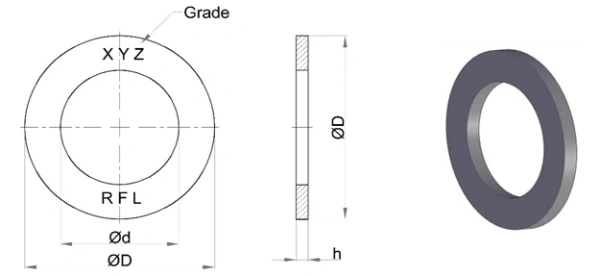
Washer selection must follow international general standards, including metric and imperial specifications. The inner diameter, outer diameter and thickness of standard washer must match the bolt specification to avoid assembly failure caused by size mismatch. In industrial production, ISO, DIN and ANSI standards are the main basis for washer size selection, ensuring the versatility and interchangeability of washers in different equipment.
Compatibility of Washers and Bolts
Good washers and bolts compatibility is the premise of stable assembly. The washer inner diameter should be slightly larger than the bolt rod diameter to ensure flexible installation; the washer hardness should match the bolt hardness, avoiding excessive washer hardness causing bolt thread damage or insufficient hardness causing washer deformation. For high-strength bolts, high-strength washer metal materials must be matched to ensure consistent structural bearing performance.
Installation, Torque and Contact Surface Notes
During washer installation, keep the contact surface flat and clean to avoid sundries affecting the fastening effect. Control the bolt tightening torque reasonably, excessive torque will cause washer deformation and workpiece damage, insufficient torque will lead to loose connection. For precision assembly of small washer and special-shaped washers, it is necessary to ensure uniform stress on the contact surface to avoid assembly deviation affecting equipment accuracy.
Washer Standards and Dimensions
Metric and Imperial Standard Washer
Standard washer is divided into metric and imperial two major specification systems. Metric washers are widely used in domestic and European industrial equipment, with millimeter as the unit; imperial washers are common in American standard equipment, with inch as the unit. The two specification systems have differences in inner and outer diameter and thickness, and cannot be mixed in assembly, which is the basic principle of washer hardware matching.
ISO / DIN / ANSI Standards
ISO is the international general washer standard, suitable for global universal assembly; DIN is German standard, with strict dimensional tolerance and high precision, commonly used in high-precision mechanical assembly; ANSI is American standard, corresponding to imperial specification washers. Different standards define the size, material and performance parameters of Type A washer, lock washer, spring washer and other products, providing unified specifications for industrial washer selection.
How to Identify Washer Type and Size
To identify washer type, first judge the structural characteristics: flat disc is standard washer, open notch is C shaped washer, serrated surface is lock washer, curved surface is crescent washer, and miniature size is small washer. For size identification, measure the inner diameter, outer diameter and thickness with a caliper, and match the corresponding ISO, DIN or ANSI standard parameters to quickly confirm the washer specification and model.
Machined Washer
What is Machined Washer
Machined washer is a high-precision washer hardware processed by mechanical laser cutting, CNC turning and other processes, different from stamping ordinary standard washers. It has high dimensional accuracy, smooth surface and customizable structure, including various special-shaped washers and non-standard precision washers, which can meet the special assembly needs that standard washers cannot meet.
Advantages of CNC Machined Washers
CNC machined washers have obvious advantages: ultra-high dimensional accuracy, small tolerance error, smooth and burr-free surface, uniform material stress. It can process complex structures such as special-shaped crescent washer, precision shoulder washer and customized C washers, and is suitable for high-precision fields such as automotive precision parts, aerospace equipment and electronic instruments.
Custom Washer Solutions
For special working conditions and non-standard assembly scenarios, custom washer solutions can be adopted. According to customer’s bolt specification, load demand, working environment and structural requirements, customize exclusive washer type, size and washer metal materials, including ultra-small small washer, special curved crescent washer, thickened high-strength washers and anti-corrosion customized washers, to solve the matching problem of special assembly structures.
Common Washer Comparisons
Flat Washer vs Spring Washer
Flat washer (standard Type A washer) focuses on pressure dispersion and surface protection, suitable for static stable connection; spring washer focuses on elastic anti-loosening and vibration reduction, suitable for dynamic vibration working conditions. Flat washer has no elasticity, while spring washer relies on metal elasticity to provide continuous preload, and the two can be used together in most industrial scenarios to achieve dual protection of pressure resistance and anti-loosening.
Large Washer vs Standard Washer
Large fender washer has a larger outer diameter and wider stress-bearing area, suitable for soft and thin workpieces to prevent deformation; standard washer has moderate size and strong versatility, suitable for most conventional bolt assembly scenarios. The core difference lies in the pressure dispersion range and applicable workpiece types.
Lock Washer vs Ordinary Washer
Ordinary standard washer only has basic pressure protection function, no anti-loosening performance; lock washer (types of lock washer) adds anti-loosening structure, which can effectively prevent bolt loosening under vibration and impact. Ordinary washers are used for static low-load scenarios, while lock washers are used for dynamic high-risk working conditions.
C Type Washer vs Traditional Washer
Traditional washers are closed ring structures, requiring complete disassembly of bolts during installation and maintenance; C washers / C shaped washer adopt open notch design, which can be installed and disassembled laterally without removing bolts, with high operation efficiency. It is an optimized special washer type for frequent maintenance scenarios.
FAQs
What are the common types of washers?
Common washer types include standard Type A washer, flat washer, fender washer, countersunk washer, shoulder washer, C washers, crescent washer, types of lock washer and various spring washers. In addition, there are small washer for precision assembly and customized CNC machined washers, covering all conventional and special industrial assembly scenarios.
What washer should be used for bolts?
The selection of washers for bolts depends on working conditions: static ordinary bolts use standard washer; vibrating equipment bolts use lock washer or spring washer; precision miniature bolts use small washer; frequently disassembled bolts use C shaped washer; automotive bolts use professional automotive washers with high anti-corrosion and anti-loosening performance.
How to identify washer type?
Identify washer type through structural features: flat closed ring is standard washer; open C-shaped notch is C washers; serrated surface is lock washer; curved crescent shape is crescent washer; miniature size is small washer. Combined with ISO/DIN/ANSI standard size parameters, the accurate washer model can be confirmed.
What are the main functions of washers?
The core functions of washer hardware include dispersing bolt fastening pressure, protecting workpiece surface, preventing bolt loosening, buffering vibration, adjusting assembly gaps, isolating and insulating, improving the stability and durability of washers and bolts assembly structure.
Is custom washer necessary?
Custom washers are necessary for non-standard assembly, precision equipment and special working conditions. Standard washer cannot meet the size, structure and material requirements of special scenarios. Custom washer metal materials and special washer type structures can solve the assembly pain points of high precision, strong corrosion resistance and special-shaped matching, which is widely used in automotive, CNC precision processing and aerospace fields.