Skip to content

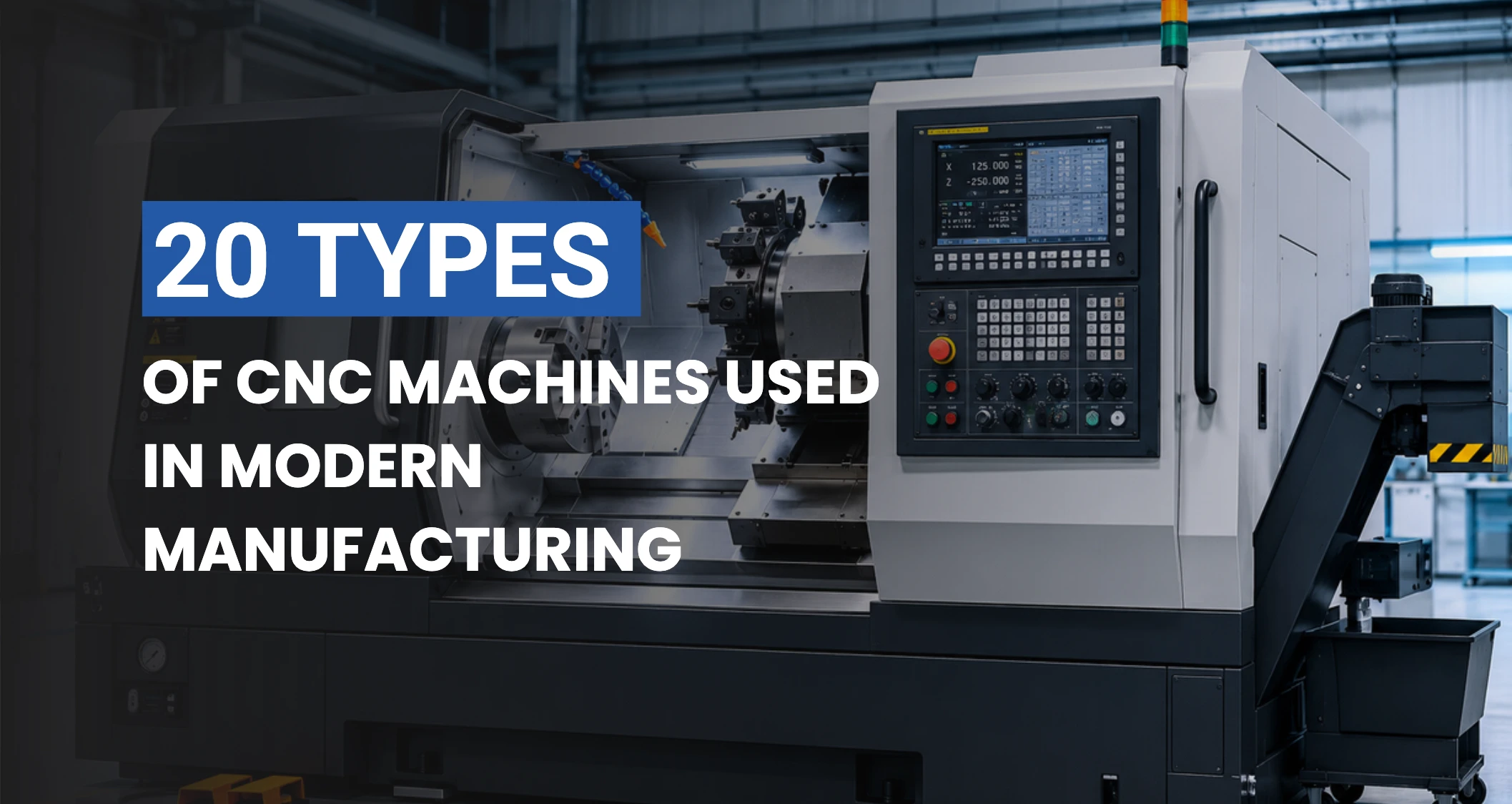
CNC machines improve manufacturing precision, production speed, material versatility, and automation across modern industries. Different types of CNC machines, including CNC milling machines, CNC lathes, CNC routers, EDM systems, grinders, drilling machines, 5-axis machines, machining centers, and hybrid CNC systems, are designed for specific machining operations, workpiece geometries, and production requirements. These automated systems support accurate cutting, drilling, grinding, bending, engraving, and forming operations for metals, plastics, wood, ceramics, composites, and industrial alloys.
Modern manufacturing industries such as aerospace, automotive, medical, electronics, construction, and industrial fabrication rely on CNC machines because they reduce production errors, improve repeatability, minimize material waste, and maintain consistent quality. Advanced machine structures, multi-axis controls, automatic tool changers, and digital programming systems enable manufacturers to produce complex geometries efficiently while reducing labor costs and enhancing operational safety. From rapid prototyping to high-volume production, CNC machines expand manufacturing capabilities and help industries achieve high-precision, cost-effective, and scalable production.
The top 20 CNC machine types used across manufacturing industries are:
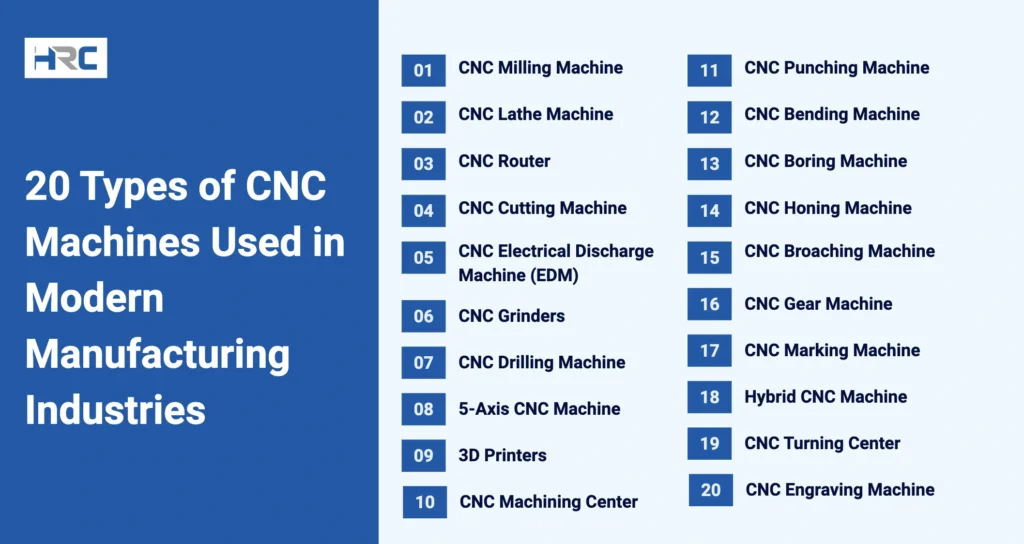
- CNC Milling Machine
- CNC Lathe Machine
- CNC Router
- CNC Cutting Machine
- CNC Electrical Discharge Machine (EDM)
- CNC Grinders
- CNC Drilling Machine
- 5-Axis CNC Machine
- 3D Printers
- CNC Machining Center
- CNC Punching Machine
- CNC Bending Machine
- CNC Boring Machine
- CNC Honing Machine
- CNC Broaching Machine
- CNC Gear Machine
- CNC Marking Machine
- Hybrid CNC Machine
- CNC Turning Center
- CNC Engraving Machine
CNC Milling Machine
A CNC milling machine is a computer-numerically-controlled machine that removes material from a stationary workpiece using rotating cutting tools. Different types of CNC milling machines include vertical, horizontal, gantry, universal, and bed-type CNC milling machines. Each type is designed for specific machining operations, workpiece sizes, and production requirements. These machines support drilling, contouring, slotting, and precision surface machining across aerospace, automotive, medical, and industrial manufacturing applications.
Below are the 5 types of CNC milling machine:
- Vertical CNC Milling Machine
A vertical CNC milling machine is a computer-controlled machine that uses a vertically oriented spindle to hold and rotate cutting tools for machining operations. It is ideal for drilling, die-making, and precision machining in the aerospace and medical industries. These machines offer high accuracy, easy setup, versatility, and cost effectiveness, making them suitable for both prototyping and production tasks.
- Horizontal CNC Milling Machine
Horizontal CNC milling machines use a horizontally mounted spindle that positions the cutting tool parallel to the worktable. This configuration provides superior chip evacuation and supports heavy-duty material removal. Horizontal mills are commonly used for large workpieces, deep slotting operations, and high-volume production environments requiring high rigidity and machining efficiency.
- Gantry CNC Milling Machine
A gantry CNC milling machine features a bridge-style frame that allows the cutting tool to move above large workpieces. Its rigid structure minimizes vibration and supports high-precision machining for oversized components such as aerospace structures, automotive frames, and industrial molds. Gantry mills are preferred for heavy-duty applications that require stability, accuracy, and consistent machining performance on large materials.
- Universal CNC Milling Machine
A universal CNC milling machine supports both vertical and horizontal milling operations within one system. Operators can switch between machining processes such as drilling, slotting, and face milling without changing equipment. This flexibility improves workflow efficiency and reduces setup time. Universal mills are commonly used for complex machining tasks that require adaptability across different materials and production requirements.
- Bed Type CNC Milling Machine
In a bed-type CNC milling machine, the worktable remains fixed while the spindle head moves across multiple axes to perform machining operations. The stable bed construction supports heavy-duty cutting applications and minimizes vibration during high-speed machining. Manufacturers often use bed-type mills for large industrial parts that require rigidity, cutting stability, and precise surface finish.
CNC Lathe Machine
CNC lathes are automated turning machines used to manufacture precise cylindrical components by rotating the workpiece against stationary cutting tools. Common types of CNC lathes include horizontal, vertical, Swiss-type, and multi-spindle lathes, each designed for different machining complexities and production demands. These machines play an important role in aerospace, automotive, electronics, and industrial manufacturing for producing shafts, bearings, bushings, tubes, and other precision-engineered parts.
CNC lathe machines are categorized into the following 4 types:
- Horizontal CNC Lathe
Featuring a horizontally mounted spindle, horizontal CNC lathes rotate workpieces along a parallel axis during turning operations. This configuration supports smooth chip removal and stable machining for long cylindrical parts such as rods, tubes, and automotive axles. Manufacturers commonly use horizontal CNC lathes for high-speed turning operations and general-purpose industrial production because of their efficiency and consistent machining accuracy.
- Vertical CNC Lathe
Built with an upright spindle arrangement, vertical CNC lathes position the workpiece vertically on a rotating table to improve stability during heavy machining operations. Gravity helps stabilize large and heavy materials during machining, making this design suitable for oversized industrial components such as turbine casings, wheels, and large bearings. Vertical CNC lathes improve machining stability, support accurate turning operations, and handle bulky workpieces more effectively than standard horizontal systems.
- Swiss-Type CNC Lathe
Designed for intricate precision machining, Swiss-type CNC lathes use a sliding headstock and guide bushing system to support slender workpieces close to the cutting tool. This setup minimizes vibration and maintains exceptional dimensional accuracy during machining. The medical manufacturing, electronics, and watchmaking industries commonly rely on these systems to produce miniature, high-tolerance components with complex geometries.
- Multi-Spindle CNC Lathe
Using several synchronized spindles, multi-spindle CNC lathes machine multiple workpieces simultaneously during the same production cycle to maximize output efficiency. This parallel machining process significantly reduces cycle times and supports high-volume manufacturing operations. Automotive, electronics, and mass-production industries prefer these systems for repetitive cylindrical components that require consistent quality and high production throughput.
CNC Router
A CNC router is a computer-numerically-controlled machine designed to cut, carve, or drill materials such as wood, plastics, and aluminum with high-speed, 3D routing capabilities. CNC routers are commonly classified based on the primary material or application they are designed to process, including wood CNC routers, stone CNC routers, metal CNC routers, foam CNC routers, plastic CNC routers, and sign-making CNC routers. These machines are widely used for detailed cutting, complex designs, and smooth surface finishing in industries such as woodworking, signage, fabrication, prototyping, and industrial manufacturing.
The 6 types of CNC routers are given below:
- Wood CNC Router Machine
Built for woodworking applications, wood CNC routers cut, carve, and drill wood with excellent precision and smooth surface finish. Rotating cutting tools follow programmed paths to create furniture parts, decorative panels, cabinets, and signage. Woodworking manufacturers prefer these systems for intricate designs, repeatable accuracy, and efficient high-volume production.
- Stone CNC Router Machine
Equipped with diamond-tipped cutting tools and water-cooled systems, stone CNC router machines process hard materials such as granite, marble, and quartz with high stability. Their rigid construction supports accurate engraving, cutting, and shaping of heavy stone surfaces. Industries commonly use these machines for countertops, monuments, architectural elements, and decorative stone fabrication, all of which require durability and precision.
- Metal CNC Router Machine
Metal CNC router machines are designed with reinforced frames, high-speed spindles, and coolant systems to machine materials such as aluminum, brass, and steel. These machines perform precise cutting and shaping operations for industrial fabrication, prototyping, and component manufacturing. Their ability to maintain dimensional accuracy and consistency makes them ideal for demanding metalworking applications.
- Foam CNC Router Machine
Featuring lightweight gantry systems and low-resistance cutting tools, foam CNC router machines process polyurethane, EVA, and polystyrene materials quickly and accurately. These machines produce clean edges and detailed foam shapes for packaging, display production, prototype modeling, and signage applications. Manufacturers choose foam CNC routers for rapid production speed and efficient large-scale foam fabrication.
- Plastic CNC Router Machine
Engineered for smooth plastic machining operations, plastic CNC routers cut materials such as acrylic, PVC, and polycarbonate with minimal surface damage. High-speed cutting tools and precision motion control systems maintain clean edges and accurate geometries throughout production. The display fabrication, sign-making, and plastic component manufacturing industries commonly use these systems for repeatable, precision processing.
- Advertising CNC Router Machine
Advertising CNC routers are optimized for producing signboards, 3D lettering, logos, and display panels for the signage industry. These machines combine high-speed spindles with multi-tool machining capability to efficiently process acrylic, PVC, and aluminum composite materials. Their ability to create detailed visual elements with consistent precision makes them valuable for modern advertising and branding applications.
CNC Cutting Machine
CNC cutting machines represent a broad category of computer-controlled cutting systems that use different cutting technologies depending on material type, thickness, and production requirements. These systems include laser, plasma, waterjet, flame, knife, ultrasonic, and oxy-fuel cutting machines. It is available in several forms, such as CNC laser cutting, CNC plasma cutting, CNC waterjet cutting, CNC flame cutting, CNC knife cutting, CNC ultrasonic cutting, and CNC oxy-fuel cutting machines. These systems are extensively used in industrial fabrication, sheet metal processing, structural manufacturing, signage production, and precision component cutting across multiple industries.
The 7 types of CNC cutting machines are:
- CNC Laser Cutting Machine
Using a focused high-powered laser beam, CNC laser cutting machines produce clean edges and highly accurate cuts on metals, plastics, wood, and composite materials. The non-contact cutting process enables intricate patterns, minimal material waste, and high-speed machining for applications requiring precise dimensional control and smooth surface finish.
- CNC Plasma Cutting Machine
Powered by a high-temperature plasma arc, CNC plasma cutting machines slice through electrically conductive metals such as steel, aluminum, and copper at high speed. Ionized gas generates the plasma stream while CNC controls maintain accurate cutting paths during operation. Heavy fabrication shops and industrial metalworking sectors use these machines for structural steel processing and for cutting thick metal plates.
- CNC Waterjet Cutting Machine
Instead of using heat-based cutting methods, CNC waterjet cutting machines use high-pressure water mixed with abrasive particles to machine materials cleanly. This cold-cutting process prevents thermal distortion and supports accurate processing of metals, glass, ceramics, stone, and composites. Aerospace manufacturers, architectural fabricators, and precision machining industries rely on waterjet systems for smooth edges and heat-free cutting performance.
- CNC Flame Cutting Machine
Built for heavy-duty steel processing, CNC flame cutting machines combine oxygen with fuel gases such as propane or acetylene to generate high-temperature cutting flames. These systems efficiently process thick ferrous metals and large steel plates in industrial fabrication. The construction, shipbuilding, and structural manufacturing industries commonly use flame-cutting machines for robust metal-cutting applications.
- CNC Knife Cutting Machine
Equipped with oscillating or rotary blades, CNC knife-cutting machines process soft, flexible materials with clean, accurate cuts. These machines handle textiles, leather, foam, cardboard, and rubber without causing excessive deformation or tearing. The packaging, upholstery, garment production, and signage industries prefer knife-cutting systems for detailed patterns and efficient soft-material fabrication.
- CNC Ultrasonic Cutting Machine
By operating with high-frequency ultrasonic blade vibrations, CNC ultrasonic cutting machines reduce cutting resistance when processing delicate materials. This vibration-assisted cutting method enables smooth machining of textiles, composites, rubber, food products, and specialty materials with minimal distortion. Manufacturers use ultrasonic cutting systems when conventional cutting tools cannot maintain edge quality or material stability.
- CNC Oxy-Fuel Cutting Machine
CNC oxy-fuel cutting machines are specialized systems designed to cut thick carbon steel and low-alloy steel. The machine directs controlled oxygen and fuel gas streams onto the metal surface to generate a combustion-based cutting process. Heavy industries and construction sectors use oxy-fuel cutting machines to cut beams, steel plates, frames, and large industrial structures that require deep-cutting capability.
CNC Electrical Discharge Machine (EDM)
CNC Electrical Discharge Machines (EDM) use controlled electrical sparks to machine conductive materials without physical contact, producing high-precision parts in hardened metals. CNC EDM systems are available in several types, including Wire EDM, Ram EDM (Sinker EDM / Die-Sinking EDM), Fast Hole Drilling EDM, Small Hole EDM. These machines are widely used for dies, molds, aerospace components, turbine parts, and other complex high-tolerance applications requiring detailed geometry and excellent surface finish.
4 categories of CNC Electrical Discharge Machine (EDM) are described below:
- Wire EDM Machine
Using a continuously moving electrically charged wire, Wire EDM machines cut conductive materials with exceptional precision and minimal mechanical stress. Controlled spark erosion follows programmed cutting paths inside a dielectric fluid environment to create intricate shapes and fine profiles. Industries commonly use these machines to produce dies, punches, aerospace components, and precision metal parts that require tight dimensional tolerances.
- Ram EDM Machine (Sinker EDM / Die-Sinking EDM)
Ram EDM machines, also known as Sinker EDM or Die-Sinking EDM machines, use custom-shaped electrodes to create complex cavities, molds, and precision features through controlled spark erosion.
- Fast Hole Drilling EDM Machine
Fast Hole Drilling EDM machines use rotating tubular electrodes to rapidly produce deep, narrow holes in hardened conductive materials. They are commonly used for turbine blade cooling holes, aerospace components, and EDM starter-hole applications.
- Small Hole EDM Machine
Small-hole EDM machines are engineered to drill extremely fine holes in delicate or difficult-to-machine materials. The process uses precision spark erosion rather than conventional cutting forces, enabling accurate micro-hole production with minimal material damage. Industries such as aerospace, electronics, and medical manufacturing use Small Hole EDM systems for turbine blade holes, electronic components, and miniature precision parts.
CNC Grinders
A CNC grinder is a computer-controlled finishing machine that uses abrasive grinding wheels to machine hardened materials with high precision and smooth surface quality. These systems are commonly used for shafts, bearings, rollers, camshafts, and tooling components that require tight dimensional tolerances and refined finishes. Common types of CNC grinders include surface grinders, cylindrical grinders, centerless grinders, and internal grinders, with each configuration designed for specific grinding operations, material geometries, and industrial applications.
Unlike conventional machining equipment, CNC grinders specialize in final finishing processes where exact dimensions and surface consistency are critical. Their rigid machine structures, precision spindle systems, and automated controls enable high-speed grinding across the aerospace, automotive, medical, and industrial manufacturing sectors. Manufacturers use CNC grinders to improve component durability, reduce surface imperfections, and maintain consistent machining accuracy during large-scale production.
CNC Drilling Machine
A CNC drilling machine is a computer-numerically-controlled system designed to produce precise holes through automated drilling, tapping, and reaming operations. Although many drilling functions are now integrated into modern CNC machining centers, dedicated CNC drilling machines remain valuable for high-volume hole-making applications and specialized production environments. These machines guide rotating drill bits along programmed machining paths to process metals, plastics, and composite materials with high accuracy and repeatability. Common types include upright drill presses, radial arm drill presses, gang drilling machines, multiple-spindle drilling machines, turret-type drilling machines, and deep-hole drilling systems for specialized industrial applications.
Compared to manual drilling systems, CNC drilling machines improve production efficiency by maintaining accurate hole positioning and consistent drilling depth during repetitive machining operations. Their machine structure often includes rigid columns, programmable spindle movement, rotating turrets, and automated tool control systems. Aerospace, automotive, fabrication, and heavy equipment industries use CNC drilling machines because they support high-speed production, complex hole patterns, and reliable machining performance across multiple manufacturing environments.
5-Axis CNC Machine
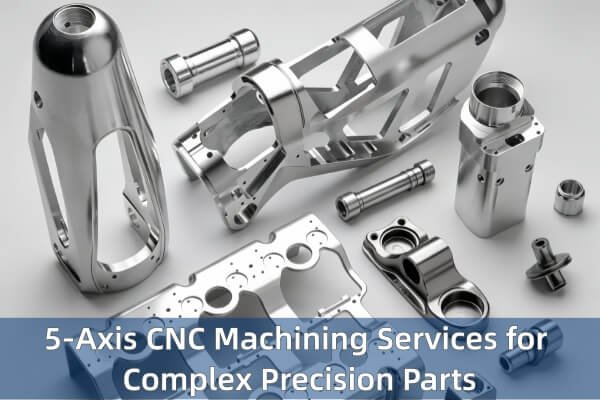
A 5-axis CNC machine is an advanced machining system that simultaneously moves a cutting tool across five separate axes to produce complex geometries with high precision. These machines combine three linear axes with two rotary axes, allowing the spindle to approach the workpiece from multiple angles within a single setup. Common configurations include table/table, head/head, and head/table systems designed for different machining requirements, workpiece sizes, and industrial manufacturing applications.
The advanced multi-axis capability of 5-axis CNC machines reduces setup time while improving surface finish quality and dimensional accuracy on intricate components. Their rigid structure, automated controls, and high-speed spindle systems support contour machining, deep cavity production, and precision manufacturing of turbine blades, aerospace parts, molds, and medical implants. Industries requiring tight tolerances and complex machining operations depend on these systems for efficient, accurate multi-surface machining.
3D Printer
Although 3D printers are not traditional CNC machines, they are often grouped with digitally controlled manufacturing equipment because they operate using computer-generated toolpaths and automated motion control systems. Unlike CNC machining, which removes material, 3D printing builds components layer by layer through additive manufacturing processes.
A 3D printer is an additive manufacturing machine that creates objects layer by layer from digital design data, rather than removing material through subtractive machining. These systems process thermoplastics, liquid resins, polymer powders, and metal powders to manufacture prototypes, lightweight structures, and complex geometries with minimal material waste. Major 3D printing technologies include Fused Deposition Modeling (FDM), Stereolithography (SLA), Selective Laser Sintering (SLS), and Direct Metal Laser Sintering (DMLS/SLM).
Unlike conventional CNC machines, 3D printers excel at producing customized parts and intricate internal structures that are difficult to machine with traditional methods. Their automated layer-based production process improves design flexibility, reduces tooling costs, and accelerates prototype development. Aerospace, healthcare, automotive, dental, and industrial engineering industries use 3D printers for rapid prototyping, lightweight component manufacturing, and precision production requiring advanced geometric complexity and digital manufacturing control.
CNC Machining Center
A CNC machining center is an automated milling machine equipped with computer numerical control systems, automatic tool changers, and multi-axis machining capability for high-precision manufacturing operations. Compared with conventional CNC milling machines, machining centers provide higher levels of automation, productivity, and operational efficiency. These advanced systems perform drilling, milling, tapping, contouring, and material removal tasks within a single enclosed machining environment. CNC machining centers process metals, plastics, and composite materials across aerospace, automotive, medical, and industrial manufacturing applications requiring speed, flexibility, and consistent accuracy.
Their integrated machine structure allows manufacturers to complete multiple machining operations with minimal manual intervention and reduced setup time. Features such as automatic tool changers, rigid frames, enclosed cabinets, and programmable controls support high-speed machining and repeatable production quality. Industries requiring automated workflow management and precision machining rely on CNC machining centers to improve operational efficiency, production consistency, and machining flexibility in large-scale manufacturing.
CNC Punching Machine
A CNC punching machine is a computer-controlled fabrication system that punches holes, slots, and custom patterns into sheet metal materials with high speed and precision. These machines use programmable punches and dies to process steel, aluminum, stainless steel, and other sheet materials during automated fabrication operations. Common configurations include turret punching machines, hydraulic punching systems, and servo-electric punching machines designed for different material thicknesses and production capacities.
High-speed punching capability allows CNC punching machines to produce complex sheet metal components with consistent dimensional accuracy and minimal material waste. Their machine structures often include automatic sheet-positioning systems, rotating turrets, programmable tooling systems, and high-force punching mechanisms for repetitive production tasks. Automotive, HVAC, electrical enclosure, construction, and metal fabrication industries depend on CNC punching machines for rapid production, flexible pattern creation, and efficient sheet metal processing.
CNC Bending Machine
A CNC bending machine is a computer-controlled fabrication system designed to bend sheet metal, pipes, tubes, wires, and structural profiles with high precision and repeatability. Common types of CNC bending machines include CNC press brake machines, CNC pipe bending machines, CNC tube bending machines, CNC roll bending machines, CNC panel bending machines, CNC wire bending machines, and CNC profile bending machines. These systems support automated forming operations across automotive, construction, aerospace, HVAC, shipbuilding, and industrial fabrication industries.
Listed below are the 7 types of CNC bending machines:
- CNC Press Brake Machine
Using a punch-and-die system, CNC press brake machines bend sheet metal into accurate angles and shapes with high repeatability. These machines support brackets, enclosures, cabinets, and industrial sheet metal fabrication. Hydraulic or electric controls improve bend precision, reduce manual labor, and maintain consistent production quality across low- and high-volume manufacturing operations.
- CNC Pipe Bending Machine
Built for automated pipe-forming operations, CNC pipe-bending machines create accurate curves and multi-radius bends in steel, aluminum, copper, and stainless steel pipes. The automotive, construction, and shipbuilding industries use these systems for exhaust systems, piping assemblies, and structural frames that require high repeatability, precise bend angles, and efficient large-scale tubular fabrication.
- CNC Tube Bending Machine
CNC tube bending machines are specialized systems used for accurate tube fabrication through automated bending processes such as mandrel, compression, and roll bending. They are capable of producing components like hydraulic lines, aerospace tubing, exhaust systems, and structural frames with precise geometry and smooth curves. These machines are widely used in manufacturing due to their high production speed, consistent bending quality, and ability to handle complex tube-forming requirements.
- CNC Roll Bending Machine
Operating through multiple programmable rollers, CNC roll-bending machines form metal sheets and profiles into curves, cylinders, and arches with controlled pressure. These systems are widely used for tanks, curved structural components, and industrial fabrication projects. Automated controls improve radius accuracy, production consistency, and efficiency during heavy-duty metal-forming operations.
- CNC Panel Bending Machine
Designed for sheet-metal panel fabrication, CNC panel-bending machines create folds, flanges, and complex bends using programmable bending blades. These systems manufacture cabinets, electrical enclosures, and industrial panels with high production speed and minimal manual handling. Automated operation improves bend consistency, production efficiency, and the repeatability of forming accuracy across large-scale manufacturing tasks.
- CNC Wire Bending Machine
Using servo-driven arms and automated controls, CNC wire-bending machines shape wire into springs, clips, hooks, and custom forms with exceptional precision. These systems process multiple wire diameters for automotive, electronics, and medical manufacturing applications. High-speed operation and repeatable bending accuracy make them suitable for intricate wire-forming production requirements.
- CNC Profile Bending Machine
Specialized for bending metal profiles, CNC profile bending machines form beams, channels, and angles into precise arcs and curved shapes through programmable roller systems. The construction, shipbuilding, and architectural industries use these machines for structural fabrication that requires repeatable geometry and high dimensional accuracy. Automated programming improves efficiency and reduces setup time during production.
CNC Boring Machine
A CNC boring machine is a computer-controlled machining system designed to enlarge and finish existing holes with high precision and dimensional accuracy. These machines guide cutting tools through automated control systems to perform accurate boring operations on large, heavy, or complex workpieces. CNC boring machines are widely used in aerospace, automotive, shipbuilding, heavy equipment, and industrial manufacturing applications requiring precise internal machining and consistent hole alignment.
The two main types of CNC boring machines are Horizontal Boring Machines (HBMs) and Vertical Boring Machines (VBMs). HBMs are commonly used for oversized or irregular components and include table-type, floor-type, planer-type, and multiple-head configurations for different machining requirements. VBMs position the workpiece vertically and are suitable for circular parts such as flanges, discs, and rings. Their rigid machine structure, multi-axis movement, and automated spindle control allow manufacturers to achieve stable machining performance, high repeatability, and efficient processing of large industrial components.
CNC Honing Machine
Precision bore-finishing operations use CNC honing machines to improve internal surface quality, roundness, and dimensional accuracy in cylindrical components. These computer-controlled systems use abrasive honing stones that expand against the bore’s inner surface to remove minor imperfections and produce smooth finishes. Industries such as automotive, aerospace, hydraulics, and heavy equipment manufacturing rely on CNC honing machines to hone engine cylinders, bearing housings, and hydraulic components that require tight tolerances.
Based on machine orientation, CNC honing machines are mainly classified into vertical and horizontal configurations. Vertical honing machines are commonly used for deep bores because gravity helps remove swarf and debris during machining operations. Horizontal honing machines support automated loading systems and flexible production environments for precision component finishing. Their automated spindle controls, abrasive finishing capability, and stable machine structure allow manufacturers to maintain accurate bore geometry, consistent surface finishes, and repeatable machining quality during large-scale production.
CNC Broaching Machine
A CNC broaching machine is a computer-controlled machining system that uses a multi-toothed cutting tool called a broach to produce precise shapes, grooves, splines, and profiles in a single controlled stroke. These machines are widely used for high-precision machining operations requiring accurate internal and external forms on metal components. Industries such as automotive, aerospace, heavy equipment, and industrial manufacturing rely on CNC broaching machines for repeatable production of keyways, gears, and complex surface features.
In terms of design and operation, they are classified into vertical and horizontal configurations, and further into push and pull broaching systems. Vertical broaching machines commonly produce internal features such as splines and keyways, while horizontal broaching machines handle long or heavy workpieces more efficiently. Surface broaching machines process flat and contoured external surfaces, whereas continuous broaching machines are well-suited to high-volume production environments. Some CNC milling machines and CNC lathes can perform limited broaching operations using specialized tooling. However, dedicated CNC broaching machines remain the preferred solution for high-volume production and complex broaching applications requiring maximum accuracy and productivity.
CNC Gear Machine
A CNC gear machine is a specialized computer numerical control system designed to manufacture gears with high precision, repeatability, and accurate tooth geometry. These machines are widely used in the automotive, aerospace, industrial equipment, and power transmission industries to produce spur gears, helical gears, bevel gears, and other precision gear components. Their automated machining capability supports consistent gear production, reduced setup errors, and efficient large-scale manufacturing operations.
Common types of CNC gear machines include gear hobbing machines, gear shaping machines, gear grinding machines, and specialized multi-axis gear machining systems. Wire EDM may also be used for certain precision gear applications, particularly when machining hardened materials or complex geometries. Gear shaping uses a reciprocating cutter to generate internal and external gear profiles, while gear hobbing uses a rotating hob cutter to produce continuous, high-speed gear profiles. Wire EDM machining produces intricate gear geometries through electrical spark erosion, making it suitable for hardened materials and precision applications. Advanced multi-axis CNC milling machines and CNC lathes can also manufacture gears using specialized tooling and programmed machining operations for complex gear-cutting tasks.
CNC Marking Machine
A CNC marking machine is an automated computer-controlled system used to permanently imprint text, logos, barcodes, serial numbers, and identification marks onto component surfaces for traceability and branding. Unlike CNC engraving machines, which remove more material to create deeper decorative features, CNC marking machines primarily focus on identification, coding, and traceability applications. These machines are widely used in automotive, aerospace, electronics, medical, and industrial manufacturing environments where durable and accurate marking is required. The two main types of CNC marking machines are fiber laser and CO2 laser machines.
Fiber laser marking machines use a concentrated laser beam to create high-resolution markings on metals and hard plastics with excellent speed and precision. Manufacturers commonly use them for industrial identification, QR codes, and serial number marking because they provide durable results with minimal maintenance. CO2 laser marking machines use carbon dioxide laser technology to mark non-metallic materials such as wood, acrylic, leather, rubber, and glass.
Hybrid CNC Machine
A hybrid CNC machine is an advanced manufacturing system that combines additive manufacturing processes with subtractive machining operations within a single machine setup. These systems integrate technologies such as 3D printing, laser cladding, milling, and turning to manufacture or repair complex components with high precision and reduced setup time. Hybrid CNC machines are widely used in aerospace, automotive, medical, and industrial manufacturing to produce intricate geometries, restore worn components, and improve production flexibility.
The two main types of hybrid CNC machines are Additive + Subtractive systems and Mill-Turn + Additive systems. Additive and Subtractive machines commonly use Direct Energy Deposition (DED) technology to deposit metal layers, followed by precision milling or finishing operations, making them suitable for heavy-duty repair and restoration work. Mill-Turn + Additive systems combine turning, milling, and additive manufacturing processes to create complex cylindrical components in a single setup. These hybrid systems reduce material waste, minimize repositioning errors, shorten production cycles, and enable advanced geometries that are difficult to achieve with conventional machining alone.
CNC Turning Center
A CNC turning center is an advanced form of CNC lathe that rotates a workpiece while automated cutting tools perform turning, drilling, threading, boring, and milling operations with high precision. Compared with traditional CNC lathes, turning centers often incorporate live tooling, sub-spindles, and multi-axis machining capability. These machines are widely used for manufacturing cylindrical and rotational components such as shafts, bushings, valves, couplings, and aerospace parts. CNC turning centers are commonly classified into horizontal, vertical, multi-axis, and mill-turn centers based on machine structure, spindle orientation, and machining capability.
Modern CNC turning centers use rigid machine beds, automated turrets, live-tooling systems, and programmable control software to support high-speed, high-accuracy machining operations. Their multi-axis capability allows manufacturers to machine complex geometries in a single setup, reducing production time and improving dimensional consistency. Industries such as aerospace, automotive, medical, oil and gas, and industrial equipment manufacturing rely on CNC turning centers for tight tolerances, automated production, large workpiece capacity, and efficient machining of precision-engineered components.
CNC Engraving Machine
A CNC engraving machine is a computer-controlled machining system designed to carve, etch, mark, and engrave precise patterns, text, logos, and surface details onto various materials. These machines use rotating engraving tools, laser systems, or diamond-tipped cutters to process metals, plastics, wood, glass, acrylic, and stone with high accuracy and repeatability. CNC engraving machines are commonly classified into rotary engraving machines, laser engraving machines, and desktop engraving systems based on their machining methods, spindle structures, and application requirements.
Advanced CNC engraving machines use automated motion control systems, high-speed spindles, and programmable software to create intricate surface designs with smooth finishing quality. Their precision capability supports detailed engraving on industrial parts, signage, molds, jewelry, nameplates, decorative products, and customized components. Industries such as advertising, woodworking, electronics, automotive, and jewelry manufacturing use CNC engraving machines because they improve production consistency, enable the creation of complex artwork, reduce manual labor, and deliver accurate engraving results across different material types and production scales.
Why is it Important to Use Different Types of CNC Machines in Modern Manufacturing?
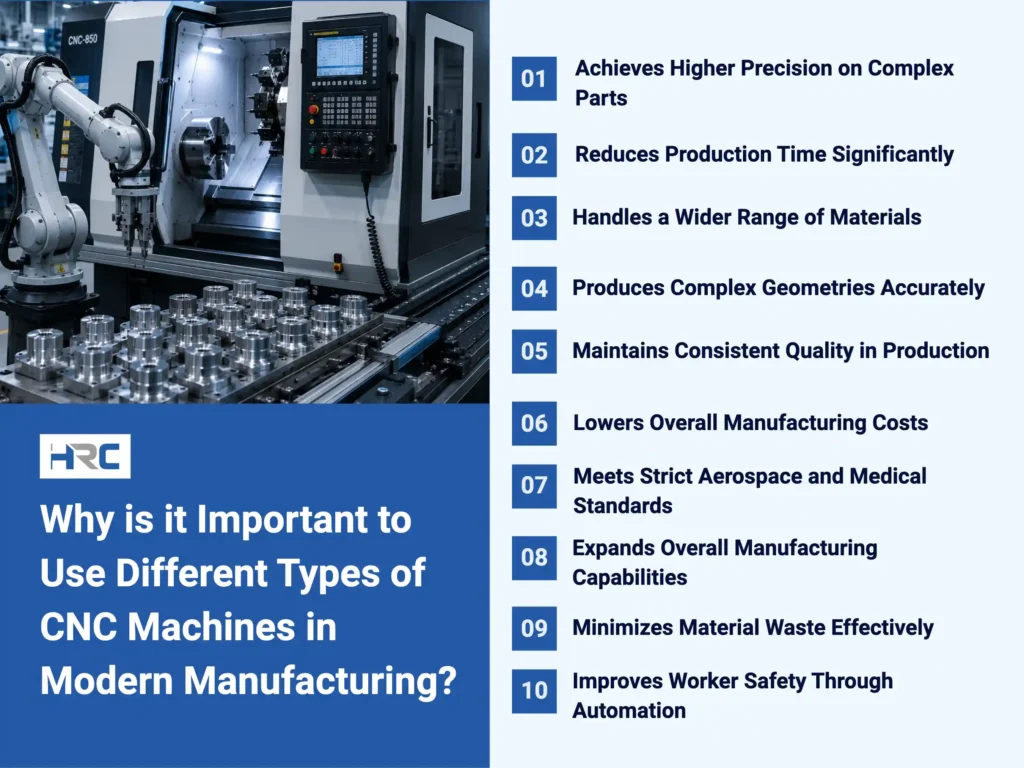
Different CNC machine types are important for precision, speed, material versatility, complex geometry production, consistent quality, cost efficiency, strict industry compliance, expanded capabilities, waste reduction, and improved safety. Using different CNC machines allows manufacturers to match specific machine strengths to different tasks, ensuring higher accuracy and faster production. It supports a wide range of materials and complex designs while maintaining consistent quality. This flexibility also reduces costs, minimizes waste, and improves safety, making modern manufacturing more efficient and reliable.
- Achieves Higher Precision on Complex Parts
CNC machines achieve high precision on complex parts through advanced control systems, automated programming, and multi-axis machining capability. These technologies accurately machine intricate geometries and tight tolerances with minimal deviation. Aerospace turbine blades, orthopedic implants, and medical components benefit from this precision because reduced machining errors improve product quality, repeatability, and manufacturing reliability.
- Reduces Production Time Significantly
Automated machining operations allow CNC machines to reduce production time by minimizing manual intervention and supporting continuous machining cycles. Features such as automatic tool changers and multi-axis setups improve machining speed and reduce the need for repositioning. Manufacturers use CNC systems for rapid prototyping and high-volume production because they accelerate cycle times and improve operational efficiency.
- Handles a Wider Range of Materials
Different CNC machines process metals, plastics, wood, ceramics, composites, and foam materials through specialized tooling and machining methods. CNC routers machine wood and plastics efficiently, while EDM systems process hardened conductive metals accurately. This material flexibility allows manufacturers to serve the aerospace, medical, automotive, construction, and industrial sectors using a single integrated production environment.
- Produces Complex Geometries Accurately
Multi-axis CNC machines, mill-turn centers, and EDM systems produce intricate geometries with exceptional accuracy through synchronized movement and advanced machining control. 5-axis CNC machines can machine multiple surfaces in a single setup, while Wire EDM and Sinker EDM create precise profiles in hardened materials. These systems reduce setup errors and improve machining efficiency for complex components.
- Maintains Consistent Quality in Production
CNC machines maintain consistent production quality through repeatable programming, automated controls, and precise machining paths. Each component follows the same programmed instructions, reducing variation between finished parts. Automotive, electronics, and industrial manufacturing industries rely on CNC systems because consistent dimensional accuracy and surface quality improve product reliability and manufacturing standardization across large production batches.
- Lowers Overall Manufacturing Costs
Automated CNC machining lowers manufacturing costs by reducing labor requirements, minimizing scrap material, and improving production efficiency. Accurate machining paths decrease material waste, while repeatable programming reduces costly production errors. Different CNC machine types optimize operations for specific materials and geometries, enabling manufacturers to achieve cost-effective production in both low-volume and large-scale manufacturing environments.
- Meets Strict Aerospace and Medical Standards
CNC machines meet aerospace and medical manufacturing standards by delivering high precision, repeatability, and process traceability during component production. Automated machining controls ensure that parts consistently meet exact specifications and regulatory requirements. Aerospace brackets, turbine components, surgical tools, and medical implants depend on CNC machining because dimensional accuracy and manufacturing consistency directly affect operational safety and reliability.
- Expands Overall Manufacturing Capabilities
Access to multiple CNC machine types expands manufacturing capability by allowing companies to produce more complex components and support advanced machining processes. Manufacturers can process different materials, create intricate geometries, and handle specialized operations using milling machines, lathes, EDM systems, and hybrid machines. This flexibility improves competitiveness and opens opportunities in diverse industrial markets.
- Minimizes Material Waste Effectively
Precise programming and optimized machining paths allow CNC machines to minimize material waste during manufacturing operations. Automated cutting accuracy reduces production errors, scrap generation, and unnecessary raw material removal. Waterjet cutting machines, CNC milling systems, and laser cutting machines improve material utilization efficiency, helping manufacturers lower production costs while supporting environmentally responsible manufacturing practices.
- Improves Worker Safety Through Automation
Automated CNC machining systems improve worker safety by reducing direct operator involvement in hazardous cutting and material-handling operations. Enclosed machining areas, automatic tool movement, safety sensors, and programmable controls protect operators from sharp tools, rotating components, and flying debris. These safety features help manufacturers reduce workplace injuries and create safer, more controlled industrial production environments.
How to Choose the Right Type of CNC Machine?
To choose the right type of CNC machine, evaluate material type, part geometry, tolerance requirements, production volume, machining complexity, and available budget. These factors help match machining capability with production goals, operational efficiency, and industry standards. CNC milling machines, lathes, routers, EDM systems, and multi-axis machines each support different materials, machining operations, and precision levels. Selecting the appropriate CNC machine improves machining accuracy, surface quality, production speed, and overall control of manufacturing costs.
- Identify the Types of Material
Start by identifying whether the workpiece material is metal, plastic, wood, ceramic, or composite. Material properties determine spindle power, tooling type, cutting speed, and coolant requirements. Hard metals may require CNC milling machines or EDM systems, while softer materials often use CNC routers. Proper material selection improves machining performance, tool life, and production accuracy.
- Define the Part Geometry
Examine the component shape, dimensions, contours, holes, and surface complexity before selecting a CNC machine. Simple geometries may require only 3-axis machining, while intricate designs often require 5-axis machines or mill-turn centers. Defining part geometry helps reduce setup changes, improve machining precision, and support efficient production of complex components.
- Set the Tolerance Requirements
Determine the dimensional tolerance and precision level required for the finished component. High-precision applications often require CNC grinders, EDM machines, or advanced machining centers with tighter control systems. Setting tolerance requirements early helps maintain product consistency, reduce machining errors, and ensure compliance with aerospace, automotive, medical, or industrial manufacturing standards.
- Determine the Production Volume
Calculate whether the project involves prototype development, low-volume batches, or mass production before choosing equipment. High-volume manufacturing may require automated systems with tool changers, multi-spindle capability, or robotic loading systems. Understanding production volume helps improve workflow efficiency, reduce cycle time, and control manufacturing costs more effectively.
- Select the Number of Axes
Choose the machine axis configuration based on machining complexity and surface accessibility. Standard 3-axis machines handle basic machining operations, while 4-axis and 5-axis systems support advanced contouring and multi-surface machining. Selecting the correct axis configuration improves machining flexibility, reduces repositioning requirements, and increases production efficiency for detailed components.
- Consider the Budget
Evaluate machine cost, tooling expenses, maintenance requirements, and long-term operational efficiency before investing in CNC equipment. Entry-level CNC machines support basic machining operations at lower costs, while advanced multi-axis systems require larger investments. Careful budget planning helps balance machining capability, production efficiency, and overall manufacturing profitability.
- Match the Machine to the Industry
Select CNC machines based on the production standards and machining requirements of the target industry. Aerospace manufacturing often uses 5-axis machining centers, the woodworking industry relies on CNC routers, and sheet metal fabrication uses CNC plasma or punching machines. Matching the machine to the industry improves operational performance and manufacturing reliability.
- Evaluate the Surface Finish Needs
Review the required surface smoothness, edge quality, and finishing standards before selecting machining equipment. CNC grinders, honing machines, and EDM systems are commonly used for superior surface finishing applications. Evaluating finish requirements helps improve product appearance, dimensional consistency, and functional performance for precision-engineered components.
- Consult a Trusted CNC Machining Manufacturer
Work with an experienced CNC machining manufacturer to evaluate production goals, material compatibility, machine specifications, and automation requirements. Professional guidance helps identify suitable CNC machine types for specific applications and production scales. Consulting experts reduces equipment selection risks, improves operational planning, and supports long-term manufacturing efficiency.