Skip to content

CNC machining uses computer-controlled automation to produce parts with high precision, repeatability, and efficiency, making it ideal for complex geometries, tight tolerances, advanced materials, and medium- to high-volume production. Manual machining relies on direct operator control, providing greater flexibility for prototypes, repairs, custom modifications, and low-volume manufacturing. Both machining methods play important roles in modern manufacturing, but their capabilities, costs, and production advantages differ significantly.
Choosing between CNC and manual machining requires evaluating factors such as production volume, part complexity, precision requirements, material type, lead time, and budget. CNC machining excels in applications that demand consistency, scalability, and repeatable quality, whereas manual machining remains valuable for custom work and projects that benefit from hands-on adjustments. Understanding how these processes compare in productivity, cost, tolerances, material capabilities, and design flexibility helps manufacturers select the most suitable solution for their specific production requirements.
What Is CNC Machining?
CNC machining is a manufacturing process that uses Computer Numerical Control (CNC) technology to automate the movement of machine tools such as mills, lathes, and grinders. A programmed set of digital instructions directs the cutting process, enabling precise material removal and consistent part production. Manufacturers use CNC machining to create complex components with repeatable accuracy. Its main advantages include precision, efficiency, and scalability, while limitations include higher equipment costs, programming requirements, and dependence on digital systems.
What Are the Main Advantages of CNC Machining?
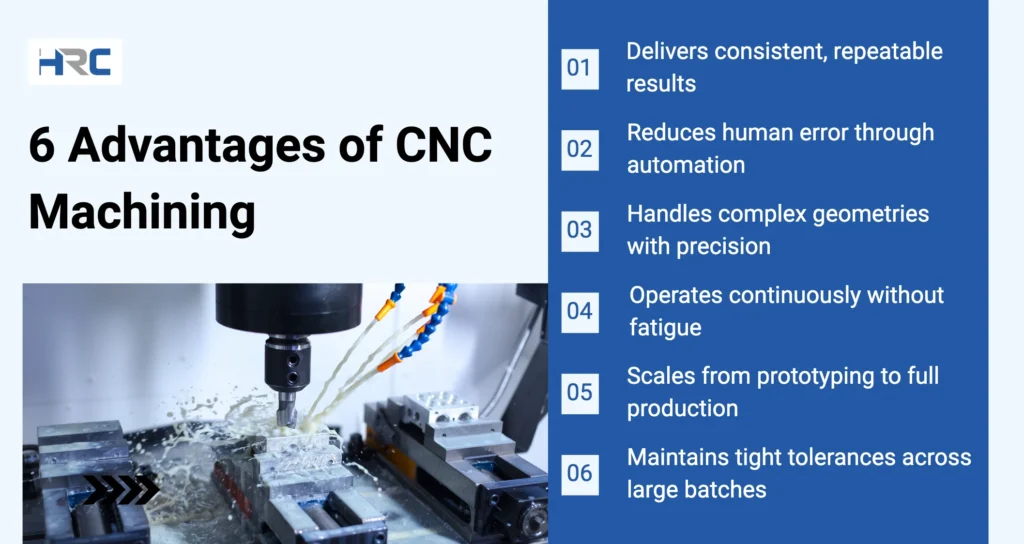
The main advantages of CNC machining are consistent and repeatable results, reduced human error, the ability to produce complex geometries with precision, continuous operation, scalability from prototyping to mass production, and the maintenance of tight tolerances across large batches. These benefits improve manufacturing efficiency, product quality, and production reliability while supporting the accurate production of complex components at various production volumes.
Below are the 6 advantages of CNC Machining:
- Delivers consistent, repeatable results
CNC machining follows programmed instructions in each cycle, producing identical parts with minimal variation. This high repeatability improves quality control, reduces dimensional inconsistencies, and ensures uniform results across production runs, making it essential for aerospace, automotive, and medical component manufacturing. - Reduces human error through automation
Automated control of tool movement, cutting paths, and machining sequences reduces operator-related errors by eliminating manual adjustments, measurement mistakes, and fatigue. Software-driven commands follow predefined parameters, lowering scrap rates, improving process stability, and ensuring consistent quality across multiple production batches. - Handles complex geometries with precision
Through advanced programming and automated tool control, CNC machining produces intricate shapes, deep cavities, curved surfaces, and multi-axis features with high accuracy. It enables complex components like turbine blades, surgical implants, and precision-engineered housings. - Operates continuously without fatigue
Unlike manual machining, CNC machines operate continuously without fatigue-related performance loss. Once programmed, they maintain consistent accuracy and speed, increasing machine utilization, reducing production time, and enabling around-the-clock manufacturing for large-volume production. - Scales from prototyping to full production
Using the same digital workflow, CNC machining supports both prototyping and large-scale production. Programs can be easily modified for design changes without changing equipment, allowing efficient transition from single prototypes to mass production while maintaining consistency and production efficiency. - Maintains tight tolerances across large batches
CNC machining controls tool movement with high positional accuracy, enabling the production of components within strict dimensional limits. Many CNC systems routinely achieve tolerances as tight as ±0.025 mm, depending on material and machine capability.
What Are the Real Trade-offs of CNC Machining?
While CNC machining offers excellent precision and consistency, it also comes with trade-offs such as higher cost and greater technical requirements. These include high upfront investment costs, the need for skilled programming and setup, reduced cost-effectiveness for low-volume production, ongoing maintenance requirements, and reliance on software and digital systems. These factors can increase operational expenses and create challenges for smaller manufacturers or projects with limited production demands.
- CNC machining requires high upfront investment in equipment, tooling, software, and infrastructure, making it costly for small manufacturers with limited production needs.
- Requires skilled programming and setup expertise as operators need CAD/CAM knowledge and machining skills, making incorrect programming a risk to quality and productivity.
- Less cost-effective for low-volume runs due to high setup and programming time, which outweigh the automation benefits for small batches.
- Requires ongoing maintenance and technical support, as complex systems require regular servicing and expert troubleshooting to avoid downtime.
- Relies heavily on software and digital systems, so errors, malfunctions, or failures can disrupt production without proper updates and backups.
What Is Manual Machining?
Manual machining is a traditional manufacturing process in which skilled operators directly control machine tools such as lathes, mills, and drill presses using handwheels, levers, and cranks, without relying on computer automation. Machinists perform cutting, shaping, and finishing operations by manually adjusting conventional equipment. This hands-on approach provides direct control over machining tasks, making it suitable for prototypes, repair work, and low-volume production. While it offers flexibility and lower equipment costs, it is generally less efficient and precise than CNC machining for complex or high-volume manufacturing applications.
We will now explore the core advantages of manual machining from a practical perspective.
What Are the Main Advantages of Manual Machining?
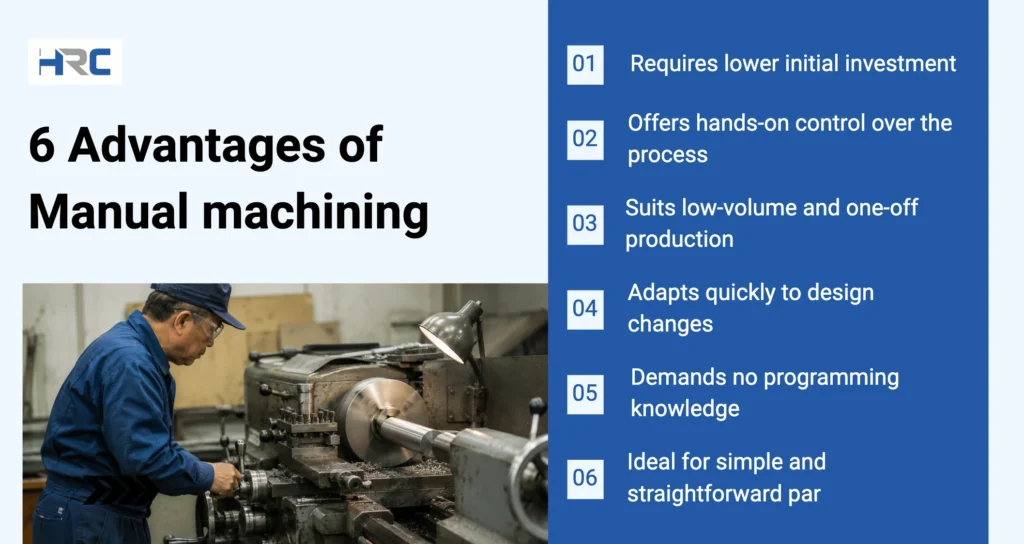
Manual machining offers several advantages, including lower equipment cost, faster setup for simple parts, and greater flexibility for prototyping and repair work. While CNC machining dominates high-volume, highly complex production, manual machining offers practical advantages that make it a viable choice for certain machining processes and scenarios.
6 advantages of Manual machining are:
- Requires lower initial investment
Conventional machine tools are more affordable than CNC systems because they lack advanced controls, software, and automation hardware. This lower cost makes manual machining accessible to small manufacturers, workshops, and educational institutions with limited budgets. - Offers hands-on control over the process
Manual machining offers direct, hands-on control throughout production, allowing machinists to adjust cutting parameters, tool positioning, and techniques in real time. This flexibility is ideal for custom parts, repairs, and quick modifications without the need for reprogramming equipment. - Suits low-volume and one-off production
For single parts or small production runs, manual machining removes the need for programming and complex setup, allowing work to begin quickly. This makes it cost-effective for prototypes, replacement parts, and custom fabrication where large production volumes are not required. - Adapts quickly to design changes
Engineering changes can be made directly at the machine without updating digital programs or toolpaths. This allows quick responses to dimensional adjustments, repairs, or customer requests, making manual machining ideal for highly customized manufacturing tasks. - Demands no programming knowledge
Manual machining depends on operator skill, measurement techniques, and equipment knowledge rather than software programming. This reduces the need for CAD/CAM expertise, lowering training requirements and simplifying production for basic machining tasks. - Ideal for simple and straightforward par
Basic components such as shafts, bushings, brackets, spacers, and mounting plates can be efficiently produced by manual machining. For simple geometries, conventional machine tools offer a practical, cost-effective solution without the need for CNC programming or automation.
What Are the Limitations of Manual Machining?
Manual machining has several key limitations that restrict its scope of application. These drawbacks include vulnerability to human error, limited capacity for complex geometries, low productivity in mass production, and heavy reliance on operator skills. First, manual machining is performed entirely by hand, which increases the risk of human error. Errors in setting feed rates, spindle speeds, or tool paths will result in inconsistent part quality and material waste. Without automated process control, it delivers lower repeatability and precision than CNC machining.
- Susceptible to human error and inconsistency due to manual adjustments, which can lead to variations in accuracy between parts.
- Restricted to simpler geometries because complex shapes require multiple setups and become harder to machine accurately.
- Slower for high-volume production since each operation needs direct operator involvement, limiting overall output.
- Heavily dependent on operator skill, meaning quality varies based on experience and the precision of the machinist.
- Difficult to maintain tight tolerances consistently due to small variations in measurement and setup during manual operation.
How CNC Machining Differs from Manual Machining?
CNC machining differs from manual machining in that it uses computer-controlled automation, whereas manual machining relies on direct operator control. CNC machining delivers higher productivity, tighter tolerances, greater repeatability, and better handling of complex geometries and advanced materials. Depending on machine capability, CNC machining commonly achieves tolerances ranging from ±0.05 mm to ±0.01 mm, with specialized processes achieving even tighter tolerances. This level of accuracy is supported by repeatability, as programmed instructions ensure each part is produced to the same specifications. In contrast, manual machining depends heavily on operator skill and experience, which can introduce variation and lead to greater differences between production runs compared to CNC machining.
Manual machining, however, offers lower setup costs, greater hands-on flexibility, and is well-suited for prototypes, repairs, and low-volume production. The choice between CNC and manual machining ultimately depends on factors such as precision requirements, production volume, complexity, and budget.
How Do CNC and Manual Machining Compare in Terms of Productivity and Efficiency?
CNC machining delivers higher productivity and efficiency than manual machining because automated systems perform machining operations with minimal operator involvement. Manual machining requires continuous supervision and direct control, which increases production time and labor input. CNC machines maintain consistent cycle times and automated tool movements, whereas manual machines rely on operator action for each machining step.
For high-volume manufacturing, CNC machining produces more parts in less time and supports unattended operation during extended production runs. In contrast, manual machining is better suited to prototypes, repairs, and small-batch work where production speed is less important than flexibility. As part complexity and production volume increase, the efficiency gap between CNC and manual machining widens.
How Do Skill Requirements Differ Between CNC and Manual Machining?
CNC machining and manual machining require different skill sets because each process relies on a distinct method of machine control. CNC operators must understand CAD/CAM software, machine programming, digital controls, and setup procedures, whereas manual machinists rely on hands-on machining experience, tool-handling skills, and real-time machine adjustments. CNC environments emphasize technical and software-based expertise, while manual machining environments prioritize practical knowledge and manual dexterity.
While CNC operators focus on creating programs, configuring machines, and monitoring automated production, manual machinists directly control cutting operations and make adjustments throughout the machining process. As a result, CNC machining requires stronger digital and programming capabilities, whereas manual machining places greater emphasis on craftsmanship, precision measurement, and traditional machining techniques.
How Do the Initial and Operating Costs of CNC and Manual Machining Compare?
CNC machining costs $30-$300+ per hour, whereas manual machining generally ranges from $40-$125+ per hour, depending on machine capabilities, operator expertise, part complexity, and geographic location. While CNC machining often requires higher upfront costs for equipment, setup, CAM programming, tooling, and CAD preparation, manual machining usually involves lower initial investment and fewer preparation expenses.
For low-volume production, prototypes, or one-off parts, manual machining is often the more economical option because it avoids programming and setup costs. A simple manually machined bracket, for example, may cost between $20 and $50 per unit. In contrast, CNC machining becomes more cost-effective as production volume increases because automation reduces labor requirements and lowers per-part costs. Depending on complexity and volume, CNC parts can cost as little as $1 in mass production or as much as $500 for highly complex, precision components.
How Do CNC and Manual Machining Differ in Precision and Tolerances?
CNC machining can achieve tolerances as tight as ±0.025 mm or better, whereas manual machining operates within wider tolerance ranges that depend on operator skill, machine condition, and measurement accuracy. CNC machines use computer-controlled movements to maintain precise tool positioning, consistent cutting paths, and repeatable machining operations, whereas manual machines rely on human adjustments, which can introduce dimensional variation between parts.
Precision and repeatability are critical for components used in aerospace, medical device manufacturing, and automotive engineering. CNC machining produces parts according to the same programmed specifications, ensuring consistent fit, function, and interchangeability. In contrast, manual machining results may vary across production runs, making it less suitable for applications that require strict dimensional accuracy and tight tolerances.
How Do CNC and Manual Machining Handle Part Complexity and Design Flexibility?
CNC machining handles complex geometries and design changes more efficiently than manual machining, whereas manual machining performs better on simple parts that require direct operator control. CNC machines use programmed toolpaths to create multi-axis cuts, tight radii, curved surfaces, deep cavities, and detailed features with consistent precision. Manual machines rely on hand-guided tool movement, which limits accuracy when part designs include intricate shapes or multiple setup angles.
Design flexibility also differs between the two methods. CNC machining adapts to design changes by updating the digital program, while manual machining requires new measurements, setups, and operator adjustments. For advanced components such as turbine blades, medical implants, and precision housings, CNC machining provides greater control over complexity. For brackets, spacers, bushings, and repair parts, manual machining remains practical.
How Do CNC and Manual Machining Differ in Material Capabilities?
CNC machining generally provides higher efficiency and more stable process control when working with a wide range of materials, especially hard-to-machine metals and engineering plastics. It can process materials such as titanium, hardened steel, and advanced engineering plastics like PEEK and polycarbonate through precise control of cutting parameters and specialized tooling, enabling consistent performance across different material types.
In contrast, manual machining is limited by machine rigidity and the physical effort required from the operator, making it less suitable for very hard or brittle materials that demand continuous force and high precision. These limitations reduce its effectiveness when working with advanced engineering materials or complex geometries. As a result, material properties such as hardness, toughness, and complexity play a key role in determining whether CNC or manual machining is the more appropriate manufacturing process for a given application.
The table below provides a quick overview of how CNC machining and manual machining differ across critical manufacturing criteria:
| Comparison Factor | CNC Machining | Manual Machining |
| Control System | Executes operations through programmed automation | Relies on direct machinist control |
| Operator Expertise | Requires CAD/CAM knowledge, programming, and machine setup skills | Requires machining experience, tool handling, and manual adjustment skills |
| Investment Requirement | Higher equipment, software, and setup costs | Lower equipment and startup costs |
| Cost Efficiency | Delivers lower per-part costs as production volume increases | Provides better value for one-off parts and small batches |
| Dimensional Accuracy | Achieves tight tolerances and consistent specifications | Accuracy depends on operator technique and machine condition |
| Production Consistency | Maintains repeatable results across large runs | Results can vary between operators and production cycles |
| Design Complexity | Supports intricate geometries, multi-axis features, and detailed surfaces | Best suited for straightforward designs and basic geometries |
| Engineering Changes | Accommodates revisions through program updates | Requires manual reconfiguration and new setups |
| Material Range | Processes advanced alloys, hardened metals, and engineering plastics | Better suited to common metals and less demanding materials |
| Manufacturing Output | Supports rapid production and extended machine operation | Prioritizes flexibility over production speed |
| Best Applications | Aerospace, medical, automotive, and high-volume manufacturing | Repairs, maintenance work, prototypes, and custom fabrication |
| Scalability | Transitions efficiently from prototype to mass production | More practical for low-volume manufacturing |
What Factors Should You Consider When Choosing Between CNC and Manual Machining?
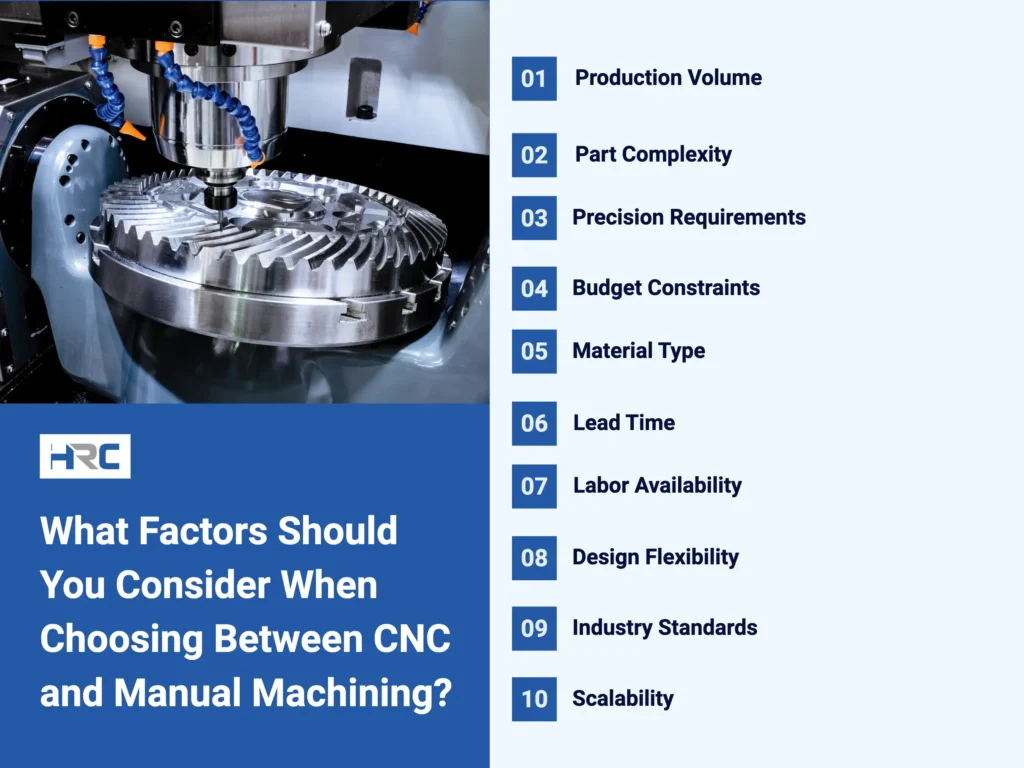
You should consider factors such as production volume, part complexity, precision requirements, budget constraints, material type, lead time, labor availability, design flexibility, and industry standards when choosing between CNC and manual machining. Each factor influences manufacturing efficiency, cost, accuracy, production capacity, and project feasibility. Evaluating these requirements helps determine which machining method best aligns with a project’s technical and operational goals.
10 factors to consider when choosing between CNC and Manual machining include:
- Production Volume
The number of parts required is one of the most important factors in machining selection. CNC machining becomes more economical as production volume increases because automation reduces labor input and improves throughput. Manual machining remains a practical choice for prototypes, custom parts, and short production runs where setup efficiency is more valuable than large-scale output. - Part Complexity
Intricate geometries, multi-axis features, and detailed surface profiles place greater demands on machining capabilities. CNC machining creates these features with programmed precision and repeatability, while manual machining is better suited to simpler designs. As complexity increases, maintaining accuracy and consistency becomes significantly easier with CNC-controlled equipment. - Precision Requirements
Projects with strict dimensional specifications require a machining process that maintains consistent accuracy. CNC machining can achieve tight tolerances and repeatable results across large batches, making it suitable for aerospace, automotive, and medical components. Manual machining can produce accurate parts, but repeatability depends heavily on operator skill and machine condition. - Budget Constraints
Cost considerations extend beyond equipment prices and include setup, labor, tooling, and long-term production expenses. Manual machining requires a lower initial investment and lower preparation costs, which benefit small projects. CNC machining demands greater upfront investment but can reduce per-part costs as production volume and repeatability requirements increase. - Material Type
Different materials respond differently to machining processes. Hard metals such as titanium and hardened steel, along with engineering plastics like PEEK, benefit from the controlled cutting conditions provided by CNC machining. Softer materials and less demanding applications can often be produced effectively using manual machining methods. - Lead Time
Meeting production deadlines requires balancing setup time against manufacturing speed. Manual machining can accelerate the production of simple parts because programming is unnecessary. CNC machining may require additional preparation at the start of a project, but automated operation shortens production cycles once machining begins. - Labor Availability
Workforce capabilities can influence process selection as much as technical requirements. CNC machining depends on personnel with expertise in programming, CAD/CAM, and setup, whereas manual machining relies on experienced machinists capable of making precise adjustments throughout the manufacturing process. The availability of skilled labor can directly affect productivity and project feasibility. - Design Flexibility
Frequent engineering revisions can change the most suitable machining method. CNC machining accommodates design updates through software modifications and revised toolpaths, reducing the need for extensive physical reconfiguration. Manual machining allows direct adjustments at the machine but may require additional measurements, setups, and operator intervention. - Industry Standards
Quality requirements vary significantly across industries and applications. Aerospace, medical, and automotive manufacturers often require documented processes, traceability, and strict dimensional consistency that align well with CNC machining. Projects with less demanding compliance requirements may achieve acceptable results through manual machining without extensive process controls. - Scalability
Future production goals should be considered before selecting a machining process. CNC machining supports growth from prototype development to large-scale manufacturing through repeatable digital workflows. Manual machining performs effectively for limited quantities, but increasing output often requires additional labor, time, and operational resources.
Should You Choose CNC or Manual Machining?
The right choice depends on your production volume, part complexity, precision requirements, and budget. CNC machining is better suited to projects that require tight tolerances, complex geometries, advanced materials, and consistent results across medium- to high-volume production runs. In contrast, manual machining is more practical for simple components, prototype development, repair work, and low-volume manufacturing, where direct operator control and quick setup are important.
When scalability, repeatability, and production efficiency are priorities, CNC machining services provide a clear advantage through computer-controlled automation and standardized machining processes. On the other hand, manual machining offers greater flexibility for custom modifications, one-off parts, and situations where programming and extensive setup would not be cost-effective. Evaluating project requirements, delivery timelines, and long-term production goals can help determine which machining method provides the best overall value.
What Else Should You Know About CNC vs Manual Machining?
Beyond cost, precision, and production volume, CNC and manual machining differ in maintenance, training, and workflow integration. CNC machines require software support, controller maintenance, and operators with programming knowledge, while manual machines depend more on mechanical upkeep and hands-on expertise. CNC systems can integrate with CAD/CAM software and production monitoring tools, whereas manual machines operate independently. Material efficiency depends on part design, tooling strategy, and process planning, and both CNC and manual machining can be optimized to reduce waste. These operational differences can influence efficiency, training requirements, and long-term manufacturing strategy.
How Are CNC and Manual Machining Used in Different Industries?
Different industries use CNC and manual machining based on their production and quality requirements. Aerospace, automotive, medical, and consumer electronics manufacturers rely on CNC machining for precision components, complex geometries, and repeatable production. Aerospace components often require highly precise multi-axis machining and strict process control, which are typically supported by advanced CNC manufacturing systems. In contrast, manual machining remains valuable for repair work, custom fabrication, restoration projects, tooling, and prototype development. While CNC machining is well-suited to large-scale manufacturing and strict quality standards, manual machining offers flexibility for specialized applications and low-volume production.
What Are Common Misconceptions About CNC and Manual Machining?
A common misconception is that CNC machining always outperforms manual machining in every situation. While CNC machining excels in precision, repeatability, and high-volume production, manual machining remains effective for repairs, prototypes, and custom one-off parts. Another misconception is that CNC machining requires little expertise, even though programming, setup, and tooling knowledge are essential. Understanding the strengths and limitations of both methods helps manufacturers choose the most suitable process for specific project requirements.