Skip to content


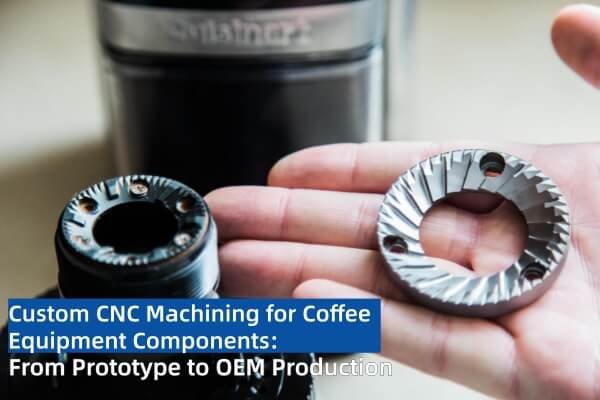
Custom grinder parts like burrs require precise concentricity and symmetrical central alignment for stable grinding operation. Besides, the grinding faces of two typical flat burrs must be parallel to each other while one of them rotates. For conical burrs, they must create an even grinding cavity between them. If they are slightly off-center or tilted, they may create uneven gaps, wobble, or rub against each other or with other components like the burr carrier. When custom coffee grinder parts are CNC machined, they are cut with high precision within the tolerance range. So custom components may help maintain precise burr alignment, concentricity, runout control, operating stability, and precision grinding.
As coffee grinder parts undergo friction, they generate heat and operational wear. CNC machining custom coffee grinder parts lets us use heavy-duty materials and appropriate alloys based on their application. Besides, we also apply suitable surface finishing based on the operating environment and conditions. Some alloys dissipate heat efficiently and reduce warping over continuous use. The custom surface finishing increases wear resistance on these coffee grinder parts. This is why we suggest custom CNC-machined coffee grinder parts for precise dimensions, resulting in stable and consistent performance. However, the design, tolerances, bearings, and assembly also matter for alignment and performance.
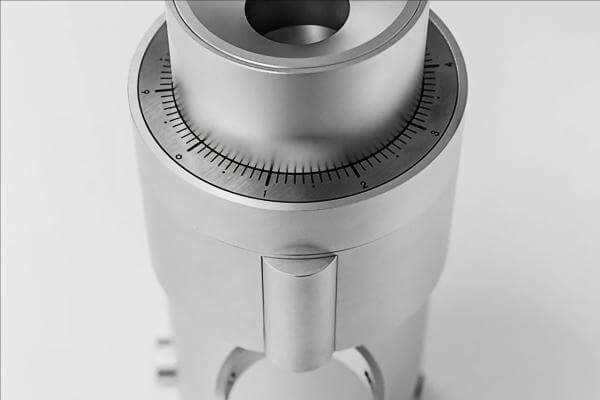
Material Selection for Custom Coffee Grinder Components
Different material alloys are used for custom coffee grinder parts and accessories based on their operating condition. For example, rotational components like grinder burrs experience high torque, continuous mechanical friction, and impact loads while crushing coffee beans into powder. So one of their critical requirements is hardness. At HRCCNC, we offer 440C stainless steel (hardened to about 58-60 HRC) or M2 tool steel (hardened to about 62-65 HRC) to give grinder burrs high durability under heavy wear. However, components like burr carriers can hold the burrs with stable alignment without adding unnecessary weight. So, we suggest high-strength aluminum alloys like 6061 or 7075 grade for balancing tensile strength and lightweightness.
Another precision adjustment component, the adjustment ring on a coffee grinder machine, may be CNC machined from stainless steel or aluminum. Central rotating parts like drive shafts require high structural integrity to resist wear from heavy torque loads. A conventional drive shaft with regular material may warp or bend under heavy rotation loads, resulting in off-axis deflection and wobble. Apart from structural strength, our material selection addresses rust, moisture, and coffee oils during grinding. Therefore, we offer materials like hardened steel and 304-grade stainless steel for shafts or spindles.
Structural components like the grinder housing require high rigidity to absorb motor vibration and provide a protective structure around other internal components. Besides, it must maintain precise mounting alignment between the drive shaft and internal grinding chamber parts. So, we widely suggest 6061 or 7075 grade aluminum for high structural rigidity, thermal dissipation, and corrosion resistance.
Common Custom CNC-Machined Coffee Grinder Parts
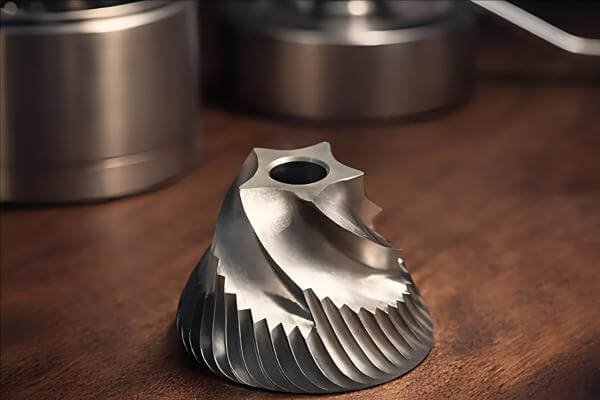
1. Grinder Burrs
These components stay in pairs inside the grinder machines and operate to fracture the coffee beans into powdered coffee grounds. One burr stays attached to the drive shaft and rotates while another burr stays stationary. Grinder burrs have critical features like bore concentricity, precise tooth geometry, sharp cutting edges, and uniform gap tolerance. To manufacture this precision grinding component, our team uses multiple methods, including multi-axis CNC milling and wire EDM, for precise cutting geometries or tooth profiles. As grinder burrs require high durability for continuous heavy loads and wear, we offer hardened 440C stainless steel or M2 tool steel to CNC machine these custom components.
However, machining complications like micro-chipping and thermal cracking during high-speed milling and wire EDM cutting of tool steels are common in the case of burrs. This can occur due to extreme temperature cycles on the cutting edges. To overcome these challenges, we balance cutting speed and extreme thermal changes to reduce these risks. Our quality inspection includes a CMM (coordinate measuring machine) to check burr dimensional tolerances. We also use optical magnification for cutting teeth and edge inspection.
2. Burr Carriers
Burr carriers function as the holders of the burr pairs in accurate spatial orientation inside the coffee grinder housings. The rotating burr carrier supports the burr driven by the shaft, while the stationary carrier supports the opposing burr. Their positions depend on the grinder design.
The burr carriers help the flat or conical rotating burr align concentrically to the drive shaft, allowing it to spin in a true circle without rubbing against the stationary burr or the grinder housing. Maintaining tight concentricity in the burr carrier bore is a critical machining requirement for stable and smooth grinding operation. If the carrier bore is off-center beyond the specified tolerance, the rotating burr may become misaligned with the stationary burr, creating an uneven grinding gap.
Also, another critical dimension is to maintain tight pilot diameter tolerance as it controls the radial positioning. The parallelism of the grinding face of two burrs is affected by mounting-face flatness, perpendicularity, and assembly accuracy. At HRCCNC, we produce these components by combining different machining methods like high-precision CNC turning, micro-milling the mounting slots, and other processes.
This custom operational part is often CNC machined from high-strength 6061 or 7075 aluminum for its balance of hardness and lightweightness. To inspect the bore concentricity and pilot diameter, we use Coordinate Measuring Machines (CMMs). Besides, for custom threads on the central bore and additional threads to hold the burrs securely, we check the thread acceptance with go/no-go gauges.
3. Drive Shafts or Spindles
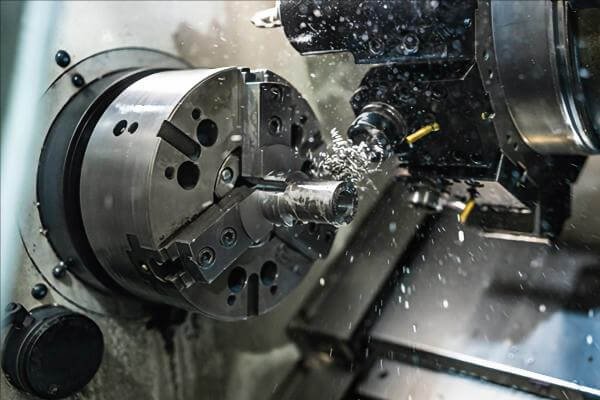
Shafts are central moving components of coffee grinding machines that transmit continuous torque from the motor to the burrs, making them rotate under heavy torsional loads. As the shafts rotate the burrs, maintaining straightness along the entire shaft length is critical. This may be complicated to machine. To manufacture these long moving components, we use CNC turning for precise cylindrical symmetry and straightness. The workpiece materials may include hardened steel and 304-grade stainless steel. To inspect critical features, we use dial gauges for specified runout checks, CMMs for datum-based geometric checks, and micrometers for dimensional checks.
4. Custom Grinder Housings
Housings are the rigid structural components of the coffee grinders, enclosing the internal motor, drive shaft or spindle, and grinding chamber. We suggest materials like 6061 grade aluminum if your critical requirements are better corrosion resistance and high formability. But if you require housings with exceptional hardness and increased wear resistance, we offer CNC-machined coffee grinder housings in 7075 aluminum. After machining, the housings undergo surface finishes like bead blasting and anodizing.
Some critical features of CNC machining these parts are achieving precise structural walls and mounting points for precise concentric alignment of the motor, drive shaft, burrs, and other internal parts. So, for CNC machining them with high accuracy, we utilize methods like precision milling, turning, and boring. These machining processes produce bearing mounting interfaces and internal motor and grinding cavities with tight tolerances.
For quality inspection, we use tools like CMMs equipped with high-precision touch probes to check the dimensional requirements and tolerance compliance. Bore dimensions and axis relationships are checked against the drawing requirements using an appropriate measurement setup.
5. Adjustment Rings
These adjustment components are precisely indexed, which lets the barista control the coffee ground size. They function by dictating the distance between two flat burrs or the inner and outer conical burrs inside the burr carrier. Adjustment rings allow a seamless switch between coffee ground sizes, from coarse filter grinds to ultra-fine espresso. They may be CNC-turned and milled from stainless steel (304 or 316 grade) or anodized aluminum.
A key challenge when producing these rings is removing micro-burrs from the threads to prevent binding during grind-size adjustment. To reduce this problem, we apply appropriate post-processing to deburr and achieve a uniform thread surface finish on both the internal and external thread surfaces of the adjustment rings. Our quality control process includes thread plug and ring gauges. In addition, we also use optical comparators to inspect the thread profile angles and depth.
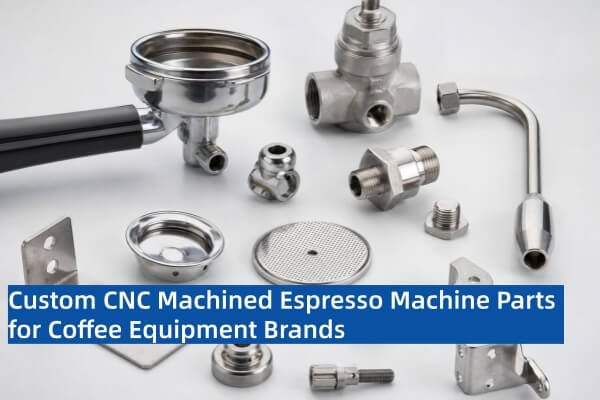
HRCCNC also CNC machines other custom parts of coffee grinder machines, such as motor mounts, bearing seats, dosing or discharge components etc.
Quality Inspection of CNC Machined Coffee Grinder Parts
Maintaining tight dimensional tolerance, stable machining operation, and appropriate surface finishing requires dedicated quality inspection methods in the production lifecycle of custom coffee grinder parts. Burrs, burr carriers, drive shafts, etc., require precise radial diameter and concentricity to fit with each other through the central bore for smooth rotational grinding operation without causing burrs to rub or create uneven coffee bean distribution.
CMMs are used for specified dimensional and datum-based geometric checks. Go/no-go thread plug and ring gauges verify thread conformity. Optical comparators inspect thread profiles and visible burrs. Functional testing checks for smooth, binding-free adjustment.
To inspect the dimensional accuracy of coffee equipment accessories, we use tools like calipers and micrometers. Also, CMMs are used for strict dimensional tolerance inspection of burr radial diameter, inner and outer diameter of burr carrier, central bore specifications of grinding chamber components, and housing wall thickness. For components with precise surface smoothness requirements after surface finishing, our quality inspection method utilizes profilometers to measure accurate surface roughness.
Custom Coffee Accessories and Grinder Parts FAQs
1. What custom coffee accessories can be CNC machined for a grinder?
Common components include burrs, burr carriers, drive shafts, housings and adjustment rings. CNC machining can also produce motor mounts, bearing seats and discharge components to match the grinder’s design and assembly requirements.
2. Which materials are suitable for custom coffee grinder parts?
Hardened 440C stainless steel or M2 tool steel may be used for burrs. Aluminum alloys such as 6061 and 7075 are options for carriers and housings, while stainless steel can suit adjustment rings. Selection depends on wear, loads, corrosion resistance and finishing requirements.
3. What tolerances should be specified for coffee grinder components?
There is no single tolerance suitable for every component. Critical requirements may include locating bore dimensions, pilot diameters, mounting-face accuracy and shaft runout. These should be defined according to bearing fits, burr alignment and assembly requirements.
4. What surface finishes can be used on CNC machined grinder parts?
Aluminum housings may be bead blasted and anodized, while adjustment threads require careful deburring. Each finish should suit the part’s wear and cleaning requirements, preserve critical dimensions and account for whether the surface contacts coffee.
5. How are custom coffee grinder parts inspected?
Checks can include CMM measurement of specified dimensions and datum relationships, shaft runout testing, thread gauging and surface roughness measurement. Adjustment components may also require functional checks for smooth movement without binding.
6. What information is needed to request a quote for custom coffee accessories?
Provide 2D drawings or 3D CAD files, material preferences, quantities, critical tolerances and surface finishes. Explain the part’s function and mating interfaces so manufacturability and inspection requirements can be reviewed.
Partnering with a Reliable Custom CNC Machined Grinder Parts Manufacturer
If you need your custom coffee grinder parts to be CNC machined and post-processed with accuracy and tight tolerances, you need to rely on an experienced manufacturer. At HRCCNC, our team of experts oversees every CNC machining step, from your drawing evaluation to final quality control inspection. After prototype production, we inspect it thoroughly and proceed with large-batch production after the first article inspection.
Contact us with your 2D drawings or 3D CAD files to get confidential DFM feedback and any free technical advice on custom coffee equipment parts. We also provide support on manufacturability, tolerance feasibility, and cost-saving opportunities. We also offer suggestions on appropriate materials and surface finishing options based on the operating conditions of the custom parts in coffee equipment.