Skip to content

An extruded heat sink and a CNC machined heat sink can look alike on a drawing, yet they reach the final part through different tooling, cost structures, and design limits. This article compares three routes for a custom heat sink: extruding the profile, machining the whole part from solid stock, and extruding a profile that CNC machining then finishes, which this guide calls the hybrid route.
These are the options compared here, not a complete list of manufacturing methods, and skived and bonded-fin designs appear in the selection guidance as alternatives. The guidance is general, and each drawing still needs its own review. HRCCNC produces custom aluminum heat sinks with both extrusion and CNC machining.
Three Routes at a Glance
As a starting point, evaluate a stock extrusion first when a catalog profile can meet the fin requirements; a new custom die when no existing profile fits and the part will be produced repeatedly; and machining from solid stock when the quantity is low, the design is still changing, or the fins cannot be formed with a constant cross section. Choose the hybrid route when an extruded profile already meets the fin requirements and machining only needs to add the remaining features.
Comparison Table: Extrusion, Machining From Solid Stock and the Hybrid Route
| Factor | Extrusion | Machining from solid stock | Hybrid route: extrusion plus CNC machining |
| How the fins are formed | A heated billet is pushed through a shaped die | Fins are milled from a solid block | Fins come from the extruded profile; machining adds features |
| Suitable applications | Uniform fin profiles in repeat production | Prototypes, small batches and fins that vary along the part | Extruded profiles that need holes, threads, flat faces or bores |
| Upfront investment | No new extrusion die for a stock profile; a new die for a custom profile. Other setup charges may apply. | Programming, fixturing and setup, with no die | Die cost if the profile is custom, plus programming and fixturing |
| Volume sensitivity | High for a custom die, since die cost is spread across parts | Lower, because machining time repeats on every part | Combines die amortization with machining time per part |
| Design-change flexibility | A cross-section change needs die work | Changes are made through the program and setup | Machined features change easily; profile changes need die work |
| Lead-time drivers | Die making for a custom profile, or stock availability | Programming, setup, cycle time and machine capacity | Profile supply plus machining and finishing |
| Typical geometry | Constant cross section along the length | Non-constant sections and multi-directional fins | Constant fin section with machined features |
Geometry, Material and Airflow Decide Cooling Performance
Neither process gives better cooling by itself, because the thermal result comes from fin geometry, alloy, airflow, and the interface to the heat source. The process matters because it limits which fin geometries can be produced at a reasonable cost.
Natural convection does not rely on surface area alone. Air next to the hot fins becomes less dense and rises, and that buoyancy force grows with the temperature difference between the surface and the surrounding air, as Simon Fraser University’s natural convection lecture notes explain. The same notes show why fin spacing matters: closely packed fins add area but lower the heat transfer coefficient, widely spaced fins do the opposite, and an optimum spacing lies between them.
Orientation and clearance also count, since Infineon’s application note AN-1057 advises vertically aligned fins for natural convection and warns against placing heat-generating parts below other equipment that blocks the rising air.
In forced convection, a fan or blower drives the air and the convection coefficient rises with air velocity, while fin efficiency still depends on fin thickness, length and alloy conductivity in either mode.
What Is an Extruded Heat Sink?
An extruded heat sink starts as a heated aluminum billet that a hydraulic press forces through a shaped die. The die forms the base and fins together in one continuous profile, which is then cut to length and may be machined or surface treated. Some buyers search for an extruded aluminum heatsink, but the defining feature is the same: a cross section set by the die.
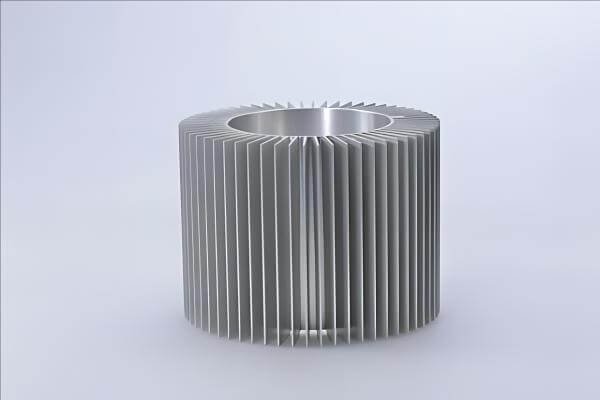
Strengths and Limits of Extrusion
Extrusion forms the fins and base as one piece with no joint between them, and a die can produce profiles ranging from simple to complex. Its main limits are geometric, starting with fin aspect ratio. Achievable fin aspect ratios depend on die design, press capacity, alloy and fin geometry. Published ratios may use different definitions and should not be treated as universal process limits. Ask the extruder how it defines the ratio and what it can achieve for the specific profile, alloy and fin thickness.
The die sets only the cross section, so holes, bosses, pockets and any feature that runs across the length need secondary operations. Extrusion tolerances are tabulated in Aluminum Standards and Data, and the Aluminum Extruders Council notes that tighter values can often be agreed with the extruder. A contact face that must be flat is usually machined and should carry a flatness callout, because Infineon recommends that all interface surfaces be smooth and flat.
What Is a CNC Machined Heat Sink?
A CNC machined heat sink is milled from solid aluminum stock, so the fins and base are produced by cutting instead of a die. Without a die, the part is not tied to a constant cross section, which allows non-constant sections and multi-directional fins. HRCCNC’s product range includes CNC machined plate fin and pin fin base heat sinks.
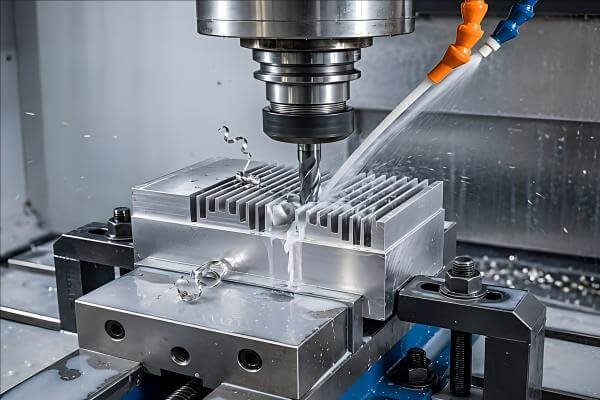
Strengths and Limits of Machining From Solid Stock
Mounting holes, threads and pockets can often be cut in the same setup as the fins, but that depends on tool access to each feature and on how the part is held, because features on several faces, deep pockets or a part that cannot be clamped securely may still need a second setup or a dedicated fixture.
Fin geometry sets the other limit, since thin or tall fins increase tool deflection and machining time, and high aspect ratios call for longer tools at slower feeds and speeds to avoid breakage, as RapidDirect’s design guide notes. More material is also removed than on an extruded part, which adds cycle time and tool wear.
Extrusion Plus CNC Secondary Machining: The Hybrid Route
The hybrid route fits when an extruded profile already meets the fin requirements and CNC machining adds what the profile cannot carry. Holes, slots or a precision contact face do not make a design hybrid on their own, because a part machined from solid stock can have all of them too. The deciding question is whether the fin geometry can come from a stock or custom extrusion.
In a typical heat sink manufacturing process on this route, the profile is extruded and cut to length, then CNC operations add the features. HRCCNC’s secondary operations include cut-to-length, surfacing and milling, drilling, tapping, countersinking, counterboring, slotting, chamfering, deburring, and bore and end-face machining, with screw kits and threaded inserts available for assembly. Thermal contact surface flatness and mounting feature alignment are the machining points that need the most control.
Surface finishing follows machining, then inspection and assembly support. Anodizing changes dimensions because the oxide grows both into and out from the surface, so threads, fitted bores and contact faces should be masked or dimensioned with the coating in mind, and HRCCNC offers masking for functional contact faces and grounding faces.
Cost, Volume and Lead Time by Route
Tooling and machining time are the two cost drivers that separate these routes, while finishing and inspection apply to all three.
Stock Profiles vs. Custom Profiles With a New Die
A stock profile uses an existing die, avoiding the cost and lead time of developing a new extrusion die. The trade-off is that the fin pitch, height and base thickness are fixed by the catalog, and secondary machining can only adapt the part around them. Whether a supplier holds stock profiles should be confirmed at the quoting stage.
A custom profile requires a new die made for that cross section. Gabrian explains that die and tooling costs are often similar for small and large orders, so the cost per part falls as volume rises. It gives a normal tool turnaround of 3 to 4 weeks, with production following within a week of sample approval, which is one supplier’s figure and not an HRCCNC lead time. More complex dies take more time and labor, which adds to both cost and schedule.
Machining From Solid Stock and the Hybrid Route
Machining from solid stock avoids die cost, so cost follows programming, setup and cycle time. Programming and setup are spread across more parts as quantity grows, but the cutting time on each part does not shrink, and oversized stock adds material removal, machine time and tool wear. That cost structure suits prototypes and small batches.
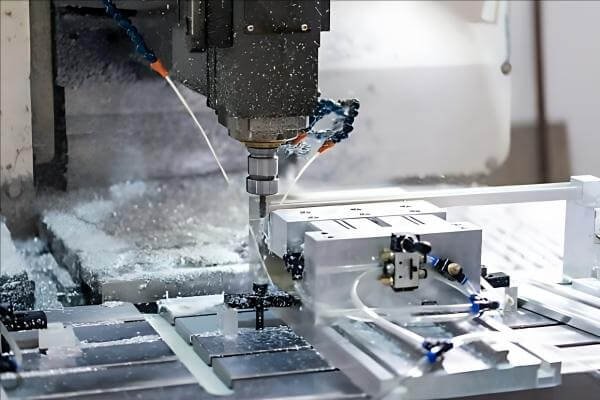
On the hybrid route, machining cost adds to the extrusion cost, so the total depends on whether the profile is stock or custom and how many features are machined. The cost crossover between a custom die and machining from solid stock has no universal quantity.
It depends on the die cost, the machining time saved per part by starting from an extruded profile, the programming and fixturing needed on each route, and the total quantity expected over the product’s life, including repeat orders. Quotes for both routes at the same quantities show where the crossover falls for a given part.
How to Choose the Right Process for Your Project
Start with the heat source size, target thermal resistance, cooling mode and installation space, because those define the fin geometry the part needs, and then match that geometry to a route.
• Evaluate a stock extrusion when a catalog profile meets the fin requirements and the remaining work is cutting to length and adding mounting features.
• Evaluate a new custom die when no stock profile fits, the fins can be formed with a constant cross section, and the expected volume and design stability can justify the die cost and tooling time.
• Evaluate machining from solid stock when the quantity is low or uncertain, the design is likely to change, or the fins vary along the part.
• Choose the hybrid route when an extruded profile, stock, or custom, already meets the fin requirements and machining adds holes, threads, flat contact faces, or bores.
When neither extrusion nor machining suits the fin geometry, other constructions are worth reviewing. Skived heat sinks have fins sliced from a solid block, giving high fin density with no joint between fin and base, which P&A International describes as costing more than extrusion. Boyd notes that skiving uses a single cutting tool with lower tooling cost but is less suited to high volume. Bonded-fin heat sinks join separate fins to a base, reaching tall fins and large footprints beyond extrusion, and Boyd lists them for fin aspect ratios above 15:1. Both need their own cost and supplier review.
Record flatness callouts, masking areas and the anodizing type and thickness on the drawing, and confirm the route through a design for manufacturability review.
Extruded Heat Sink FAQs
1. Can an extruded heat sink be used without CNC machining?
Yes. An extruded heat sink may only need cutting to length if the profile already meets the mounting, dimensional and contact-surface requirements. CNC machining becomes necessary when the design requires features such as threaded holes, pockets, fitted bores or a precision mounting face.
2. Does CNC machining provide better cooling than extrusion?
Not automatically. Cooling performance depends on fin geometry, material, airflow and the thermal interface with the heat source. CNC machining offers more geometric flexibility, but a suitable extruded profile can meet the same thermal requirements. Compare designs under the intended operating conditions rather than judging performance by manufacturing method alone.
3. Should I choose a stock extrusion or a custom heat sink profile?
Start with a stock profile if its fin spacing, height and base dimensions suit the application. A custom profile is worth evaluating when standard options cannot meet the requirements and expected repeat orders can justify a new die. Compare tooling, secondary machining and total production costs before deciding.
4. Is there a minimum quantity that makes extrusion cheaper than CNC machining?
There is no universal break-even quantity. The comparison depends on whether an existing extrusion die is available, the cost of a new die, machining time per part and expected repeat orders. Request quotes for the same design requirements and quantities to identify the more economical route.
5. Can an extruded heat sink be modified after production?
Yes. CNC machining can add holes, threads, slots, pockets and precision contact faces to an extruded profile. However, access, remaining wall thickness and fin stability limit what can be changed. Review modifications before production, particularly when they affect the fins, mounting interface or surface finish.
6. What information is needed to quote a custom heat sink?
Provide a drawing or 3D model, material, quantity, expected repeat volume, finish and critical tolerances. Include the heat source size, thermal requirements, cooling mode and available installation space. Identify any flatness requirements, threaded features and anodizing masking areas so the supplier can assess the manufacturing route.
Custom Heat Sink Projects With HRCCNC
HRCCNC produces custom heat sinks using extrusion, CNC machining or a combination of both, using AL 6061 and 6063 as common alloys and other grades where thermal conductivity, strength, finish or machining needs call for them.
Finishes include clear, black, gold, bright silver, champagne and natural anodizing, and inspection covers base flatness, hole position, thread quality, fin spacing and surface appearance. Prototype validation, small batch production and repeat orders are supported with DFM review. For a quote, send a drawing or 3D file with the dimensions, alloy, finish, quantity and expected repeat volume, thermal requirements and application, plus the heat source size, target thermal resistance and installation space. Mark the features that need machining and say whether you expect an existing profile or a new custom profile. The engineering team responds within 24 hours, so send your drawing through the custom aluminum heat sinks page for review and quotation.