Skip to content

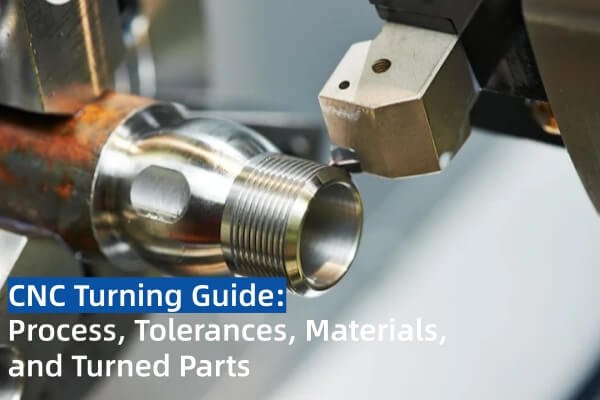
Picture a lathe running, and you’re already picturing CNC turning, even without knowing the name for it. A bar of metal spins, a tool bites into it, and material falls away until what’s left matches the drawing. Simple to picture. Harder to get right. The details are what decide whether a part comes off that machine ready to use, or lands back on the bench for rework. This guide covers what actually happens during the process, what tolerances are realistic to expect, which materials behave well on a lathe and which don’t, and what’s worth checking before a turned-parts drawing goes out for quote.
What Is CNC Turning?
The Core Process: Rotating Workpiece, Stationary Tool
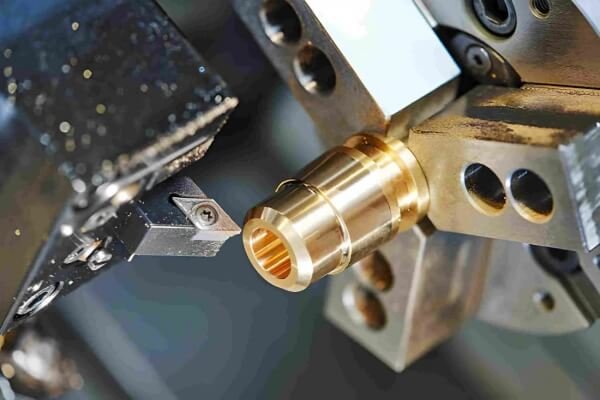
Here’s the one-line version, in case you came for exactly that: what is CNC turning? It’s a machining process where the workpiece rotates against a cutting tool that stays largely fixed in position, removing material to shape cylindrical features. That’s the opposite setup from milling, where the tool spins and the workpiece generally doesn’t. The rotation is what makes turning the natural choice for round parts. Shafts, pins, bushings, anything built around a central axis tends to come off a lathe faster and cheaper than it would off a mill.
CNC Turning vs CNC Milling: Which Process Fits Your Part?
| Factor | CNC Turning | CNC Milling |
| What rotates | Workpiece | Cutting tool |
| Best-fit geometry | Cylindrical, round features | Flat surfaces, pockets, complex 3D shapes |
| Typical parts | Shafts, pins, bushings, fittings | Brackets, housings, plates |
| Cycle time on round parts | Faster | Slower |
The short version: if a part is fundamentally round, turning almost always wins on cost and speed. If it’s fundamentally not round, milling wins instead. Plenty of real parts need both, which is exactly what turn-mill equipment exists for, more on that further down.
Common Turning Operations
A lathe isn’t a one-trick machine. Straight turning reduces diameter along a length. Taper turning does the same at an angle. Facing squares off an end. Threading cuts helical grooves for fasteners. Grooving cuts a recess into the diameter. Knurling presses a textured pattern into the surface, usually for grip. Boring enlarges an existing hole from the inside. Most turned parts use a combination of several of these in a single program, not just one.
The CNC Turning Process, Step by Step
From CAD Drawing to G-Code
A turned part starts as a 3D model or 2D drawing, gets programmed into toolpaths through CAM software, and comes out the other end as G-code the lathe’s controller can actually run. The programming stage is where a lot of the real decisions get made: which operations happen in which order, where the part gets held, and how many setups the job actually needs.
Workholding: Chucks, Collets, and Bar Feeders
Most turned parts get held in a three-jaw chuck, which grips reliably across a wide range of diameters but sacrifices a bit of concentricity compared to other options. Collets grip more precisely and suit smaller diameter, higher-volume work. Bar feeders push raw stock through the spindle automatically, letting a lathe run multiple parts unattended once it’s set up. The right choice depends less on the part and more on the volume: one-off prototypes rarely justify a bar feeder, but a production run of several thousand pieces almost always does.
Conventional CNC Lathes vs Multi-Axis Turn-Mill Centers
A conventional CNC lathe turns. That’s the whole job description, and it does it well: two axes, a spindle, a turret, straightforward programming. A multi-axis turn-mill center adds live tooling, sometimes a sub-spindle, sometimes a Y-axis, and suddenly the same machine can drill, mill, and tap features that would otherwise need a second setup on a different machine entirely. The tradeoff is complexity. Turn-mill programming takes more expertise, and not every shop running lathes actually runs turn-mill equipment well. Worth asking directly if your part needs it.
CNC Turning Tolerances: What’s Actually Achievable
Standard vs Precision Tolerance Grades
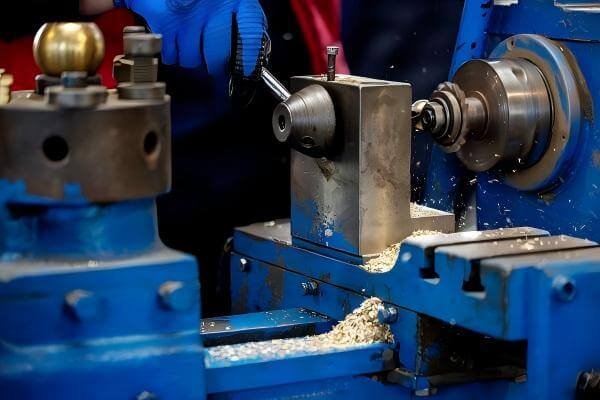
Standard CNC turning can typically hold tolerances around ±0.05 to ±0.1 mm, depending on part geometry, material, machine condition, and setup. Precision turning can tighten this to approximately ±0.01 to ±0.025 mm under controlled conditions. Tolerances around ±0.005 mm or tighter may be achievable for specific features and suitable geometries, but typically require highly controlled tooling, setup, inspection, and thermal conditions.
What Affects Achievable Tolerance
Material matters more than most people expect walking in. Free-machining stainless holds tolerance more predictably than a gummier grade under identical cutting conditions. Length-to-diameter ratio matters just as much: a shaft under roughly a 4:1 ratio resists deflection on its own, but push past that and the workpiece starts to whip or flex under cutting force unless it’s supported with a steady rest or the tailstock. Rigidity in the setup, chuck, tooling, and machine itself sets a ceiling no amount of careful programming gets around. And thermal growth is real. A part that measures in spec right off the machine can drift out of tolerance as it cools, especially on longer production runs where the machine itself has been generating heat for hours.
Specifying Tolerance on Your Drawing Without Overpaying
Not every dimension on a turned part earns a tight tolerance. Calling out precision only on the diameters and features that actually need it, bearing fits, mating surfaces, sealing diameters, and leaving the rest at a standard commercial tolerance keeps a quote from pricing the whole part as if every dimension mattered equally. It usually doesn’t.
Materials for CNC Turning
Free-Machining Steels and Stainless Grades
Free-machining steels like 12L14 aren’t an accident. They’re built to turn well, plain and simple: clean cuts, manageable chips, tolerance that holds without a fight, none of which general-purpose steel hands you for free. Stainless is trickier across the board, but grades vary a lot here too. 303 stainless is genuinely known as the free-machining stainless grade, while 304 and 316 turn harder and tend to work-harden if the tool isn’t kept sharp and the feed rate isn’t managed carefully.
Aluminum and Brass for Turned Parts
Aluminum turns fast, and it forgives mistakes, which is exactly why so much prototype and low-volume turned work runs through it. Brass earns its reputation too. Free-cutting grades like C360 are basically the yardstick everyone else gets measured against. Nothing else cuts quite that clean. It cuts clean, produces short chips instead of long stringy ones, and rarely fights the tool the way steel or stainless can. If a turned part doesn’t have a specific reason to be steel, brass is worth a second look.
Engineering Plastics on the Lathe
Acetal (Delrin) and nylon both turn well and show up often in bushings, spacers, and low-load mechanical parts. PTFE turns too, but it’s soft enough that workholding pressure alone can distort a thin-walled feature, so fixturing needs more care than it would for a metal of the same geometry.
Matching Material to Part Function, Not Just Cost
The cheapest material that machines the fastest isn’t automatically the right call. A bushing that needs to survive years of rotation under load has different requirements than a one-off prototype spacer, and picking material based purely on machining ease can produce a part that turns beautifully and fails in service anyway.
Live Tooling and Turn-Mill Capability: Beyond Basic Turning
What Live Tooling Adds
Live tooling mounts driven tools directly on the turret, letting a lathe drill, mill, or tap without moving the part to a second machine. The tools sit either face-mounted on the turret or arrayed radially, and a servo drives them independently of the main spindle. Add a Y-axis and the machine can reach features that aren’t parallel or perpendicular to the spindle centerline, off-axis holes and flats that a basic two-axis lathe simply can’t touch without a separate setup.
When a Turn-Mill Part Beats a Turning-Plus-Milling Assembly
Every setup change is a chance for something to shift, and a part that needs a hole drilled off-center or a flat milled onto an otherwise round shaft used to mean exactly that: turn it, move it, mill it. A turn-mill machine collapses that into one setup, which cuts handling time and removes the accumulated error that comes from re-fixturing a part between operations. It’s not automatically the cheaper option on every job, but on parts with several off-axis features, it usually is.
Common CNC Turned Parts and Applications
Shafts, Pins, and Spindles
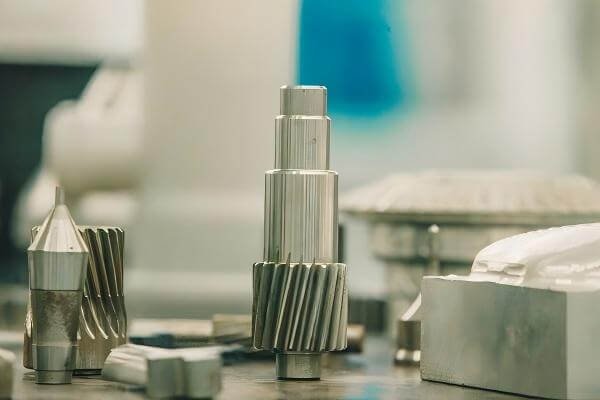
The most straightforward turned geometry there is, and also some of the highest-volume work a lathe produces, since these parts are round by definition and turning is simply the fastest way to make them.
Bushings, Sleeves, and Fittings
Bushings and sleeves depend on tight inner and outer diameter control since they usually locate other components around them. Fittings add threading and sealing surfaces on top of that, which is where operation sequencing on the lathe actually starts to matter.
Threaded and Fastener-Style Components
Custom fasteners, threaded inserts, and standoffs are turned constantly, particularly when an off-the-shelf fastener doesn’t quite match the application’s thread pitch, length, or head geometry.
Industries That Rely on CNC Turned Parts
Automotive, aerospace, medical devices, hydraulics, fluid power: five very different industries, all leaning on CNC turned parts for the same reason. Round, rotating, pressure-bearing components show up constantly in every one of them, and that’s exactly the geometry turning was built for.
Surface Finish and Secondary Operations for Turned Parts
As-Turned Finish vs Ground or Polished Finish
A well-tuned lathe running sharp tooling produces a respectable finish straight off the machine, often good enough for plenty of applications without any further work. Bearing fits, sealing surfaces, and cosmetic parts usually need better than that, which is where grinding or polishing comes in as a dedicated secondary step.
Common Secondary Steps
Deburring removes sharp edges left at the end of a cut, and it’s rarely optional since a turned part almost always has at least one edge worth breaking. Plating adds corrosion resistance, or sometimes just the look a part needs. Heat treatment may be performed before or after certain machining stages, depending on the material, hardness requirements, and final tolerance specifications. When possible, rough machining before hardening can reduce tool wear, while finish machining or grinding may still be required after heat treatment.
Cost Factors in CNC Turning
What Drives Cycle Time on a Lathe
Diameter, length, and the sheer number of operations in the program all add up directly to cycle time. A part that needs turning, facing, threading, and grooving in sequence takes longer than one that just needs a diameter reduced, and that time difference shows up directly on the quote.
Bar Stock vs Custom Blanks
Bar stock in a common size is cheap and available immediately. A custom blank, cut to a specific diameter that isn’t standard stock, adds cost and lead time before the lathe even starts cutting. Designing around standard bar sizes where the application allows it is one of the simplest ways to keep a turned part’s cost down.
Getting an Accurate CNC Turning Quote
Material, tolerance, quantity, and how many operations the program actually runs: none of these move the price on their own. They move it together. Which is exactly why a real drawing gets you a reliable quote, and a rough description doesn’t.
Choosing a CNC Turning Partner: What to Check Before You Send a Drawing
Questions Worth Asking Before You Commit to a Production Run
Ask what tolerances a shop actually holds in production, not just what they claim is achievable in ideal conditions. Ask whether they run live tooling or turn-mill equipment if your part needs it, rather than assuming every lathe shop does. And ask how they inspect turned features, since a diameter that’s never actually measured isn’t a verified diameter.
Red Flags on a Turned-Parts RFQ
A quote that ignores your called-out tolerance and returns a flat price regardless of spec is worth a second look. So is a shop that can’t say which grade of a material they’re quoting, since 303 and 304 stainless machine differently enough that the distinction actually matters on the shop floor.
FAQs
1. What is CNC turning used for?
CNC turning is commonly used to produce cylindrical parts such as shafts, pins, bushings, sleeves, fittings, threaded components, and other parts built around a central axis.
2. What is the difference between CNC turning and CNC milling?
In CNC turning, the workpiece rotates while the cutting tool removes material. In CNC milling, the cutting tool rotates while the workpiece typically remains fixed. Turning is generally better suited to cylindrical parts, while milling is commonly used for flats, pockets, and complex geometries.
3. What tolerances can CNC turning achieve?
Standard CNC turning can typically achieve tolerances around ±0.05 to ±0.1 mm, while tighter tolerances may be possible depending on the material, geometry, machine condition, tooling, and setup.
4. What materials are suitable for CNC turning?
Common CNC turning materials include aluminum, stainless steel, carbon and alloy steels, brass, and engineering plastics such as acetal, nylon, and PTFE. Material selection should be based on both machinability and the part’s functional requirements.
5. What factors affect the cost of CNC turned parts?
Major cost factors include material, part size, geometry, tolerances, quantity, machining operations, cycle time, and secondary processes. Designing around standard bar stock and applying tight tolerances only where necessary can help control costs.
6. What information is needed for a CNC turning quote?
A complete RFQ should include a 3D model or technical drawing, material, quantity, tolerances, thread specifications, surface finish, and any secondary processing requirements. Providing complete information helps the manufacturer evaluate manufacturability and prepare a more accurate quote.
Get Your CNC Turned Parts Quoted by HRCCNC
Our Approach to CNC Turning
HRCCNC machines turned parts in stainless steel, aluminum, brass, and engineering plastics, with tolerances down to ±0.009 mm on suitable geometry. DFM review is built into the quoting process, so tolerance callouts and material choice get checked against what’s realistically achievable before production starts. Whether your part is straightforward turning or needs off-axis features, send a drawing and we’ll confirm the right approach. Production runs under ISO 9001:2015, with CMM-based inspection used to verify parts against the drawing.
Request a Quote in 3 Steps
1. Upload your drawing: STEP, IGS, or PDF, with material, tolerance, and thread specs called out
2. Get a DFM review: confirming the operation sequence and tolerance fit your part’s actual function
3. Receive your quote: with lead time based on your real geometry and quantity