Skip to content

If your part has angled holes, a deep cavity, and a curved surface on the back, a 3-axis mill may require three or more setups. Each time the part is unclamped and repositioned, there is a risk of small alignment errors that can affect feature-to-feature accuracy. A 5-axis CNC machine helps solve this problem by adding two rotary axes to the standard X, Y, and Z movements, allowing the cutting tool to reach the part from multiple angles in a single setup. At HRCCNC, we provide 5-axis CNC machining services for complex precision parts in aluminum, stainless steel, titanium, and engineering plastics, from one-off prototypes to low-volume production runs.
So here’s the plan for this 5-axis CNC machining guide: how the process actually works, what pushes the price up or down, which parts are actually worth the extra cost, and how you can tell if yours is one of them.
What Is a 5-Axis CNC Machine?
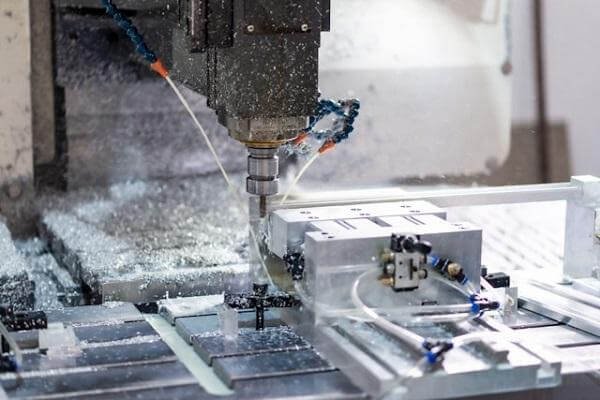
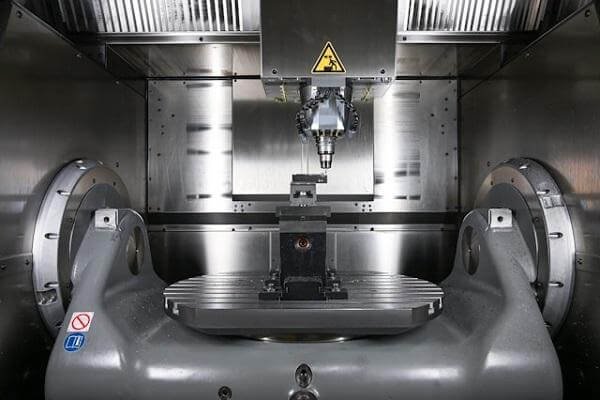
Simplest way to put it: a 5-axis CNC machine moves the tool and workpiece along five coordinate axes instead of the usual three. Three of those, X, Y, Z, are just straight-line movement, nothing new there. The other two are rotary, some pairing of A, B, or C, with A turning around X, B around Y, C around Z.
Might be the cutting head that rotates, might be the worktable, sometimes both, depends on the machine. That’s the real difference from a standard mill: the tool reaches several faces of a part without anyone stopping the job to set it up again. Fewer setups. Features that actually line up. And it gets into angles a 3-axis tool has no way of touching.
5-Axis CNC Machine vs. 5-Axis CNC Machining Services: What’s the Difference?
The machine itself is just a piece of advanced equipment. 5-axis CNC machining services are what you’re actually paying for when you outsource a part: everything that surrounds it, the programming know-how, the shop-floor experience, someone who’s run this exact kind of job before and knows where it can go wrong.
Buy the machine yourself and you’re on the hook for capital investment, operator training, CAM software licensing, and none of that gets you a single finished part yet. Often that’s six figures just to get in the door. Tooling and maintenance keep piling on after, month after month, whether or not you’re actually running anything.
Hiring a shop skips most of that headache. Send over a print, and a good supplier will tell you straight whether it actually needs 5-axis or would run cheaper on 3-axis or 3+2. You get parts back. No CAM license to buy, no operator to train up. Most companies, even the ones with fairly steady 5-axis needs, come out ahead going this route instead of trying to build the whole capability themselves.
How Does a 5-Axis CNC Machine Work?
Every job starts life as a CAD model. CAM software takes that and works out the toolpaths, then the machine’s controller turns those paths into real, coordinated movement across the linear and rotary axes together. Before any of it touches actual metal, most shops run the program through a collision simulation, because with more axes in motion there’s more room for the tool to clip the fixture, or worse, the machine itself.
As the cutter runs, it holds whatever angle the feature needs right then, tilting into a pocket one second, sweeping across a contoured surface the next. Get a part with features on four or five sides, and that one setup can knock out what would’ve taken three or four separate cycles on a 3-axis mill.
There’s really three ways these machines get built. Table-table, or trunnion: the workpiece rotates and tilts while the spindle just sits there. Works well on smaller, precise parts. Head-table splits the job between a tilting spindle and a rotating table, a decent all-rounder across a wide size range.
Head-head, or swivel-head, keeps the table still and puts both rotations in the spindle, which tends to suit the bigger, heavier stuff. Each setup trades rigidity for reach a little differently, but a CNC machine with 5 axes always lands in the same place: several sides of a part, one clamping, done. Something a 3-axis machine just can’t manage.
Take a housing with mounting bosses on two angled faces and a bore that has to line up with both. On a 3-axis mill, that’s a fixture change, a re-zero, a fresh set of work coordinates, and a wait while the part comes off and goes back on. A 5-axis CNC machine just tilts and keeps cutting. No second fixture. No re-zero. No gap where the part might’ve shifted a few thousandths from where it started.
3+2-Axis vs. Simultaneous 5-Axis CNC Machining: What’s the Difference?
Not every 5-axis CNC machining job moves all five axes at once, worth knowing that going in. With 3+2, sometimes called positional or indexed 5-axis, the two rotary axes tilt the part to a fixed angle and lock there. The actual cutting happens with just X, Y, and Z moving, so really it’s a 3-axis operation sitting at a compound angle. A bracket needing holes at six different angles is a textbook 3+2 job: index, cut, index again, and repeat. Simpler to program, cheaper to run, which is exactly why shops reach for it even on machines built for full simultaneous motion.
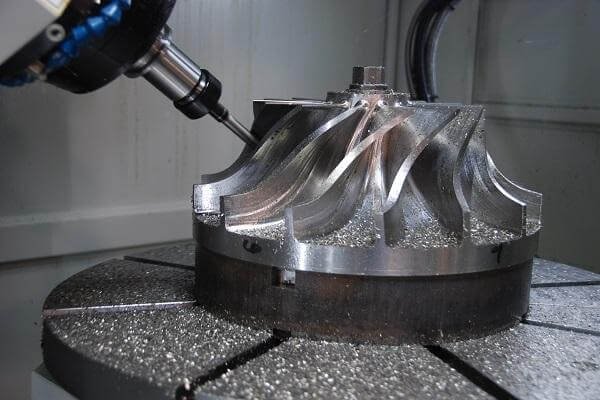
Simultaneous 5-axis CNC machining is a different animal. Here all five axes move together, so the tool can chase a surface that’s constantly changing shape underneath it. Autodesk points to this as the go-to method for tight control over complex, organic contours, think turbine blades and impeller vanes, where the airfoil profile keeps twisting and never settles at one angle. Most real jobs mix both on the same part, honestly. A shop might index through the easy holes, then switch to simultaneous motion only where the surface actually calls for it, instead of forcing the whole job through one method just because that’s the habit.
3-Axis vs. 5-Axis CNC Machining: Which Is Better for Your Part?
Neither wins automatically. Comes down to the geometry, and a shop that knows its business makes that call based on the part sitting in front of them, not out of habit.
| Factor | 3-Axis CNC Machining | 5-Axis CNC Machining |
| Axis movement | X, Y, Z | X, Y, Z plus 2 rotary axes |
| Part access | Limited to fixed orientation | Multiple angles and sides |
| Setups for complex parts | Often several | Frequently just one |
| Best-suited geometry | Simple to moderate | Complex, multi-angle, compound |
| Programming and labor | Simpler, less specialized | More advanced, more experience required |
| Typical cost per hour | Lower | Higher |
Got a simple bracket, or a mostly flat plate? 3-axis is usually the cheaper, smarter call. No reason to pay for capability you’re not going to use. But once a part has features spread across several faces, compound angles, tolerances that need to hold across all of it, 5-axis tends to win even at the higher hourly rate. It’s a fair question, and the cost section below explains why.
Got a part like that, angled holes, deep cavities, tolerances that have to hold across several faces? Send us the CAD file and we will tell you straight whether 3-axis, 3+2, or full 5-axis is actually the cheaper way to make it.
What Are the Benefits of 5-Axis CNC Machining for Your Parts?
Fewer setups, for one. Machining several faces in one clamping cuts out the repositioning steps that eat into your schedule, plus the fixturing cost tacked onto every extra setup.
Accuracy holds up better too. Unclamp and re-reference a part enough times and small errors sneak in and stack on top of each other. Keep it fixtured through more operations and most of that just disappears. Matters most when features on different faces need to line up dead on.
Then there’s the geometry itself. Compound angles, deep cavities, holes at non-standard angles, all the stuff a 3-axis tool physically can’t reach. It becomes routine.
Surface finish tends to come out better too, almost as a bonus. Keep the cutter at a good angle against the surface, and you often skip a round of hand polishing or other finishing work.
Tooling gets shorter and stiffer, generally. Multi-axis positioning often lets a machinist run a shorter tool on a given feature. Less deflection, less chatter, tool usually lasts longer too. Add it all up and total production time tends to drop, even with the machine billing at a higher hourly rate. Fewer setups, less rework, part gets to you faster overall.
When Should You Choose 5-Axis CNC Machining Services?
5-axis CNC machining services make sense when a design has to be machined from several orientations, when repeated setups would put feature-to-feature accuracy at risk, when compound-angle holes or surfaces show up on the print, or when tool access on a 3-axis machine is a genuine problem. A manifold with ports drilled at odd angles into a curved body is a good example of this.
Try holding that on a 3-axis machine and you’re usually building custom fixturing just to get the part square for each hole, and that fixturing bill alone can wipe out whatever you saved on machine time. If several operations can fold into one setup, that’s a good sign on its own too, especially on parts where consistency across a whole production run matters as much as any single dimension.
That said, a simple bracket, plate, or straightforward prismatic part rarely needs any of this. 5-axis CNC machining costs more to run, mostly because the machines are a much bigger investment and programming them safely takes real skill. Pay for that capability on a part that doesn’t call for it and you’re just adding cost with nothing to show for it. If a supplier’s any good, they’ll tell you that flat out instead of trying to upsell you.
Not sure which category your part falls into? Send us your drawings and specs, and we’ll tell you plainly whether 5-axis is worth it before we ever quote the job.
What Parts and Industries Use 5-Axis CNC Machining?
Most parts that get the biggest payoff share a few things in common: features on more than one side, compound angles, cavities that are deep or awkward to get into, complex 3D contours, or features cut in different planes that all need to agree with each other.
In aerospace, that’s turbine blades, impellers, blisks, structural airframe parts, places where surface accuracy and weight both matter at the same time. Sandvik’s own guidance on blisk production calls for a five-axis machine with strong simultaneous dynamics, given how tightly the aerodynamic profile has to be held.
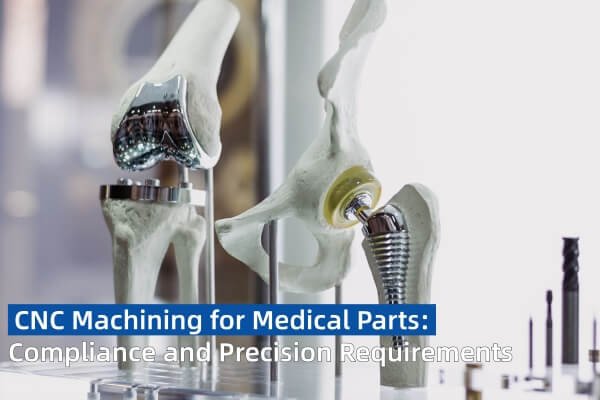
Blade profile tolerances on parts like this are commonly held to a few thousandths of an inch across the whole surface, tight enough that 3+2 indexing alone usually can’t deliver it. Medical manufacturing carries the same demand for tight, multi-plane tolerances, often on titanium implants and surgical instruments, where a joint that’s a hair out of round gets the whole part rejected. Automotive shops lean on 5-axis for performance parts, engine components, and prototypes. Mold and die work relies on it for contoured cavity surfaces that would otherwise be difficult and time-consuming to produce any other way.
5-Axis CNC Machining Cost: What Affects the Price?
5-axis CNC machine price is a fair question if you’re weighing whether to buy the equipment yourself. Honestly, a production-grade machine is a huge investment on its own, often several hundred thousand dollars before installation, tooling, or training even come into it. That’s a big part of why 5-axis carries a higher shop rate than 3-axis to begin with. But if you’re buying finished parts rather than a machine, that hourly rate really isn’t the number to fixate on.
What actually moves your quote is a handful of things. Part complexity and the number of distinct features add programming and cutting time. Material changes everything about cutting speed and tool wear, and something like titanium or 17-4 stainless just takes longer to cut than aluminum, chews through tools faster too if you push it too hard.
Part size and quantity change how efficiently a shop can run the job. Tolerance and finish requirements decide how much care, and how many inspection steps, each part needs. Lead time counts as well. Rush the schedule, and it almost always costs more than sticking to a normal one.
Here’s the part that trips up a lot of buyers. 5-axis CNC machining can actually come out cheaper per part overall, even at the higher hourly rate, because it kills the extra setups and cuts the scrap and rework that come from tolerance stack-up, and it usually finishes faster too.
It’s common for a print to look simple until you actually count the compound angles on it, and once those extra setups get priced in, the “expensive” 5-axis quote often beats the 3-axis one. On a complex part, the process with the higher hourly rate is often the cheaper one once you’re looking at the whole job, not just machine time.
How to Choose a 5-Axis CNC Machining Partner
Start with what the machine can actually do. Ask if a shop runs true simultaneous 5-axis, 3+2 positioning, or both, and which setup they’ve got, trunnion, head-table, head-head, since one fits your part better than the others depending on size and geometry.
Material experience matters just as much, arguably more. A shop that’s already cut a lot of your alloy, 6061 aluminum say, or 17-4 stainless, or a titanium grade used in aerospace, knows how it’ll behave under the cutter before they even start the job. You don’t want them figuring that out on your dime.
Beyond that, look for tolerance control they can actually show you, design-for-manufacturability feedback that catches problems before they turn into scrap, real inspection reports instead of just someone’s word for it, lead times that actually hold, and communication that doesn’t go dark for a week at a time. A shop’s track record on parts like yours tells you more than any spec sheet will, since 5-axis programming carries more collision risk and complexity than a 3-axis job ever does. Ask to see work that actually resembles what you’re sending them, not just a general portfolio.
Why Work with HRCCNC for 5-Axis CNC Machining?
For a complex part, the strategy matters just as much as the machine cutting it. Before we recommend 3-axis, 3+2, or full simultaneous 5-axis, we look at your CAD model, material, tolerances, and quantity first, so you’re not paying for capability your part doesn’t actually need.
We run precision CNC machining on everything from a single prototype to full production batches, in aluminum, stainless steel, titanium, brass, copper, and engineering plastics. Got angled holes, cavities that go deep, features on multiple faces that all need to agree, or a finish that has to look as good as it measures? Send us your drawings, and we’ll tell you what it actually takes to make it.
A few things that come standard with working with us:
- Design-for-manufacturability (DFM) feedback before your job goes into production, so problems get caught on the drawing instead of in the part
- CAD files accepted in STEP, IGES, X_T, and native formats, along with 2D drawings for tolerance and finish callouts
- Dimensional inspection reports available on request, including first-article inspection for new parts
- Surface finishing options including anodizing, bead blasting, and plating
- A quote that spells out the recommended machining strategy, expected lead time, and cost, so you know exactly what you’re paying for before the job starts
What to Prepare Before Requesting a 5-Axis CNC Machining Quote
A complete request comes back faster and more accurate. At minimum, a shop needs your 3D CAD model in a native or neutral format like STEP, plus a 2D drawing if tolerances or finish callouts aren’t already captured in the model itself. Specify your material, including any grade or condition requirements, and your quantity too, whether that’s one prototype or an ongoing production run, since both change pricing and how the job gets planned out.
Don’t leave tolerance and surface finish expectations to guesswork; just spell them out. Leave them vague and a shop’s stuck choosing between two bad options: quote conservatively, and your price climbs, or guess, and risk a part that doesn’t actually meet what you needed. Hand over more up front, and a team can tell you faster whether it’s a 3-axis job, a 3+2 job, or needs full simultaneous 5-axis, and that first quote you get back will actually mean something.
FAQs
1. What types of parts are best suited for 5-axis CNC machining?
5-axis CNC machining is best suited for parts with complex geometry, angled holes, deep cavities, curved surfaces, or features that need to be machined from multiple sides. It is commonly used for aerospace components, medical parts, impellers, molds, housings, and precision prototypes.
2. Is 5-axis CNC machining always more expensive than 3-axis machining?
Not always. The hourly rate for 5-axis machining is usually higher, but it can reduce the total cost for complex parts by minimizing setups, custom fixturing, rework, and tolerance stack-up. For simple flat or prismatic parts, 3-axis machining is usually more cost-effective.
3. What is the difference between 3+2-axis and simultaneous 5-axis machining?
In 3+2-axis machining, the rotary axes position the part at a fixed angle, and the cutting is done with three linear axes. In simultaneous 5-axis machining, all five axes move at the same time, allowing the tool to follow complex curved surfaces and changing angles. Many parts use a combination of both methods.
4. What materials can be used for 5-axis CNC machining?
5-axis CNC machining can be used with aluminum, stainless steel, titanium, brass, copper, engineering plastics, and other machinable materials. The best material depends on the part’s strength, weight, corrosion resistance, tolerance, and surface finish requirements.
5. What files should I send for a 5-axis CNC machining quote?
For an accurate quote, send a 3D CAD file such as STEP, IGES, X_T, or a native CAD file. If your part has specific tolerances, threads, surface finishes, or inspection requirements, include a 2D drawing as well. Material, quantity, and expected lead time should also be provided.
6. How do I know if my part really needs 5-axis CNC machining?
Your part may need 5-axis machining if it has features on multiple faces, compound angles, deep pockets, curved profiles, or tight feature-to-feature tolerances. If you are unsure, send your CAD model and drawings to HRCCNC. Our engineers can review the design and recommend whether 3-axis, 3+2-axis, or full 5-axis machining is the most cost-effective option.
Conclusion
The higher hourly rate on 5-axis pays for itself on the parts that genuinely need it. Complex geometry, tolerances that have to hold across several faces, features a 3-axis tool just has no shot at reaching. Anything simpler, stick with 3-axis or 3+2 and keep the savings. Not sure which camp your part falls into, 3-axis, 3+2, or full 5-axis? Send HRCCNC your CAD model, 2D drawing, material, quantity, and tolerance requirements, and we’ll recommend whichever one actually makes sense for your part.