Skip to content
Laser marking, engraving, and etching are high-precision, non-contact surface processing technologies widely adopted in modern manufacturing. They utilize focused laser energy to form durable texts, patterns and markings on workpiece surfaces. They support part identification, product traceability, branding, decoration, and compliance needs. Rising demands for industrial automation and product tracking have led many manufacturers to replace traditional mechanical engraving, inkjet printing, and chemical etching with laser-based processes. They offer high precision, strong stability, low material loss, and lower long-term operating costs.
People often mix up the three terms in daily use. In reality, they differ in working principles, processing depth, material removal, durability, suitable materials, applications, and costs. Understanding their core features, strengths, weaknesses, and suitable ranges helps companies optimize production flows, control costs, maintain consistent quality, and select the right process based on actual needs. This knowledge also supports industry process selection, equipment setup, and real-world implementation.
Understanding Laser Marking, Engraving, and Etching
Laser processing relies on high-energy beams that create thermal effects on material surfaces. Operators adjust laser power, pulse frequency, scanning speed, and focal length to trigger oxidation, melting, or vaporization. This produces various durable marks. Each process affects materials differently in terms of depth, surface finish, and wear resistance.
All three change the material surface through controlled laser energy, yet they vary in energy delivery, interaction time, and heat-affected zones. To choose wisely, you must know their basic definitions and principles. Match them to mark depth, visual results, durability, and production requirements.
Note that equipment makers and industries sometimes define “marking,” “etching,” and “engraving” with some overlap. This article distinguishes them mainly by material removal depth and final effect.
What is Laser Marking and How Does It Work?
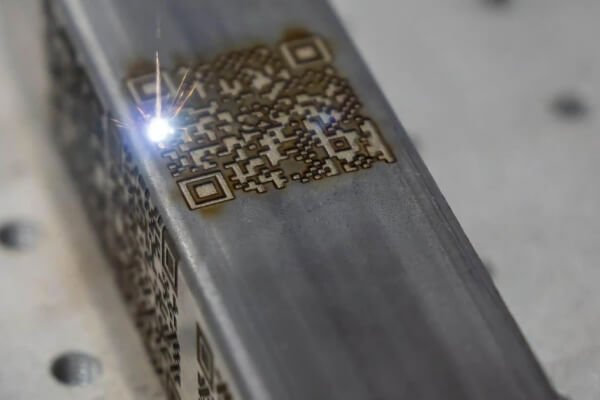
Laser marking is a low-removal or near-zero-removal non-contact surface modification process. It uses medium to low-power laser beams on the material surface. This triggers oxidation, annealing, carbonization, or other surface reactions that change surface color, reflectivity, and microstructure.
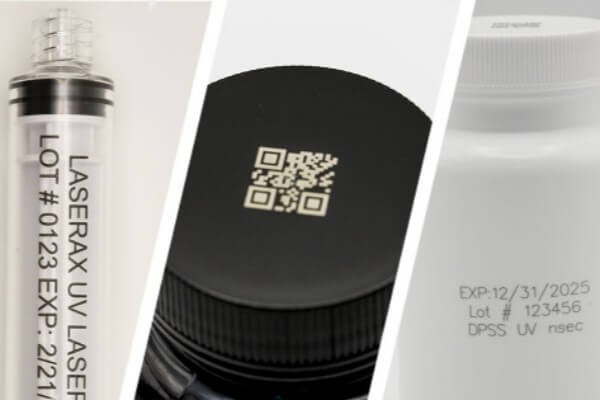
By affecting only a microscopic surface layer, the process leaves the workpiece substrate completely intact, preserving original dimensional tolerances and introducing minimal mechanical stress. Different materials respond to specific reactions. The result is a smooth, tactile-free mark with high contrast and lasting clarity. This fast, accurate process fits automation well. Manufacturers use it for QR codes, barcodes, brand logos, and part numbers in electronics, automotive, medical, and aerospace industries.
What is Laser Engraving and How Does It Work?
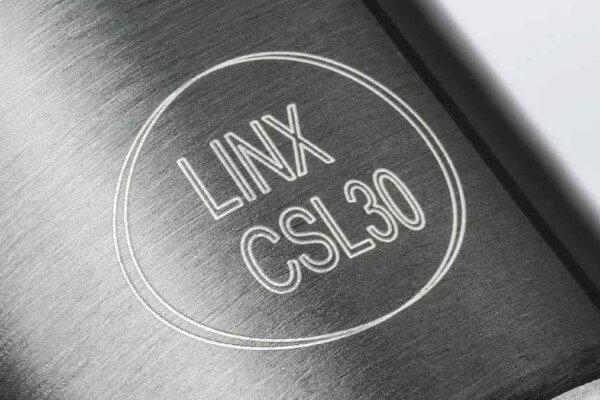
Laser engraving is a high-power subtractive process. A high-energy laser beam generates intense heat that quickly vaporizes and melts the surface material to remove part of the substrate. It creates marks with noticeable depth and a tactile, three-dimensional texture. You can control engraving depth precisely by adjusting parameters across a wide range. The engraved mark forms recessed structures within the material surface, providing strong wear resistance and good durability against corrosion and impact.
This process works on metals, plastics, and other materials. It suits industrial nameplates, molds, tools, and parts in harsh environments. However, it alters workpiece structure, so control depth carefully on thin-wall parts or components that need high structural strength to avoid performance issues.
What is Laser Etching and How Does It Work?
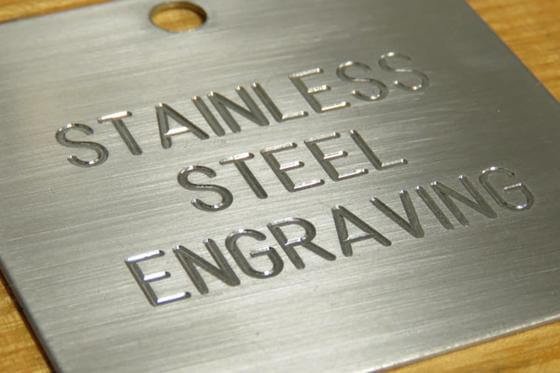
Laser etching sits between laser marking and laser engraving. Industry terminology may vary, and some manufacturers classify laser etching as a form of shallow laser engraving, while this guide distinguishes the three processes primarily by material removal depth and surface characteristics.
It adopts high-frequency short-pulse lasers to rapidly heat and locally melt the material surface. After cooling, the surface layer undergoes structural changes and forms a fine matte surface via localized melting, with only minimal material removed.
Etching depth stays shallow. It creates smaller heat-affected zones than deep engraving, which makes it ideal for parts that need tight dimensional stability. Marks have clean, sharp edges. This efficient process delivers good clarity and moderate wear resistance while typically generating less material removal than deep engraving. Companies use it for part numbers, brand information, and functional traceability marks.
Key Differences Between Laser Marking, Engraving, and Etching
These laser processes share the same technology family, but they differ fundamentally in how they work. They vary significantly in processing depth, material removal, wear durability, speed, cost, and appearance. Suitable materials and production volumes also differ. Clear distinctions help balance product durability, looks, and efficiency. Companies can then match processes to batch sizes, usage conditions, and custom needs.
| Comparison Item | Laser Marking | Laser Etching | Laser Engraving |
| Material Removal | Near-zero removal | Minimal removal | Substantial removal |
| Processing Depth | Surface layer | Shallow layer | Deep layer |
| Surface Feel | No noticeable texture | Light texture | Obvious recessed texture |
| Wear Resistance | Material-dependent (High for metals, Medium for plastics) | Medium to high | High |
| Processing Speed | Fast | Medium | Slow |
| Production Cost | Low | Medium | High |
| Typical Uses | Barcodes, QR codes, medical devices | Anodized aluminum styling, serial numbers on thin parts | Molds, dies, heavy-duty industrial tags |
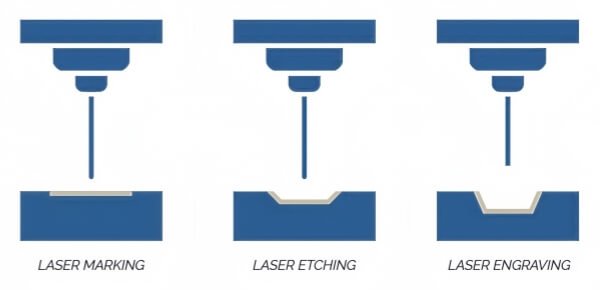
Surface Depth and Material Removal
Laser marking generally causes minimal material removal and primarily changes the surface appearance or microstructure.
Laser etching removes only a thin layer of material. Its depth is typically several to tens of microns, and it may exceed 0.1 mm in industrial deep etching applications, forming subtle and slightly raised surface textures.
Laser engraving removes a large volume of material. Its common depth ranges from tens of microns to over 0.5 mm for standard deep engraving, and the depth can reach several millimeters for heavy-duty deep engraving according to laser power, material, and processing time.
Durability and Wear Resistance
Laser engraving creates recessed marks within the material surface, providing excellent durability and wear resistance. It generally offers stronger resistance to friction, corrosion, and harsh environments than surface-level marking methods.
Laser etching forms marks through surface melting and solidification. It provides medium wear resistance suitable for normal conditions.
Laser marking primarily modifies the top surface layer. Its wear resistance varies significantly depending on the material and marking technique. For example, annealing on stainless steel offers excellent durability, while marking on plastics is more moderate. In typical industrial environments the marks remain clear, but they generally provide lower wear resistance than deep engraving under heavy abrasion or harsh corrosion.
Processing Speed and Production Cost
Laser marking uses low power and short cycle times with no consumables. It runs fastest and costs the least per part, which makes it well suited for high-volume production lines.
Laser etching offers medium speed, moderate energy, and cost. It fits small to medium flexible batches.
Laser engraving needs multiple scanning passes to remove material. It takes more time and energy, runs slowest, and costs more overall. It suits low-volume, high-value products that prioritize long service life.
Appearance and Surface Finish
Laser marking produces smooth, flat surfaces with sharp, clean mark edges and excellent contrast. It works well for fine characters and barcodes.
Laser etching creates fine matte textures with a soft, shallow relief feel for better visual depth.
Laser engraving delivers deep recesses with strong three-dimensional touch and high visibility. It also provides a stronger three-dimensional appearance and tactile feel.
Suitable Materials and Production Volume
Laser marking works on a wide range of materials, including metals, plastics, and thin-wall parts. It supports large-volume standard production.
Laser etching suits metals, ceramics, and decorative materials. It fits thin parts and medium to small-sized appearance-focused batches.
Laser engraving is suitable for many hard and thick materials when appropriate laser systems and parameters are used. It suits parts that need structural strength and fits small-batch custom or deep-marking work. You can pair the processes with proper equipment to match different production scales and needs.
Benefits of Each Technique
Each laser process brings unique strengths that fit different manufacturing situations and requirements. They address needs for precision, durability, efficiency, appearance, and traceability. Review their highlights to match project goals, volume, and budgets. This reduces mismatches and waste while selecting the best fit.
Advantages of Laser Marking
Laser marking runs fast with excellent precision and sharp mark edges. It affects workpieces very little, introduces relatively low mechanical and thermal stress, and helps preserve original dimensions and performance. The process needs no consumables, stays clean and eco-friendly, and skips extra finishing steps. Maintenance is simple, and operating costs stay low. It integrates easily into automated lines and traceability systems, which support high-volume efficient runs. The process is generally suitable for many materials and thin precision parts because it introduces relatively low thermal impact. Marks last long, meet compliance rules, and deliver strong results.
Advantages of Laser Engraving
Laser engraving allows flexible depth control and creates recessed marks with strong long-term durability. It offers excellent wear and weather resistance for tough and complex conditions. The three-dimensional texture improves visibility and can enhance resistance to wear and unauthorized alteration. The process performs well on many hard materials when matched with suitable laser systems and optimized parameters. It meets long-term industrial needs and also supports customized decorative finishes. Its application range is very broad.
Advantages of Laser Etching
Laser etching balances processing speed and visual quality. It runs faster than engraving. Its smaller heat-affected zone fits thin-wall and precision parts better than deep engraving. Finished textures feel fine and soft with a gentle shallow relief that raises appearance levels. Setup and changeovers are easy, which supports flexible multi-product runs. Medium wear resistance keeps it reliable for daily use while maintaining reasonable processing costs. It serves as an ideal choice that combines practical performance and good looks.
Materials Best Suited for Each Method
Materials differ in thermal conductivity, melting points, and surface conditions. They also absorb laser energy differently, which affects heat flow and results. Thickness and coatings further influence mark quality and efficiency. Matching processes to material types ensures good results, workpiece integrity, and cost control.
Actual laser compatibility depends on material composition, surface condition, coating type, wavelength absorption, and processing parameters.
Metals and Stainless Steel
Stainless steel, carbon steel, and titanium alloys are highly compatible with fiber laser processing. Laser annealing marking can create high-contrast dark marks with minimal surface disruption. Surfaces stay smooth and stable over time. Choose laser engraving for deep structures and high wear resistance. Laser etching works for everyday shallow marks and decorative needs. Finished marks resist corrosion and hold color well.
Aluminum and Anodized Surfaces
Anodized aluminum works excellently with laser marking and etching. The laser precisely bleaches or strips the anodized layer to form high-contrast, clean marks without damaging the underlying aluminum substrate. Pure aluminum and alloys are softer and may produce burrs, so shallow marking and etching are recommended. Higher laser power or multiple passes may be required for deeper engraving on aluminum. For aluminum sheets thinner than 1 mm, deep engraving is not recommended, as it may lead to deformation and reduced structural strength.
Plastics and Polymers
Plastics and polymers often use CO₂ or UV lasers. Markings are formed through surface color change or material foaming. Engineering plastics respond best to laser marking with clean edges and stable contrast. Thick hard plastics support light shallow engraving for textured looks. Thin-wall and transparent plastics are generally better suited for low-heat marking processes to reduce the risk of deformation, yellowing, or cracking. Different plastics absorb light differently, so adjust parameters during actual runs.
Coated and Painted Materials
Painted, plated, and filmed materials work best with laser marking and etching. The process removes the top coating precisely to reveal the base color for clear marks while protecting the inner material. Laser engraving risks damaging the base, so it fits only thick coatings where slight base cutting is acceptable.
Practical Applications and Industry Uses
Laser marking and related laser surface-processing technologies are widely used across many manufacturing industries. It appears in electronics, automotive, medical, aerospace, hardware, and packaging. It supports identification, traceability, branding, compliance, anti-counterfeiting, and decoration. Speed, durability, and standards help match the right laser process to each scene. This aids quality control and digital production management.
Common Applications for Laser Marking
Laser marking focuses on low-damage, high-precision work for high-volume compliance marks. It creates serial numbers, barcodes, QR codes, and brand logos. Applications include electronic components, auto parts, and precision hardware for traceability. It also supports medical device coding, food batch labeling, and anti-counterfeit marks. The process fits electronics, automotive, medical, and aerospace sectors widely.
Common Applications for Laser Engraving
Laser engraving is commonly used for deep, durable marks with strong wear resistance and clear tactile depth. It serves tools, molds, outdoor hardware nameplates, heavy equipment, and aerospace parts in harsh conditions. It also works for jewelry engraving, wood and leather crafts, and custom creative gifts. This process fits any scene that needs lasting tactile marks.
Common Applications for Laser Etching
Laser etching runs efficiently and creates fine-textured marks. It suits anodized aluminum appearance parts, precision hardware, and automotive interior components. Other uses include bathroom hardware, ceramic tableware, and premium digital device housings. It balances good looks with medium wear resistance, which makes it ideal for consumer products and precision components that emphasize decoration.
Part Traceability, Identification, and Compliance
All three laser processes can create unique codes, serial numbers, and QR codes to meet industry regulatory standards and support modern product traceability requirements defined by organizations such as GS1 Standards. Laser marking supports high-volume, fast compliance marks at low cost and high efficiency. Laser engraving is suitable for products requiring long-term traceability in outdoor and heavy-duty environments. Laser etching combines compliance with appearance enhancement for mid-range products. Durable clear marks improve quality control, supply chain tracing, anti-counterfeiting, and recall management. They fit strict fields like medical, automotive, and aerospace.
Equipment Options and Integration
Choose suitable laser sources and control systems to meet different material and process needs. Laser equipment connects to automated lines, robotic arms, and CNC machines. It also links to various management systems. Seamless integration into existing flows maintains precision and consistency while raising overall efficiency. This enables digital traceability and better production returns.
Types of Laser Systems and Machines
Common types include fiber, CO₂, UV, and green lasers. Fiber lasers are widely used for metal marking and engraving and can also process certain plastics and coated materials. They see the widest daily use. CO₂ lasers are commonly used for non-metal materials such as wood, leather, acrylic, paper, and various plastics. They have low efficiency and severe thermal deformation when processing bare metals, so they are mostly applied to coated or anodized metal surfaces instead.
UV lasers are often referred to as “cold processing” lasers. They deliver extremely low heat impact and minimal heat-affected zones compared with conventional lasers, ideal for heat-sensitive, fragile materials and ultra-precision thin components.
Different processes use specific power levels. Professional control and scanning systems let you adjust parameters flexibly for any precision and depth requirement.
Integrating Laser Systems into Manufacturing Workflows
Laser equipment works standalone or connects to automated lines with robots and conveyors. Vision positioning enables fully automatic loading, unloading, and unmanned operation, which cuts labor needs sharply.
Equipment links to production management systems for real-time data sync on products and processing. It can also integrate with online inspection, sorting, and defect-marking systems. This standardizes operations, improves yield, and fits digital smart production models.
How to Select the Best Laser Process for Your Application
Start by identifying the material and workpiece thickness. Then consider required mark depth, usage environment, and durability level. Factor in appearance, batch size, efficiency, and total cost. Include industry compliance, traceability, and anti-counterfeit needs. Compare these against process features to select the right solution and avoid poor results or wasted costs.
When Laser Marking Is the Best Choice
Choose laser marking when minimal surface impact and dimensional preservation are important. It delivers outstanding precision for fine characters and tiny QR codes. It fits high-volume, high-speed production and controls costs well. Laser marking is generally suitable for thin-wall parts, coated materials, and lightweight components because of its relatively low thermal impact. Use it for flat high-contrast marks without three-dimensional depth, or in medical and electronics scenes that demand high surface integrity and dimensional accuracy.
When to Use Laser Engraving
Select laser engraving for deep three-dimensional marks that require maximum mechanical durability. It withstands outdoor and heavy-duty conditions, offering excellent resistance to friction, harsh chemicals, and heavy wear. Marks feel clear, offer high recognition, and improve resistance to unauthorized alteration. It works on hard metals, thick solid wood, stone, and other robust materials. Even with longer times and higher costs, it fits molds, tools, industrial nameplates, long-life parts, and premium custom products.
When Laser Etching Delivers Better Results
Choose laser etching to balance speed and appearance. It creates fine matte textures and soft shallow relief effects that look better than standard marking. It fits scenes that need only shallow textures and medium daily wear resistance. Laser etching is commonly used on anodized aluminum, plated materials, precision hardware, and certain ceramics. It handles basic marking plus appearance enhancement for mid-to-high-end parts and small-to-medium flexible production. Thin-coated workpieces process stably too.
Summary and Recommendations
Laser marking, engraving, and etching belong to laser surface processing. They differ clearly in depth, durability, efficiency, and appearance. Laser marking provides low-damage, high-efficiency processing for large-volume precision and compliance marking applications. Laser engraving offers greater depth and wear resistance for harsh, long-life marks. Laser etching balances efficiency and texture for product decoration.
Laser processing is non-contact. Compared to traditional methods, it creates less stress, higher precision, stronger stability, and lower maintenance costs. For high-volume, low-damage applications, fiber or UV lasers are preferred. For outdoor and heavy-duty parts requiring maximum durability, fiber laser engraving performs best. Laser etching is an excellent choice for premium appearance parts that need fine surface textures and decorative effects. Thin or heat-sensitive components benefit most from UV “cold processing” to minimize the heat-affected zone (HAZ). Non-metals are best processed with CO₂ lasers.
Companies should match material features, usage conditions, production volume, and cost budgets for balanced quality, efficiency, and expense. Always run sample tests before full production to confirm results meet actual needs.
Actual results may vary depending on laser wavelength, pulse duration, material composition, surface coating, and machine parameters.
For manufacturers seeking reliable laser marking, engraving, and etching solutions for CNC-machined parts, sheet metal components, and custom industrial products, HRCCNC provides professional manufacturing support, precision laser processing, and customized production services tailored to different materials and application requirements.
FAQs
1. What is the difference between etching and engraving?
The main difference between etching and engraving is the depth of material removal. Laser etching slightly melts or expands the material surface to create shallow markings, while laser engraving physically removes material to form deeper recessed features. Because engraving creates greater depth, it generally offers higher durability and wear resistance.
2. In etching vs engraving, which process is better for permanent markings?
In etching vs engraving comparisons, laser engraving is usually considered more permanent because it cuts deeper into the material surface. Laser etching is still durable for many industrial applications, but engraving is preferred when components are exposed to heavy wear, friction, or harsh operating conditions.
3. What are the common types of laser marking?
The most common laser marking types include oxidation marking, annealing marking, carbonization marking, and color marking. Different marking methods are selected based on the material type and desired appearance. Fiber laser systems are commonly used for metal marking, while CO₂ and UV lasers are often used for plastics and specialty materials.
4. Can laser etching patterns be customized for industrial products?
Yes. Laser etching patterns can be fully customized to include logos, serial numbers, QR codes, barcodes, decorative textures, and functional identification markings. Modern laser systems provide high precision and repeatability, making them suitable for both aesthetic and industrial applications.
5. Which materials are best suited for laser etching patterns?
Laser etching patterns can be applied to a wide range of materials, including stainless steel, anodized aluminum, coated metals, plastics, and painted surfaces. Material compatibility depends on laser wavelength, power settings, and the desired contrast or texture.
6. How do manufacturers choose between laser marking, etching, and engraving?
Manufacturers typically evaluate factors such as material type, required marking depth, durability, production speed, and visual appearance. Laser marking is often preferred for high-speed surface identification; laser etching is suitable for shallow textured markings; and laser engraving is ideal for deep and highly durable permanent markings.