Skip to content

While 3-axis machines operate along linear paths to provide a highly cost-effective and straightforward solution for flat or simple parts, 5-axis systems utilize additional rotational axes to machine intricate, multi-sided shapes in a single setup. Whereas a 3-axis configuration minimizes upfront equipment costs and programming time, it requires manual part reorientation for multi-faceted jobs. Conversely, 5-axis technology eliminates human error and drastically improves surface finishes, but commands a much higher machine investment and hourly operating rate.
Determining which CNC machining configuration is right for your part manufacturing comes down to matching your component’s geometry, required tolerances, and production volume with the most cost-effective workflow. For parts with simple, flat surfaces or straightforward features accessible from a single direction, 3-axis machining remains the most practical and economical choice due to its low setup costs and simple programming. However, if your project involves intricate 3D shapes, deep cavities, or tight geometric tolerances across multiple faces, 5-axis machining is the superior choice because its single-setup capability minimizes manual labor, eliminates human alignment errors, and dramatically compresses overall lead times.
What Is a 3 Axis CNC Machine?
A 3-axis CNC machine is a type of milling machine that moves a cutting tool or workpiece along three linear axes. X (left to right), Y (front to back), and Z (up and down). This machining configuration allows the cutting tool to remove material from a workpiece with precise movement across flat and moderately contoured surfaces. Manufacturers commonly use 3-axis CNC machining to produce components such as brackets, panels, housings, and other mechanical parts with straightforward geometries.
One main limitation of this type of machine is that it requires manual repositioning of the workpiece to access multiple sides, which can increase labor and reduce efficiency when working with complex shapes.
What Are the Main Applications for 3 Axis CNC?
The main applications for 3-axis CNC include milling flat surfaces, drilling and threading, general prototyping, basic mold making, and routing and engraving. 3-axis CNC machines are efficient and cost-effective tools for a range of manufacturing tasks that require movement along three linear axes.
- Milling Flat Surfaces: 3-axis CNC machines excel at leveling, facing, and squaring off raw materials. It creates structural panels or prismatic parts with a consistent surface finish and dimensional accuracy
- Drilling and Threading: These machines are commonly used to bore precise holes and cut threads or key slots in components. This capability is important for producing parts such as mounting plates, brackets, and housings that require accurate hole placement.
- General Prototyping: 3-axis CNC machining supports rapid production of simple, functional prototypes and custom fixtures. Manufacturers use these machines to test part designs or create jigs for assembly processes.
- Basic Mold Making: 3-axis CNC machines are suitable for routing simple cavities and cores for vacuum forming, carbon fiber layup, or basic casting applications. This reduces lead times for producing molds with straightforward geometries.
- Routing and Engraving: These machines are widely used for cutting 2D and 2.5D signs, wood millwork, and custom engravings. It produces engraved nameplates, decorative panels, or detailed woodwork with high repeatability.
What Are the Advantages of 3 Axis CNC Machining?
The advantages of 3-axis CNC machining are cost-effective manufacturing, simple machine operation, low maintenance requirements, efficiency for standard parts, consistent machining accuracy, and faster setup for simple jobs. 3-axis CNC machining provides accurate, cost-efficient manufacturing of parts with flat surfaces, simple contours, and standard machining features. A 3-axis CNC machine controls movement across the X, Y, and Z axes to perform milling, drilling, slotting, and cutting operations with stable precision. This machining method supports reliable production workflows while maintaining dimensional consistency for common industrial components.
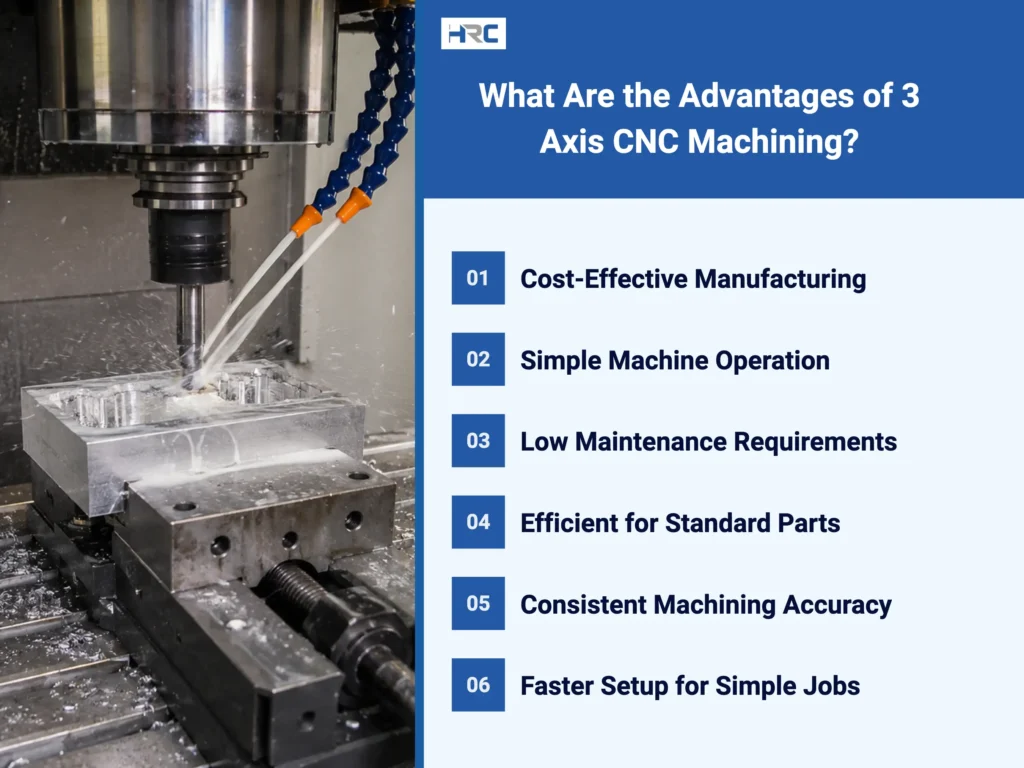
Cost-Effective Manufacturing
Manufacturers use 3-axis CNC machines because they require lower equipment investment and lower operating costs than advanced multi-axis systems. The simpler machine configuration lowers tooling expenses, setup requirements, and programming complexity during machining operations. Small and medium-sized machine shops commonly produce brackets, panels, housings, and mounting plates with this process while maintaining economical production cycles.
Simple Machine Operation
3-axis CNC machining simplifies machine programming and daily operation by using straightforward tool paths and linear axis movement. Operators can create machining programs more efficiently because the process does not require complex coordination of rotational axes. This structure reduces training requirements and supports stable production for routine milling and drilling applications.
Low Maintenance Requirements
A 3-axis CNC milling machine has fewer moving assemblies and mechanical components than a multi-axis machining center. The absence of rotational axes reduces mechanical wear during continuous machining operations and lowers the frequency of maintenance procedures. Machine shops benefit from reliable uptime, predictable servicing schedules, and reduced long-term maintenance costs.
Efficient for Standard Parts
3-axis CNC machining delivers precise results for components with flat faces, pockets, slots, and drilled holes. Manufacturers commonly use this process for 2D and 2.5D machining applications because the machine maintains stable cutting motion across simple geometries. This capability supports the efficient production of industrial parts used in electronics, automotive assemblies, tooling systems, and general manufacturing.
Consistent Machining Accuracy
Linear axis control allows 3-axis CNC machines to maintain repeatable cutting accuracy throughout the machining cycle. Stable spindle movement and controlled tool positioning support precise dimensional results across multiple production runs. This consistency helps manufacturers produce identical parts with reliable tolerances for standard engineering applications.
Faster Setup for Simple Jobs
Compared with multi-axis machining systems, 3-axis CNC machines require less setup preparation for straightforward machining tasks. Operators can secure the workpiece, load cutting tools, and begin machining operations with minimal fixture adjustments. This simplified workflow shortens setup time and improves production efficiency for simple components and short-run manufacturing projects.
What Is a 5 Axis CNC Machine?
A 5-axis CNC machine is a type of advanced milling machine that operates along five axes: three linear axes (X, Y, and Z) and two rotational axes (typically labeled A and B, or A and C). This configuration allows the cutting tool or the workpiece to move and rotate simultaneously, enabling dynamic orientation adjustments during machining.
As a result, a 5-axis CNC machine can produce complex, multi-sided shapes-such as aerospace impellers, medical implants, and sculpted surfaces-in a single setup without the need to manually reposition the part. This capability reduces setup time and minimizes the risk of dimensional errors, which will be discussed in more detail in the following section.
What Are the Main Applications for 5 Axis CNC?
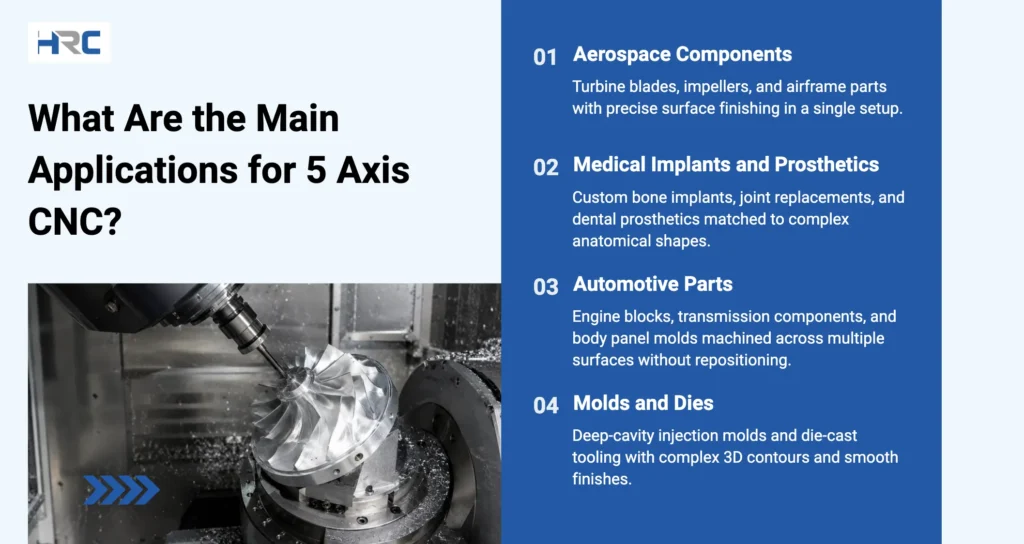
The main applications for 5-axis CNC include aerospace components, medical implants and prosthetics, automotive parts, and molds and dies. 5-axis CNC machines excel at machining complex, contoured parts from multiple angles with fewer setups and higher precision.
- Aerospace Components: 5-axis CNC machines produce jet engine turbine blades, impellers, and structural airframe parts. These components often have aerodynamic shapes and require precise surface finishing, achieved through multi-axis rotation and single-setup machining.
- Medical Implants and Prosthetics: Utilizing 5-axis capabilities creates custom bone implants, joint replacements, and dental prosthetics. The machine fabricates parts matching complex anatomical shapes to improve patient fit and function.
- Automotive Parts: Multi-axis CNC machines manufacture engine blocks, transmission components, and custom molds for body panels. Reaching multiple surfaces in a single setup ensures high precision and reduces machining time.
- Molds and Dies: Advanced 5-axis setups machine intricate molds with deep cavities and complex 3D contours for plastic injection molding and die casting. This process creates detailed features and smooth surface finishes.
What Are the Advantages of 5 Axis Over 3 Axis CNC?
The advantages of 5-axis over 3-axis CNC include single-setup machining, the ability to handle complex geometries and undercuts, superior surface finish and precision, and faster production rates. The fundamental difference between 5-axis and 3-axis CNC machines is that 5-axis machines allow the cutting tool to approach the workpiece from five different directions in a single setup, while 3-axis machines operate along only three linear axes.
- Single-Setup Machining: 5-axis CNC machines can machine multiple faces and features of a part without the need to manually reposition or reclamp the workpiece.This reduces setup errors, shortens fixture preparation time, and improves process reliability, allowing a complex aerospace bracket with angled surfaces to be machined in one continuous operation.
- Ability to Handle Complex Geometries and Undercuts: The two additional rotational axes (typically labeled A and B, or A and C) enable the cutting tool to reach areas that are inaccessible on a 3-axis CNC mill. This allows the machining of deep cavities, curved surfaces, and severe undercuts, like those in medical implants or turbine blades, without custom fixtures or multiple setups.
- Superior Surface Finish and Precision: Maintaining optimal tool orientation allows the use of shorter cutting tools, reducing tool deflection and vibration. This results in smoother surface finishes and higher dimensional accuracy for parts with steep walls or intricate contours.
- Molds and Dies: Advanced 5-axis setups machine intricate molds with deep cavities and complex 3D contours for plastic injection molding and die casting. This process creates detailed features and smooth surface finishes.
What Are the Advantages of 5 Axis Over 3 Axis CNC?
The advantages of 5-axis over 3-axis CNC include single-setup machining, the ability to handle complex geometries and undercuts, superior surface finish and precision, and faster production rates. The fundamental difference between 5-axis and 3-axis CNC machines is that 5-axis machines allow the cutting tool to approach the workpiece from five different directions in a single setup, while 3-axis machines operate along only three linear axes.
- Single-Setup Machining: 5-axis CNC machines can machine multiple faces and features of a part without the need to manually reposition or reclamp the workpiece.This reduces setup errors, shortens fixture preparation time, and improves process reliability, allowing a complex aerospace bracket with angled surfaces to be machined in one continuous operation.
- Ability to Handle Complex Geometries and Undercuts: The two additional rotational axes (typically labeled A and B, or A and C) enable the cutting tool to reach areas that are inaccessible on a 3-axis CNC mill. This allows the machining of deep cavities, curved surfaces, and severe undercuts, like those in medical implants or turbine blades, without custom fixtures or multiple setups.
- Superior Surface Finish and Precision: Maintaining optimal tool orientation allows the use of shorter cutting tools, reducing tool deflection and vibration. This results in smoother surface finishes and higher dimensional accuracy for parts with steep walls or intricate contours.
- Faster Production Rates: Eliminating manual part rotation and repeated alignment checks streamlines the manufacturing process. This efficiency shortens cycle times and improves throughput for intricate components in industries like automotive and electronics.
3-axis vs 5-axis CNC Machining Comparison Table
While 3-axis CNC machines are highly cost-effective and efficient for processing flat or straightforward parts on a single plane, 5-axis systems utilize dynamic tool rotation to seamlessly machine intricate, organic geometries in a single continuous operation. Whereas a 3-axis setup relies on time-consuming manual part reorientations that can compromise tolerances between opposing faces, 5-axis technology eliminates human error and minimizes lead times on advanced multi-sided projects.
| Feature | 3-Axis CNC Machining | 5-Axis CNC Machining |
| Movement Axes | 3 Linear axes (X, Y, Z) | 3 Linear + 2 Rotational axes (A, B, or C) |
| Typical Tolerances | ±0.025 mm | ±0.005 mm |
| Part Geometry | Flat, simple, 2D/2.5D parts; no undercuts | Complex, multi-angled, 3D contours, undercuts |
| Setup Process | Multiple manual setups for complex parts | Single setup for multi-sided machining |
| Surface Finish | Standard: risk of setup seam marks | Superior due to continuous tool contact |
| Machine Purchase Cost | $50,000 to $100,000 | $150,000 to over $1,000,000 |
| Hourly Operating Cost | $50 to $100 per hour | Higher hourly rate; lower total cost for complex parts |
| Lead Times | Faster for simple jobs; slower for complex jobs | Shorter overall lead times for intricate geometries |
3 Axis vs 5 Axis CNC: Precision and Surface Finish
The main difference between 3-axis and 5-axis CNC machines lies in their movement capabilities and the resulting impact on precision and surface finish. A 3-axis CNC machine moves the cutting tool or workpiece along three linear axes (X, Y, and Z), making it suitable for machining flat or moderately contoured parts. In contrast, a 5-axis CNC machine operates along three linear axes plus two rotational axes, allowing the cutting tool to approach the workpiece from virtually any direction.
This expanded movement enables continuous tool-to-workpiece contact, improving geometric control and allowing the creation of intricate shapes. Consequently, 5-axis machines achieve higher precision, with typical tolerances reaching ±0.005 mm, compared to ±0.025 mm for 3-axis machines. The ability to machine multiple surfaces in a single setup reduces the risk of misalignment and minimizes setup time by up to 60%, contributing to a superior surface finish where smooth transitions and tight tolerances are required in aerospace, medical, or advanced automotive applications.
3 Axis vs 5 Axis CNC: Complexity and Part Geometry
The main difference between 3-axis and 5-axis CNC machining lies in the number and type of movements each machine can perform. A 3-axis CNC machine moves the cutting tool or workpiece along three linear axes: X (left to right), Y (front to back), and Z (up and down). In contrast, a 5-axis CNC machine adds two rotational axes-typically labeled A and B or A and C-allowing the cutting tool or table to tilt and rotate, which enables access to the part from virtually any angle.
It directly affects the complexity and geometry of the parts each machine can handle. 3-axis CNC machines are best suited for flat or simple parts, such as basic brackets, plates, or housings, where all features are accessible from a single direction and do not require undercuts or features on multiple faces. By comparison, 5-axis CNC machines are designed to produce complex parts with multi-angled surfaces, deep cavities, or intricate contours, such as aerospace turbine blades, medical implants with organic shapes, and automotive components with compound curves. Given their advanced capabilities, 5-axis CNC machines carry a higher price tag than their 3-axis counterparts.
3 Axis vs 5 Axis CNC: Cost and Investment
New 3-axis CNC machines range from $50,000 to $100,000, while 5-axis machines start around $150,000, with advanced industrial systems exceeding $1,000,000. This significant cost gap reflects their complexity and capabilities, making 5-axis systems roughly 1.5 to 3 times the entry cost of a 3-axis machine, and far more at the high end. The lower price point of 3-axis machines makes them a more accessible option for many machine shops and manufacturers.
Hourly operating rates differ. Running a 3-axis CNC machine costs between $50 and $100 per hour. While 5-axis machines have higher hourly rates due to their advanced features and maintenance needs, they often reduce total part costs for complex geometries. This cost-effectiveness comes from minimizing the number of setups, reducing manual labor, and lowering the risk of errors during machining operations. For example, a 5-axis milling machine can complete intricate parts in a single setup that would otherwise require multiple fixtures and repositioning on a 3-axis CNC mill. Although the initial investment and operating costs for 5-axis CNC machining are higher, these machines offer clear advantages for manufacturing complex parts efficiently
3 Axis vs 5 Axis CNC: Lead Time and Setup Requirements
Lead time and setup requirements differ significantly between 3-axis and 5-axis CNC machining, especially as part complexity increases. A 3-axis CNC machine moves the cutting tool along three linear axes-X, Y, and Z-which is efficient for simple, flat parts. For these straightforward components, setup is quick, and production runs smoothly. When machining complex parts with features on multiple sides, a 3-axis CNC requires the operator to manually unmount, reorient, and reclamp the workpiece several times. Each manual setup increases total lead time and the risk of alignment errors, making the process slower and more labor-intensive for intricate geometries.
In contrast, a 5-axis CNC machine uses three linear axes and two rotational axes (A and B, or A and C). This expanded axis rotation allows the cutting tool or the workpiece to tilt and rotate, enabling access to nearly any surface in a single setup. Consequently, 5-axis CNC machining can produce complex, multi-sided parts without repeated manual intervention, reducing both setup and lead times. While 5-axis programming is more advanced, the reduction in handling reduces production cycles and improves dimensional accuracy. Choosing between these technologies ultimately depends on part complexity, required tolerances, and production efficiency goals.
When Does 3 Axis CNC Fall Short vs 5 Axis?
A 3-axis CNC falls short of a 5-axis machine when parts require multi-angle machining, deep cavities, complex contours, or access to multiple surfaces within a single setup. Since a 3-axis CNC machine only moves along the X, Y, and Z axes, it cannot maintain continuous tool access around complex geometries. This limitation increases setup changes, reduces machining flexibility, and affects efficiency for precision components.
- Complex Geometries: A 3-axis CNC machine cannot continuously approach complex surfaces from multiple directions during machining. Parts with angled features, curved profiles, or intricate shapes often require repositioning to ensure all machining operations are performed accurately.
- Deep Cavities and Steep Walls: Deep pockets and vertical walls require longer cutting tools in 3-axis machining setups. Longer tools increase vibration and tool deflection, which can reduce surface finish quality and affect dimensional accuracy during precision machining.
- Undercuts and Hidden Areas: 3-axis CNC machines approach the workpiece from a fixed vertical direction, which prevents access beneath overhangs or inside recessed features. Internal undercuts and concealed geometries often require secondary operations or specialized tooling.
- Free-Form Surfaces: Curved and organic surfaces are more difficult to machine smoothly with a 3-axis CNC system. Limited tool orientation can leave visible step marks on free-form contours, increasing the need for polishing and post-processing work.
- Multiple Setup Requirements: Manufacturers frequently rotate, flip, and re-clamp the workpiece to machine different sides on a 3-axis CNC machine. Each additional setup increases production time and introduces the possibility of alignment variation between machining operations.
- Reduced Efficiency for Precision Parts : Complex aerospace, automotive, and medical components often require simultaneous multi-angle machining to maintain tight tolerances. A 3-axis setup may struggle to achieve consistent precision for these advanced machining applications compared with a 5-axis CNC machine.
When Does 5 Axis CNC Fall Short vs 3 Axis?
A 5-axis CNC falls short of a 3-axis machine in specific scenarios, especially where simplicity, cost, and rigidity are priorities. The following areas highlight where 3-axis CNC machining is often the better choice:
- Cost and Setup Efficiency: Standard 3-axis CNC systems require a lower initial investment and have lower maintenance costs than 5-axis models. Machine shops often select 3-axis mills for high-volume production of simple parts, such as flat plates or brackets, because the cost per part is lower and the setup process is faster.
- Programming Simplicity: Operating a 3-axis machine involves less complex programming and a shorter learning curve. Operators can program and run standard 2D or shallow 3D parts, such as basic housings or mounting plates, with less specialized expertise than is required for 5-axis milling.
- Rigidity for Deep Cuts: 3-axis machines allow the use of shorter, thicker, and more rigid cutting tools. This setup provides greater stability and is preferred for deep-pocket milling or heavy material removal in parts such as large blocks or molds.
- Simple Part Production: Basic 3-axis setups offer a lower cost per part for straightforward shapes and flat surfaces. Manufacturers often use 3-axis mills for components like spacers, washers, or simple covers, where advanced axis rotation or complex tool paths are unnecessary.
How Should You Choose a CNC Machining Service Provider?
Choose a CNC machining service provider by matching your part’s complexity, budget, and production volume with the provider’s technical capabilities and resources, specifically evaluating their equipment capabilities, quality certifications, material versatility, turnaround times, and capacity, and quoting platforms. For simple, flat, or cylindrical parts, a CNC machining provider provider with strong 3-axis CNC machining capabilities may offer cost-effective solutions. For complex, multi-sided components that require high precision and reduced lead times, a provider with advanced 5-axis CNC machines is often the better fit.
- Equipment Capabilities: Ensure the provider operates both 3-axis and 5-axis CNC machines to handle a wide variety of basic and complex part geometries.
- Quality Certifications: Confirm they hold recognized industry certifications such as ISO 9001, AS9100, or ISO 13485 to ensure standardized quality management systems and compliance with industry-specific requirements.
- Material Versatility: Evaluate their expertise in machining a range of materials, including metals such as stainless steel and titanium, as well as engineering plastics.
- Turnaround Times and Capacity: Review their production capacity and scheduling reliability to guarantee they can meet your specific project deadlines.
- Quoting Platforms: Look for digital quoting systems that let you upload files, get instant pricing, and receive immediate manufacturability feedback.
What Should You Look for in a Quote?
Look for setup fees versus machining time, the number of setups, tolerance and alignment requirements, tooling costs, and production volume in a quote to understand the trade-offs between setup fees, machining time, and process complexity, especially when comparing 3-axis and 5-axis machining options.
- Setup Fees vs. Machining Time: Note that 3-axis machines have lower hourly rates but require multiple setups for complex parts, whereas 5-axis machines cost more per hour but save labor by machining all sides in a single setup.
- Number of Setups: Check the total number of setups required, as multiple setups on a 3-axis machine increase misalignment risks and labor costs, while a 5-axis mill reduces setups by reaching more surfaces in a single operation.
- Tolerance and Alignment Requirements: Identify whether your parts require strict geometric tolerances between opposing faces (stricter than ±0.002 inches), which would benefit greatly from the high precision of a single 5-axis setup.
- Tooling Costs: Watch for specialized shorter tools or custom soft jaws in 5-axis quotes, which are necessary to avoid collisions during complex machining operations and can increase initial costs.
- Production Volume: Consider your order size, as 3-axis machining is more cost-effective for one-off prototypes, but the setup and labor savings of 5-axis machining multiply and become more economical as volume increases.
Weigh these factors based on your part’s complexity and production volume, and compare quotes using these criteria to select the most cost-effective and precise CNC machining solution for your needs.