Skip to content

High-speed machining shows up on a lot of shop websites as a bullet point, but few buyers know what separates real HSM capability from simply having a higher-RPM mill. HSM combines elevated cutting speed and feed with controlled radial engagement, matched tooling, and a machine built to hold accuracy at high dynamics. Get one piece wrong, and the advantage disappears. This guide covers what HSM is, how feeds and speeds get decided, where it outperforms conventional machining, and what to weigh before outsourcing it.
What Is High-Speed Machining?

HSM Is a System, Not a Spindle Spec
There’s no single RPM number that defines high-speed machining. What determines it is cutting speed, tool diameter, workpiece material, toolpath strategy, tooling, and machine dynamics together, not spindle RPM alone. Real HSM needs speed matched to tool and material, feed matched to chip load, controlled radial engagement, smooth CAM interpolation, and a machine that can accelerate through the programmed path without lagging. A higher top RPM alone doesn’t make a mill HSM-capable, a distinction worth confirming before committing a production run to a new supplier.
What Is a High-Speed Machining Center?
A shop’s website claiming “high-speed machining” doesn’t always reflect real capability; sometimes it just means a mill with a higher top RPM. A genuine high-speed machining center needs a spindle with torque that holds up at actual cutting speed, not a peak number rarely used in practice; a frame that stays rigid and thermally stable as heat builds up during longer cuts; controller look-ahead fast enough to avoid hesitation at speed; and chip evacuation that keeps pace so chips don’t pack into a pocket and compromise the finish. The torque curve at actual operating speed and controller look-ahead tend to reveal real capability faster than a spec sheet.
HSM vs Conventional Milling vs HSC vs HEM
These terms aren’t strictly standardized industry-wide. HSM and HSC (High-Speed Cutting) are frequently used interchangeably. HEM refers more specifically to a toolpath strategy built around constant engagement, deep axial cuts, and light radial engagement, rather than a speed category.
| Strategy | Typical Engagement | Typical Cutting Pattern | Best Fit |
| Conventional toolpaths | Engagement may vary significantly, especially in corners | Often uses wider radial cuts and application-dependent axial depth | Simple features and suitable rigid setups |
| HSM / HSC | Application-dependent | Emphasizes elevated cutting or contouring speed, smooth motion, and controlled machine dynamics | Molds, dies, complex surfaces, thin features, and finish-critical work |
| HEM / dynamic milling | Typically low, controlled radial engagement with greater axial engagement | Constant-engagement roughing at elevated feed rates | Efficient roughing and consistent tool loading |
How High-Speed Machining Actually Works
Controlled Tool Engagement
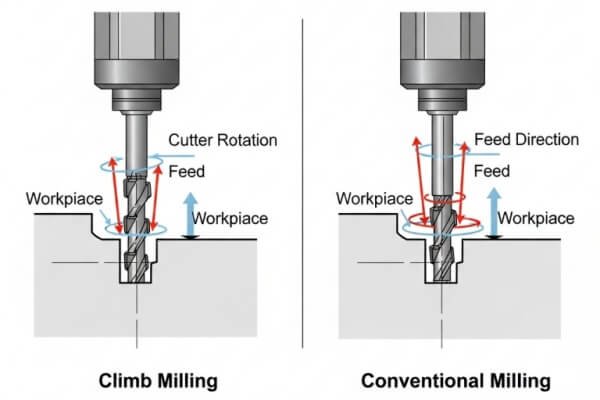
In conventional pocketing, cutter engagement can double at a corner, spiking force, heat, and chatter, limiting how aggressively a pass can run. Constant-engagement strategies such as trochoidal milling and adaptive clearing help reduce sudden increases in cutter engagement. When the machine, tooling, and setup are suitable, this can support higher average feed rates and more consistent tool loading.
Radial Chip Thinning, Simplified
When radial width of cut drops below about half the tool diameter, maximum chip thickness becomes lower than the programmed feed per tooth, so the feed rate may sometimes be increased while maintaining the target chip thickness. Using metric units, spindle speed can be calculated as cutting speed (m/min) × 1,000 ÷ [π × tool diameter (mm)], while feed rate (mm/min) equals RPM × flute count × feed per tooth (mm/tooth). These formulas provide starting values only; final parameters should be validated against the cutting-tool manufacturer’s recommendations and the actual machining setup.
Material Removal Rate: Winning Without a Big Radial Bite
Material removal rate equals axial depth times radial width times feed rate. A small radial width combined with high axial engagement and a high feed rate can outperform a heavy conventional pass while keeping cutting forces and heat more predictable.
Feeds and Speeds in High-Speed Machining: What Buyers Should Know
Key Factors That Determine Feeds and Speeds
Feeds and speeds in HSM depend on several variables together: material, tool type and diameter, spindle speed, feed rate, radial and axial depth of cut, and coolant or chip evacuation method. Change one and the others usually need to move with it. For example, changing the tool diameter without adjusting spindle speed changes the surface speed even if nothing else changes.
Why Feeds and Speeds Matter for Part Quality and Cost
Get feeds and speeds wrong and the results show up quickly: premature tool wear, poor surface finish, chatter on thin features. Get them right and cycle time can drop without sacrificing tolerance. This coordinated programming approach is what separates genuine HSM results from relying on spindle speed alone.
High-Speed Machining vs Conventional Machining: Which Wins for Your Part?
When Conventional CNC Milling Still Wins
Conventional milling still makes sense for heavy stock removal on large, rigid parts, simple geometry with no thin-wall or deep-pocket risk, and lower-spec machines without the dynamics for true HSM toolpaths.
When High-Speed CNC Milling Wins
High-speed milling tends to earn its place on parts that would challenge conventional methods: complex cavities, multiple surfaces, geometry that doesn’t sit still for a standard toolpath. Thin walls are a clear example. Cut conventionally, they can flex or distort under cutting force before the tool finishes the pass; HSM’s lighter, more controlled cuts reduce that risk. On suitable geometry, the resulting finish can also reduce the need for secondary polishing, depending on material and surface requirements. Volume matters too: once a job needs a lot of parts quickly, shorter cycle times carry real weight.
None of this makes HSM the automatic answer. It suits certain parts better than others, and the part in front of you should settle it, ideally at the quoting stage rather than after a prototype comes back wrong.
5-Axis High-Speed CNC Machining: Where HSM Gets Serious

Why Combining Axes Matters for Complex Geometry
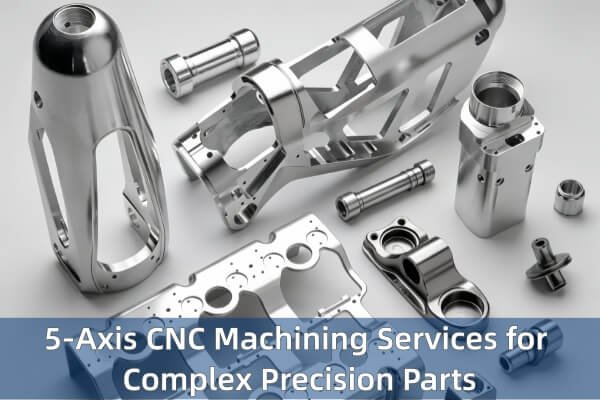
Continuous tool reorientation keeps the cutting angle favorable on curved and undercut geometry that 3-axis HSM can’t reach cleanly, useful for impellers, medical implants, and aerospace structural parts. Fewer repositionings also mean less compounding error.
What 5-Axis HSM Requires From Your Manufacturing Partner
5-axis high-speed CNC machining demands accurate collision checking, precise postprocessor calibration, tool center point control, and workholding that doesn’t foul rotary travel. Inexperienced shops often fall short here, so confirming a supplier’s actual 5-axis track record is worth doing before committing tooling budget.
Growing Demand for 5-Axis HSM
Demand for 5-axis capability has been increasing as parts trend toward more complex geometry, particularly in aerospace, medical, and robotics. Sourcing decisions made now should account for where a supplier’s capability is headed, not just where it stands today.
HSM Tooling, Holders & Workholding: Why It Affects Your Quote
Tooling Matched to Material
Fine-grain carbide, variable-helix geometries, and ball-nose or barrel tooling for 3D finishing get selected based on material. There’s no single universal HSM tool, and a supplier defaulting to the same setup across every job is worth questioning.
Holder Balance, Runout & Workholding
At high RPM, even small tool imbalance shows up as vibration and premature wear, so holder balance grade matters more than at conventional speeds. Workholding needs short tool overhang and rigid fixturing, with extra care around thin walls and, for 5-axis work, clearance for rotary travel.
Materials and High-Speed Machining: What Changes by Material
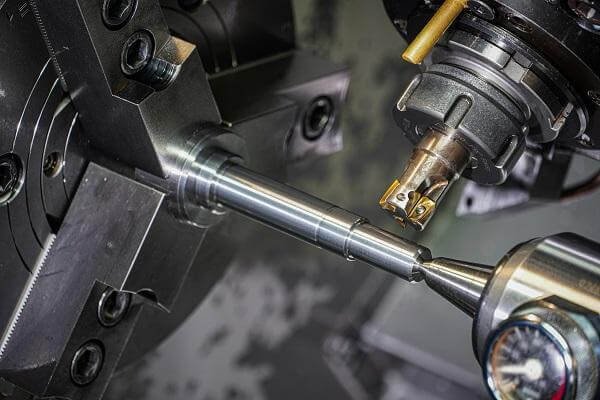
Aluminum, Steel & Stainless
Aluminum is the most forgiving material for HSM and supports the highest achievable speeds. Steel and stainless run at lower speeds with more attention to heat and chatter, and stainless work-hardens quickly if engagement isn’t tightly controlled.
Titanium, Hardened Steel, Plastics & Composites
Titanium and nickel alloys have low thermal conductivity, concentrating heat at the cutting edge, so conservative, validated parameters matter more than chasing maximum speed. Hardened steels are workable with the right tooling and toolpath strategy. Plastics bring different concerns, mainly heat sensitivity, chip evacuation, distortion, and workholding, rather than spindle speed. Composites add further considerations: abrasive tool wear, delamination, fiber pullout, and dust extraction.
Key Benefits of High-Speed CNC Milling for Buyers
Shorter Cycle Times
HSM can substantially reduce cycle time on suitable parts, though the result depends on material, geometry, tooling, machine dynamics, and the process used as the comparison baseline.
Better Surface Finish, Less Secondary Work
On suitable mold, die, and complex-surface applications, HSM may reduce polishing requirements and, in some cases, replace certain EDM operations.
Better Control of Thin-Wall Deflection
Lower cutting-force peaks mean less thin-wall deflection and less workholding movement during the cut, which helps with delicate features. That doesn’t by itself guarantee a tighter final tolerance, though; achievable tolerance still depends on machine accuracy, thermal stability, tooling, workholding, programming, and inspection together.
Limitations of High-Speed Machining
Why HSM Requires Rigid, Purpose-Built Machines
HSM asks a lot of the machine itself. A frame that isn’t rigid enough, or a spindle without the right torque curve at speed, will chatter or wear tools out faster, regardless of program quality.
CAM Strategy Is Critical to HSM Success
The best equipment still depends on toolpath strategy. Poorly programmed engagement angles erase the advantage HSM is meant to deliver, no matter how capable the machine is.
Tool Holders and Balancing Matter More at High Speed
An unbalanced holder that’s a non-issue at conventional speeds becomes a real problem at HSM speeds: vibration, poor finish, shortened tool life.
Not Every Part Benefits From HSM
Simple, low-tolerance parts on rigid stock often don’t need HSM, and paying for the capability where it isn’t called for adds cost without value.
In-House HSM vs Outsourcing to a CNC Milling Partner
The Capital Cost of Building In-House HSM Capability
Effective in-house HSM capability may require a suitable high-speed spindle, adequate controller look-ahead, a rigid and thermally stable machine, appropriate CAM software, and experienced programmers. The investment is generally easier to justify when there is a consistent workload.
When Outsourcing Your CNC Milling Wins
Outsourcing tends to win for prototypes and variable-volume production, multi-material programs that would otherwise need several in-house setups, and projects needing certified quality documentation without building an internal quality system from scratch.
What Affects the Cost of High-Speed CNC Milling?
Cost on an HSM job comes down to part complexity, material, tolerance, tooling requirements, and volume, not a flat rate. The most reliable number is a quote against the actual drawing, since geometry affects cycle time more than most buyers expect.
FAQs
1. What spindle speed is considered high-speed machining?
There is no single spindle-speed threshold that defines high-speed machining. The appropriate speed depends on the workpiece material, tool diameter, cutting-tool design, feed per tooth, toolpath, and machine dynamics. A high maximum RPM alone does not make a machine HSM-capable.
2. What is the difference between HSM and HEM?
High-speed machining is a broad machining approach that emphasizes suitable cutting speeds, smooth machine motion, optimized tooling, and accurate control at high dynamics. High-efficiency milling is a more specific roughing strategy that typically uses low radial engagement, greater axial engagement, and consistent tool loading.
3. Which materials are suitable for high-speed machining?
High-speed machining can be applied to aluminum, steel, stainless steel, titanium, hardened steel, plastics, and composites. However, cutting speeds, tooling, coolant strategy, and tool engagement must be adjusted for each material and application.
4. Does high-speed machining always improve part accuracy?
Not necessarily. HSM can reduce cutting-force peaks, improve surface finish, and help control thin-wall deflection, but final accuracy still depends on machine condition, thermal stability, tooling, workholding, programming, and inspection.
5. When should buyers consider 5-axis high-speed machining?
Five-axis HSM is worth considering for parts with complex surfaces, undercuts, multiple machining angles, or features that would otherwise require several setups. It can improve tool access and reduce repositioning, although the best approach depends on the drawing and production requirements.
6. How is the cost of high-speed machining calculated?
The cost depends on part geometry, material, tolerances, tooling, inspection requirements, surface finish, and order volume. Because these factors affect programming effort and cycle time, the most reliable way to determine cost is to request a quote using the actual 3D model and 2D drawing.
How HRCCNC Delivers High-Speed CNC Machining
Why Work With HRCCNC for High-Speed CNC Machining
HRCCNC runs 3-, 4-, and 5-axis CNC milling equipment suited to high-speed CNC machining work, with engineering review built into the quoting process to check toolpath strategy and material fit before production starts.
Our Approach to Quality Control
HRCCNC operates an ISO 9001:2015-certified quality management system. Depending on the drawing requirements and inspection plan, dimensional verification may include CMM inspection and other appropriate measuring equipment.
Request a Quote for Your High-Speed CNC Milling Project
Whether a part calls for 3-axis efficiency or full 5-axis access on complex geometry, sending a drawing is the fastest way to find out which approach fits.