Skip to content

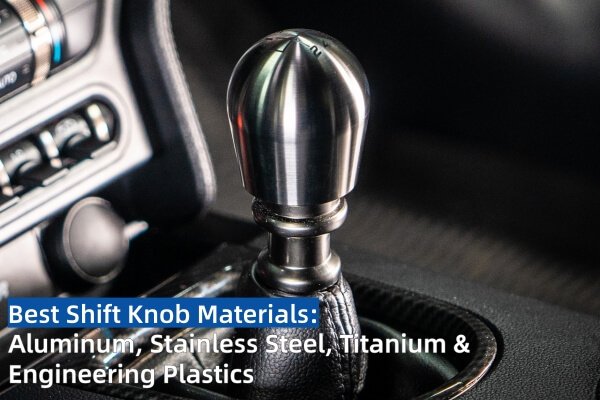
Choosing custom shift knob materials is a bigger engineering decision than it looks. Price and appearance are important, but so are thermal conductivity, density, and surface finish.
Common concerns include uncomfortable surface temperatures and reduced grip with damp hands. That’s why weight, heat transfer, grip, wear resistance, and cost all need attention. The popular claim that “heavier is better” also shouldn’t be accepted at face value.
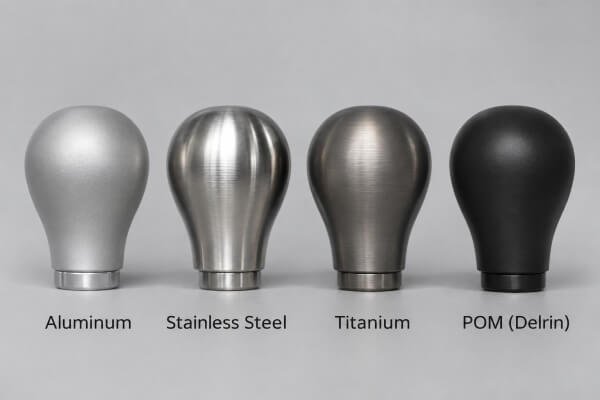
Below, we compare aluminum, stainless steel, titanium, and acetal (POM) on the same criteria. Use this guide to choose the right material for your custom knob project.
Shift Knob Materials at a Glance: Quick Comparison
Before we get into the details, here’s a quick comparison of popular shift knob materials across the points you need to check. Densities are published values. The other ratings are relative, based on typical CNC-machined knobs with a standard finish.
Table 1: Custom Shift Knob Materials Compared by the Same Six Criteria
| Material | Density (g/cm³) | Temperature comfort | Grip (typical finish) | Durability | Customization | Relative cost* |
| Aluminum 6061-T6 | 2.70 | Low | Good when bead blasted or knurled | Good; anodize can wear on edges | Excellent | $ |
| Stainless Steel 304/316 | ~7.9 | Medium | Slippery when polished, good when brushed | Excellent | Good | $$ |
| Titanium Grade 5 | ~4.43 | Medium to high | Good when bead blasted, slick when polished | Excellent | Good | $$$ |
| Acetal (POM / Delrin) | ~1.41 | High | Good, slightly waxy (depends on finish) | Good | Limited (few stock colors, no anodizing) | $ |
*Relative cost is for a similar knob design. Actual cost depends on geometry, finish, and order quantity as well.
How Does Material Affect Shift Knob Weight and Feel?
Out of all the factors to discuss, weight and temperature are the two that users feel most easily.
Weight and Shift Feel
Weight depends on the density of the material. Here’s the approximate mass of a solid 45 mm ball made of aluminum, stainless steel, titanium, and acetal (POM) before any bore or thread is cut:
Table 2: Same Geometry, Different Mass (calculated from published densities)
| Material | Approx. mass of a solid 45 mm ball |
| Acetal (POM) | ~67 g |
| Aluminum 6061-T6 | ~130 g |
| Titanium Grade 5 | ~210 g |
| Stainless Steel | ~375 g |
This is why a weighted shift knob is usually made from stainless steel, brass, or a plastic shell with a metal core. The extra mass increases the lever’s inertia, so once you start a shift, the knob tends to keep moving through the gate. Many drivers perceive this as a smoother shift. However, some feel it hides the feedback from the gearbox.
So, don’t take “heavier is better” as a general rule. It depends on your vehicle, and the knob should match the right weight for it. A heavier knob gives a different feel, but it doesn’t guarantee faster shifts.
Temperature Comfort
Temperature comfort means how hot or cold you feel when you touch the shift knob. Your skin can’t sense the knob’s temperature directly. But it reacts to how fast heat flows in or out of your hand. This property is called thermal effusivity.
Given below are approximate thermal effusivity values of common shift knob materials kJ/(m²·K·√s):
- Aluminum (6061-T6) – about 20
- Stainless steel (316L) – about 7
- Titanium (Grade 5, Ti-6Al-4V) – about 4
- Acetal (POM homopolymer, e.g., Delrin) – about 0.8
(Values are approximate and calculated using published thermal conductivity, density, and specific heat data at about 22 °C.)
A higher effusivity means heat travels faster between your hand and the knob. So, high-effusivity materials feel cold in winter and hot in summer, while low-effusivity materials feel closer to your skin temperature. That’s why aluminum shift knobs feel hot when you park your car on a hot day.
You should also consider grip, durability, customization, and cost. Since these factors depend as much on the finish as on the material, we cover them under each material below.
Metal Shift Knob Materials: Aluminum, Stainless Steel, and Titanium
Aluminum Shift Knobs: Lightweight and Highly Customizable
Aluminum is a popular choice for lightweight, customized shift knobs. 6061-T6 is the go-to grade, and 7075 is chosen for extra strength.
Aluminum machines easily, holds threads well, and anodizes evenly. For these reasons, machining costs are also lower, so it’s usually one of the most cost-effective metals for shift knobs. Our 6061 vs 7075 guide explains how the two grades compare.
You get a wide range of colors on CNC aluminum shift knobs with Type II anodizing. But dyed colors can sometimes fade under UV and wear through on edges. Color retention depends mainly on the coloring process and sealing quality. Use light-fast dyes or electrolytic coloring followed by proper sealing to hold color better under UV.
If you need the color to stay durable under heavy daily wear, ask for Type III hardcoat anodizing for better abrasion resistance. According to the Aluminum Anodizers Council, Type III hardcoat reaches about the same hardness as nitrided steel, but with a limited number of color options. To improve grip, we highly recommend bead blasting before anodizing.
If you’re going for a CNC aluminum shift knob, there are two main trade-offs to consider: low weight and high thermal effusivity. If you want more weight, you can add a steel core in the middle. To reduce heat transfer, you can add a POM or leather grip section covering the surface of the ball (see hybrids below).
Stainless Steel Shift Knobs: Heavy and Durable
Stainless steel is the standard choice for heavier knobs. A stainless steel shift knob weighs close to three times as much as the same shape in aluminum. It also needs no coating, so there’s nothing to wear through over time.
Grade 316 is better suited for corrosion resistance than 304, since it contains molybdenum. It might surprise you, but this is an important factor to consider, because sweat contains salt. After machining, you can also ask for passivation to further improve the corrosion resistance of freshly machined surfaces.
Polished stainless steel can get slippery with damp hands and shows fingerprints. So, go for a brushed or bead-blasted finish for easier handling. Stainless steel usually machines more slowly than aluminum, so expect a higher machining cost. See our stainless steel machining capabilities here.
Titanium Shift Knobs: Premium Feel at a Higher Cost
Titanium gives you a middle ground between aluminum and stainless steel in weight. Grade 5 titanium (Ti-6Al-4V) has a density of about 4.43 g/cm³. It has much lower thermal effusivity than aluminum, so titanium shift knobs feel more comfortable to touch. Titanium naturally resists corrosion from sweat, too.
You can anodize titanium in colors like bronze, blue, or purple tones. These colors come from the thickness of the oxide layer, not from dyes. Therefore, they don’t fade as easily as the dyed coatings on aluminum knobs. However, the thin layer can still scratch.
The main drawback of titanium is cost, because titanium bars are expensive and machine slowly. So, titanium shift knobs are better suited for premium applications, like high-end performance builds or limited-edition runs.
Non-Metallic & Hybrid Shift Knob Materials
Acetal (POM) is one of the most common engineering plastics used in shift knobs. Nylon and PEEK are also used in certain cases, and you can ask us directly about them. However, neither is usually the first choice for general applications, since nylon absorbs moisture and PEEK is expensive.
Delrin and Acetal (POM) Shift Knobs
POM (polyoxymethylene) and acetal are two names for the same engineering plastic. It’s available as a homopolymer or a copolymer. Delrin is a trade name for acetal homopolymer, and copolymer grades are sold under several other names. So, to clear up any confusion: if you ask for Delrin, you’re specifying a homopolymer.
The main advantage of acetal is comfort. It generally feels less hot or cold to the touch than metal at the same surface temperature. It machines to a smooth, slightly waxy surface. But POM knobs are very light (about 1.41 g/cm³) and come in fewer colors than anodized aluminum.
Since it’s a plastic, the threads aren’t as strong as metal ones. So if you plan to remove and replace the knob often, it’s better to add a metal threaded insert.
Hybrid and Composite Shift Knobs
Hybrid and composite knobs are made of a combination of materials:
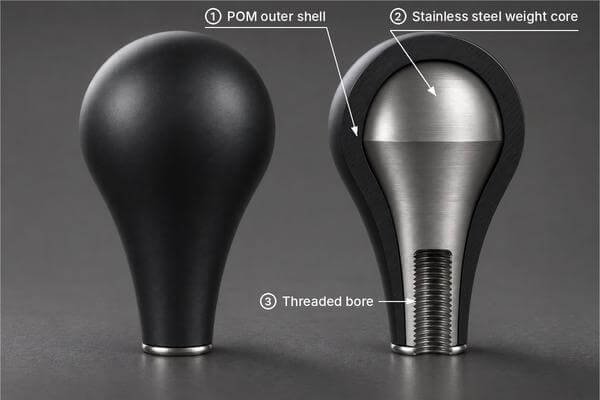
- Hybrid Shift Knobs – two or more separate materials are used together to make one knob (E.g., POM shell with a stainless steel core).
- Composite Shift Knobs – one final material made by combining fibers and resin. A common example is carbon fiber.
A hybrid shift knob balances several performance aspects by using two materials. In a POM-over-steel knob, the outer shell handles comfort and appearance, while the core provides enough weight for a weighted shift knob feel.
Summary: Shift Knob Material Recommendations
When choosing custom shift knob materials, you should balance weight, strength, grip, climate, machinability, cost, and appearance. Use the table below to shortlist options based on your top priority, then discuss the final choice with your team and supplier.
Table 3: Recommended Shift Knob Materials by User Priority
| Priority | Best Shift Knob Materials (In General) |
| Low weight, wide color range | Aluminum 6061-T6 |
| Heavier, smoother-feeling shifts | Stainless Steel or POM over a steel core |
| Comfort in hot or cold climates | POM or a POM hybrid |
| Premium feel, corrosion resistance | Titanium Grade 5 |
| Surface wear resistance | Stainless Steel or hardcoat aluminum |
| Lowest cost for large batches | POM or aluminum |
Which Shift Knob Material Is Best for You?
Before you decide the final material, check these points in order:
- Target weight: weighted or lightweight (with a value in grams)
- Temperature comfort: how hot or cold the cabin gets in the country where the car is used
- Grip: the surface feel and comfort with dry or damp hands
- Durability: daily wear, ring contact, and sweat exposure
- Appearance: color range and finish options
- Quantity and budget: order volume and target cost per unit
Before ordering, also confirm the thread size, mounting method, and console clearance. For an automatic gear selector shift knob, check the release button and pushrod too. Refer to our CNC shift knob process guide for guidance regarding fitment.
FAQs About Custom Shift Knobs
1. What is the best material for custom shift knobs?
The best material depends on your priorities. Aluminum offers low weight and many color options, stainless steel adds weight, and POM provides better hot and cold touch comfort. Titanium combines intermediate weight with a premium appearance.
2. Are heavier shift knobs always better?
A heavier knob changes the shifter’s inertia and may make shifts feel smoother. However, some drivers prefer the feedback of a lighter knob. Added weight does not guarantee faster shifts, so consider your vehicle and driving preferences.
3. Which shift knob material is most comfortable in hot or cold weather?
POM generally feels less hot or cold on initial contact than metal at the same surface temperature. A POM shell over a metal core can combine this comfort with added weight. POM can still become hot in direct sunlight.
4. Is Delrin the same as POM?
Delrin is a brand name for acetal homopolymer, also known as POM-H. POM is the broader material family, which includes both homopolymer and copolymer grades. Specify the required grade when ordering custom parts.
5. Can a custom shift knob combine plastic and metal?
Yes. A hybrid design can use a POM outer shell for touch comfort and a stainless steel core for weight. This allows you to adjust the knob’s mass while retaining a plastic gripping surface.
6. Will a custom shift knob fit any vehicle?
Fitment depends on the vehicle and mounting design. Check the thread diameter and pitch, mounting method, installation depth, and reverse lockout clearance. Automatic selectors may also require compatible release buttons, pushrods, or vehicle-specific adapters.
At HRCCNC, material selection is the first step in every custom shift knob project we quote. Send us your top priority, thread size, and target weight, and our engineers will recommend a material and finish that fit your vehicle and budget. Explore our custom shift knob service or request a quote to get started.