Skip to content
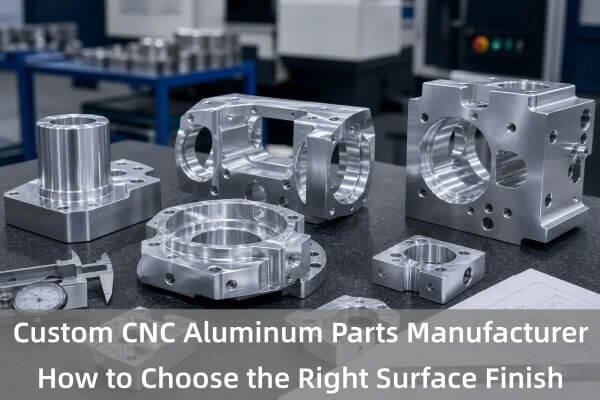
Custom CNC aluminum parts can have precise and accurate dimensions if they are manufactured by experienced suppliers. The machining can still result in visible tool marks on the parts. It may only look like a visual problem at first glance and can be left as the ‘as-machined’ outer texture.
However, an ‘as-machined’ surface may not provide sufficient corrosion or wear resistance for certain applications and service environments. In such cases, applying an appropriate surface finish after machining can help protect the aluminum parts and maintain their performance.
Besides covering up tool marks, finishing requirements depend on the application, environment, roughness, appearance, and wear. This post-processing step is highly important not only for giving the part visual marketability, but also for prolonging the part’s service life by making it corrosion- or wear-resistant, durable, smoother, etc.
But choosing the right surface finish for a certain custom CNC aluminum part is not as straightforward. Even though the material is specific (i.e., aluminum), choosing the right surface finish is complex because different applications have different requirements. This article will help you by showing why an experienced manufacturer and surface finishing are necessary for custom CNC-machined aluminum parts. Besides, it will also guide you on how to choose the right surface finish.
A Manufacturer’s Role in Surface Finishing: Key Considerations Before Production
Project success relies on high-quality product manufacturing and proper post-processing of CNC-machined parts for high performance. To ensure Aluminum CNC parts with dimensional accuracy and the right surface finishes, a manufacturer plays the primary role. This is why evaluating a manufacturer’s machining and surface finishing capabilities is important.
● Machining Quality
Surface treatments hide minor tool marks but not machining bumps or lines. Moreover, it sometimes exaggerates the dimensional curving flaws, which makes the parts look more commercially unpleasant. This is why the machining quality of the manufacturer is important to evaluate prior to partnering.
When the manufacturing team is experienced, they know which machining process to use to produce certain CNC aluminum parts with accurate dimensions at every point of the surface. For example, 3-axis CNC machining can be used to produce both simple flat parts and complex featured parts.
However, using this machining technique on a part with complex geometry may require multiple setups and more time, unlike 4-axis or 5-axis machining. It may result in slight dimensional flaws with each setup change. So, accurate surface finishing results also rely on a manufacturer’s machining quality.
● Surface Finishing Quality
Surface finish is not only about applying it uniformly, but it is also about understanding and suggesting the right surface finish based on application. When an unprofessional or inexperienced manufacturer applies the surface finish on CNC-machined aluminum parts, the possibility of using the wrong and non-uniform surface finish remains.
It results in corrosion build-up, friction, mechanical wear, reduced performance, and short service lifespan, etc. This is why evaluating the manufacturer’s surface finishing capability and experience is highly important for ensuring the longevity and performance of the aluminum CNC parts.
● In-house Surface Finish
Partnering with a manufacturer like HRCCNC can be beneficial, as the team coordinates machining and surface finishing through a single point of contact. This can simplify communication, quality inspection, and delivery planning while reducing the need to coordinate with multiple suppliers.
HRCCNC manufactures custom CNC aluminum parts according to the approved drawings and coordinates the appropriate surface finish based on the application requirements. The parts are inspected before shipment to help ensure that the specified dimensional and finishing requirements are met.
Key Considerations Before Production:
A manufacturer needs to ensure dimensional accuracy and the right surface finish for Aluminum CNC parts. But you still need to include some aspects in the drawings before production.
Part size: Sometimes the plating layers may add material onto the substrate, like electroplating. But in surface finishes like anodizing, the layer grows inward and outward from the substrate surface in different ratios based on anodizing type and process. However, a layer of coating for surface finish has a thickness, no matter how small. So, during specifying the dimensions on the part drawings, this extra coating thickness needs to be considered.
Coating Thickness: Based on the coating dimensional allowance, specify how thick you want the coating to be. Consider some facts, like too-thin coatings may be scratched easily and work as a starting point for corrosion and wear. Thick coatings may provide hardness in certain surface finishes like anodizing but may increase the possibility of peeling or cracking in painting.
Smoothness Level: Specify the average roughness (Ra) requirement on your CNC aluminum parts after considering the applications. Depending on different applications, your parts may require a matte texture or mirror-like smoothness. These specifications help the manufacturer to pick suitable finishes for your custom aluminum CNC parts.
Why Do CNC Aluminum Parts Need Surface Finishing?
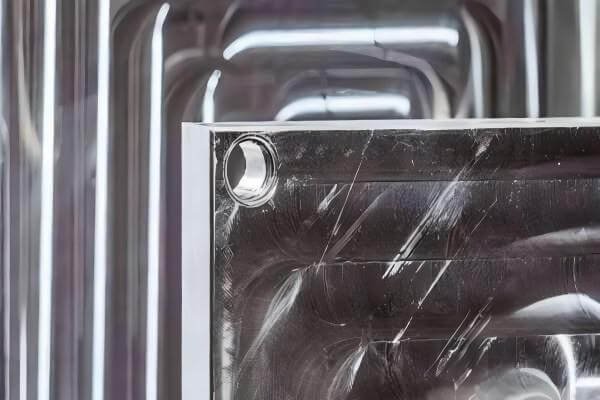
The surface of a CNC aluminum part, as-machined, may have commercially unappealing tool marks. With or without marks, these CNC components are exposed to environmental conditions. This exposure can reduce the part’s performance and service life due to corrosion and friction. This is why HRCCNC recommends having surface finishing on your CNC aluminum parts for aesthetics and durability.
1. Corrosion and Wear Resistance
Aluminum CNC parts without any protective coating can get corroded over time with constant exposure to the environment. Suitable finishes operate as a layer between the substrate and environment, shielding the parts from corrosion.
Besides, these aluminum parts, when assembled into devices, may undergo friction when the device is operational. This friction makes the parts wear out and become unusable soon. Compared with many steels, aluminum generally has lower surface hardness and may be more susceptible to wear in demanding applications. Certain surface treatments can increase surface hardness and improve the wear resistance and service life of aluminum parts.
2. Reducing Visible Tool Marks and Adding Texture
Custom CNC aluminum parts may have visible fine lines or tool marks from the machining process. Surface finishing can reduce the visibility of minor tool marks and create a cleaner, more consistent appearance. It can also produce a matte, textured, or glossy surface based on the project requirements. However, sharp edges and significant machining defects should be corrected before surface finishing.
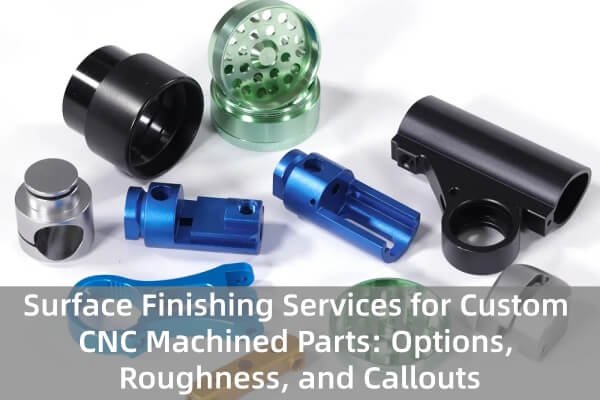
3. Customized Color
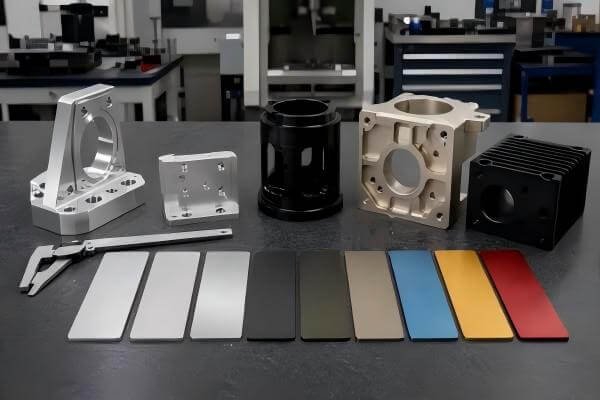
You may want a custom color on your custom CNC aluminum parts. As-machined aluminum parts have the traditional silver color of the material. But these parts often need custom color on them as well.
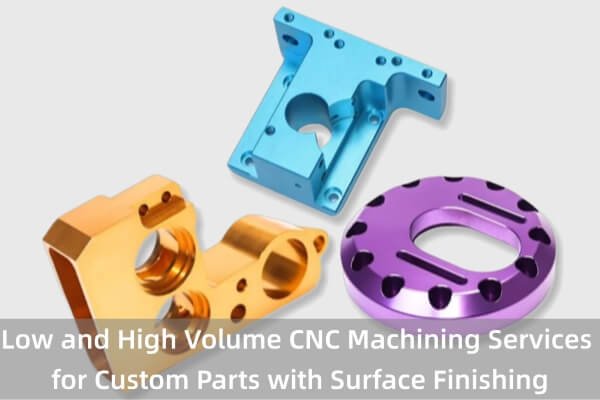
Surface finishes like anodizing are the most popular in the CNC machining industry for applying permanent custom color on the parts due to their high dye absorption. Besides, painting can also add a custom color coating on CNC aluminum parts. However, its durability depends on the coating system and service environment.
4. Functionality
Apart from aesthetics and protection, surface finishes can provide specific functional properties. Depending on the process, a finish may improve electrical contact, provide electrical insulation, or create a textured surface for better grip. The appropriate finish should be selected according to the part’s functional requirements.
What Surface Finishes for CNC Aluminum Parts Do We Offer?
To choose the right surface finish, you must know the details about the usually available finishing options for aluminum. Here are the post-processing options our engineering team at HRCCNC has been offering for the custom CNC aluminum parts manufactured by us:
1. Anodizing
Its main benefits include improved surface hardness, wear resistance, corrosion resistance, dielectric performance, and appearance.
We apply anodizing to CNC aluminum parts for several advantages, such as surface hardness, wear and corrosion resistance, electrical insulation, and custom dye absorption. Anodizing provides improved durability by producing a thick and hard oxide layer on the surface through an electrochemical process.
Our team often suggests this finishing method when components in certain industries like aerospace, military, mechanical, and industrial require high corrosion resistance.
2. Sand/Bead Blasting
You can consider Sandblasting or bead blasting if you only require appearance and texture improvement by hiding the tool marks on the aluminum CNC components. It utilizes fine media propelled at high pressure to remove blemishes like oxidation, scale, and stubborn contaminants.
We may also recommend blasting as a surface preparation step before painting or coating. However, sand or bead blasting does not provide significant corrosion protection by itself.
3. Electroplating
Generally, this finishing is applied for its wide variety of advantages, such as strong corrosion resistance, wear resistance, hardness, etc. Besides, electroplating improves decorative appearance. However, compared with other finishes like anodizing, electroplating on aluminum CNC parts is more complex than applying it to other materials.
This is because aluminum rapidly forms a stable oxide layer when exposed to air. Although this natural oxide layer provides some environmental protection, it can interfere with the adhesion of subsequently deposited metal coatings. Proper cleaning and pretreatment are therefore required before electroplating aluminum parts.
HRCCNC applies aluminum electroplating after proper pretreatment for these electroplated layers to stick to the surface and improve its corrosion resistance. One such pretreatment is zincating, where the thin oxide layer is replaced by a thin film of zinc, which allows the electroplating material to coat over the surface.
4. Electroless Nickel Plating
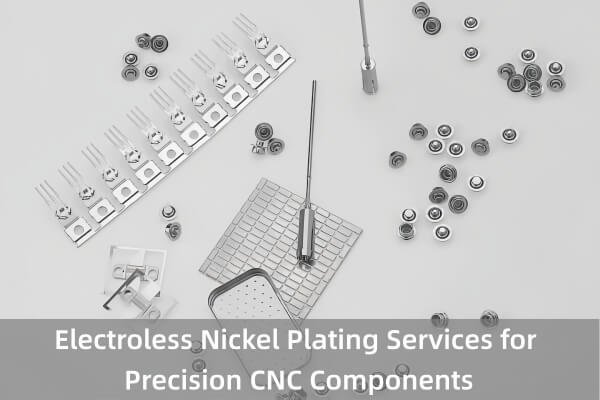
Electroplating is not limited to simple flat parts. However, its thickness may vary around edges, recesses, and deep features. Electroless nickel plating can provide more uniform coverage on many precision CNC aluminum components with complex geometries. It can be suitable for parts with holes, pockets, internal threads, and recesses, provided the plating solution can circulate freely over the surfaces. However, it still adds thickness, and very small or deep internal features should be reviewed with the finishing supplier.
5. Brushed Finish
Aluminum CNC parts in medical devices, telecommunication equipment, automotive parts, and consumer goods are where brushed finish is applied most. When your machined parts are intended to be used in consumer devices, you may require a modern look. A brushed finish is then applied with the purpose of providing a balance of surface uniformity and aesthetic appeal. Its directional satin finish and consistent grain pattern can create a more uniform appearance and make some minor surface marks less noticeable.
6. Powder Coating
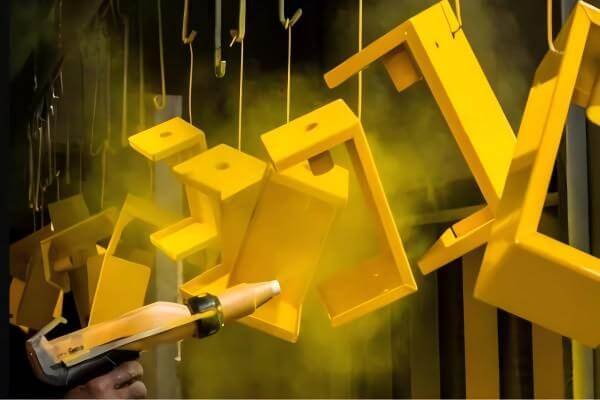
If you particularly require a strong, wear-resistant surface finish, our team at HRCCNC keeps powder coating as a suggested option. Powder coating creates a uniformly thick and durable coating over the Aluminum CNC component. This hard coating protects the components from mechanical wear such as chipping and scratching.
Though this post-process may not always prevent fading over time with UV exposure, it still provides good resistance to weathering. Its outdoor performance depends on the powder chemistry, with exterior-grade polyester generally preferred for outdoor use. As it has a significant coating thickness, areas of the aluminum parts with tight tolerances may need masking before powder coating the part. HRCCNC recommends pre-planning the allowance in the design stage if this particular surface finish is required.
7. Painting
For custom CNC aluminum parts, the primary benefit of painting is its improved appearance. We offer a wide range of custom color options for your decorative needs. Some common applications of this finishing option are commercial and consumer product parts, automotive body panels, industrial equipment parts, etc. Like powder coating, painting adds a thick finishing coating on the surface of aluminum parts. So, tight-tolerance areas on the component may need masking or allowance.
Comparison Table of Available Surface Finishes
| Surface Finish | Best For | Appearance | Protection Level | Cost Level |
| Anodizing | Aluminum parts, corrosion resistance | Matte / Colored | High | Medium |
| Sand/Bead Blasting | Aesthetic texture, pre-coating | Uniform Matte | Low | Low |
| Electroplating | Wear resistance, decorative parts | Glossy Metallic | High | Medium to High |
| Electroless Nickel Plating | Complex geometries, precision/tight-tolerance parts | Semi-bright / Uniform Metallic | High | Medium to High |
| Brushed Finish | Consumer products, modern look | Linear Pattern | Low | Low |
| Powder Coating | Outdoor use, durable parts | Colored / Glossy | High | Medium |
| Painting | General purpose | Color Coating | Medium | Low to medium |
Note: The ratings above are general comparisons only. Actual performance and cost depend on the aluminum alloy, coating type and thickness, pretreatment, sealing, masking requirements, part geometry, batch size, and applicable testing standards.
How to Choose the Right Surface Finish for Aluminum CNC Parts?
You can choose the right surface finish by balancing performance, application, and cost. The right choice depends on considering all your requirements and first making a shortlist of applicable surface finishes. This may feel like a complex task, so we’ll guide you with suggestions for how to choose the right surface finish.
For corrosion resistance: If you require your CNC aluminum parts to resist corrosion and weather damage, some surface finish options for your parts are anodizing, hard coat anodizing, and nickel plating.
For color and appearance: For particular custom colors on your custom aluminum parts with CNC machining, Type II anodizing, powder coating, and painting are suitable.
For matte texture: Aluminum parts in some industries require a specific matte texture. If you are looking for your parts to be smooth yet not shiny, you can consider bead blasting, sandblasting, or bead blasting plus anodizing.
For wear resistance: Aluminum CNC parts assembled into industrial equipment usually face severe mechanical friction, causing them to provide low performance over time. To prevent such wear, you can consider hard coat anodizing or electroless nickel plating.
For complex geometry: If your aluminum CNC parts have simple flat surfaces, electroplating provides good protection. However, in the case of complex geometry, you may consider electroless nickel plating for more uniform coverage and protection.
For tight tolerances: HRCCNC recommends considering the coating thickness before choosing any surface finish. For example, if you need decorative color on an aluminum part with tight tolerances, anodizing with dye absorption may be better than applying a thick paint coating. If you still prefer finishing with thick coatings, pre-plan the allowance and masking requirements in the design stage.
For cost-sensitive projects: Some finishing processes can be expensive, such as electroplating, particularly on CNC aluminum parts, due to their pretreatment requirements. However, if you are looking for cost-efficient options, you can choose basic anodizing, bead blasting, or painting depending on quantity.
For food-grade or medical-related parts: If your aluminum CNC parts are to be used in food-grade or medical-related devices, do not only look for a polished finish. Focus on cleanability, surface roughness, material compatibility, and required standards when choosing the finishing option.
A finish should not be described as “food-grade” or “medical-grade” unless the complete material and coating system has been evaluated against the applicable regulations and end-use requirements.
This may help you to make the initial shortlist. Finally, you can choose the right finishing option from this shortlist that aligns with your part’s functional requirements, environmental exposures, and cost targets.
FAQs
1. Do all custom CNC aluminum parts need a surface finish?
No. An as-machined finish may be suitable for parts used in mild environments or internal applications. Surface finishing is recommended when improved corrosion resistance, wear resistance, appearance, color, or electrical insulation is required.
2. What is the best surface finish for corrosion-resistant aluminum parts?
Anodizing is a common choice because it improves corrosion resistance while maintaining the natural characteristics of aluminum. Powder coating and electroless nickel plating may also be suitable, depending on the environment, alloy, geometry, and performance requirements.
3. Does anodizing affect the dimensions of CNC aluminum parts?
Yes. Anodizing creates an oxide layer that grows both into and above the original aluminum surface. The dimensional change depends on the anodizing type, alloy, coating thickness, and process conditions. Critical holes, threads, and mating surfaces may require masking or machining allowance.
4. Which surface finish is suitable for tight-tolerance aluminum parts?
The right option depends on the tolerance and required function. Anodizing is often more suitable than thick paint or powder coating, but its dimensional growth must still be considered. Electroless nickel plating provides relatively uniform coverage but also adds measurable thickness.
5. Does sandblasting or bead blasting protect aluminum from corrosion?
Not by itself. Sandblasting and bead blasting mainly improve surface texture, reduce the visibility of minor tool marks, and prepare the surface for another coating. Anodizing, painting, or powder coating is usually needed when significant corrosion protection is required.
6. What information should I provide when ordering finished CNC aluminum parts?
Provide the aluminum alloy, CAD files or 2D drawings, dimensional tolerances, required surface roughness, finish type, coating thickness, color, service environment, and masking requirements. You should also identify all critical holes, threads, sealing surfaces, and electrical-contact areas.
Partner with a Custom CNC Aluminum Parts Manufacturer with the Right Surface-Finishing Capabilities
Though we have guided you on what to consider when choosing the right surface finish on your custom CNC aluminum parts, you may still feel a little confused. To choose the suitable one based on all your requirements, partnering with a reliable supplier may streamline the process.
HRCCNC supplies custom CNC aluminum parts with precise dimensions and accurate designs based on the drawings provided. It also offers a variety of surface finishes available for these aluminum parts. Besides, we offer free technical guidance on choosing the right aluminum alloy, machining method, and the right surface finishing option.
To make informed decisions about surface finish choice for your Custom CNC aluminum parts, contact us at HRCCNC with your CAD files or 2D drawings. Our experienced team of engineers will suggest the right and most effective finishing options based on your application and requirements.