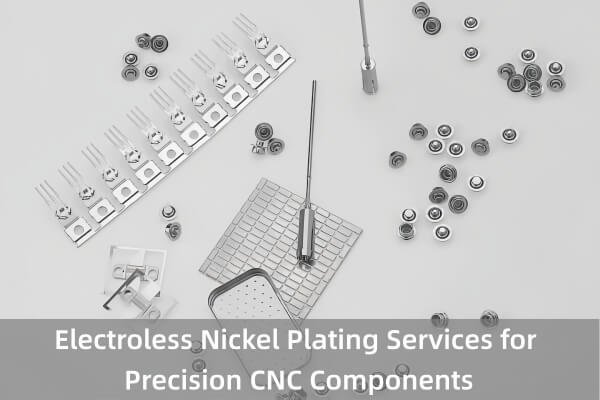
When it comes to complex CNC machined parts, standard electroplating may show limitations when uniform coverage is required. The coating may struggle to reach complex geometries like tight screw holes and deep pockets, leading to uneven coating thickness. Electroless nickel plating services work as a more effective alternative.
In Electroplating, the coating thickness depends on the current density (current per unit area). Due to the high current density on the smooth substrate surface, metal deposition occurs faster, leading to a thicker coating. On the contrary, tight screw holes, deep holes, internal threads, and recesses get slower deposition due to low current density. Eventually, these complex geometries get thinner plating.
To achieve a uniform coating on complex CNC machined components, electroless nickel plating is used. It’s a chemical plating process in which a layer of nickel-phosphorus alloy (3μm to 40μm) is usually coated onto CNC-machined components. Sometimes, a nickel-boron alloy layer can also be coated. Electroless nickel plating provides an even coating for strong corrosion and wear resistance all over the precision CNC components.
Why Is Plating or Finishing Important for CNC Machined Parts?
Precision CNC components require dimensional accuracy to maximize the performance of the equipment they are assembled into. Raw CNC machined parts are exposed to environmental conditions. This makes them highly vulnerable to corrosion, which compromises their precise dimensional accuracy.
That is why plating or surface finishing is highly important for CNC machined parts. It works as a key protective layer between the substrate material and environmental exposure. Plating makes these precise parts resistant to corrosion and mechanical wear.
At HRCCNC, in addition to precision CNC machining, we provide a full range of standard electrolytic and electroless surface-finishing solutions for CNC components. Depending on your design complexity, material, and application needs, choosing the right plating service is important.
Electrolytic Nickel Plating vs Electroless Nickel Plating in Precision CNC Components
Electrolytic and electroless nickel plating are equally popular methods used on precision CNC parts. Though their fundamental goal is the same, they differ in application process and result.
As the name implies, electrolytic nickel plating needs an electric current to apply the coating onto the raw CNC machined element. In contrast, electroless nickel finishing does not require any electric current to deposit the coating on the substrate.
In terms of results, the electrolytic plating process produces an even final coating onto the simple CNC parts. However, when it comes to complex CNC machined geometries, nickel electroplating fails to reach complex internal threads or deep recesses. This results in uneven coating thickness.
On the contrary, electroless nickel plating uses a chemical reaction for an even deposition of the nickel alloy on the raw metal of the CNC parts. This results in uniform coating against wear and corrosion resistance.
How to Know When to Apply Electroless Nickel Plating Solution for CNC Machined Parts?
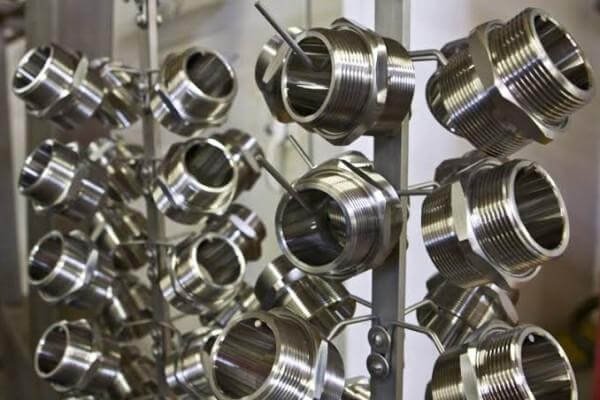
We manufacture CNC machining parts according to your exact specifications. But whether they last long-term or fail in a short time depends on your precision plating choice. The right choice will reduce failure risks of the precision CNC components and extend their high-performance lifetime. Now, how to choose the right metal finishing for CNC components? You should consider the following features of them.
1. Complex Geometries:
If the CNC machined parts have complex internal threads, sharp corners internally, and deep blind holes, then you should choose electroless nickel plating.
2. Strict Dimensional Tolerance:
Does the application of the CNC machined part require strict dimensional uniformity at the micrometer level? If you are not certain, contact us at HRCCNC to get a suitable plating method recommendation. We will suggest electroless nickel plating when strict dimensional uniformity and tight coating control are required.
3. Critical Protective Needs
Will your CNC machined parts be used in industrial applications in a harsh environment? Then they need EN plating to be protected from corrosion and heavy mechanical wear.
4. Metal of the Raw CNC Component
Specify the material to CNC machine the components. Electroless metal plating is usually applicable to aluminum, steel, stainless steel, and also on some non-ferrous metals such as copper, bronze, and brass.
Though Electroless nickel plating is more effective in components with the above features, it can be comparatively expensive.
If your CNC machined parts are flat, without sharp internal corners or deep recesses, using other plating techniques will be better. Electroplating is one of our most popular metal finishing services for our simple CNC machined components at a low cost.
For aluminum CNC machined parts requiring a vibrant decorative color, HRCCNC’s Anodizing service is best for them.
What Does Our Electroless Nickel Plating Process Look Like for Our CNC Machining Components?
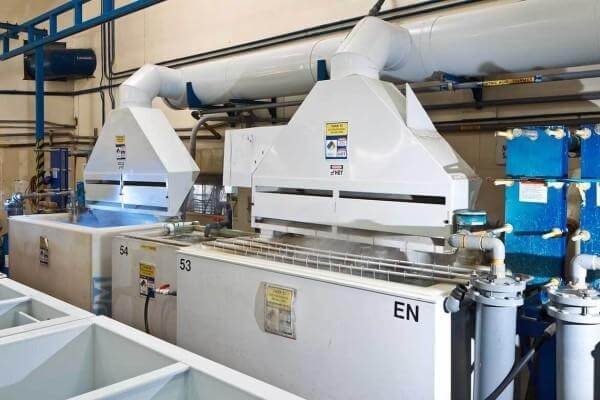
Our electroless nickel plating is a multi-step, strict process to make sure the nickel phosphorus alloy gets a consistent and even deposition onto the raw CNC machined parts.
First Step: Cleaning
This is a pre-plating step where we clean the raw CNC machined components thoroughly. We start with degreasing them in an alkaline cleaning bath. It dissolves the remnant machining oils, grease, cutting fluids, or any contamination from the surface.
After that, the parts get a brief acid dip called etching. It removes the surface oxides and microscopic rust from the substrate. Lastly, we rinse off the raw CNC parts thoroughly to prevent solution cross-contamination.
Second Step: Autocatalytic Chemical Bath
The cleaned CNC parts are submerged in a heated chemical solution with nickel and reducing agents in the absence of electricity. The phosphorus content in the plating is strictly controlled according to the exact requirement.
This chemical process ensures an even layer of nickel phosphorus is coated evenly on both the smooth surface and deep blind holes and complex internal threads.
Third Step: Post-plating Rinsing or Baking
Lastly, the CNC components with electroless nickel plating go through a final rinsing. Depending on your requirement, they can go through a post-plating bake to make sure there is no trapped gas under the coating.
Types of Electroless Nickel Plating Services for CNC Machined Parts We Provide
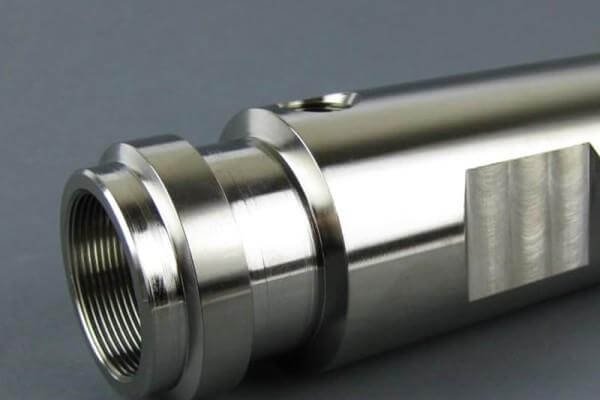
Electroless nickel plating has a wide range of applications. Example: Components in devices related to medical, aerospace, automotive, electronics, printing circuit boards, etc. This plating can be divided into two categories in terms of gained resistance.
1. Electroless Nickel Corrosion-resistant Finish for CNC Machined Parts
- Low Phosphorus Electroless Nickel coating (1%-5% Phosphorus)
- Mid Phosphorus electroless Nickel coating (5%-9% Phosphorus)
- High Phosphorus electroless Nickel coating (10%-13% Phosphorus)
The CNC machined parts are assembled into operational devices. When these devices operate in highly corrosive, marine, or acidic environments, these types of plating are required for strong corrosion protection.
2. Electroless Nickel Wear-resistant Finish for Precision CNC Parts
- Boron Electroless Nickel coating (0.5%-5% Boron)
- Composite Electroless Nickel coating (10%-30% Ceramic/mineral particles)
- Polymers Electroless Nickel coating (10%-30% Polymer particles)
The CNC machined parts that are integrated with industrial devices undergo heavy mechanical impact, continuous friction, or abrasive contact, these plating methods are most effective.
How Should You Know Which Electroless Nickel Coating to Pick for Precision CNC Components?
At HRCCNC, besides our primary CNC machining services, we provide a variety of surface finishing options for those CNC components. Choosing the right electroless nickel plating method may feel a little confusing. This table might help you.
| Electroless Plating Method | Composition / Core Material | Gained Advantages & Characteristics | Common Application Cases |
| High-Phosphorus | 10%-13% Phosphorus | • Maximum corrosion protection• True amorphous (glass-like) layer with no crystalline boundaries• Completely non-magnetic | • Marine components• Chemical processing equipment• Electronics requiring interference shielding |
| Mid-Phosphorus | 5%-9% Phosphorus | • Balanced corrosion and wear resistance• Bright aesthetic finish• Most economical and versatile option | • Bringing under-sized parts back to tolerance• General industrial machinery parts• Automotive components |
| Low-Phosphorus | 1%-5% Phosphorus | • Highest as-plated hardness for high-wear zones• Poor corrosion protection when exposed to acidic environments.• Creates compressive stress to reduce steel fatigue• Excellent electrical conductivity and solderability | • Alkaline chemical manufacturing (e.g., caustic soda)• Electronic connectors and components• High-friction mechanical assemblies |
| Boron Coatings | 0.5%-5% Boron | • Exceptional hardness that can exceed hard chrome when heat-treated• Low coefficient of friction• High-wear protection (though higher porosity limits acidic corrosion defense) | • Aerospace wear components• Heavy-duty automotive applications• Solderable electronics (using low 0.5%–3% boron) |
| Composite Coatings | 10%-30% Ceramic/Mineral Particles (e.g., silicon carbide, diamonds) | • Extremely high hardness and melting points• Drastically reduces abrasion and wear loss• Rough, matte finish | • High-abrasion mechanical tools• Drive shafts and rotors• Industrial components facing heavy frictional impact |
| Polymer Coatings | 10%-30% Polymer Particles (e.g., Teflon™/Fluorocarbons) | • Minimizes friction and eliminates galling• Provides self-lubricating, non-stick release properties• Matte grey to chalk white appearance | • Moving parts requiring a dry lubricant surface• Molds and release dies• Precision bearing surfaces |
Request a FREE QUOTE from a Fast Turnaround CNC Machining Company with Suitable Plating Services
Partnering with HRCCNC, you’ll find a team that will give you a comprehensive solution for your CNC component needs. We operate under the strict standards of ISO 9001:2015 certification.
Raw materials sourcing, CNC machining, a variety of advanced surface finishing, and secure worldwide on-time delivery – get all your CNC machining solutions under one roof.
Our CNC machining services are strictly focused on dimensional accuracy for their application requirements. After precision manufacturing, our surface finishing options are applied to reduce corrosion failure. For plating implementation, our goal is to reduce unevenness in the coating to control post-plating dimensions.
With our strict control in every step of the CNC machining and plating process, we consistently help reduce rework or scrap risk. Contact us with drawings, materials, tolerance requirements, surface finish needs, and application conditions. HRCCNC will recommend the right machining and plating solution based on your material, environment, and performance needs.
FAQs
1. What is electroless nickel plating for CNC machined parts?
Electroless nickel plating is a chemical surface finishing process that deposits a nickel-phosphorus or nickel-boron alloy layer onto CNC machined components. Unlike electroplating, it does not require electric current, which helps create a more uniform coating on complex geometries, internal threads, deep holes, and recessed features.
2. Why choose electroless nickel plating instead of standard electroplating?
Electroless nickel plating is often preferred for complex CNC parts because it provides more uniform coating thickness. Standard electroplating depends on current density, so coating thickness may vary in deep holes, internal threads, and recessed areas. Electroless nickel plating uses a chemical reaction, making it more suitable when consistent coverage is important.
3. Which CNC components are suitable for electroless nickel plating?
Electroless nickel plating is suitable for CNC machined parts with complex geometries, tight dimensional requirements, internal threads, deep blind holes, sharp internal corners, or harsh operating environments. It is also commonly used when parts need improved corrosion resistance, wear resistance, and controlled coating thickness.
4. What materials can be used with electroless nickel plating?
Electroless nickel plating is commonly applied to aluminum, steel, stainless steel, copper, brass, bronze, and other compatible metal substrates. The best plating method depends on the base material, part geometry, tolerance requirements, and final application environment.
5. Does electroless nickel plating affect part dimensions?
Yes. Electroless nickel plating adds a controlled coating layer to the component surface, so plating thickness must be considered during CNC machining and finishing planning. For precision components, HRCCNC can review drawings, tolerance requirements, and coating thickness needs to help maintain post-plating dimensional accuracy.
6. How can I choose the right electroless nickel coating for my CNC parts?
The right coating depends on your application. High-phosphorus coatings are often used for strong corrosion protection, while low-phosphorus, nickel-boron, composite, or polymer-based coatings may be selected for wear resistance, hardness, low friction, or specific functional needs. HRCCNC can recommend a suitable CNC machining and plating solution based on your material, geometry, tolerance, surface finish, and operating conditions.