Skip to content


A custom aluminum heating block is a machined aluminum body with wells cut to hold sample tubes or vials, used with a heater. The geometry looks simple, yet small drawing decisions shape the finished part: tube fit, well position, burrs at the well rim and alignment with the instrument tray. A drawing that leaves these undefined can lead to avoidable revisions.
This guide explains how an aluminum heating block is specified and machined, from the first prototype to repeat orders, and what to prepare before requesting a quotation for HRCCNC’s aluminum dry bath blocks.
What Is an Aluminum Heating Block and Where Is It Used?
Names and Typical Applications
The same part is sold under several names: heating block, heat block, dry bath block and block heater. In each case it is a solid piece of aluminum with wells for tubes, vials or other sample containers. The spelling aluminium heating block is common outside North America and refers to the same part. This article covers laboratory and instrument blocks, not heater blocks in other types of equipment.
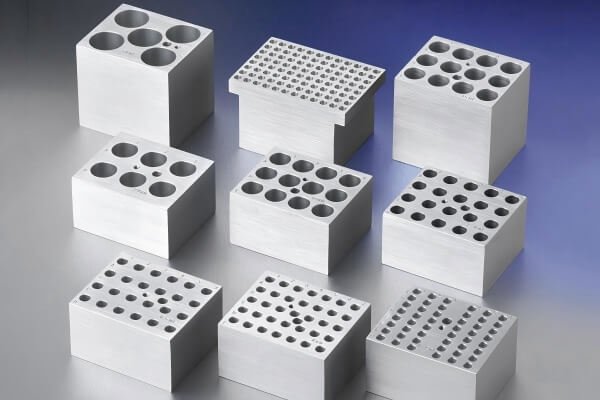
Typical applications include laboratory heating equipment such as dry bath heaters, sample warmers, incubators and temperature control modules. Medical testing equipment uses blocks in diagnostic instruments and sample holders. Biotech sample preparation relies on blocks built around microtubes, small vials and PCR tube formats. OEM instruments require the same block to be supplied repeatedly to equipment manufacturers. In all of these uses, each sample sits in its own well, so well-to-well consistency supports repeatable tube placement. It does not, by itself, guarantee uniform heating, a point covered in the design section below.
Product Types
Common configurations include multi-well dry bath blocks with dense hole arrays, where spacing and position are checked against the drawing, and microtube and PCR tube blocks with small bores, where consistency from well to well is especially important. Deep-well heating blocks require careful control of hole depth, straightness, bore finish and burrs. Round reaction blocks for hot plate stirrers combine well spacing with tapped mounting holes, and OEM heating fixtures add locating features, assembly dimensions and optional laser marking. Standard tube blocks, interchangeable sample blocks and a 96-well version are also part of the range. Any of these can serve as a starting point for a customized drawing.
Material Selection and Design Considerations
Aluminum is widely used for heating blocks because it generally conducts heat well, machines cleanly and weighs less than steel. 6061-T6 is the common machining grade for these blocks and suits standard layouts. 7075 is offered as an option on several blocks, and other aluminum grades can be discussed once the drawing has been reviewed. The material does not need to be final before requesting a quotation. Describing how the block will be used, such as frequent handling, regular cleaning or a tight assembly, helps the engineers recommend a suitable grade.
Neither alloy is automatically better. The table below summarizes general trade-offs. These are general design considerations, not HRCCNC test data, and the grade should be confirmed at quotation.
| Factor | 6061-T6 | 7075 |
| Thermal performance | Generally conducts heat somewhat better | Generally somewhat lower; whether this matters depends on the design |
| Strength | Moderate, adequate for most standard layouts | Higher, which may suit thin walls or heavier handling loads |
| Machinability | Machines well and is widely used for CNC work | Machines well, though its hardness can increase tool wear |
| Corrosion resistance | Generally better | Generally lower; a protective finish may be worth considering |
| Availability | Common standard grade for these blocks | Optional on several blocks; confirm at quotation |
| Cost | Generally lower | Generally higher |
The remaining points are also general design considerations that should be settled on the drawing.
Tube-to-bore fit. Define the tube’s outside diameter, the required clearance, the insertion depth and the acceptable variation. The fit should allow easy insertion and removal without excessive looseness.
Well geometry. Bore diameter, depth, straightness, spacing, remaining wall thickness and bottom geometry can affect machinability, tube contact and block performance. Deep or closely spaced wells call for more careful review.
Anodizing. Anodizing adds a surface layer, so it may change bore size and mating dimensions. For critical holes or thermal-contact surfaces, the drawing may need a dimensional allowance, post-finish inspection or masking.
Temperature uniformity. Accurate wells alone do not guarantee uniform heating. Block thickness and mass, heater location, sensor position, bottom-face contact, tube fit, warm-up time and the complete temperature-control system all contribute. Consistent well dimensions support repeatable tube placement, but thermal performance should be confirmed at the system level.
Drawing and inspection requirements. Identify the critical dimensions, state whether each applies before or after finishing, and specify any inspection or thermal-validation criteria the application requires.
What Can Be Customized on a Custom Aluminum Heating Block
Layouts, Hole Dimensions and Spacing
Layout is the most visible customization: a single well or a dense grid, one bore size or several on the same body, for vials, PCR tubes, microtubes, test tubes or other containers. If an instrument must accept more than one container type, a mixed-bore block can cover them in one footprint, and HRCCNC reviews mixed diameters feature by feature.
Hole depth, bore diameter and spacing are the three core dimensions of an aluminum heating block. Depth sets how far the tube enters the metal, diameter sets the fit, and spacing sets the aluminum remaining between neighboring wells, which also affects how the part is clamped during machining. HRCCNC reviews hole diameter, depth, position, flatness and mating dimensions from the 2D drawing, so marking critical dimensions separately from general ones is useful.
Mounting Features and Finish Options
A block installed on a heater also needs threaded holes, mounting features and locating features to fit the surrounding assembly. For interchangeable blocks, the mating dimensions must stay consistent because the same block is fitted repeatedly.
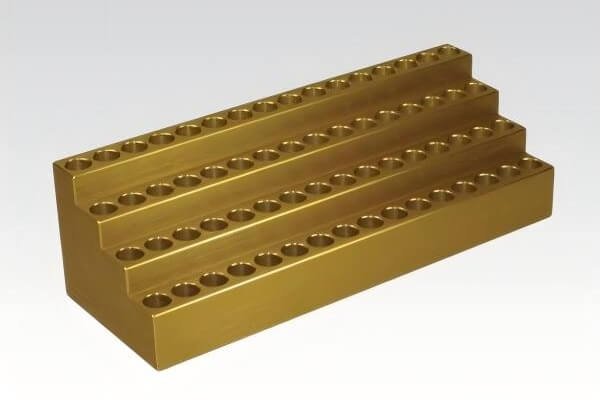
Available finishes include as-machined, bead blasted, clear anodized, natural hard anodized and custom finishes. Many projects can run as-machined. Clear anodizing can give a more uniform surface, and hard anodizing may be considered where the block will see wear. The choice should reflect handling and cleaning requirements and be stated in the request.
How CNC Machining Produces an Aluminum Heating Block
The geometry is simple, but several features need attention on most jobs: bore depth, hole spacing, flatness, deburring and surface finish.
Milling, Drilling, Boring and Reaming
Stock is first cut to size by CNC milling. The wells are then drilled, and bored or reamed where the drawing requires a tighter fit. Tapping, chamfering and deburring follow, and the finished part is inspected. The number of steps depends on the layout. A shallow, widely spaced pattern is relatively straightforward, while a deep, closely spaced one requires more planning, which is why the drawing is reviewed before pricing.
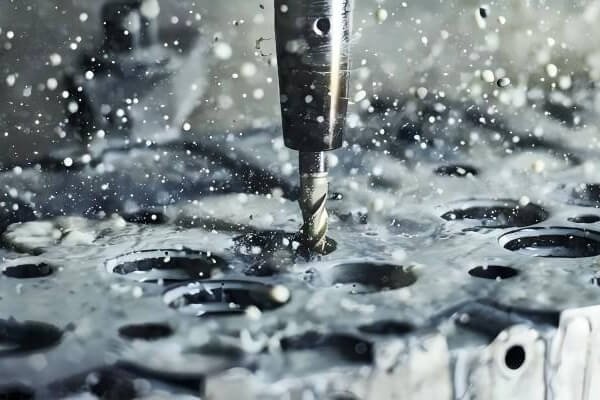
Deep-hole accuracy and dense hole layouts are two of the main machining concerns. Depth, straightness and bore consistency are reviewed before tooling is chosen, and tight spacing calls for stable clamping, a planned machining sequence and burr control. Two blocks that look similar on paper can machine very differently depending on hole depth and spacing.
Flatness, Deburring and Surface Finish
Bottom faces and mating surfaces are checked where heat transfer or assembly fit matters. A flat, smooth bottom face supports contact with the heater, and a flat mating surface supports seating in the instrument. A burr in a well can scratch a tube or prevent it from seating, so deburring and chamfering should be planned as part of the machining process rather than treated as an afterthought. Well edges and outer faces are cleaned before finishing, and on OEM fixtures, functional faces are protected while the finish is applied.
From Prototype to Production
Prototype Samples and Low-Volume Trial Orders
A few prototype samples allow tube fit, spacing and finish to be tested in the customer’s own equipment before further commitment. When a project requires approval, HRCCNC reviews prototype samples before repeat batch production, which provides a practical point to revise the drawing if needed. A low-volume trial order can follow, showing how the design holds across a small batch. With a new instrument, this is where minor design changes tend to become apparent.
Inspection, Repeat Batches and Consistency
Finished blocks are checked for hole size, depth, spacing, flatness and visible surfaces against the drawing requirements. Identifying the most important dimensions lets inspection focus on them. Once a sample is approved, repeat batches follow the same drawing, supported by stable machining, clean wells and careful packing. HRCCNC protects finished blocks from scratches, contamination and damage before shipment.
Before scaling up, four items should be fixed on the approved sample: tube or vial specification, hole depth and spacing, finish, and the inspected dimensions. Changing any of them during a repeat order can introduce avoidable problems. Keeping the approved sample and the drawing revision on file allows later orders to be matched to the first.
Aluminum Heating Block FAQs
1. What is an aluminum heating block used for?
An aluminum heating block holds tubes or vials in machined wells and transfers heat from a dry bath, heater or temperature-control module. It is commonly used in laboratory equipment, diagnostic instruments, sample preparation systems and OEM devices.
2. Which aluminum grade is best for a heating block?
6061-T6 is the standard choice for many heating blocks because it machines well, conducts heat effectively and offers good corrosion resistance. 7075 may suit designs that need greater strength or thinner walls, but the final grade should be selected after the drawing and operating conditions are reviewed.
3. How should tube-to-bore clearance be specified?
Specify the tube’s outside diameter and tolerance, the required clearance, the insertion depth and the acceptable variation. Also state whether the bore dimensions apply before or after anodizing. Prototype testing is recommended because tube dimensions can vary between suppliers.
4. Does anodizing affect the bore dimensions of an aluminum heating block?
Yes. Anodizing creates an oxide layer that can change bore size and other mating dimensions. Critical bores may require a dimensional allowance, masking or inspection after anodizing.
5. Can a custom aluminum heating block be prototyped before production?
Yes. Prototype samples allow the tube fit, well depth, spacing, finish and assembly dimensions to be checked in the actual equipment. Any necessary drawing changes can then be completed before repeat batch production.
6. What information is needed to quote a custom aluminum heating block?
Provide a 3D model or 2D drawing, the aluminum grade, tube size, bore depth and spacing, surface finish, critical tolerances, quantity and target lead time. STEP, STP, IGS, X_T, SLDPRT, PDF, DWG and DXF files can be used for quotation review.
What to Send for a Custom Aluminum Heating Block Quote
Each drawing is reviewed before quotation. The engineering team considers the machining route, how tolerances will be controlled and where inspection should focus, so that deep wells, tight spacing or demanding finishes are identified before production and not during it. HRCCNC’s team responds to quotation requests within 24 hours.
A complete request speeds up the review. Include:
- A drawing or model in STEP, STP, IGS, X_T, SLDPRT, PDF, DWG or DXF format
- Material grade
- Tube size, hole depth and hole spacing
- Surface finish
- Tolerance notes and critical dimensions, with an indication of whether each applies before or after finishing
- Any inspection or thermal-validation criteria
- Quantity and target lead time
Send everything through the aluminum dry bath blocks page for review and quotation.