
Imagine trying to manufacture one thousand bolts with identical dimensions and precise threads manually. It may not be practically possible to manufacture such identical and precise parts in a short time with manual tools. This is why we moved from conventional manufacturing equipment to CNC machining as technology advanced. But what is the meaning of CNC machining? This is an automated manufacturing method to produce components with high dimensional accuracy and reduced production time. Therefore, CNC machining is essential to modern manufacturing. This article will delve into the CNC meaning and its importance. Additionally, it will explain CNC machining method variations and common applications in different industries.
What is CNC Machining?
CNC machining is a contemporary manufacturing process in which pre-programmed computer software controls the movement of factory tools and machinery. What does CNC stand for? It stands for computer numerical control. These programs can be used to control a wide variety of advanced tools, such as grinders and lathes, as well as mills and CNC routers. CNC machining enables manufacturers to operate many three-dimensional cutting tasks in a single set of instructions and in a short time.
It overcomes the limitations of manual manufacturing, where people in the operating team guide the tool at every step of the production. Instead, computer programs dictate the direction of the cutters. Different types of CNC machining, such as 3-axis, 4-axis, and 5-axis methods, are applied to workpiece materials to achieve machinability access from different directions. You can get your CNC parts machined from a wide range of materials, such as aluminum, stainless steel, brass, titanium, PC polycarbonate, ABS, POM, etc.
A brief comparison between CNC and manual machining can be done in terms of part quality, production speed, and cost efficiency. CNC machining reduces dimensional errors often found in precision parts produced by manual machining. It retains consistent dimensions throughout repeated batches of parts machined with the same specifications. Unlike traditional machining methods, CNC machining significantly reduces production time per part and also supports continuous production for long hours. Lastly, the automated machining process is cost-effective for repeat production despite its initial expenses.
Why Is CNC Machining Important?
Manual machining often comes with several limitations, which have mostly been overcome with CNC machining. Here’s why CNC machining is crucial in modern manufacturing:
Dimensional Accuracy
The conventional method of machining often lacks precision when producing large volumes of parts. It may result in dimensional inaccuracies when manually cutting the parts. CNC machining greatly reduces this problem by reducing human error in the cutting process.
In CNC equipment, the workpiece materials are held stationary with fixtures, while an automated cutting edge moves to machine them into the expected components. Otherwise, a workpiece held on the equipment table moves toward the stationary cutter for the machining operation. This ensures good dimensional accuracy, which conventional machining often fails to provide.
Quality Consistency
The specified dimensions may vary slightly in many parts manufactured with manual, hand-operated machinery. This causes critical problems in many industry applications. Equipment that requires precision parts may even face premature failure. CNC machining reduces these limitations by maintaining dimensional consistency in production runs of multiple batches.
Reduced Production Time
Another reason for the importance of automated machining processes is their production time. While machining parts with manual tooling requires a long production time, CNC machining significantly reduces this period. In fact, computer-controlled machining can manufacture a part in a small fraction of the time required by manual machining. This enables you to efficiently have large quantities in production runs of multiple batches in a short time.
Cost-efficiency for Repeat Batches
Though the initial cost of CNC machining is higher than conventional machining, automated manufacturing is cost-efficient for repeat production. Compared to manual machining tools, computer-controlled machinery is more advanced. Hence, they often cost more. Besides, unlike manual methods, CNC machining requires high-end software programs, advanced equipment, CNC machinists, programmers, and other human resources.
So, the CNC machining method has higher upfront costs. However, the high quantity of parts produced in repeat batches in short cycle times compensates for the initial expenses. The production cost per part is often lower in automated processes due to high production quantity and speed.
Some CNC Machining Methods Explained
1. CNC Milling
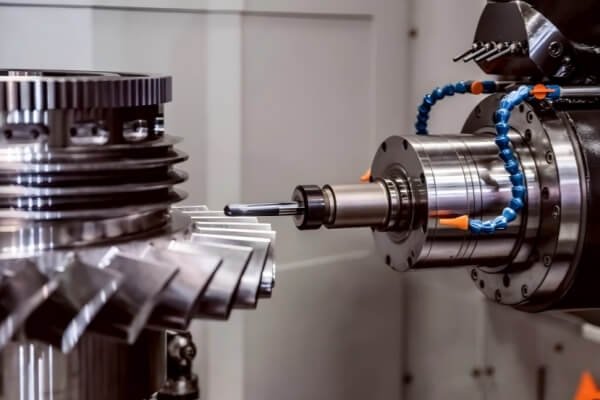
It’s a computer numerical control or automated machining method where the cutting tool rotates and moves to manufacture the parts. In CNC milling, the workpiece material remains held in place by fixtures. This method uses a milling machine with a multi-point cutter that rotates at high speed and removes material from the workpiece to produce a CNC-machined part.
It operates in 3-, 4-, and 5-axis milling modes, which enable the rotating cutter to move in the necessary directions and provide greater geometric accessibility. In multi-axis milling, the tool, table, or workpiece may rotate or tilt. This directional toolpath in CNC milling is generated by a computer-aided manufacturing (CAM) system. The system operates the rotating multi-point cutter at high speed to remove material efficiently in 2D and 3D parts. CNC milling provides high accuracy and repeatability to machine parts with a variety of complexity in different industries.
Common Applications of CNC Milling
- Automotive – Brackets, housings, heat sinks, and structural machine parts
- Aerospace – Structural brackets, turbine components, and complex multi-axis parts
- Medical – Surgical instruments, implants, and precision medical assemblies
- Consumer Electronics – Aluminum housings, internal frames, and connector components
2. CNC Turning
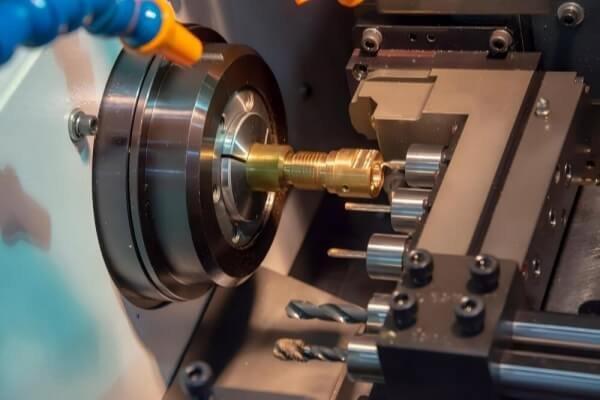
CNC turning is often used to machine cylindrical or rotational parts like bushings, shafts, fasteners, and precision pins. This method uses computer-controlled or CNC lathes to remove material from the workpiece. During CNC turning, the workpiece rotates around its axis while the cutting tool moves along the required axes to remove excess material and achieve the desired shape.
Such rotational motion results in machining cylindrical parts of complex design. The vertical and horizontal axis turning directions of the workpiece are decided by the part geometry. For longer parts, manufacturers often use the horizontal turning axis. The vertical axis rotation of the workpiece is usually used in CNC turning when the parts are heavy or have a large diameter.
The working process in CNC turning involves the workpiece being held by a chuck before starting the operation. Afterwards, the CNC machine reads G-code or toolpath from the CAM programming created based on the CAD file. It guides the turning center to operate several steps like facing, threading, knurling, drilling, etc. These operations result in CNC-machined cylindrical parts.
Common Applications of CNC Turning
- Aerospace – Shafts, rotors, fasteners, fuel system and landing gear components
- Automotive – Bushings, shafts, connectors, and drivetrain components
- Medical – Surgical instruments, implantable parts, and diagnostic devices
- Consumer Electronics – Housings, pins, threaded inserts, and connector parts
3. CNC Grinding
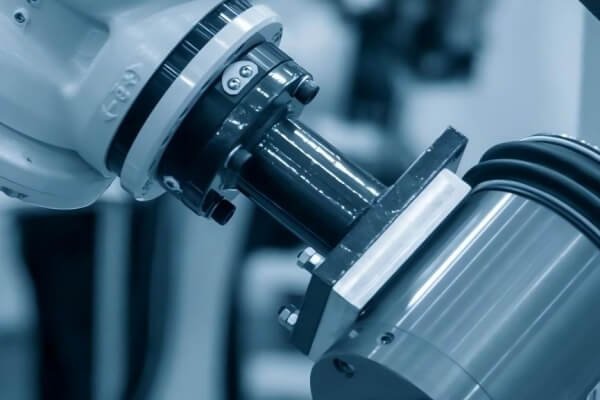
CNC grinding is a complementary precision machining process operated on parts or workpieces to remove small amounts of material. In this method, a rotating abrasive wheel is used to refine the part dimensions based on your exact specifications. The table with the part, rotating wheel head, or a combination of both may move in place to complete the grinding operation and achieve tight tolerances and surface finishes.
This movement is automated by a computer control program based on parameters and machine configuration. CNC grinding is often applied as an additional machining method for better surface finishing after CNC milling or turning.
4. CNC EDM
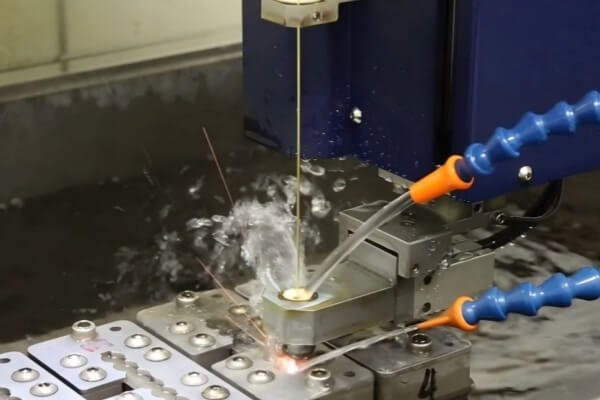
This method is often used to machine precision-cut features, such as narrow slots, deep cavities, etc., which manual machining struggles with. EDM stands for electrical discharge machining. So CNC EDM is a computer-programmed machining system where electrical discharge is used to remove material from the workpiece. Unlike many CNC machining methods, where a wide range of materials can be used, CNC EDM is only supported for conductive materials.
The machining process involves a controlled, rapid electrical spark erosion between an electrode or wire and the workpiece. This spark cuts and removes material without any direct contact with the workpiece. Manufacturers use wire EDM machining, sinker EDM machining, and EDM drilling to produce narrow slits, mold cavities, tooling inserts, etc. Sinker EDM, usually using a custom 3D electrode, sinks vertically to create 3D complex contours, blind cavities, internal pockets, etc. Wire EDM moves along X-Y axes to make 2D profile cuts, straight lines, and through-holes that go all the way through the material.
To stabilize the machining process and control the heat generated from the electric spark, dielectric fluid is used. In sinker EDM, the workpiece and electrode are typically submerged in a hydrocarbon-based dielectric oil. Whereas, deionized water is used for wire EDM, which controls heat and also removes the debris.
How Does a CNC Machining Project Work?
Do you want your parts to be CNC-machined rather than machined with manual control for faster production, better dimensional accuracy, and consistent quality? Here are the project steps you may encounter at manufacturers like HRCCNC.
1. Sending Drawings
To have CNC-machined parts, you must send our team your 2D drawings or 3D CAD files. So, you initially have to get your drawings ready, which should have certain specifications, such as part design, tolerances, roughness, material, surface finishing, quantity, application, delivery time, etc.
2. Engineering Review and Quotation
The engineering team then evaluates the specifications and provides DFM feedback on the provided files. They review the drawings based on factors such as manufacturability and machining risk. In addition, they review the material selection, tolerance feasibility, and cost-saving opportunities. This allows you to update your drawing based on their feedback before production or prototyping. You’ll also get a quotation to produce parts with a CNC process based on the part complexity, material, required roughness, surface finishing, quantity, etc.
3. CNC Programming and Machining
After your design update, our team creates computer-aided manufacturing (CAM) programming, which will convert the digital 2D or 3D part design into step-by-step instructions. These sets of instructions dictate every movement of the cutting tool and part-holding table of the CNC machining equipment. Eventually, your parts are CNC machined with high accuracy and production efficiency, with significantly less manual control except for setup changes.
4. Surface Finishing
This step is operated based on your requirements and applications of the CNC components. The goal of surface treatment is not only to hide tool marks or provide visual enhancement, such as color and texture. Based on the operating environment of the CNC parts, various surface finishes improve corrosion resistance, durability, wear resistance, electrical or thermal conductivity, etc.
5. Quality Check
Finally, to control the quality of precision CNC-machined parts, they undergo strict inspection methods, such as CMM inspection for dimensions and geometry and profilometer testing for surface roughness. To ensure the specified color or appearance on the CNC components, we operate D65 inspection in standardized daylight illumination booths. Besides, components with threads undergo micrometer testing to measure their exact numerical pitch diameter. Go/no-go plug is usually used to inspect the internal threads to determine whether the part is within acceptable limits. To inspect the external threads, we often use ring gauges.
Choosing the Right CNC Machining Partner
An experienced CNC manufacturing partner is crucial to getting high-quality parts on time and within budget. Partnering with an unreliable manufacturer may lead to your parts having out-of-spec tolerances, wrong metal alloys or grades, inefficient CNC machining methods, and costly production delays.
At HRCCNC, our team of experts oversees every CNC machining step, from your drawing evaluation and programming to precision machining, surface treatment, and final inspection. We offer suggestions on suitable materials and surface finishing options based on your application and also suggest cost-saving opportunities before CNC part production.
FAQs
1. What does CNC stand for in manufacturing?
CNC stands for Computer Numerical Control. It refers to the use of computer programs to control machining equipment, allowing manufacturers to produce parts with consistent dimensions, accuracy, and repeatability.
2. What is the difference between CNC machining and manual machining?
CNC machining uses programmed instructions to control machine movements, while manual machining relies more heavily on direct operator control. CNC machining generally provides better repeatability and efficiency, especially for complex parts and repeat production.
3. What materials can be used for CNC machining?
CNC machining supports a wide range of metals and plastics, including aluminum, stainless steel, brass, titanium, ABS, polycarbonate (PC), and POM. Material selection depends on the part’s application, mechanical requirements, and budget.
4. What are the main types of CNC machining?
Common CNC machining processes include CNC milling and CNC turning. Other CNC-controlled material removal processes include CNC grinding and electrical discharge machining (EDM), which are used for specific precision features and finishing requirements.
5. Is CNC machining suitable for prototypes and small batches?
Yes. CNC machining is suitable for prototypes, small batches, and repeat production. It allows manufacturers to produce functional parts directly from engineering designs without requiring dedicated molds, making it useful for product testing and design verification.
6. What information is needed to get a CNC machining quote?
To request a CNC machining quote, you should provide 2D drawings or 3D CAD files, material specifications, required tolerances, surface finishing requirements, and order quantity. Details about the part’s application and expected delivery time can also help manufacturers provide an accurate quotation.
Contact us with your 2D drawings or 3D CAD files to get free technical advice on CNC machining. We may help you determine whether your parts need CNC turning, milling, EDM, or additional grinding.