Skip to content

Sheet metal fabrication is a manufacturing process that uses flat metal sheets to produce functional parts through cutting, forming, joining, and surface finishing operations. It is a popular method for manufacturing automotive parts, aerospace components, appliances, electronic parts, brackets, and other functional components.
Sheet metal fabrication offers several advantages when compared to other manufacturing processes. It does not require custom molds as in molding and casting and therefore reduces tooling costs and lead times. It is also a fast and cost-effective manufacturing method and can be more practical than 3D printing for mass production. If you start with the right sheet thickness and proper DFM guidelines, sheet metal manufacturing offers a useful combination of strength, production efficiency, and affordability.
Main Stages of the Sheet Metal Fabrication Process
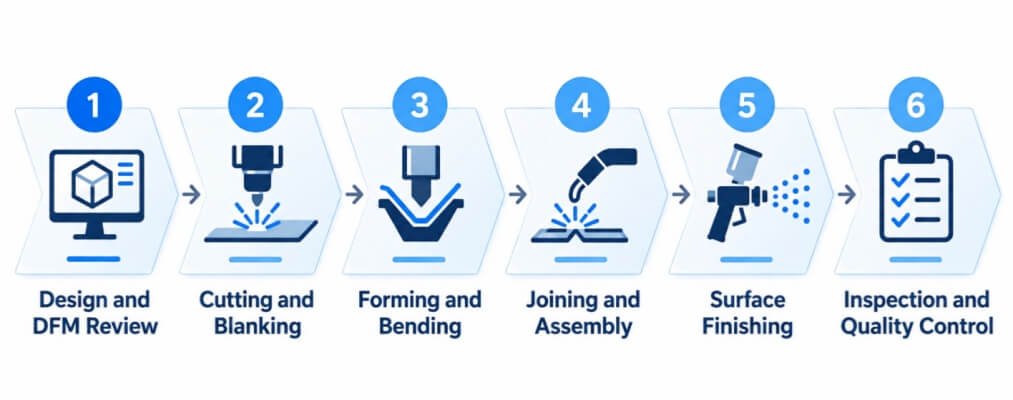
The complete sheet metal fabrication process can be explained in six main steps:
1. Design and DFM Review
You submit 2D drawings and 3D CAD models to the manufacturer for a Design for Manufacturability (DFM) review. The manufacturer checks the sheet thickness, hole placements, bend geometry, and assembly clearances to make sure the part can be formed correctly. After the review, the manufacturer creates the flat pattern layout of the component.
2. Cutting and Blanking
The prepared flat profile of the part is cut from a large metal sheet. Suppliers use different cutting methods, such as laser cutting, punching, and shearing, based on required precision and the nature of the cuts.
3. Forming and Bending
After cutting, the obtained flat blank is bent and formed into a three-dimensional part. Press brake bending is the primary method used for flanges and channels. Additionally, methods like sheet rolling, stamping, and deep drawing are also used to obtain the final shape.
4. Joining and Assembly
Sometimes, the complete part cannot be obtained by forming a single sheet layout. In such cases, two or more such metal sections are joined together through welding, fasteners, or hardware insertion.
5. Surface Finishing
Surface finishing is important not only for achieving the desired appearance, but also for adding functional properties, such as corrosion resistance, electrical insulation, and controlled friction. HRCCNC provides a wide range of finishes and treatments, including brushing & polishing, powder coating, anodizing, electroplating, and bead blasting, to achieve your desired surface finish.
6. Inspection and Quality Control
Quality of the product is checked at the First Article Inspection (FAI), throughout production, and also finally at the end. Suppliers use visual inspection, CMMs, protractors, and digital gauges to verify critical dimensions, coating thickness, and assembly alignments.
Common Sheet Metal Fabrication Techniques
In sheet metal fabrication, there are many cutting, bending, and assembly techniques to choose from. Your supplier will select the techniques that best suit your part geometry, production volume, required precision, and budget.
Cutting Techniques
Sheet metal cutting techniques can be divided into two categories as thermal and mechanical methods. Thermal methods use focused energy, while mechanical methods use physical forces and abrasion to cut and separate metal sheets.
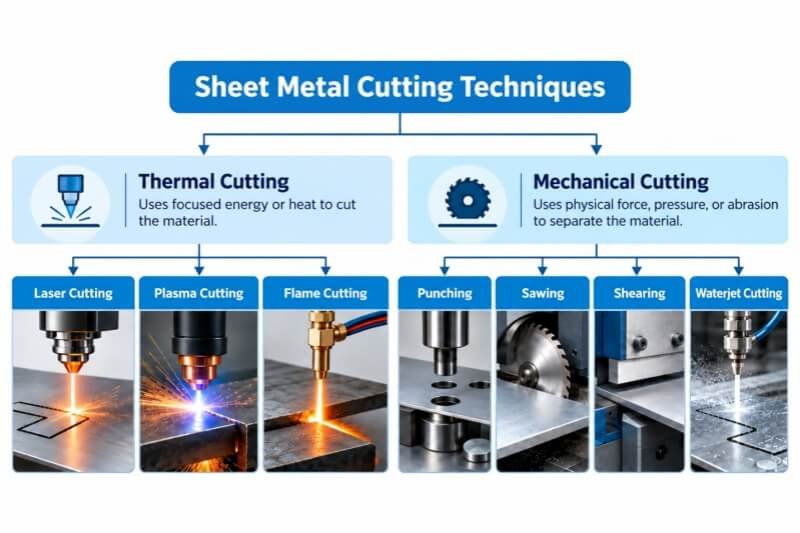
- Laser Cutting – cuts complex shapes and fine details without custom tooling
- Plasma Cutting – cuts thick conductive metals rapidly using ionized gas arcs
- Waterjet Cutting – uses a high-pressure beam of water. Best for cutting heat-sensitive materials since this method doesn’t involve any heat.
- Punching – best for cutting holes, slots, and stamped shapes efficiently.
- Shearing – hydraulic shears can cut sheet metal into simple rectangular or straight-edged blanks.
- Sawing & Grinding – usually handles initial rough cut-offs.
At HRCCNC, we use a 6000 W laser cutting system to process sheets up to 3000 × 1500 mm.
Bending & Forming Techniques
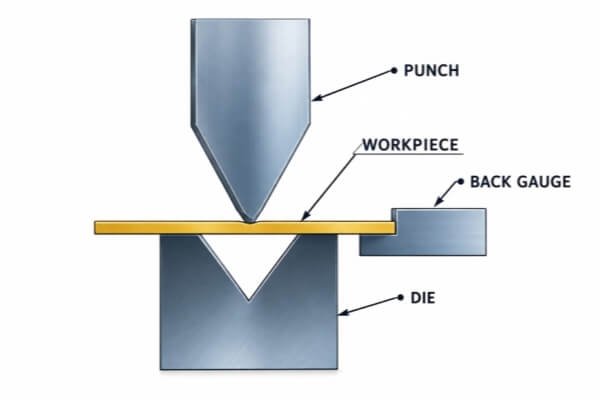
The most common sheet metal bending method is V-bending using a press brake. Here, we apply force through a punch and die to permanently deform the metal. There are several techniques used in press brake bending, including:
- Air bending – the punch presses the sheet without touching the bottom. A flexible method for making different bend angles.
- Bottoming – the punch presses the sheet against the die. Provides better accuracy and less springback.
- Coining – A more forceful, more precise version of bottoming.
Additionally, advanced forming methods such as deep drawing, roll forming, and stretch forming are used to create continuous 3D profiles and curved components.
Welding and Assembly Techniques
In sheet metal assembly, welding is used to join permanent assemblies, while mechanical fasteners are used for semi-permanent or serviceable joints. Sheet metal manufacturers usually offer a variety of welding methods, such as TIG welding, MIG welding, spot welding, and laser welding, so you can choose based on the geometry, budget, and cleanliness required.
For specialized requirements, HRCCNC provides fastener-free joints using tab-and-slot designs, clinching, and hemming based on your requirements. If you need to distribute stresses more evenly across a larger area, adhesive bonding may also be recommended for certain designs.
How to Choose the Right Sheet Metal Material
Depending on your requirements, sheet metal manufacturers provide a wide range of steel, aluminum, stainless steel, copper, and brass options to suit different chemical and mechanical requirements. Steel is one of the most common sheet metal materials produced globally due to its high strength, formability, and affordability.
Table 1: Common Sheet Metal Materials and Their Properties
| Material & Grade | Key Properties | Formability | Weldability | Cost |
| Aluminum (5052) | Lightweight, corrosion-resistant | High | High | Moderate |
| Aluminum (6061) | Lightweight, corrosion-resistant, high strength | Moderate | Moderate | Moderate |
| Aluminum (7075) | Lightweight, high strength, and good strength-to-weight ratio | Limited; depends on temper and forming conditions | Generally poor for conventional fusion welding | High |
| Low-Carbon Steel | High strength, economical | High | High** | Low |
| Stainless Steel (304 / 316) | Corrosion-resistant, heat- and chemical-resistant, high strength | Moderate | High | High |
| Copper & Brass | High electrical and thermal conductivity, good corrosion resistance | High | Low to Moderate | High |
Note: Weldability and formability generally decrease as carbon content increases. Galvanized carbon steel requires special care during welding to protect and restore its zinc coating. The ratings above are general guidelines; actual formability and weldability depend on the specific alloy, temper, sheet thickness, and manufacturing process.
Sheet Metal Fabrication vs. Other Manufacturing Methods
During the design stage, buyers commonly compare sheet metal fabrication with CNC machining and 3D printing. Each method has its own advantages and limitations, and here is a quick comparison:
Table 2: Sheet Metal vs CNC Machining vs 3D Printing Comparison
| Feature | Sheet Metal Forming | CNC Machining | 3D Printing (Additive) |
| Best For | Thin-walled shells, panels, enclosures | Solid blocks, thick pockets, 3D contours | Organic, hollow, or lattice structures |
| Material Usage | Efficient (nesting on flat sheets) | Subtractive (chips and scrap) | Additive (minimal material waste) |
| Tooling Expense | Low to Moderate (But potentially with dedicated tooling) | Low (Can get higher with specialized fixtures) | Low(Usually no dedicated part-specific tooling) |
| Scalability | High (Prototype to Mass Production) | Suitable for prototypes and production runs, depending on part complexity and cycle time | Low to Moderate |
| Cost | Low to moderate (cost-effective for high volumes) | Moderate to High (Higher for complex machining) | Low for prototypes, higher for larger volumes |
When Should You Use Sheet Metal Fabrication?
Sheet metal fabrication is generally advantageous for thin-walled parts, enclosures, brackets, and covers. For processes such as laser cutting and press braking, you don’t need to invest in hard tooling changes during product scaling. The material waste is also minimum when efficiently cut. This is the standard production method for:
- Electronics & Telecommunication Parts – server racks, PCB mounting panels, shielded enclosures.
- Industrial Equipment – control boxes, safety guards, equipment frames.
- Automotive Parts – structural brackets, floor panels, heat shields.
- Medical Devices – stainless equipment housings, trays, and support carts.
However, for thick solid blocks and tight tolerances, a method like CNC machining is more effective. Also, for prototypes and parts with complex internal channels, 3D printing can be a better option.
Sheet Metal Design Guidelines for Manufacturable Parts
Following DFM guidelines is a major part of a successful sheet metal fabrication process. Since sheet metal parts are made from relatively thin material, maintaining proper bend radii, allowances, clearances, and tolerances is critical for both part performance and manufacturing reliability.
- Choose the right sheet thickness – keep the sheet thickness consistent across a single component.
- Use practical bend radii – maintain the bend radius-to-wall thickness ratio (R:T) advised by your manufacturer to reduce the risk of cracking. A common starting point is an inside bend radius of around 1–1.5 times the material thickness, but the suitable radius depends on the material grade, temper, and bending process. Confirm the recommended minimum bend radius with your manufacturer.
- Keep holes away from bends – design your hole edges sufficiently away from bend lines to reduce distortion. Discuss with your supplier to decide on the suitable DFM range based on your material, size requirements, and bend angles.
- Add bend reliefs – add relief slots where bends meet adjacent flat sections. The relief length should extend beyond the bend region (approximately bend radius + material thickness).
- Use self-clinching hardware – use standard nuts, studs, or standoffs instead of tapping threads directly into thin sheets.
- Apply realistic tolerances – avoid specifying machining-level tolerances such as ±0.05 mm for sheet metal parts unless required and confirmed to be achievable. Typical bending tolerances vary with material, thickness, part geometry, and process, so confirm critical dimensions with your manufacturer during the DFM review.
Choosing Your Sheet Metal Fabrication Partner
When choosing your sheet metal manufacturing partner, always evaluate their in-house capabilities. Choose a supplier that can provide cutting, forming, welding, hardware insertion, and finishing under one roof to avoid unnecessary delays. Working with a supplier that provides DFM engineering support before production is also beneficial for reducing mid-production errors and rejected batches. Finally, verify compliance with ISO 9001:2015 and any other application-specific certifications required for your project.
FAQs
1. What Is Sheet Metal Fabrication?
Sheet metal fabrication is the process of converting flat metal sheets into finished parts through cutting, bending, forming, joining, and surface finishing. It is commonly used to manufacture enclosures, brackets, panels, equipment housings, and other industrial components.
2. What Materials Are Commonly Used in Sheet Metal Fabrication?
Common materials include aluminum, carbon steel, stainless steel, copper, and brass. Aluminum is lightweight and corrosion-resistant, while carbon steel offers strength and affordability. Stainless steel is suitable for applications requiring corrosion resistance, while copper and brass are often selected for their electrical and thermal conductivity.
3. What Are the Main Sheet Metal Fabrication Processes?
The main processes include laser cutting, punching, shearing, bending, forming, welding, and assembly. Surface finishing may also be applied to improve appearance, corrosion resistance, or other functional properties. The appropriate processes depend on the part design, material, production volume, and required specifications.
4. How Do You Choose the Right Sheet Metal Thickness?
The right sheet metal thickness depends on the required strength, weight, stiffness, forming requirements, and operating conditions. Thicker sheets can provide greater rigidity but may increase material costs and forming difficulty. Consult your manufacturer to balance structural requirements with manufacturability and cost.
5. What Is the Difference Between Sheet Metal Fabrication and CNC Machining?
Sheet metal fabrication is generally suited to thin-walled parts, panels, brackets, and enclosures made by cutting and forming sheet material. CNC machining removes material from a workpiece to produce precise features, pockets, and complex three-dimensional geometries. The best option depends on part geometry, material, tolerances, production volume, and budget.
6. What Factors Affect the Cost of Sheet Metal Fabrication?
Sheet metal fabrication costs depend on material type and thickness, part dimensions, design complexity, cutting and forming operations, welding and assembly requirements, surface finishing, order quantity, and inspection requirements. Simplifying the design, selecting suitable materials, and reviewing manufacturability before production can help control costs.
Looking for a custom sheet metal fabrication solution? Contact HRCCNC to discuss your project and request a quotation.