Skip to content

In the back of every sound structure are the appropriate decisions on fasteners. They integrate, reinforce, and bind materials across industries. Whether you are putting together machinery or building a structure, knowledge of fasteners is important to make sure that it is stable, functions well, and ensures its long-term safety.
Classification of Fasteners
Fasteners can be classified based on their design, the type of joint they form, and whether the connection can be disassembled.
Permanent:
Joints formed by permanent fasteners cannot be disassembled without destroying the material or the fastener itself. They are typically used when long-term strength, rigidity, or sealing is required. Examples include rivets, welding, and adhesives.
Non-permanent:
Non-permanent fasteners, on the other hand, are assembled and disassembled. This includes bolts, screws, nuts, and washers. They allow maintenance, upgrades, or adjustments without damaging the structure.
To further categorize them, we may also classify them based on the type of thread, purpose, and suitability to the environment.
By threading: Threaded vs Non-threaded
Threaded fasteners like bolts and screws contain helical cuts that give a grip and adjustability. Unthreaded types, such as rivets and pins, rely on deformation, friction, or expansion to hold materials in place.
By function
Fasteners can be load-bearing or designed for alignment, vibration resistance, or sealing. The purpose for which a fastener is intended is usually the determining factor of which fastener will be best used in a specific task.
Materials, Coatings, and Environmental Suitability
Fasteners may be made of steel, stainless steel, brass, aluminum, or titanium. Corrosion is prevented by coating with zinc, nickel, or black oxide. Stainless or galvanized steel is more suitable in an outdoor or marine environment, where it has better rust resistance.
Major Fastener Types & Their Application
Numerous types of fasteners are adapted to certain mechanical requirements. We will discuss the most prevalent ones and their applications.
Bolts
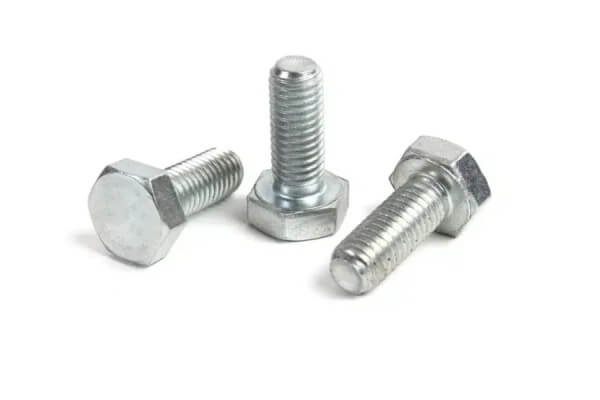
Bolts are threaded fasteners that require a nut to create a high clamping force. They are used where joints are exposed to both shear and tensile loads.
Definition & Differentiating Characteristics
Bolts feature a smooth shank with threads on one side and a head on the opposite end. Unlike screws, they don’t create threads in the material themselves but are secured in place using a nut.
Types of Bolts:
- Hex Bolts: These are most prevalent, and the heads are six-sided to allow tightening of wrenches easily.
- Carriage Bolts: Include a smooth, dome-shaped head and a square section beneath it that locks into place to stop the bolt from rotating when tightened.
- Eye Bolts (with loop): It has a looped head that is used to attach ropes, hooks, or chains.
- U-Bolts: These resemble the letter U, which is used to fasten the pipes or round objects.
- Double-End Bolts (Stud Bolts): Threaded on both ends, often used for flange connections.
- Socket Head Bolts (Allen Bolts): Have recessed hex sockets to fit into small or tight places.
Applications:
Automobiles, construction, heavy machinery, and infrastructure are some of the main applications of bolts. Metal components are united with hex bolts; wood constructions are united with carriage bolts; and pipes and cylindrical objects are firmly attached with U-bolts.
Selection Tips:
Select the length of the bolt to be used such that there are at least two to three complete threads over the nut. Always align the grade of bolt and material to the load requirement and environment. Washing under the head of bolts will allow them to spread the load and avoid damage to the surface.
Screws
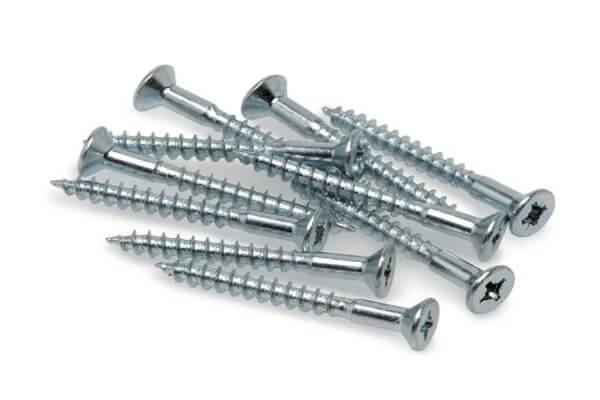
Screws are universal fasteners that form their own mating threads and provide fast, secure assembly.
Definition & How They Differ:
Screws have an advantage over bolts in that they do not require a nut. Their shank is tapered or fully threaded and grips materials such as plastic, metal, or wood, which gives it a great holding power.
Common Screw Types:
- Lag Screws (wood screws): These are heavy and strong wood screws to join wood to wood or wood to metal.
- Machine Screws: Uniform threads that can be used as tapped holes in equipment or electrical components.
- Self-tapping Screws: Create their own threads as they are driven into thin materials like sheet metal.
- Sheet Metal Screws: Sharp threads that are used to screw thin metals together.
- Wood Screws: Have coarse threads designed for gripping wood surfaces.
- Eye Screws: Have a looped head that is used to suspend or tension.
Applications:
Screws come everywhere: carpentry and furniture assembly, automotive and electronic enclosures, etc. They are self-locking in nature and are easily installed.
Selection Tips:
Select screw size based on the thickness of the material. For outdoor use, choose corrosion-resistant screws. Pilot holes should be pre-drilled to avoid splitting or misaligning of wood.
Nuts
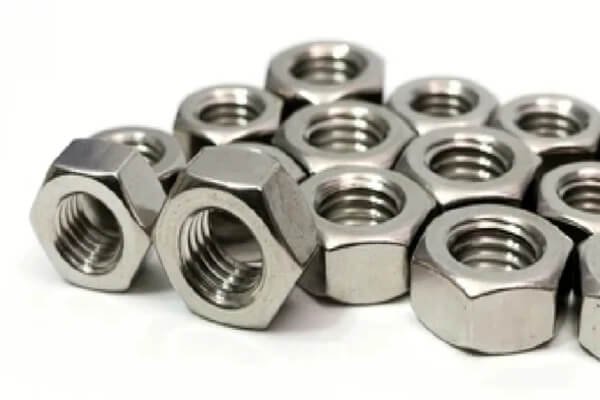
Nuts are needed as companions of bolts to hold joints together by the use of thread and compression force.
Definition & Role:
A nut is an internally threaded component that fits onto a bolt to hold materials in tension. It prevents loosening and maintains the clamping pressure.
Common Nut Types:
- Hex Nuts: The most common, regular six-sided design.
- Lock Nuts: Nylon inserts or distorted threads are used.
- Nylock Nuts: lock nuts where the nut contains nylon to increase friction and keep the nut from backing off.
- Cap Nuts: Have closed ends, which are protective and finished.
- Castle Nuts: Nuts with a slot that is held in place by a cotter pin, which are used in automotive and aviation applications.
- Flange Nuts: Have an integrated base that helps distribute the load.
Use Cases:
Machinery, structural assemblies, and mechanical joints can not do without nuts. Lock and Nylock nuts should be used in vibrating conditions, and cap nuts are used to provide a shield against moisture and debris.
Washers
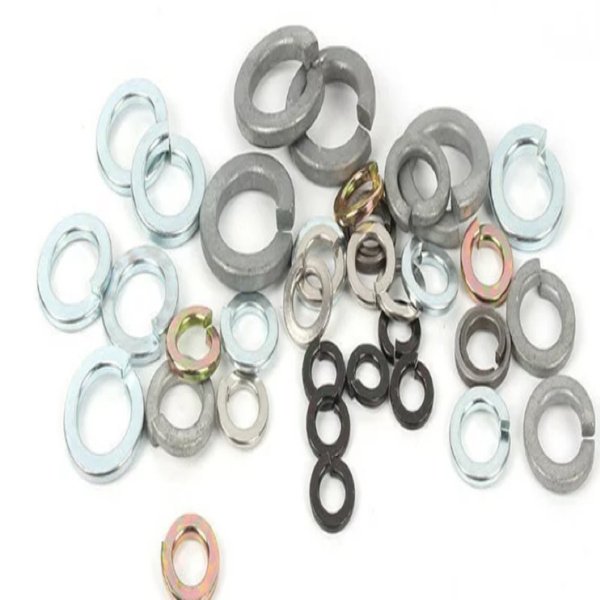
Washers have a low but significant role in improving the performance and life of fastened joints.
Definition & Role:
A washer is a flat or contoured disc positioned between the fastener and the surface to help spread the load, protect the material, and enhance fastening security.
Types:
- Flat Washers: These are used to distribute loads and eliminate surface deformation.
- Lock Washers: Do not loosen because of vibration or movement.
- Spring Washers: Provide constant tension to keep the joint tight.
- Fender Washers: Big outer diameter when using thin or soft material.
- Toothed Washers: Provide a better hold on metals.
Applications:
Mechanical assemblies, electrical panels, and piping systems have washers. They reduce wear, improve the precision of torque, and eliminate the loosening of fasteners with time.
Rivets & Other Permanent Fasteners
When a connection is required permanently and cannot be tampered with at all, then rivets will be used.
Definition:
A rivet is a metal pin with a head on one side and a plain shank that is deformed on the other end during installation to fasten materials together permanently.
Types:
- Solid Rivets: Commonly used in structural and aerospace applications, providing maximum strength and durability.
- Blind Rivets: Can be installed from only one side, making them ideal for situations where the reverse side of the joint cannot be reached.
- Pop Rivets: Commonly used for lightweight materials and quick repairs.
Applications:
Rivets are commonly used in metal fabrication, aerospace, and automotive. They are good in situations where vibration or shear forces are fixed and where welding is inappropriate.
Specialized Fasteners
Some applications require specialized fasteners designed for specific purposes or environmental conditions. They are engineered to perform where standard bolts or screws cannot, providing customized solutions for heavy-duty applications.
Tanner Bolt
Tanner Bolts, also known as sleeve anchors, are used to fasten materials to concrete or masonry surfaces firmly. When tightened, the sleeve expands outward, gripping the substrate to provide high holding strength. They are mainly used in structural and construction applications where vibration resistance and load-bearing stability are critical.
Lag Bolts (Lag Screws)
Lag bolts are heavy-duty screws that are used on wood and other softer materials. They have a heavy shank and deep threads, giving them high load-carrying capacity — ideal for timber framing, decking, and structural beams. They are also used where bolts would normally require pre-drilled holes and nuts.
Eye Screws / Eye Bolts
Eye screws and eye bolts are characterized by a looped head that allows attachment of ropes, cables, or hooks. They are commonly used in rigging, marine lifting systems, and tensioning operations. The loop design ensures smooth load distribution, minimizing stress concentration during lifting or anchoring.
Carriage Bolts
Carriage bolts feature a domed head with a square section just below it, which locks into the material to keep the bolt from turning while being tightened. They are ideal for wooden constructions where one side needs a smooth, finished appearance. They are also used in furniture and construction projects requiring both a clean finish and high holding strength.
Common Mistakes & Best Practices
Even high-quality fasteners will fail in the wrong hands. Determining the typical errors aids in the discouragement of joint failure, corrosion, and safety hazards in mechanical or structural systems.
Over-sizing / Under-sizing
An undersized fastener may strip under stress, while an oversized one can crack or deform the material. Load distribution should always be maintained by adhering to the torque and sizing suggestions of the manufacturer.
Neglecting Washers
Omitting washers may seem insignificant, but it often causes uneven pressure and surface damage. Washers also assist in the dispersion of the load and guard the material at the head of the nut or bolt. The right type of washer is also used to increase the accuracy of torque and to avoid loosening over time.
Using Wrong Materials In Corrosive Environments
When incompatible materials are combined in corrosive environments, galvanic corrosion can occur, weakening the joint over time. As an example, aluminum will deteriorate easily when it is mixed with carbon steel in a marine system. Use the right materials under the right conditions, e.g., galvanized fasteners or stainless steel for outdoor work.
Ignoring Torque Specification
One of the biggest causes of early failure is over- or under-tightening of fasteners. Too much torque will strip off threads or bend parts, whereas too little torque leads to a poor grip. Use calibrated torque tools and follow specification charts to ensure consistent tension across all fasteners.
Mismatched Nut/Bolt Grading
Using mismatched grades of nuts and bolts can cause uneven stress and thread failure. Both grades exhibit definite tensile strength and hardness properties, which are supposed to be in harmony. Always check the labels to ensure both parts meet the same grade and performance standard.
Skipping Thread Lubrication Or Locking
Friction management of threads is required to assemble them reliably. Proper lubrication reduces wear, ensures accurate torque, and prevents galling on stainless steel bolts. The use of thread-lock compounds in vibration-prone areas is a given when the fasteners are well tightened.
Insufficient Pilot Holes Or Prep
Driving screws into hard materials without pilot holes may cause cracking, splitting, or thread stripping. Proper pilot holes guide the screw to decrease stress, but also to provide an appropriate alignment. Preparation should also include cleaning the surfaces and checking the hole depth to ensure maximum fastener engagement.
Conclusion
Fasteners may seem simple, but their correct selection and use determine the strength, safety, and longevity of every structure. From bolts and screws to rivets and washers, each plays a crucial role. To ensure precision and reliability in your projects, our professional CNC machining services are the ideal complement to high-quality fasteners. For top-grade components and expert guidance, visit HRCCNC today.