Skip to content

Throughout your product development, prototypes are useful at different stages, starting from testing the concept, fit, geometry, function, and materials and extending to evaluating production readiness before committing to mass production. Even a small oversight during prototype validation can cost you thousands in product rejections. That’s why CNC machining has remained a trusted method for producing functional prototypes for decades.
CNC machining is a highly precise manufacturing method that does not need dedicated tooling as in casting. CNC prototypes are also free from interlayer weaknesses found in certain 3D-printing technologies. You receive precise parts made from production-grade materials with excellent repeatability.
With this article, let’s learn whether CNC-machined prototypes are best for you, how they compare with other prototyping methods, prototyping costs, and what you should consider before placing an order.
What Is CNC Prototyping?
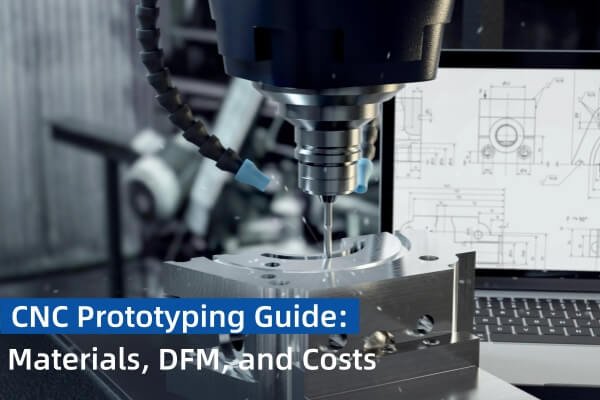
CNC prototyping is the process of cutting a functional prototype from a solid block of metal or plastic using computer-controlled machine tools.
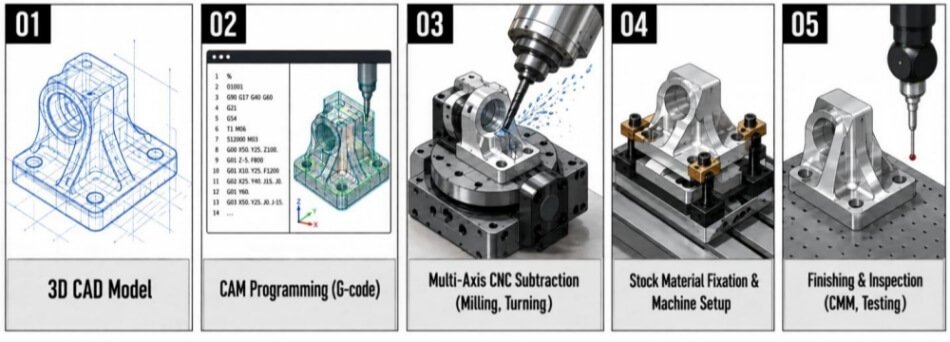
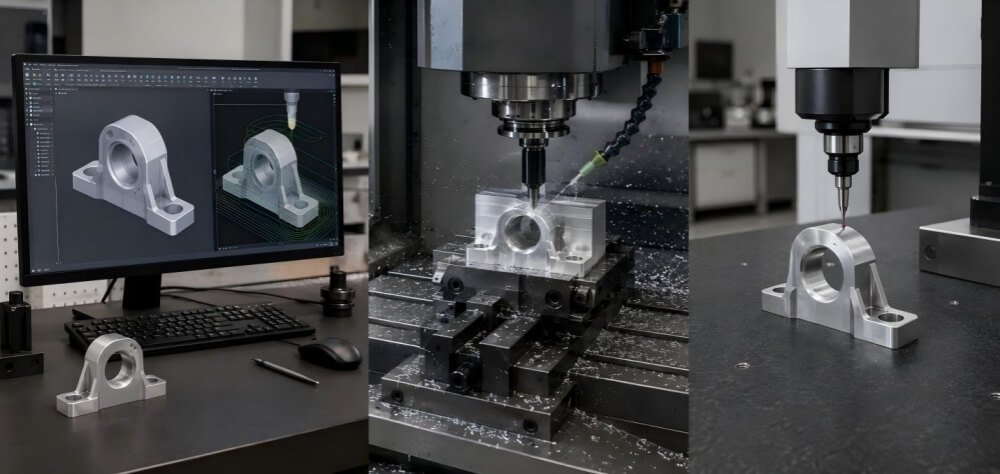
Your CAD model is first imported into the CAM software. The programmer then selects the tools, fixtures, machining strategy, cutting parameters, and toolpaths. The CAM software post-processes these toolpaths into machine-specific G-code. Based on the code, the machine removes material by milling or turning until the part matches your specification. Finally, the prototype is deburred and inspected using suitable equipment, which may include calipers, micrometers, gauges, optical systems, or CMM inspection.
This is a subtractive machining process that gives you parts that closely represent your final product without requiring dedicated production tooling.
Why You Should Choose CNC Machining for Prototypes
When you expect strong structural integrity, prototype CNC machining provides several engineering advantages:
- Since CNC prototypes are machined from solid stock, you get parts that retain the bulk properties of the selected billet, plate, or bar stock. They also don’t have the layer weaknesses associated with certain 3D printing technologies such as FDM.
- CNC prototypes can achieve tight tolerances around ±0.025 mm, but this depends on your product’s geometry, fixturing, and the manufacturer’s machining capabilities.
- You can achieve high-quality surface finishes around Ra 0.4 µm with secondary processes such as grinding, lapping, or polishing. As-machined surfaces commonly range from Ra 1.6 µm to Ra 3.2 µm.
- A large pool of alloys and polymers is compatible with CNC machining. Common examples are 6061 or 7075 aluminum, 316 stainless steel, brass, and engineering plastics such as POM or PEEK.
- You get excellent repeatability.
- CNC rapid prototyping does not need dedicated molds. Therefore, the cost of producing a small number of parts is reasonable, and a design change only requires an update to the CNC program.
What Is CNC Rapid Prototyping?
CNC rapid prototyping is a faster version of the same CNC prototyping process. In rapid prototyping:
- You receive quotes within hours
- A machinist confirms manufacturability
- Parts can be completed and shipped within one to five days
Rapid CNC prototyping is useful when you are testing fit, refining geometry, and evaluating revisions of an evolving design, especially if you want to continue development without interruptions. However, you have to pay a premium for the faster turnaround, so choose it only when the urgency justifies the additional cost.
CNC Prototyping vs. CNC Production Machining
In CNC prototyping, preparing a new setup for a small batch is one of the largest cost drivers. So, you are paying more for that flexibility and speed. But in production machining, the setup cost is amortized across a larger batch, and you are paying for consistency.
Table 1: Differences Between CNC Prototyping and Mass Production (Note: This is a general comparison. The requirements may vary and can be adjusted to suit your specific project.)
| Factor | Prototype CNC Machining | CNC Production Machining |
| Objective | Prove the design works | Make the proven design repeatedly and economically |
| Volume | Lower quantities(usually around 1 to 20 parts) | Repeated or high-volume orders(500 to 10,000+ parts) |
| Fixturing | Uses flexible and simple custom fixtures | Uses dedicated and automated custom fixtures |
| Tooling | Uses standard tooling | Uses specialized custom tooling to optimize cycle time. |
| Cost | High per-unit share | Low per-unit share |
| Inspection | Spot checks, first article inspection (depends on tolerances, risks, and regulatory requirements) | Sampling plans, SPC, full traceability (based on the production plan and standards) |
| Turnaround Time | Fast(often 3 to 10 working days) | Longer initial lead time (due to fixture design and process validation) |
In a prototype run, we usually prioritize setup speed and tool adaptability over small reductions in cycle time. For example, we may use a general-purpose cutter even if a specialized high-feed cutter could reduce the machining time by 30 seconds. Why? Developing a specialized machining strategy takes additional time and increases costs, which may not be justified for only a few parts.
Material Selection for CNC Prototypes
Material choice is one of the main cost and lead time drivers of CNC prototyping. You should carefully balance mechanical requirements against machinability when selecting a prototype material. CNC machining supports a wide range of metals and engineering plastics. If two grades satisfy your requirements, prototype with the more affordable option and save the premium alloy for final validation.
Engineering Metals
If your parts are going to bear heavy loads or withstand high temperatures, specify a suitable metal despite the additional cost. The following grades are among the leading options for industrial prototyping. Each one balances machinability and mechanical performance in a slightly different way.
Table 2: Common Metal Options for CNC Prototype Machining
| Metal | CNC Prototyping Remarks |
| 6061-T6 Aluminum | A highly popular metal for housings and brackets. Has excellent machinability, a high strength-to-weight ratio, and responds well to Type II/III anodizing. |
| 7075-T6 Aluminum | Consider when you need a yield strength near 500 MPa. More expensive and difficult to weld, so your requirements must justify the additional cost. |
| 304 and 316L Stainless Steels | Good choices for corrosion resistance and toughness. Used in medical devices, marine hardware, and fluid lines. However, they require slower cutting speeds and specialized tooling due to work-hardening. |
| Titanium Grade 5 (Ti-6Al-4V) | Has an outstanding strength-to-weight ratio and biocompatibility. However, due to its low thermal conductivity, it requires low cutting speeds, heavy coolant flow, and rigid machine setups. |
Engineering Plastics
Don’t assume that plastics are simply cheaper alternatives to metals. If your part must withstand chemical exposure or provide electrical isolation, an engineering plastic will be more suitable than a metal. Plastics are also significantly lighter, and most of them machine faster than metals.
Table 3: Engineering Plastics Used for CNC-Machined Prototypes
| Type of Plastic | CNC Prototyping Remarks |
| POM / Delrin (Polyoxymethylene) | Has high stiffness, low coefficient of friction, good machinability, and dimensional stability. Ideal for gears, bushings, and snap-fit assemblies. |
| PEEK (Polyether ether ketone) | A high-performance thermoplastic. Depending on the grade and loading conditions, PEEK can provide long-term service at temperatures around 240 °C. It can be a good replacement for metal alloys in corrosive, high-temperature, or high-voltage environments. |
| Polycarbonate (PC) | Impact-resistant and transparent. Used for fluidic manifolds, clear covers, and sight glasses. Can be vapor-polished post-machining to restore optical clarity. |
What Drives Your Cost and Lead Time
The cost of CNC prototyping is usually predictable, and you can control most of the factors that influence it. The main cost drivers are the material, part complexity and number of setups, axis count (3-axis vs. 5-axis), tolerance and finish, quantity, and inspection requirements.
Here are some practical tips to optimize your budget without compromising functionality:
- Minimize axis changes – If your part has features on six different sides, we’ll need to perform several manual reorientations, additional setups, or multi-axis machining. This increases setup time and cost.
- Avoid undercuts – Features that cannot be reached by vertical tooling require custom T-slot cutters, side mills, or multi-axis indexing, which adds extra machining time and cost.
- Use standard stock dimensions – Size your outer dimensions slightly smaller than standard stock plate and bar sizes (e.g., design for a 48 mm height rather than 50.5 mm to fit standard 50 bar stock).
Regarding lead time, rapid prototypes with straightforward designs can usually be shipped within one to five days. However, multi-setup parts made from hard metals or specialized engineering plastics may take one to two weeks.
DFM Guidelines: Designing Parts for CNC Prototyping
To avoid long machining lead times and unnecessary engineering change orders (ECOs), incorporate Design for Manufacturability (DFM) rules during your initial CAD layout. The following are some general DFM guidelines commonly used in CNC prototype manufacturing. However, we highly recommend contacting your supplier to determine the exact limits, as they depend on your design, material, and available tooling.
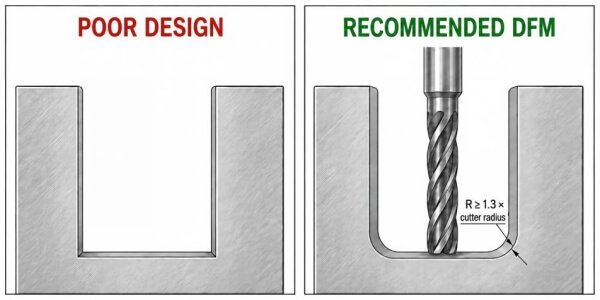
1. Radius Internal Pocket Corners
CNC milling tools are round. A vertical end mill cannot cut a sharp 90° inside corner. So, always add an internal vertical fillet radius. As a general practice, we keep the corner radius at least 10% larger than the cutter radius to prevent tool chatter. This means, if you’re using a 6 mm end mill, design your internal pocket corners with a radius of 3.3 mm (diameter 6.6 mm) or larger. The exact percentages depend on the tooling, so always finalize the numbers with your supplier.
2. Standardize Aspect Ratios on Deep Pockets
Deeper features need special tooling and cost more. The general practice is to limit pocket depth to about four times the tool diameter. For narrow slots, limit overall depth to three times the tool diameter. These are also general guidelines and may not suit every design, so contact your supplier to determine the exact limits.
3. Maintain Minimum Wall Thicknesses
Machining forces can distort thin metal or plastic walls during cutting. The common industry practice is to keep wall thickness above roughly 0.8 mm for metal and 1.5 mm for plastic.
4. Avoid Unnecessary Tight Tolerances
Specifying tight tolerances for non-critical applications increases your costs with no justifiable benefit. You may refer to standard ISO 2768-m tolerances for general dimensions. Apply tight tolerances only to functional features, and mark your datums clearly.
How to Evaluate CNC Machining Prototype Manufacturers
When you compare CNC prototype manufacturers, check whether the supplier is qualified and knowledgeable enough to produce parts for your application:
- Check whether they have relevant qualifications, such as ISO 9001 as a baseline, AS9100 for aerospace and defense, ISO 13485 for medical devices, IATF 16949 for automotive parts, ISO 22163 for railway applications, ISO 19443 for nuclear-sector work, and ISO 29001/API Spec Q1 for oil and gas applications.
- Evaluate their inspection capabilities, such as first-article reports, CMM measurements, and material certificates.
- If you’re planning to go through several rounds of prototyping with the same manufacturer, see whether they are flexible and consistent.
The best partners treat CNC machining for prototyping as an engineering service. They ask about your application and provide suggestions on alternative materials or machining methods that may be better for your case.
FAQs About CNC Prototyping
1. What is CNC prototyping?
CNC prototyping is a subtractive manufacturing process that uses computer-controlled machine tools to cut functional prototypes from solid blocks of metal or plastic. It is commonly used to test a part’s fit, geometry, function, and material before moving to production.
2. How long does CNC prototyping take?
Simple CNC prototypes can often be completed and shipped within one to five days. More complex parts that require multiple setups, hard metals, specialized engineering plastics, or additional inspection may take one to two weeks.
3. What materials are commonly used for CNC prototypes?
Common CNC prototyping materials include 6061-T6 and 7075-T6 aluminum, 304 and 316L stainless steel, Titanium Grade 5, POM, PEEK, and polycarbonate. The best material depends on the required mechanical properties, operating environment, machinability, cost, and intended application.
4. What tolerances can CNC prototypes achieve?
CNC prototypes can achieve tight tolerances around ±0.025 mm, depending on part geometry, fixturing, material, and the manufacturer’s machining capabilities. Tight tolerances should generally be specified only for critical functional features to avoid unnecessary machining costs.
5. What factors affect the cost of CNC prototyping?
The main cost factors include material, part complexity, the number of setups, axis requirements, tolerances, surface finish, quantity, and inspection requirements. Simplifying part geometry, avoiding unnecessary undercuts and tight tolerances, and using standard stock sizes can help reduce costs.
6. How is CNC prototyping different from CNC production machining?
CNC prototyping focuses on flexibility, fast setup, and producing small quantities for design validation. CNC production machining focuses more on repeatability, optimized cycle times, dedicated fixturing, and reducing per-unit costs across larger production quantities.
Conclusion
A prototype gives you a practical way to test and improve a design before moving to the next development or production stage. Therefore, you should design carefully, choose a reliable supplier with proven CNC prototyping experience, and always ask for DFM feedback.
Get DFM Feedback on Your CNC Prototype
If you’re planning to use the same supplier for production, choose one who has the capacity to convert the prototyping knowledge into a stable production run. At the same time, choose materials wisely and follow DFM guidelines to reduce unnecessary costs and receive a prototype that is accurate enough for your technical evaluations.